
DAO Governance Estimator
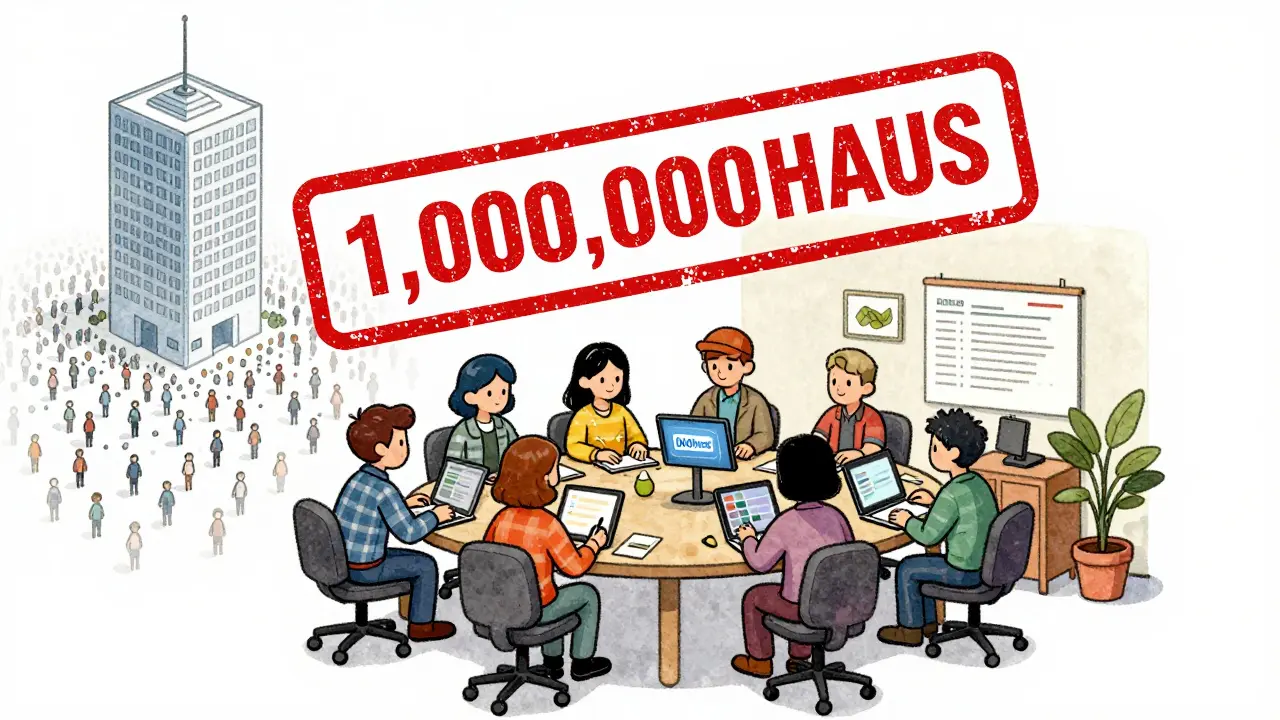
DAOhaus uses HAUS tokens for governance. Your voting power is proportional to your token holdings out of the total 1,000,000 HAUS tokens. Unlike speculative assets, HAUS is a utility token for participation.
Your Voting Power: 0%
Out of 1,000,000 HAUS tokens, your holdings represent 0% of the total supply.
Key Insight: Since DAOhaus is designed for small groups, even a small number of tokens can be influential. At 50 tokens, you'd have 0.005% voting power - enough to participate in governance decisions.
DAOhaus isn’t just another crypto coin. It’s a platform built to let anyone create and run a decentralized organization - no coding needed. The HAUS token is the fuel that powers it, but understanding DAOhaus means looking past the price chart and into how it actually works.
What DAOhaus actually does
DAOhaus lets groups of people form digital cooperatives called DAOs - organizations that run on rules written in code, not by a CEO or board. Think of it like a digital town hall where every member gets a vote, and decisions happen on the blockchain. You don’t need to be a programmer to use it. The platform gives you a simple interface to set up a treasury, invite members, and vote on proposals - all without writing a single line of code.
It’s built on top of Moloch v3, a specific type of smart contract designed for small, tight-knit groups. Unlike big corporations, these DAOs operate on a simple principle: if you don’t like a decision, you can walk away with your share of the funds. That’s called a "rage quit." It’s not about consensus - it’s about exit rights. This makes DAOhaus ideal for small teams, art collectives, or grant funds where trust matters more than scale.
The HAUS token: What it is and what it’s not
The HAUS token is the native currency of the DAOhaus platform. There are exactly 1,000,000 HAUS tokens in existence - no more, no less. That fixed supply was intentional. It’s not meant to be mined or inflated like Bitcoin or Ethereum. Instead, HAUS is used for governance: you need it to propose changes, vote on spending, or join certain DAOs created on the platform.
But here’s the catch: HAUS isn’t a store of value. It’s a utility token. You don’t hold it to get rich. You hold it to participate. That’s why its price has crashed so hard. At its peak in July 2021, one HAUS token was worth $156.13. Today, it trades around $0.29. That’s a 99.76% drop. The reason? Most people bought it hoping for a price surge, not to actually use the platform. When the hype faded, so did the demand.
Still, HAUS has real utility. If you’re running a DAO on DAOhaus, you’ll need HAUS to pay for gas fees, submit proposals, or even pay members. It’s not speculative - it’s operational.
How DAOhaus works behind the scenes
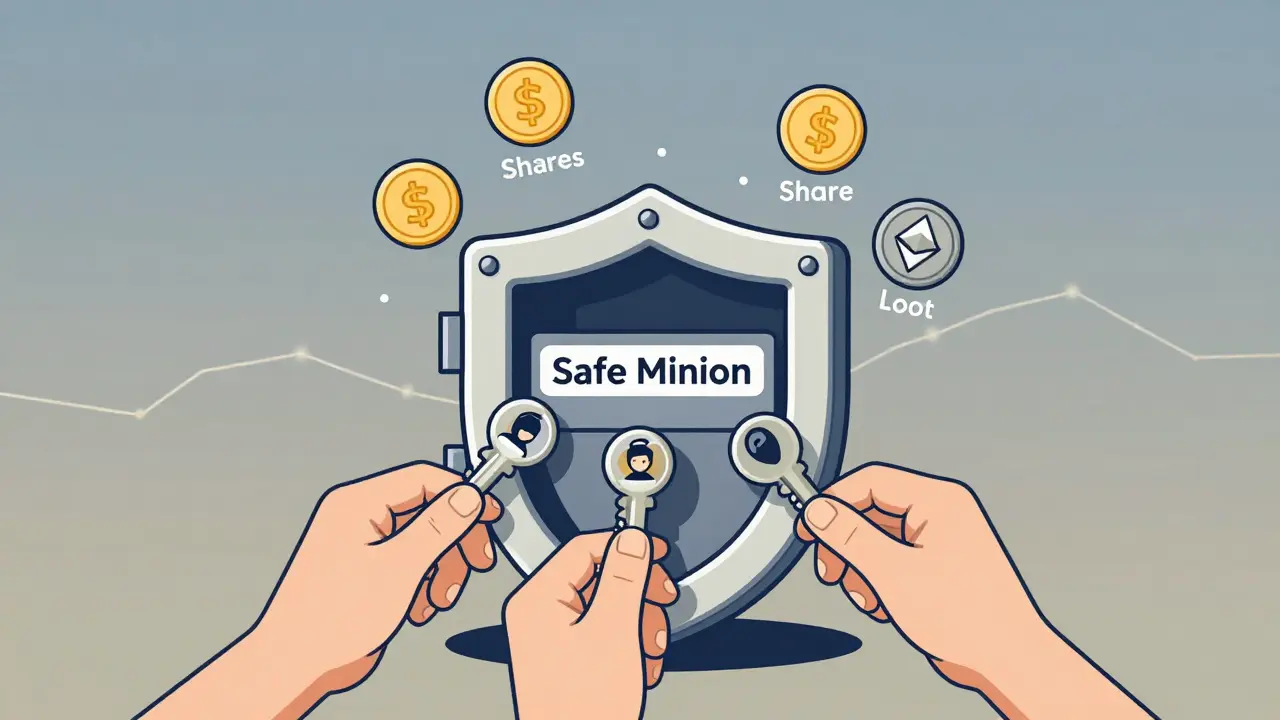
Every DAO created on DAOhaus uses something called a "safe minion." That’s just a fancy name for a shared digital wallet built on Gnosis Safe. It’s not controlled by one person. Instead, it requires multiple signatures to move funds - usually from members who hold voting power. This means no single person can steal the DAO’s money. If someone tries, others can stop them.
Members get two things: shares and loot. Shares give you voting rights. Loot is a non-voting membership token - think of it like a digital badge that says, "I was here." You can earn loot by contributing time, money, or skills to the DAO. But only shares let you vote on how the treasury is spent.
The whole system runs on Ethereum. That means transactions are public, permanent, and verifiable. You can see every vote, every transfer, and every proposal ever made. That transparency is the whole point. If you’re worried about corruption or mismanagement, DAOhaus makes it impossible to hide.
Who uses DAOhaus - and who doesn’t
DAOhaus isn’t for everyone. It’s perfect for small groups: a team of 5-20 people building an open-source tool, a group of artists funding a mural project, or a community raising funds for local causes. It’s simple, fast, and secure.
But if you’re trying to run a global company with thousands of members, DAOhaus won’t cut it. The Moloch v3 design doesn’t handle large-scale voting well. If you have 10,000 members, you’ll need something more advanced like Snapshot or DAOstack. DAOhaus is built for intimacy, not scale.
That’s why its market cap is tiny - around $300,000 as of late 2023. Compare that to DeepDAO ($16.7 million) or Boardroom ($28.7 million). DAOhaus isn’t trying to compete with them. It’s filling a niche: easy, no-code DAOs for small teams.
Where to trade HAUS and how to get it
You won’t find HAUS on Coinbase or Binance. It’s only listed on decentralized exchanges. The most active trading pair is on Honeyswap, a DEX built for the Ethereum ecosystem. To buy HAUS, you’ll need ETH, a wallet like MetaMask, and some basic knowledge of how DEXs work.
Don’t expect liquidity. Because HAUS is a niche token, the order books are thin. You might pay a higher slippage than you would with Bitcoin or Ethereum. That’s normal. It’s not a liquid asset - it’s a tool.
If you’re not trading, you can earn HAUS by contributing to DAOs on the platform. Some DAOs pay members in HAUS for writing, coding, moderating, or designing. It’s a way to get involved without buying.
Is DAOhaus still alive?
Yes. The platform is still operational. You can still create a DAO at app.daohaus.club. The interface still works. The smart contracts are still secure. The community is small, but active.
But it’s not growing. There haven’t been major updates since 2022. No new features. No marketing push. The team behind it is quiet. That’s not a bad thing - DAOhaus was never meant to be a startup. It was meant to be a tool. And tools don’t need hype to be useful.
For developers, designers, and small collectives who want to try decentralized governance without complexity, DAOhaus still delivers. It’s not flashy. It’s not profitable. But it works.
Alternatives to DAOhaus
If DAOhaus feels too limited, here are other options:
- DeepDAO - Tracks and analyzes DAOs across the ecosystem. Great for research, not creation.
- DAOstack - More advanced governance tools, better for larger organizations.
- Snapshot - Off-chain voting. Fast and cheap, but less secure than on-chain.
- Boardroom - Clean interface, strong analytics, popular among institutional DAOs.
DAOhaus stands out because it’s the only one that lets you build a fully on-chain DAO with zero code. If that’s what you need, nothing else does it as simply.
Final thoughts: Is HAUS worth anything?
If you’re looking to invest in HAUS for profit, the answer is no. The token has lost nearly all its value. The market doesn’t believe in it anymore.
But if you’re looking to build something real - a community, a project, a shared fund - then DAOhaus still offers something rare: a way to start a DAO in under 15 minutes. No lawyers. No paperwork. No middlemen.
The real value of HAUS isn’t in its price. It’s in its function. And for a small group that wants to govern itself, that’s still worth something.
Comments (5)

- Stanley Machuki
- December 10, 2025 AT 10:30 AM
DAOhaus is the real deal if you actually want to run something with your crew without some corporate suit breathing down your neck
HAUS isn't a coin it's a key and most people missed that completely
Price dropped because speculators left and the builders stayed
That's how you know it's working

- Lynne Kuper
- December 10, 2025 AT 21:36 PM
Oh wow so HAUS crashed 99.76% because people thought it was a pump-and-dump instead of a wrench to build with?
Wow. Just wow. You'd think after 10 years of crypto we'd learn not to treat every utility token like a lottery ticket
But nope here we are again watching people throw money at tools they refuse to use

- Lloyd Cooke
- December 12, 2025 AT 09:45 AM
The philosophical underpinning of DAOhaus rests not upon speculative valorization but upon the ontological assertion of collective autonomy through cryptographic protocol
HAUS, as a finite token, functions not as capital but as a sacramental token of participation-a ritual object in the ecclesia of decentralized will
Its devaluation is not a failure but an exfoliation of the herd mentality that mistook governance for gain
The platform endures not because it is profitable but because it is true to its purpose: to allow small tribes to govern themselves without the scaffolding of hierarchy
One cannot monetize sovereignty, only instrumentize it-and the market, in its infinite ignorance, has done precisely that
And yet, the contracts remain immutable, the votes remain transparent, the safes remain unbreached
Therein lies the quiet dignity of DAOhaus: it asks nothing of you but your presence, and gives everything in return

- Kurt Chambers
- December 13, 2025 AT 03:53 AM
usa made this shit and now its worth 29 cents??
lol usa always makes the best tools then lets china and china's bots buy them up for pennies
no wonder we cant compete anymore
if you aint using daohaus your just a sheep waiting for the next crypto meme

- Kelly Burn
- December 14, 2025 AT 19:03 PM
HAUS is the OG no-code DAO builder 🧱✨
It's not dead it's just vibing in the background like that one friend who actually builds stuff while everyone else is posting their BAYC selfies 🤫
Real builders know: utility > hype
And if you're still trading HAUS for profit... maybe try using it first? 🤔💸
Also the rage quit feature? Chef's kiss 👌
Post-Comment
Categories
Popular Articles