
Aave Lending Calculator
Calculate Your Aave Loan
Results
Important: Your position will be liquidated if collateral value drops below 70% of current value.
Aave requires 80% LTV ratio for most assets.
Always maintain a buffer above liquidation threshold.
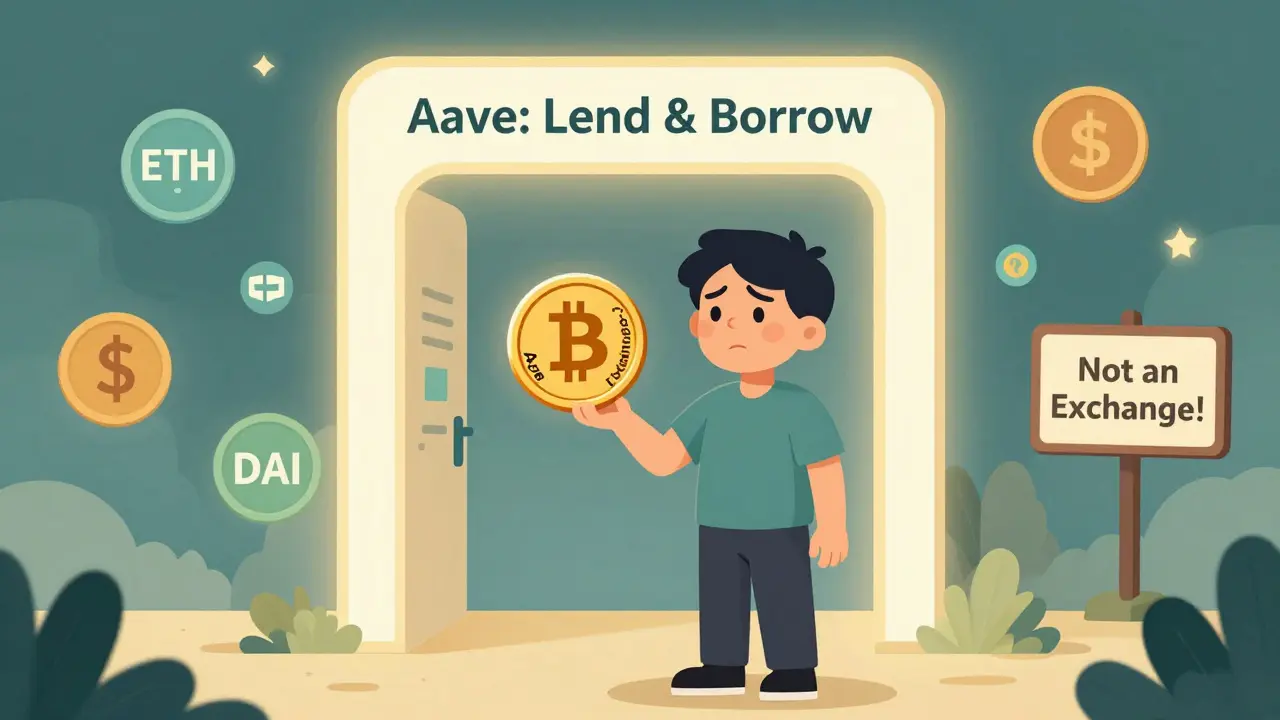
Many people search for "Aave crypto exchange" thinking it’s a place to buy and sell Bitcoin or Ethereum like Coinbase or Binance. That’s a common mistake. Aave isn’t an exchange at all. It’s a decentralized lending and borrowing platform - a DeFi protocol that lets you earn interest on your crypto or take out loans using your holdings as collateral. If you’re looking to trade, Aave won’t help. But if you want to put your crypto to work, it’s one of the most powerful tools in DeFi.
What Aave Actually Does
Aave started as ETHLend in 2017 and rebranded to Aave in 2020. Since then, it’s grown into one of the largest DeFi protocols, with over $18 billion locked in its smart contracts as of October 2025. It operates on 12 blockchains, including Ethereum, Polygon, Arbitrum, and Optimism. You don’t deposit money into Aave like a bank. Instead, you connect your wallet - like MetaMask or Trust Wallet - and lend or borrow crypto directly through smart contracts.
Here’s how it works: You deposit ETH, USDC, DAI, or other supported tokens. In return, you earn interest automatically. The rate changes based on how much of that asset is being borrowed. If lots of people are borrowing USDC, the interest you earn on your USDC goes up. If no one’s borrowing, the rate drops. It’s dynamic, transparent, and happens without any middleman.
On the flip side, you can borrow crypto by locking up other assets as collateral. For example, you can deposit ETH and borrow up to 80% of its value in USDC. If ETH drops too far in price, your position gets liquidated to protect lenders. That’s the core mechanic of all DeFi lending - overcollateralization.
Flash Loans: Aave’s Secret Weapon
Aave’s most unique feature is flash loans. These are uncollateralized loans - you don’t need to put up anything upfront. But there’s a catch: you have to return the loan, plus a small fee, within one Ethereum block (about 13 seconds). If you don’t, the whole transaction reverses, like it never happened.
Why does this matter? Flash loans are used by experienced traders for arbitrage, collateral swapping, and other advanced strategies. For example, if ETH is trading at $3,200 on one exchange and $3,220 on another, a trader can borrow $1 million in USDC via flash loan, buy ETH on the cheaper exchange, sell it on the pricier one, repay the loan, and pocket the $20,000 profit - all in under 15 seconds. Aave handles 78% of all flash loan volume in DeFi, processing over 12,500 daily with a 99.87% success rate.
But here’s the truth: flash loans aren’t for beginners. They require deep technical knowledge, scripting skills, and a solid understanding of gas fees. Most retail users will never use them. But their existence shows how advanced Aave’s infrastructure is.
The GHO Stablecoin: Aave’s Own Digital Dollar
In 2024, Aave launched GHO, its own native stablecoin pegged to the US dollar. Unlike DAI or USDC, GHO is minted by users who deposit collateral into Aave’s protocol. To create $100 in GHO, you need to lock up at least $115 worth of ETH or other assets. This 115% collateralization makes GHO one of the safest stablecoins in DeFi.
By October 2025, GHO had a market cap of $1.8 billion and was live on Ethereum, Polygon, Arbitrum, and Optimism. What makes GHO special is that Aave allows approved third parties - called facilitators - to mint GHO too. This means institutions, DeFi protocols, or even future payment apps could integrate GHO without needing to go through Aave directly. It’s a quiet move toward real-world adoption.
Interest rates on GHO are competitive: around 2.7% APY when deposited, and 3.2% APR when borrowed. That’s lower than some competitors like Yearn.finance (4.1% APY), but GHO’s stability and integration with Aave’s lending ecosystem make it a strong choice for long-term holders.

How Aave Compares to Other DeFi Platforms
Aave isn’t the only player. MakerDAO and Compound are its biggest rivals. Here’s how they stack up:
| Feature | Aave | Compound | MakerDAO |
|---|---|---|---|
| Total Value Locked (TVL) | $18B | $11.2B | $24.7B |
| Supported Chains | 12+ | 5 | 3 |
| Flash Loans | Yes (78% market share) | No | No |
| Native Stablecoin | GHO ($1.8B) | None | DAI ($5.1B) |
| Max LTV Ratio | 80% | 75% | 80% |
| Beginner-Friendly? | No | Yes | Medium |
| Gas Fees (Ethereum) | $4.20 avg | $3.80 avg | $5.10 avg |
Aave leads in flexibility and innovation. It supports more blockchains than anyone else. Its flash loan system is unmatched. But it’s not the easiest to use. Compound has a cleaner interface and lower barriers to entry. MakerDAO has the most widely used stablecoin (DAI), but lacks flash loans and multi-chain support.
Who Should Use Aave?
Aave isn’t for everyone. If you’re new to crypto and just want to buy Bitcoin and hold it, skip Aave. You’ll be overwhelmed.
But if you’ve used DeFi before - if you’ve swapped tokens on Uniswap, staked ETH on Lido, or earned yield on Curve - then Aave is worth your time. It’s ideal for:
- Traders who need flash loans for arbitrage or position adjustments
- Investors who want to earn yield on idle crypto without selling
- Users who already hold ETH, USDC, or DAI and want to borrow against them
- Advanced users comfortable with wallet management and gas fee tracking
It’s not ideal for:
- People who want a simple mobile app like Coinbase
- Those who hate reading documentation or managing collateral ratios
- Users who can’t afford to lose money if prices swing too fast
According to user surveys, 83% of Aave users have been in DeFi for over a year. Only 18% of all DeFi users have ever interacted with Aave - compared to 63% for Uniswap. That tells you who it’s built for: professionals, not beginners.

Security and Risks
Aave’s code has been audited by six top security firms: Trail of Bits, OpenZeppelin, ConsenSys Diligence, Certik, PeckShield, and Certora. That’s more than almost any other DeFi project.
It also has a $450 million Safety Module. This is a pool of staked AAVE tokens that gets used to cover losses if a borrower defaults and collateral is insufficient. It’s like an insurance fund powered by the protocol’s own governance token.
But risks still exist:
- Smart contract bugs - even audited code can have flaws
- Price volatility - if your collateral drops too fast, you get liquidated
- High gas fees on Ethereum - transactions can cost $4 or more during peak times
- Regulatory uncertainty - the SEC has signaled it may target DeFi protocols
The biggest risk for most users? Misunderstanding collateral ratios. About 68% of support tickets come from users who set their LTV too high and got liquidated when prices dipped 10%. Always leave a buffer.
Getting Started With Aave
If you’re ready to try it, here’s the step-by-step:
- Get a Web3 wallet (MetaMask or Trust Wallet recommended)
- Buy some ETH, USDC, or DAI on an exchange like Coinbase or Kraken
- Send those tokens to your wallet
- Go to app.aave.com and connect your wallet
- Complete the interactive security quiz (required before borrowing)
- Deposit your crypto to start earning interest
- Optionally, borrow against your deposits using the borrowing tab
There’s no KYC. No sign-up form. You just connect your wallet and go. But don’t skip the quiz. It’s there for a reason - to make sure you understand liquidation risks.
The Bottom Line
Aave isn’t a crypto exchange. It’s a financial engine for crypto natives. It offers features no centralized platform can match: flash loans, cross-chain lending, and a native stablecoin built on overcollateralization. It’s powerful, secure, and growing fast - especially among institutions.
But it’s not for casual users. The interface is complex. The risks are real. The learning curve is steep. If you’re looking for a simple way to buy and sell crypto, look elsewhere. But if you want to earn yield, borrow without selling, or experiment with DeFi’s most advanced tools - Aave is one of the best places to start.
As of October 2025, Aave’s governance token AAVE was trading around $272. Its future depends on GHO’s adoption, institutional use of Aave Arc, and whether regulators let DeFi evolve without shutting it down. For now, it’s still the most innovative lending protocol in crypto - if you’re ready for the ride.
Is Aave a crypto exchange?
No, Aave is not a crypto exchange. It doesn’t let you buy or sell crypto directly. Instead, it’s a decentralized lending and borrowing platform where you deposit crypto to earn interest or borrow against your holdings. To trade crypto, you need an exchange like Coinbase or Uniswap. Aave works alongside those platforms but doesn’t replace them.
Can I lose money using Aave?
Yes. If the value of your collateral drops too much, your position can be liquidated. For example, if you borrow $10,000 using ETH as collateral and ETH’s price falls sharply, Aave’s system will automatically sell part of your ETH to repay the loan - even if you didn’t want to sell. This is called liquidation. It’s built into the design to protect lenders, but it can cost you money if you don’t manage your risk.
What is GHO and how is it different from USDC or DAI?
GHO is Aave’s own stablecoin, pegged to the US dollar. Unlike USDC (issued by Circle) or DAI (issued by MakerDAO), GHO is minted directly by users who deposit collateral into Aave’s protocol. It requires 115% collateralization, making it one of the safest stablecoins in DeFi. GHO is also designed to integrate with other protocols through facilitators, giving it potential for wider use beyond just Aave.
Are flash loans safe for beginners?
No. Flash loans are advanced tools used by professional traders for arbitrage and complex strategies. They require coding knowledge, real-time market analysis, and precise timing. A single mistake can cost you thousands in gas fees or failed transactions. Beginners should avoid flash loans entirely until they’ve mastered basic lending and borrowing on Aave.
How much does it cost to use Aave?
There are no subscription fees. But you pay gas fees every time you interact with the protocol - depositing, borrowing, or repaying. On Ethereum, gas fees average $4.20 per transaction. On Polygon, they drop to under $0.85. You also pay a small fee (0.09%) on flash loans and borrow interest rates that vary by asset and demand. Always check the current rates before acting.
Is Aave safe from hacks?
Aave is one of the most secure DeFi protocols. Its code has been audited by six top security firms, and it has a $450 million Safety Module backed by staked AAVE tokens to cover losses. There have been no major exploits on the main Aave protocol since its launch. However, no system is 100% hack-proof. Always use a hardware wallet like Ledger, never share your private keys, and never interact with fake Aave websites.
Do I need to own AAVE tokens to use the platform?
No. You can deposit, borrow, and earn interest on Aave without owning any AAVE tokens. AAVE is the governance token - used to vote on protocol changes and to back the Safety Module. Owning it gives you voting power and potential rewards from staking, but it’s not required to use the core lending and borrowing features.
What’s the easiest way to start using Aave?
Start by depositing a stablecoin like USDC or DAI. Go to app.aave.com, connect your wallet, and deposit a small amount - say $100. You’ll instantly start earning interest with no risk of liquidation. Once you understand how that works, you can explore borrowing or using other assets. Don’t jump into flash loans or high-LTV positions until you’re confident.