

Crypto Compliance Requirements Calculator
Determine what compliance requirements apply to your crypto business based on your business model and operating jurisdictions.
Running a crypto business in 2025 isn’t just about building a good app or attracting users. It’s about surviving regulators who are watching every transaction, every wallet, and every customer sign-up. If you’re launching a crypto exchange, wallet service, stablecoin issuer, or even a DeFi platform, crypto compliance isn’t something you can skip. It’s not a box to check. It’s the foundation your business is built on.
Why Crypto Compliance Can’t Be an Afterthought
In 2020, a lot of crypto startups thought they could fly under the radar. Not anymore. The SEC, FinCEN, and EU regulators are now actively shutting down unlicensed platforms. In 2024 alone, the U.S. imposed over $1.2 billion in crypto-related penalties. The EU’s MiCA regulation went fully live in 2025, making it illegal to operate a virtual asset service provider without formal licensing. If you’re handling customer funds, trading tokens, or issuing stablecoins, you’re now legally classified as a financial institution.Compliance isn’t about fear. It’s about trust. Customers choose platforms that prove they’re secure and legal. Investors won’t fund projects that look like they could be shut down next week. Banks won’t open accounts for businesses that can’t show they’re following the rules. Your compliance program isn’t a cost center-it’s your license to operate.
The Five Core Pillars of Crypto Compliance
Every serious crypto business needs a compliance program built on five non-negotiable pillars, as defined by FinCEN under the Bank Secrecy Act. These aren’t suggestions. They’re legal requirements if you’re classified as a Money Services Business (MSB).- Internal Policies and Procedures: Document every step of your AML and KYC process. How do you verify users? How do you flag suspicious transactions? What happens when you file a report? These can’t be vague. They need to be clear, written, and followed exactly.
- Compliance Officer: You need one person-fully empowered-who owns compliance. This isn’t a side task for your head of engineering. This person reports directly to leadership, has access to all systems, and can shut down risky activity without asking for permission.
- Employee Training: Every new hire, from customer support to developers, needs training. A support rep who ignores a suspicious request can trigger a regulatory violation. Training isn’t a one-time webinar. It’s quarterly refreshers with real examples from your own platform.
- Independent Testing: You can’t audit yourself. Hire an outside firm-at least once a year-to test your controls. They’ll try to bypass your KYC, exploit gaps in monitoring, and see if your SAR filings are accurate. Their report isn’t optional. It’s required.
- Risk-Based Design: Not all users are the same. A person sending $50 in Bitcoin monthly needs less scrutiny than someone moving $500,000 in stablecoins daily. Your system must adapt. High-risk users get enhanced checks. Low-risk users get faster onboarding. One-size-fits-all doesn’t work anymore.
Licensing: It’s Not Just One Form
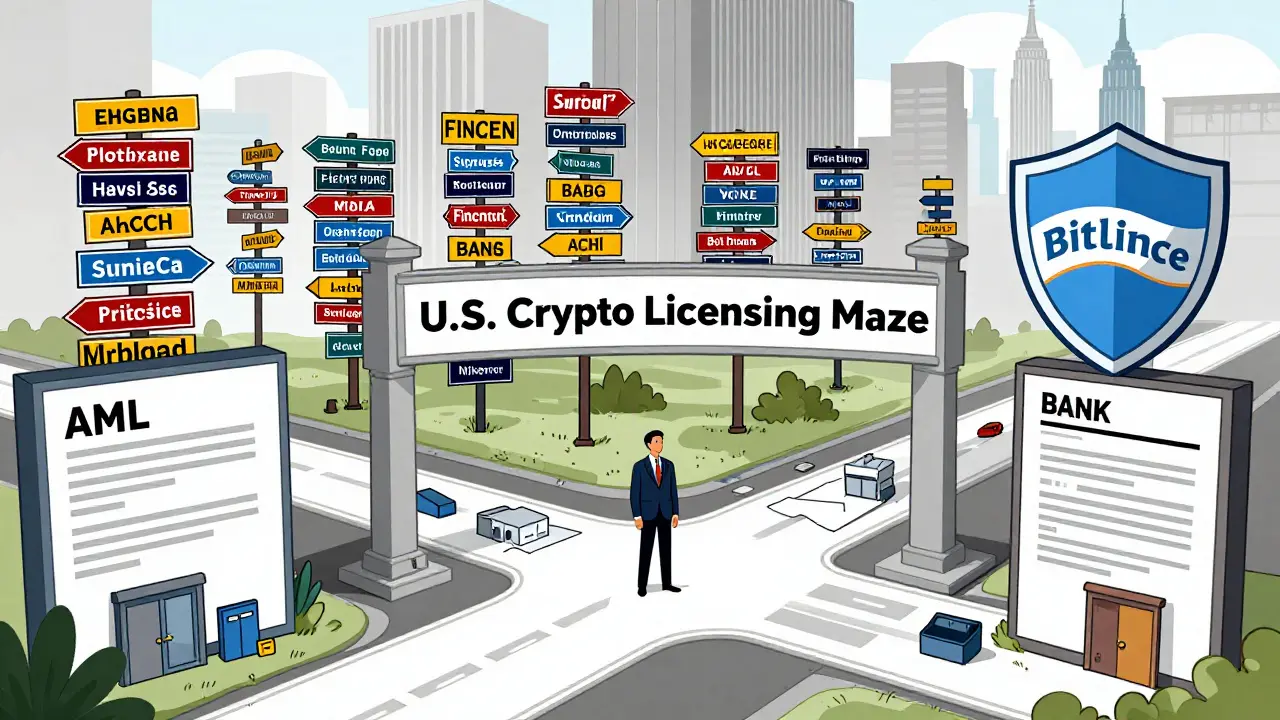
There’s no single “crypto license.” You need multiple, depending on what you do and where you operate.In the U.S., if you’re moving money-even crypto-you must register with FinCEN as an MSB. That’s step one. But if you’re operating in New York, you also need a BitLicense from NYDFS. If you’re trading tokens that could be classified as securities (like many DeFi tokens), you need SEC registration. If you’re offering crypto futures or options, you need CFTC and NFA approval. Custody services? You’ll need OCC or state banking approval.
In the EU, MiCA changed everything. If you’re offering crypto services to EU customers, you need a VASP license-no exceptions. This covers exchanges, wallets, custodians, and even some DeFi protocols that act like financial intermediaries. You can’t just “target” EU users and hope they don’t notice. MiCA applies if your service is accessible in the EU, regardless of where your company is based.
Other regions have their own rules. Singapore requires separate licenses for payment services, crypto trading, and custody. Japan’s FSA demands strict capital reserves and segregation of customer assets. The UK’s FCA requires registration but doesn’t issue licenses for all crypto activities-yet.
Bottom line: If you’re operating internationally, you need a legal team that understands each jurisdiction. Don’t assume one license covers you everywhere. It doesn’t.

AML and KYC: Beyond Basic ID Checks
KYC used to mean collecting a driver’s license and a selfie. Now, it’s a multi-layered system.Your KYC process must include:
- Real-time identity verification using APIs from providers like Sumsub, Onfido, or Veriff
- Document authenticity checks (can your system detect a fake passport?)
- Sanctions screening against global lists (OFAC, UN, EU)
- Pep screening (politically exposed persons)
- Tiered verification: Light checks for small users, full EDD for large or high-risk accounts
AML goes further. You need transaction monitoring software that flags patterns: rapid deposits and withdrawals, mixing services, known darknet wallet addresses, or unusual volume spikes. AI tools from Chainalysis, Elliptic, or CipherTrace analyze blockchain data in real time. These aren’t luxuries-they’re now standard.
You must file Suspicious Activity Reports (SARs) with FinCEN whenever you see red flags. You must file Currency Transaction Reports (CTRs) for cash transactions over $10,000. Failing to file these isn’t negligence-it’s a federal crime.
Data Privacy and Cybersecurity: The Hidden Compliance Layer
Compliance isn’t just about money. It’s about data.If you collect personal information-names, addresses, ID scans-you’re subject to data privacy laws. In the U.S., that means GLBA (for financial institutions) and state laws like CCPA or NYDFS cybersecurity requirements. In the EU, GDPR applies. You need:
- End-to-end encryption for customer data
- Strict access controls (who can see what, and why)
- Incident response plan (what you do if you get hacked)
- Regular penetration testing
- Third-party vendor audits (your KYC provider must be compliant too)
And if you’re operating in the EU, the Digital Operational Resilience Act (DORA) adds another layer. You need to prove you can withstand cyberattacks, have backup systems, and report incidents within hours-not days. DORA applies to any crypto firm serving EU customers, even if you’re based in Texas.
Costs and Timelines: What to Expect
Let’s be real: Compliance isn’t cheap or fast.For a simple wallet service with no trading: 3-6 months to set up, $50,000-$150,000 in legal and tech costs.
For a full crypto exchange with fiat on-ramps, custody, and trading: 12-18 months. Initial setup costs $500,000+. Annual compliance costs: $200,000-$1 million, depending on volume and jurisdictions.
Multi-state U.S. licensing? Add 18-24 months and $2-5 million total. That includes bonds, legal fees, audits, and ongoing reporting.
International expansion? Multiply complexity. Each country requires its own legal review, licensing, and compliance structure. Don’t rush it. A single misstep can trigger a shutdown.

Tools That Actually Work in 2025
You can’t do this manually. You need automation.- Transaction Monitoring: Chainalysis, Elliptic, TRM Labs
- KYC/Identity Verification: Sumsub, Onfido, Jumio
- Regulatory Change Tracking: ComplyAdvantage, LexisNexis Risk Solutions
- Reporting Automation: Notion-based systems won’t cut it. Use platforms like ComplyAdvantage or Alloy that auto-generate SARs and CTRs
These tools integrate into your backend. They don’t replace your compliance officer-they empower them.
What Happens If You Skip Compliance?
The risks aren’t theoretical.- SEC enforcement action: fines, asset freezes, permanent shutdown
- CFTC penalties for unregistered derivatives trading
- FinCEN civil penalties up to $1 million per violation
- Loss of banking relationships (no bank will touch you)
- Reputation damage that kills customer trust
- Criminal charges for executives in extreme cases
There’s no comeback from a regulatory shutdown. Your users leave. Your investors pull out. Your team quits. And you can’t just restart under a new name-regulators track that.
Where to Start Right Now
If you’re building a crypto business in 2025, here’s your action plan:- Define your exact business model: Are you an exchange? Wallet? Stablecoin issuer? DeFi protocol?
- Identify every jurisdiction you operate in-or plan to serve.
- Consult a crypto-specific legal firm (not a general attorney).
- Map out your compliance pillars: policies, officer, training, testing, risk model.
- Select your KYC/AML tech stack and integrate it before launch.
- Start the licensing process early. Some applications take 9-12 months.
- Build your cybersecurity and data privacy framework from day one.
- Train your team on compliance before you onboard your first user.
Compliance isn’t a hurdle. It’s your competitive advantage. Platforms that get it right attract institutional investors, banking partners, and loyal users. Those that don’t? They disappear.
Do I need a license if I only accept crypto and don’t convert to fiat?
Yes. If you’re holding or transferring crypto on behalf of users-even without fiat conversions-you’re likely classified as a Money Services Business under FinCEN rules. Most U.S. states also treat crypto transfers as money transmission. You still need MSB registration and possibly a state Money Transmitter License.
Can I use a third-party compliance provider instead of hiring my own team?
You can outsource KYC, AML monitoring, and reporting to providers like Sumsub or Chainalysis. But you still need a designated compliance officer internally who takes legal responsibility. Regulators won’t accept “we used a vendor” as an excuse for failing to comply.
What’s the biggest mistake crypto startups make on compliance?
Waiting until they have users to start compliance. Many founders think, “We’ll get licensed once we hit 10,000 users.” That’s too late. Regulators look at intent. If you’re operating without a license-even with one user-you’re already in violation. Start compliance before launch.
Is MiCA the only regulation I need to worry about if I’m in the EU?
No. MiCA covers licensing and AML, but you also need to comply with GDPR for data privacy and DORA for cybersecurity and operational resilience. Each EU country may add local rules too. MiCA sets the baseline, but it’s not the full picture.
How often do I need to update my compliance program?
At least annually, but often more. Regulations change constantly-new sanctions lists, updated guidance from FinCEN, new MiCA interpretations. Your compliance officer should review policies quarterly and update them whenever a new rule affects your business. Automated regulatory change tracking tools help, but human oversight is still required.

Comments (5)

- Ian Esche
- November 28, 2025 AT 04:54 AM
Let’s be real - if you’re not already knee-deep in compliance, you’re already dead. I’ve seen three crypto startups go under in the last year because they thought ‘we’re just tech guys’ and regulators wouldn’t notice. Nope. The SEC doesn’t care if your UI is pretty. They care if your AML system can trace a $2M wash trade from a North Korean wallet. Get your MSB registration done before you even deploy your beta. No excuses.

- Felicia Sue Lynn
- November 28, 2025 AT 17:20 PM
There’s a deeper truth here that rarely gets spoken: compliance isn’t just about avoiding fines - it’s about reclaiming the moral high ground of finance. For decades, crypto was sold as liberation from broken systems. But true liberation isn’t escaping regulation - it’s building systems so transparent, so accountable, that they earn the trust of those who once feared them. The most revolutionary thing a crypto firm can do today isn’t to innovate faster - it’s to operate with more integrity than the banks it replaced.

- Christina Oneviane
- November 30, 2025 AT 00:03 AM
Oh wow, so now we’re supposed to pay $2 million to play by rules written by people who still think Bitcoin is a drug cartel’s side hustle? Cute. Meanwhile, the same regulators who shut down your exchange are sipping champagne in their penthouses while their hedge funds pump altcoins through offshore shell companies. This isn’t compliance - it’s extortion dressed up as law. Build in Malta, serve the world, and laugh all the way to the bank.

- fanny adam
- December 1, 2025 AT 01:05 AM
It is not coincidental that the timing of MiCA’s full enforcement aligns precisely with the U.S. Federal Reserve’s accelerated digital currency pilot programs. The consolidation of financial sovereignty under centralized authorities is being systematically engineered under the guise of ‘consumer protection.’ The requirement for a designated compliance officer is not a safeguard - it is a backdoor to mandatory identity linkage, enabling real-time surveillance of every blockchain interaction. This is the end of financial privacy, and the article, though technically accurate, fails to acknowledge that this is not regulation - it is subjugation.

- Eddy Lust
- December 2, 2025 AT 16:04 PM
man i just wanna build something cool without having to file 14 forms before my first user signs up. but honestly? the guy who said ‘start compliance before launch’? 100% right. i tried the ‘build first, ask later’ thing last year. got a cease-and-desist before my app hit 50 users. lost my domain, my server, my sanity. now i’m working with a crypto lawyer before i even pick a color scheme. it’s boring as hell, but at least i’m still in the game. also, if you’re using notion for SARs… please stop. just stop.