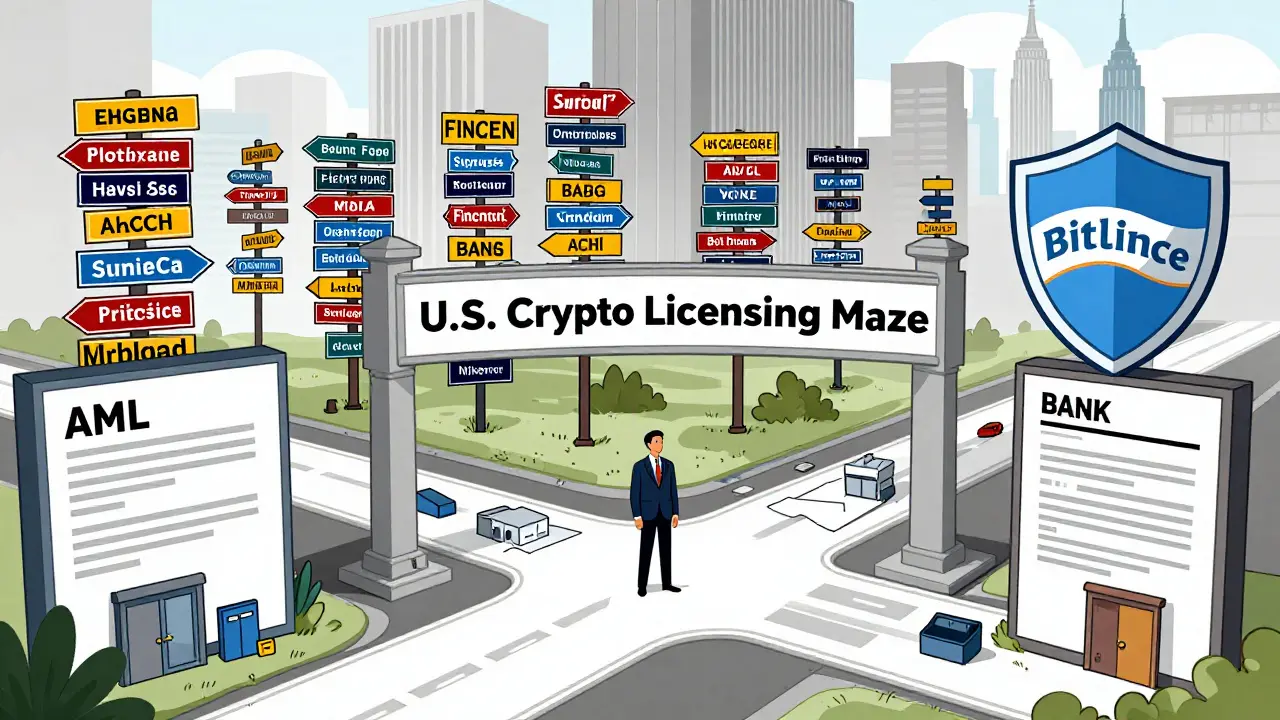

Running a cryptocurrency business in the U.S. isn’t just about building a good app or having a solid blockchain idea. If you want to operate legally, you’re facing one of the most complex regulatory mazes in modern finance. By 2026, there’s no such thing as a single crypto license. Instead, you’re dealing with overlapping federal rules, 47 state licensing systems, and a handful of unique frameworks that can make or break your business before it even starts.
Federal Requirements: FinCEN and the MSB Rule
Every crypto business that exchanges, sends, or holds digital assets for others must register with FinCEN as a Money Services Business (MSB). This isn’t optional. It’s the baseline. The rule dates back to 2013, but it’s still the foundation of everything. If you’re a crypto exchange, a wallet provider, or even a peer-to-peer platform that handles fiat conversions, you’re an MSB.
Registering with FinCEN means you’re subject to the Bank Secrecy Act. That brings real obligations: you must file reports for transactions over $10,000, keep records for five years, and file Suspicious Activity Reports (SARs) if something looks off. You also need a full Anti-Money Laundering (AML) and Countering the Financing of Terrorism (CFT) program. That includes customer identification, ongoing monitoring, and staff training. No shortcuts. No exceptions.
Many startups think they can skip this because they’re "just a tech company." But if your platform moves value between users and dollars-or even between crypto and stablecoins-you’re in the money transmission business. FinCEN doesn’t care if you call it "crypto." If it moves money, you’re regulated.
State-Level Licenses: The Real Bottleneck
While FinCEN sets the federal floor, state licenses are where most businesses get stuck. Forty-seven states and Washington D.C. require a Money Transmitter License (MTL) if you’re transmitting crypto to or from fiat currency. That means if you let users deposit USD and buy Bitcoin, you need a license in every state where you have customers.
But here’s the catch: not all states treat crypto the same. Some, like New York, have their own special rule: the BitLicense. Issued by the New York State Department of Financial Services (NYDFS), it applies to any business that does any of these five things:
- Receiving or transmitting virtual currency
- Storing or holding custody of it
- Buying or selling it as part of a customer business
- Providing exchange services
- Controlling or administering it
And here’s the kicker: if your business serves even one New York resident, you need a BitLicense-even if your company is based in Texas. That’s why so many crypto firms end up applying for it, even if they don’t plan to operate in New York. It’s become the de facto national standard.
Other states are more flexible. Wyoming offers a Special Purpose Depository Institution (SPDI) charter for crypto-native banks. Illinois doesn’t require licensing for purely digital transfers. California requires a minimum net worth of $250,000. New York demands $500,000. And some states have no clear rules at all, leaving businesses guessing.
Costs and Timelines: It’s Not Cheap or Fast
Getting licensed isn’t just paperwork. It’s a financial and time investment most startups don’t anticipate.
Application fees range from $500 in states like Florida to $5,000 in New York. But that’s just the tip of the iceberg. You’ll need:
- Legal counsel familiar with state money transmission laws
- Financial auditors to prove capital reserves
- Compliance officers to build AML programs
- Cybersecurity experts to meet NYDFS Part 500 standards
- Background checks for every owner and executive
According to industry data, the average startup spends between $500,000 and $2 million to get fully licensed. And the timeline? Six to 18 months. New York’s BitLicense process averages 180+ days. Wyoming’s SPDI charter takes about 90. Most other states sit somewhere in between.
And here’s the worst part: applications get rejected. About 42% of first-time applicants fail because their AML program is too weak, their capital is insufficient, or their ownership structure isn’t clear. Many don’t realize they need to disclose every single investor with more than 5% ownership. One founder in Ohio spent $300,000 and 11 months before realizing his offshore investor had to be disclosed-and then got denied.

Banking: The Hidden Hurdle
Even after you get licensed, you still need a bank. And that’s harder than getting the license.
Traditional banks are terrified of crypto. They’ve been fined millions for working with unlicensed exchanges. So even if you have a BitLicense and a clean FinCEN registration, banks will still ask for more. They want:
- Proof of ongoing compliance
- Real-time transaction monitoring
- Third-party audits
- Insurance
Seventy-three percent of crypto businesses report difficulty securing banking services. Many end up using specialized crypto-friendly banks like Mercury, Evolve Bank & Trust, or Cross River Bank. Some even have to use multiple banks because no single institution will take all their business.
Without a bank, you can’t process withdrawals. Without withdrawals, you can’t operate. It’s a catch-22 that’s cost more startups than regulatory fines.
Who’s Getting Licensed-and Who Isn’t
As of early 2026, licensed crypto businesses control 92% of all U.S. trading volume. That’s not a coincidence. Exchanges like Coinbase, Kraken, and Bitstamp are licensed in nearly every state. They’ve spent years building compliance teams and paying millions in legal fees.
Meanwhile, unlicensed platforms are being pushed out. The SEC has increased enforcement actions by 220% since 2022. The Treasury Department now says even some DeFi platforms with centralized control need MSB registration. And banks are cutting off accounts for anyone without proof of licensing.
Forty-seven of the Fortune 500 companies now hold crypto licenses. They’re not doing it for fun. They’re doing it because their customers demand it-and because regulators are watching.

What’s Changing in 2026
The system is starting to shift. The Money Transmitter Modernization Act, introduced in Congress in 2024, could create a federal licensing system that replaces most state requirements. If it passes, businesses could apply once instead of 30+ times.
Meanwhile, 23 states passed new crypto laws in the first half of 2024. Wyoming, Delaware, and Texas are leading the charge with clear, business-friendly rules. Gartner predicts 65% of states will form interstate compacts by 2026, cutting compliance costs by 30%.
But until then, the patchwork remains. If you’re launching a crypto business today, you’re not just building software-you’re building a legal infrastructure. And that’s the real challenge.
What You Need to Do Right Now
If you’re serious about launching a crypto business in the U.S., here’s your checklist:
- Register with FinCEN as an MSB-don’t wait.
- Identify which states you’ll serve. Start with the ones that matter most.
- Calculate your capital requirements. New York? $500K. California? $250K. Wyoming? Varies.
- Build a real AML/CFT program-not a template. Include transaction monitoring, risk ratings, and training logs.
- Secure a crypto-friendly banking partner early. Don’t wait until you’re licensed.
- Hire a compliance consultant with proven experience. Businesses that do cut application time by 40%.
There’s no shortcut. But there is a path. And it starts with understanding the rules-not ignoring them.
Do I need a license if I only trade crypto-to-crypto?
Yes-if you’re operating as a business. FinCEN considers any platform that facilitates crypto-to-crypto trades for customers as a money transmitter. Even if no fiat is involved, if you’re charging fees or acting as an intermediary, you need an MSB registration. Some states may also require a money transmitter license depending on how they define "transmission." Always check state rules.
Can I operate without a license if I’m based outside the U.S.?
No-if you serve U.S. customers. U.S. regulators have extraterritorial reach. If your platform allows U.S. users to deposit funds, trade, or withdraw, you’re subject to U.S. law. New York’s BitLicense explicitly applies to any business serving New York residents, regardless of location. Many companies have been fined or shut down for operating without a license while claiming they were "overseas."
What’s the difference between a BitLicense and a Money Transmitter License?
A BitLicense is a specific type of MTL issued only by New York State. It’s stricter than most. It requires additional cybersecurity standards, consumer protection rules, and ongoing reporting. Other states issue generic MTLs under the Uniform Money Services Act. The BitLicense covers more activities and has higher capital requirements. But because it applies to anyone serving New Yorkers, many companies treat it as the gold standard-even if they’re not based in New York.
How long does it take to get licensed?
It varies. FinCEN MSB registration takes 60-90 days. State licenses take longer: 90 days in Wyoming, 180+ days in New York, and 6-12 months in states with backlogged systems. Most businesses take 8-14 months total to get fully licensed across all required states. The timeline depends on how complete your application is and whether you’ve hired experienced compliance help.
Can I apply for licenses in multiple states at once?
Not easily. Each state has its own application form, fee, and requirements. Some states participate in the Nationwide Multistate Licensing System (NMLS), which allows you to submit one application for multiple states. But not all states use it, and crypto-specific rules often override it. For states like New York, California, and Texas, you’ll need separate, detailed applications.
What happens if I operate without a license?
You risk fines, shutdowns, and criminal charges. The SEC, FinCEN, and state regulators have all pursued enforcement actions against unlicensed crypto firms. Penalties can exceed $1 million per violation. In extreme cases, executives have faced jail time. Even if you’re small, regulators can freeze your assets and ban you from the industry permanently. It’s not worth the risk.

Comments (10)

- Danica Cheney
- February 9, 2026 AT 07:58 AM
lol just register with fincen and call it a day
who cares about 47 states
its 2026 not 2012

- laura mundy
- February 9, 2026 AT 16:06 PM
this is why crypto will never go mainstream. too many overpaid lawyers making up rules as they go. if you're a tech company and you let people send btc, why are you suddenly a bank? this isn't regulation. it's rent-seeking dressed up as compliance.

- Jacque Istok
- February 10, 2026 AT 11:03 AM
you think new york's bitlicense is the bottleneck? try getting a bank account after that. i've seen 7 startups die because chase refused to touch them even with full licenses. the real enemy isn't the state regulators-it's the 1980s banking infrastructure still clinging to life.

- Mendy H
- February 10, 2026 AT 18:27 PM
this article reads like a compliance consultant's sales pitch. $2 million to launch? more like $2 million to pay your law firm to tell you what you already knew. the fact that you need a cybersecurity expert just to apply for a license proves the system is broken. not because crypto is risky-because bureaucracy is profitable.

- sabeer ibrahim
- February 12, 2026 AT 04:07 AM
india has 120000 crypto users and we dont need 47 licenses. why does america need this much red tape? its not about security. its about control. and the banks? they're scared because crypto makes them irrelevant. so they pay lobbyists to make it impossible for anyone else to compete.

- Taybah Jacobs
- February 12, 2026 AT 16:05 PM
While I appreciate the comprehensive overview, I must emphasize the importance of foundational compliance. The regulatory framework, though complex, exists to protect consumers and maintain financial integrity. Skipping steps may seem expedient, but it risks systemic harm. A measured, deliberate approach is not merely prudent-it is ethically imperative.

- Oliver James Scarth
- February 14, 2026 AT 04:37 AM
The UK doesn't have this mess. We have one regulator, one set of rules, and a damn good one at that. America's federalism is a luxury for academics and a nightmare for entrepreneurs. You're not building a business-you're playing a game of regulatory whack-a-mole. It's absurd.

- Kieren Hagan
- February 14, 2026 AT 20:34 PM
I've advised 14 crypto startups through this process. The biggest mistake? Waiting until the last minute to engage compliance. The second biggest? Assuming your legal team knows crypto. Most don't. Hire someone who's done this before-not someone who just passed the bar. Time and money saved: 60%.

- sachin bunny
- February 16, 2026 AT 08:34 AM
this is all a lie. the fed is just scared of crypto. they're hiding behind 'licensing' to stop you from owning your own money. they'll come for your btc next. 🤡🔐💸

- Mrs. Miller
- February 16, 2026 AT 13:52 PM
you know what's funny? in japan they have one national license. in germany, one EU-wide one. here? we need 47 licenses and a prayer. it's not about security. it's about who gets to profit from the chaos. and honestly? i'm tired of watching american innovation get strangled by its own bureaucracy.