
Bitcoin Halving Calculator
Calculate remaining blocks, estimated time to next halving, and new mining reward. Based on Bitcoin's fixed halving schedule.
Next Halving Information
Halving Timeline
At block 1,050,000
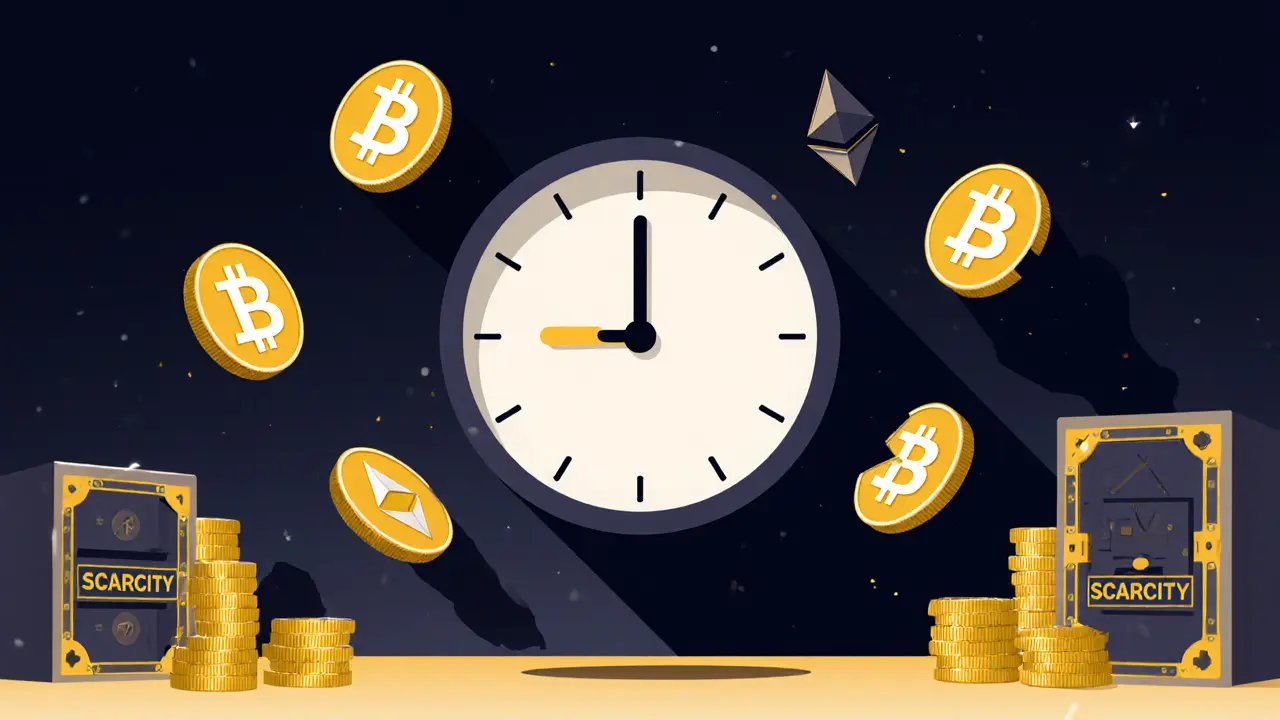
By 2028, the Bitcoin network will cut its mining rewards in half for the fifth time. That’s not just a technical update-it’s a reset button for the entire market. Every halving reduces the number of new coins entering circulation, making each remaining coin scarcer. And scarcity, in a world where money is constantly being printed, has a way of driving value. But this time, it’s not just Bitcoin. TAO, Ethereum Classic, and other networks are lining up their own halvings in a tight window between late 2025 and mid-2026. This isn’t a series of isolated events. It’s a synchronized supply shock hitting the crypto ecosystem all at once.
What Exactly Is a Halving?
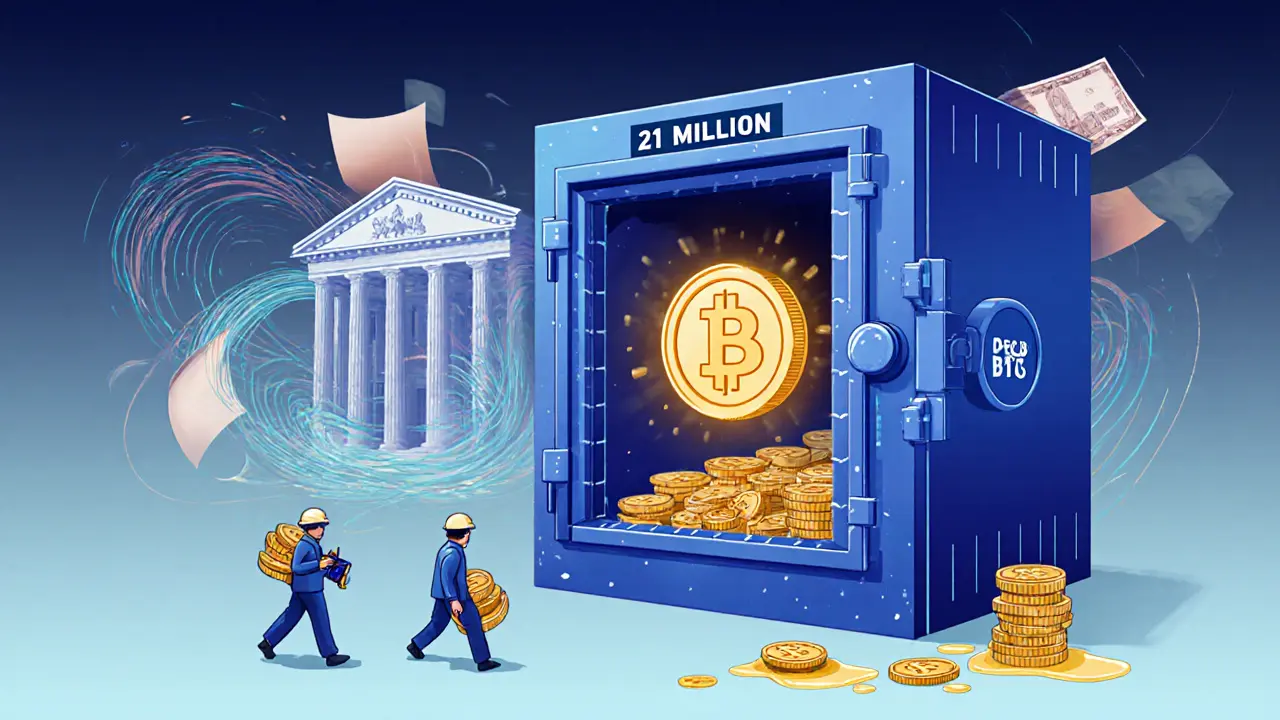
A halving is a built-in rule in certain blockchains that cuts the reward miners get for validating transactions. Bitcoin, for example, started with 50 BTC per block. That dropped to 25 in 2012, then 12.5 in 2016, 6.25 in 2020, and 3.125 in 2024. The next one, in April 2028, will bring it down to 1.5625 BTC per block. It’s designed to mimic the diminishing returns of mining precious metals-like gold-until no new coins are left to mine. Bitcoin will hit its 21 million cap in 2140. After that, miners will rely entirely on transaction fees to stay paid.
This isn’t just about Bitcoin. Ethereum Classic, still using proof-of-work like Bitcoin, will halve its rewards on July 23, 2026, at block 25,000,001. And then there’s Bittensor (TAO), which is different. TAO doesn’t just reduce rewards-it’s tied to dozens of subnets, each with its own token (Alpha). When TAO’s reward drops in late 2025, it could destabilize the whole ecosystem. Miners might pull out of subnets if their Alpha tokens lose value relative to TAO. No one knows exactly how this will play out. It’s the first real-world test of a complex, multi-token network undergoing a supply shock.
Why Do Halvings Move Prices?
It’s simple economics: less supply, same or growing demand = higher price. But it doesn’t happen overnight. After the 2024 Bitcoin halving, prices didn’t jump right away. They sat around $60,000 for months. Then, six to eight months later, they began climbing. By January 2025, Bitcoin hit $110,000. That pattern has repeated since 2012. The market needs time to absorb the new reality-fewer coins coming in, more people noticing.
What’s different now? Institutional money. Back in 2020, retail traders drove the rally. Today, companies like ARK Invest bought $37.7 million in Bitcoin after the 2024 halving. Big players aren’t gambling-they’re accumulating. They’re betting that over the next four years, Bitcoin becomes harder to buy, not easier. Exchange reserves are falling. That means coins are moving out of trading platforms and into long-term wallets. That’s a classic sign of accumulation before a price surge.
And it’s not just Bitcoin. Global liquidity matters too. When central banks print more money-when M2 money supply grows-Bitcoin tends to rise. In 2020, the Fed flooded the system with cash. Bitcoin went from $8,000 to $60,000 in a year. In 2024, inflation stayed sticky, rates stayed high, but institutions kept buying. The link between money printing and Bitcoin’s price isn’t perfect, but it’s strong enough to matter.
The 2025-2028 Halving Wave
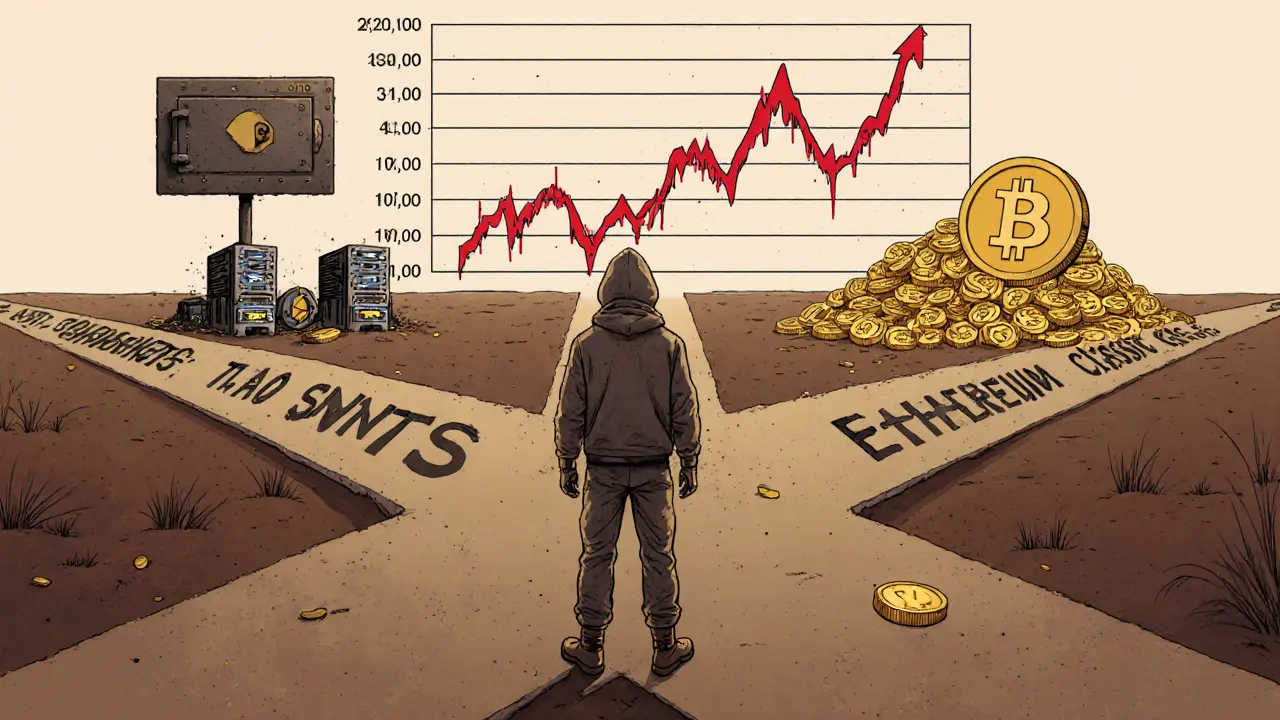
Between December 2025 and July 2026, three major halvings are scheduled:
- TAO (Bittensor) - Expected around December 13, 2025, when 10.5 million TAO are in circulation. The exact date depends on miner behavior, subnet fees, and token recycling.
- Ethereum Classic - July 23, 2026, at block 25,000,001.
- Bitcoin - April 2028, at block 1,050,000.
This is the first time in crypto history that multiple major networks are halving within a 12-month window. That means miners across different chains will face reduced income at the same time. Some might shift from one network to another, trying to maximize profits. That could cause temporary volatility in hash rates and prices. If miners pull out of Ethereum Classic because TAO rewards are higher, Ethereum Classic’s security could weaken. If miners flood into Bitcoin, it could make mining more expensive and push BTC prices up faster.
And TAO is the wild card. Its ecosystem isn’t a single token-it’s a web of subnets. Each subnet has its own Alpha token, used to pay for AI model training and data services. When TAO’s issuance drops, Alpha tokens will become relatively more abundant. That could cause Alpha prices to drop, which might make subnets less profitable. Miners might stop running them. That could break parts of the network. No one has seen this before. The market will have to learn on the fly.
What Happens After the Halving?
Historically, Bitcoin’s price peaks 12 to 18 months after a halving. That’s the pattern. But this cycle might be different. Interest rates are higher. Debt is longer. Institutions are buying slowly, not in a frenzy. Some analysts think the next peak could be delayed until late 2026 or even 2027-not 2025 as it was in previous cycles.
Price predictions vary. Some models say Bitcoin could hit $175,000 by the end of 2025. Others say $900,000 by 2030. Those numbers aren’t magic. They’re based on supply curves, adoption trends, and historical cycles. But they all assume one thing: Bitcoin becomes scarcer, and demand doesn’t stop growing.
Long-term, the real challenge isn’t price-it’s sustainability. When Bitcoin’s block reward drops to almost nothing, miners need transaction fees to keep the network secure. Right now, fees are tiny. But if Bitcoin becomes the global digital gold, transaction volume will rise. Fees will rise with it. That transition-from new coins to fees-is the biggest test Bitcoin has ever faced. If it works, the network stays secure. If it fails, miners leave, security drops, and trust erodes.
What Should You Do?
Don’t chase price spikes. Halvings aren’t trading signals-they’re structural shifts. If you’re holding Bitcoin, TAO, or Ethereum Classic, the halving is just one part of a longer story. The real question is: Are you in this for the long term?
Here’s what to watch:
- Exchange reserves - Are coins moving out of exchanges? That’s accumulation.
- Hash rate trends - Are miners leaving networks? That’s a red flag for security.
- Transaction volume - Is Bitcoin’s fee revenue growing? That’s the key to its future.
- Global liquidity - Are central banks still expanding money supply? That’s a tailwind.
If you’re not holding any of these assets, don’t rush in just because a halving is coming. Wait for the market to react. Look for signs of real adoption-not hype.
What’s Next After the Halvings?
After the 2028 Bitcoin halving, there will be 29 more before 2140. Each one will be smaller, less noticeable. The market will mature. Halvings won’t be the big event they are today. But the foundation they’ve built will remain: scarcity, decentralization, and a fixed supply.
For TAO, the 2025 halving will be a make-or-break moment. If its multi-subnet model survives, it could become the blueprint for future AI-blockchain hybrids. If it fails, it’ll be a cautionary tale.
For Ethereum Classic, the 2026 halving is a last stand. It’s the final major proof-of-work chain still standing. If it holds up, it proves that decentralized mining still matters. If it fades, it signals the end of an era.
And for Bitcoin? It’s not just a currency anymore. It’s becoming a global asset class. The halvings are the rhythm of its growth. Every four years, it gets harder to mine. Every four years, it gets harder to ignore.
When is the next Bitcoin halving?
The next Bitcoin halving is expected in April 2028, at block 1,050,000. It will reduce the mining reward from 3.125 BTC to 1.5625 BTC per block. This follows the pattern of every 210,000 blocks, or roughly every four years. The last halving happened on April 20, 2024.
Will TAO’s halving affect Bitcoin’s price?
Not directly, but indirectly, yes. If TAO’s halving causes panic or volatility in the broader crypto market, it could trigger short-term sell-offs in Bitcoin. But if TAO’s ecosystem remains stable and its price rises, it could signal strong investor confidence in decentralized AI networks, which might boost sentiment for Bitcoin too. The market is interconnected, even if the blockchains aren’t.
What happens to miners after a halving?
After a halving, miners earn half as many new coins for the same work. To stay profitable, they need either higher token prices or lower operating costs. Many inefficient miners shut down. The ones that survive are usually those with cheap electricity and modern hardware. Over time, this leads to a more centralized mining industry-but also a more secure network, because only the strongest players remain.
Is Ethereum Classic’s halving still relevant?
Yes. While Ethereum moved to proof-of-stake, Ethereum Classic remains a proof-of-work chain with active mining. Its halving on July 23, 2026, is one of the last major supply shocks in the PoW space. It’s a test of whether decentralized mining can survive as Bitcoin and other chains mature. If it holds, it proves PoW still has value. If it fades, it’s a sign the era of energy-intensive mining is ending.
Can halvings cause crashes?
Rarely. Halvings are predictable and priced in over time. The real risk comes from unexpected events-regulation, macroeconomic shocks, or a major hack. If the market is overleveraged before a halving, a sudden drop in liquidity could trigger a sell-off. But historically, halvings have been followed by bull markets, not crashes. The supply shock is designed to be deflationary, not destabilizing.
Comments (10)

- Mark Adelmann
- November 28, 2025 AT 10:18 AM
Man, I’ve been watching this play out since 2016. Halvings aren’t magic, but they’re the only thing in crypto that actually follows a schedule. Everyone panics when the reward drops, then forgets about it until the price starts climbing. This time feels different though-so many chains doing it at once. It’s like a synchronized heartbeat.

- ola frank
- November 29, 2025 AT 07:43 AM
The structural implications of concurrent halvings across heterogeneous consensus architectures are non-trivial. TAO’s subnet-based tokenomics introduce a feedback loop where Alpha token depreciation could trigger miner attrition, thereby reducing network hash power and increasing vulnerability to 51% attacks. This is not merely a supply shock-it’s a systemic risk multiplier in a nascent, untested economic model.

- SHASHI SHEKHAR
- November 29, 2025 AT 11:33 AM
Bro, I’ve been mining ETC since 2020 and I can tell you-this halving is gonna be brutal. Miners are already switching to Bitcoin because of the fees and liquidity. TAO? Nah, most of us don’t even understand how the subnets work. It’s like trying to drive a Tesla with a manual transmission while blindfolded. And don’t get me started on how Alpha tokens are just memes with a whitepaper. 🤡 But hey, if TAO survives, it’ll be the first AI-blockchain hybrid that actually does something useful. Until then, I’m stacking sats and ignoring the noise. 🚀📈

- Ben Costlee
- December 1, 2025 AT 05:15 AM
I remember when people said Bitcoin would die after the 2012 halving. Then 2016. Then 2020. Each time, the same panic, then the same rally. This time, it’s not just about Bitcoin-it’s about whether we can handle multiple supply shocks at once. The real question isn’t price. It’s whether the ecosystem can hold together without collapsing under its own complexity. I’m not betting on hype. I’m betting on resilience.

- Abby cant tell ya
- December 1, 2025 AT 19:37 PM
Ugh, another ‘halving is magic’ post. Newsflash: the price doesn’t care about your charts. It cares about who’s buying and who’s selling. Right now, retail is tapped out. Institutions are buying slow. And TAO? Please. That’s just a VC-funded Ponzi with AI buzzwords. Don’t fall for the FOMO. Wait for the dump.

- Janice Jose
- December 3, 2025 AT 16:55 PM
Abby, I get you’re skeptical-but ignoring the pattern just because it’s been repeated doesn’t make it less real. The market isn’t just emotion. It’s math. Less supply, more demand, over time-it works. I’m not buying TAO. But I’m watching. And I’m holding. Not because I think it’ll go to the moon, but because I believe in the principle.

- stephen bullard
- December 4, 2025 AT 01:22 AM
Think about it-halvings are like the seasons of crypto. Winter comes, everyone complains, then spring hits and everything grows. This time, it’s not just one tree-it’s a whole forest. TAO might crack. ETC might fade. But Bitcoin? It’s been through this before. It’s not going anywhere. The real story isn’t the price. It’s how we learn to live with scarcity in a world obsessed with infinite growth.

- imoleayo adebiyi
- December 5, 2025 AT 03:40 AM
From Nigeria, I see how people in the West treat halvings like religious events. But for many of us, Bitcoin is not speculation-it’s survival. When inflation eats your salary, having something with a fixed supply matters. I don’t care about TAO subnets or hash rates. I care that I can send money to my family without a bank saying no. Halvings make that more valuable. That’s all I need to know.

- Angel RYAN
- December 6, 2025 AT 10:14 AM
Miners are the unsung heroes here. They don’t get applause. They just run rigs, pay bills, and hope the price catches up. After the halving, a lot of them will disappear. But the ones left? They’ll be tougher, smarter, better. That’s how networks get stronger. It’s not about the coins. It’s about the people keeping the lights on.

- Vaibhav Jaiswal
- December 7, 2025 AT 14:50 PM
Just watched the 2024 halving play out. Took 8 months. This one? Probably 10. But when it hits? You’ll feel it in your bones. TAO’s gonna be wild. ETC? Might be the last PoW standing. Bitcoin? Still the king. Chill. Wait. Watch reserves. That’s all you need.