
Imagine borrowing money without a bank, without a credit check, and without waiting days for approval. All you need is cryptocurrency as collateral and an internet connection. That’s DeFi lending - and it’s changing how people access credit around the world.
No More Credit Scores or Paperwork
Traditional loans live and die by your credit score. Banks look at your income, your history, your job, even your bank statements. If you’re self-employed, new to the country, or just had a late payment five years ago, you’re out of luck. DeFi lending doesn’t care. Not one bit.Instead of credit checks, DeFi uses something called over-collateralization. If you want to borrow $10,000, you might need to lock up $15,000 worth of Bitcoin or Ethereum. The system doesn’t ask if you’re trustworthy - it just makes sure there’s more value behind the loan than the loan itself. If the price of your crypto drops too far, the smart contract automatically sells part of your collateral to cover the loan. No human steps in. No call from a collections agent.
This model removes bias. A single mom in rural Kansas and a trader in Lagos can both get the same loan terms. No one asks where you’re from, what your name sounds like, or whether you’ve ever opened a bank account. All that matters is the crypto you put up.
Full Control Over Your Money
When you take out a traditional loan, the bank holds your money. Even your savings account? They can freeze it. They can charge fees. They can change the rules. With DeFi, you never give up control.Your crypto stays in your own wallet. You don’t deposit it into a bank’s system. You don’t sign over rights to your assets. You just lock it temporarily in a smart contract - a piece of code running on a blockchain. That contract only does what it’s programmed to do. If you repay the loan on time, your crypto comes back. If you don’t, it gets sold. No middlemen. No delays. No surprises.
This isn’t just convenience - it’s power. You decide when to borrow, how much, and when to pay back. No appointment. No branch visit. No phone hold. Just click, sign, and go.
Faster, Cheaper, Always Open
Getting a traditional loan can take days - sometimes weeks. You fill out forms. You wait for underwriters. You wait for approvals. DeFi lending happens in minutes. Sometimes seconds.There’s no overnight processing. No weekend closures. No holiday delays. DeFi platforms like Aave and Compound run 24/7, 365 days a year. You can borrow at 3 a.m. on Christmas. The system doesn’t sleep.
Costs are lower too. Banks charge origination fees, servicing fees, late fees, prepayment penalties. DeFi platforms usually charge a small interest rate - often under 5% - and that’s it. No hidden charges. Everything is visible on the blockchain. You know exactly what you’re paying before you click confirm.
Yield Farming and Earning While You Borrow
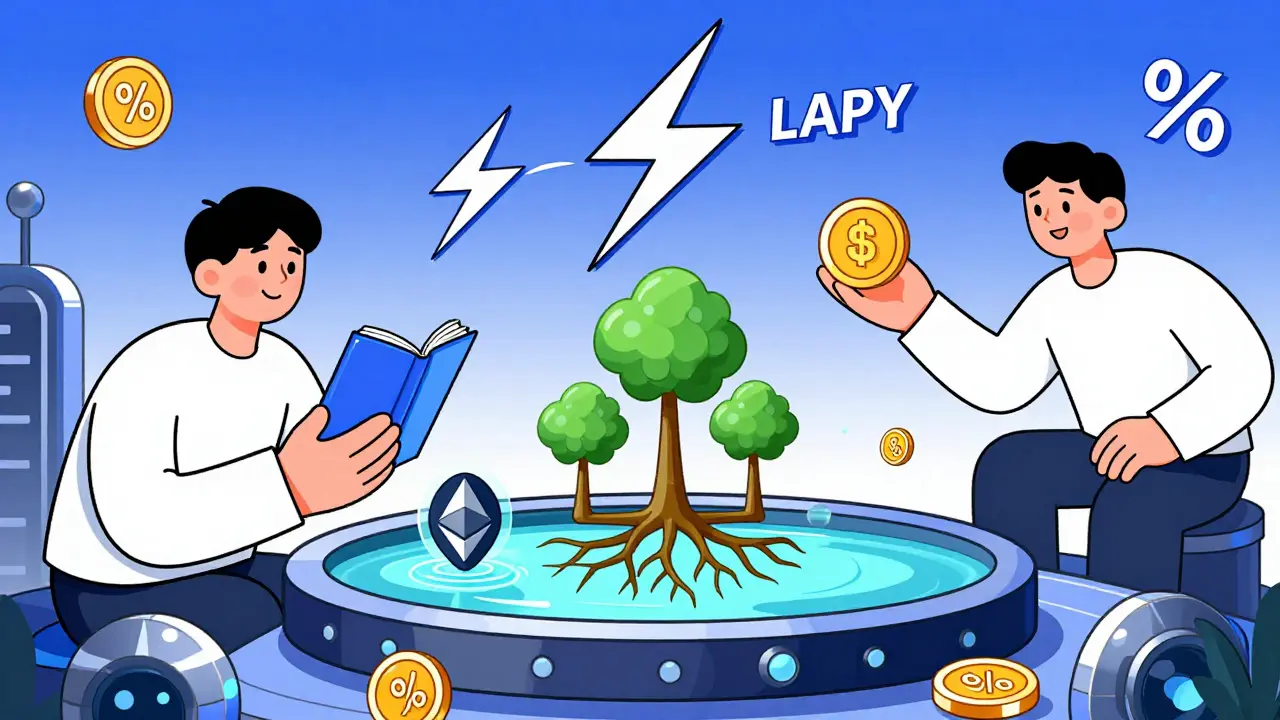
Here’s where DeFi gets wild. You don’t just borrow - you can earn more.Let’s say you lock up $10,000 in Ethereum to borrow $7,000 in stablecoins. You use that $7,000 to buy more ETH. Then you stake your original ETH in a liquidity pool and earn 8% APY. Meanwhile, your borrowed stablecoins sit in a savings protocol earning 4%. You’re not just borrowing - you’re leveraging your assets to make money on both sides.
This is called yield farming. It’s not for beginners. It requires understanding price swings, liquidation risks, and gas fees. But for those who know what they’re doing, it’s one of the most powerful tools in crypto finance. Traditional banks don’t let you do this. They don’t even offer products like it.

Flash Loans: Borrowing Without Collateral
DeFi has a feature no traditional bank can match: flash loans. These are unsecured loans - no collateral required. But there’s a catch: you have to borrow and repay it all within one blockchain transaction - usually under 15 seconds.How? Traders use flash loans to exploit price differences between exchanges. For example, if Bitcoin is $42,000 on Exchange A and $42,100 on Exchange B, a trader can borrow $1 million via flash loan, buy BTC on A, sell it on B, repay the loan, and pocket the $2,380 profit - all before the transaction even finishes.
It sounds like magic. It’s not. It’s code. And it’s only possible because DeFi is open, programmable, and interconnected. Traditional banking? Impossible. No bank would let you borrow a million dollars with no collateral and no credit check - and then expect it back in 10 seconds.
Transparency You Can’t Get from a Bank
Every transaction on a DeFi platform is public. Anyone can see who borrowed what, when, and at what rate. Smart contracts are open-source. You can read the code. You can verify the rules. You can even audit the system yourself.Compare that to traditional banking. Where’s your loan agreement stored? Who wrote the terms? Can you see the algorithm that decided your interest rate? No. It’s locked behind layers of legal jargon and proprietary systems.
With DeFi, there’s no black box. You know exactly what you’re signing up for. That’s not just transparency - it’s accountability.
Interoperability: Building on Top of Finance
DeFi isn’t a single app. It’s a Lego set.You can take a lending protocol like Aave, connect it to a decentralized exchange like Uniswap, then plug in a yield optimizer like Yearn Finance. Suddenly, your loan becomes part of a larger financial machine that works together automatically. New tools are built on top of existing ones every week.
Traditional finance? Each bank is its own island. You can’t connect Chase to Wells Fargo’s systems. You can’t build your own app that automatically transfers money between them. Everything is locked down, proprietary, and slow to change.
DeFi is open. Anyone can build on it. That’s why new financial products emerge so fast - and why innovation moves at lightning speed.
But It’s Not Risk-Free
DeFi isn’t perfect. It’s not magic. The biggest risk? Volatility. If your collateral drops 30% overnight, you could get liquidated. Smart contracts can have bugs. Scammers target users who don’t understand what they’re doing.And there’s no FDIC insurance. If you lose your keys or get hacked, there’s no bank to call. You’re on your own.
That’s why DeFi isn’t for everyone. But for people who understand the risks - and want control, speed, and opportunity - it’s the most powerful financial tool ever created.
Who’s Using It - And Why
Most DeFi borrowers aren’t buying homes or cars. They’re traders. Investors. Crypto natives.They borrow stablecoins to buy more crypto, betting the price will go up. Or they borrow governance tokens to vote on protocol changes, influencing the future of the network. It’s speculative. It’s aggressive. But it’s legal, transparent, and accessible.
Traditional banks lend to businesses and homeowners. DeFi lends to people who want to grow their crypto holdings. Different goals. Different systems. Neither is right or wrong - they just serve different needs.
The Future Is Open Finance
In 2021, DeFi had $80 billion locked in protocols. Today, it’s over $120 billion. Adoption is growing fast - especially in countries with unstable banks or limited access to credit.DeFi isn’t trying to replace banks overnight. It’s offering an alternative. One that’s faster, cheaper, and more open. One that puts power back in the hands of users.
For people tired of waiting, paying fees, and being judged by outdated systems - DeFi lending isn’t just better. It’s the only option that makes sense.

Comments (7)

- Wayne mutunga
- February 3, 2026 AT 12:42 PM
DeFi lending is wild because it doesn’t care who you are - just what you’ve got locked up. I’ve seen people in countries with hyperinflation use it to actually keep their savings from evaporating. No bank would ever let them do that.
It’s not perfect, but it’s the first time finance has ever been truly neutral. That’s huge.

- Gary Gately
- February 3, 2026 AT 17:52 PM
bro i just used aave last week and got a loan in 2 mins no cap. no credit check no forms no bs. my crypto got liquidated tho lmao i was dumb and didnt set alerts

- Joshua Clark
- February 5, 2026 AT 16:26 PM
What’s fascinating about DeFi isn’t just the absence of middlemen - it’s the architectural elegance of it all. Smart contracts aren’t just automated; they’re deterministic, transparent, and immutable. When you lock collateral, you’re not trusting a person or a policy document - you’re trusting math, logic, and consensus. And when you factor in composability - the ability to stack protocols like Legos - you’re not just borrowing money, you’re participating in a programmable financial ecosystem that’s evolving in real-time. Traditional finance is like a rotary phone in a 5G world; it’s functional, sure, but it’s fundamentally limited by its design. DeFi doesn’t just improve on it - it redefines what’s possible. The fact that you can execute a flash loan in under 15 seconds with no collateral? That’s not innovation - it’s a revolution in microsecond increments.

- Brandon Vaidyanathan
- February 6, 2026 AT 20:16 PM
Let’s be real - most people who use DeFi are just gambling with leverage and pretending it’s ‘financial freedom.’ You think you’re smart because you’re yield farming? Nah. You’re just one bad price swing away from losing everything and crying on Twitter.
And don’t get me started on ‘transparency’ - yeah, the code is open, but 99% of users don’t read it. They just click ‘approve’ on some random contract and pray. That’s not empowerment - that’s digital Russian roulette.
Also, ‘no credit check’? Cool. So now the system rewards reckless behavior. Congrats, you’re the hero of your own financial disaster movie.

- Gareth Fitzjohn
- February 7, 2026 AT 11:55 AM
I’ve been watching DeFi for a few years now. It’s impressive technically, but I still wonder how many users truly understand the risks. The speed and openness are great, but I’ve seen too many people lose everything because they didn’t realize how quickly liquidations can happen.
It’s not a replacement for banks - it’s a different tool. Like using a chainsaw instead of a hand saw. Useful, but dangerous if you don’t know what you’re doing.

- Katie Teresi
- February 8, 2026 AT 03:37 AM
DeFi is just crypto bros playing with other people’s money and calling it ‘innovation.’ If you’re not in the US with a real job and real savings, you’re just gambling. This isn’t finance - it’s a casino run by code.

- josh gander
- February 8, 2026 AT 17:45 PM
Hey Katie - I hear you, and I get why you’re frustrated. But let’s not throw the baby out with the bathwater. DeFi isn’t perfect - I’ve lost money to bad contracts too 😅
But here’s the thing: it’s giving people who’ve been locked out of the system for decades a real shot. A single mom in Nigeria? She can borrow to feed her kids. A freelancer in Argentina? He can hedge against inflation. That’s not gambling - that’s dignity.
Yeah, the risks are real. That’s why we need education, not mockery. And yeah, some people are reckless - but that’s true in traditional finance too. Ever heard of subprime mortgages? 😅
DeFi is messy, wild, and beautiful. It’s not the end of finance - it’s the beginning of something more human. Let’s help each other learn, not shame each other for trying. 💪🪙