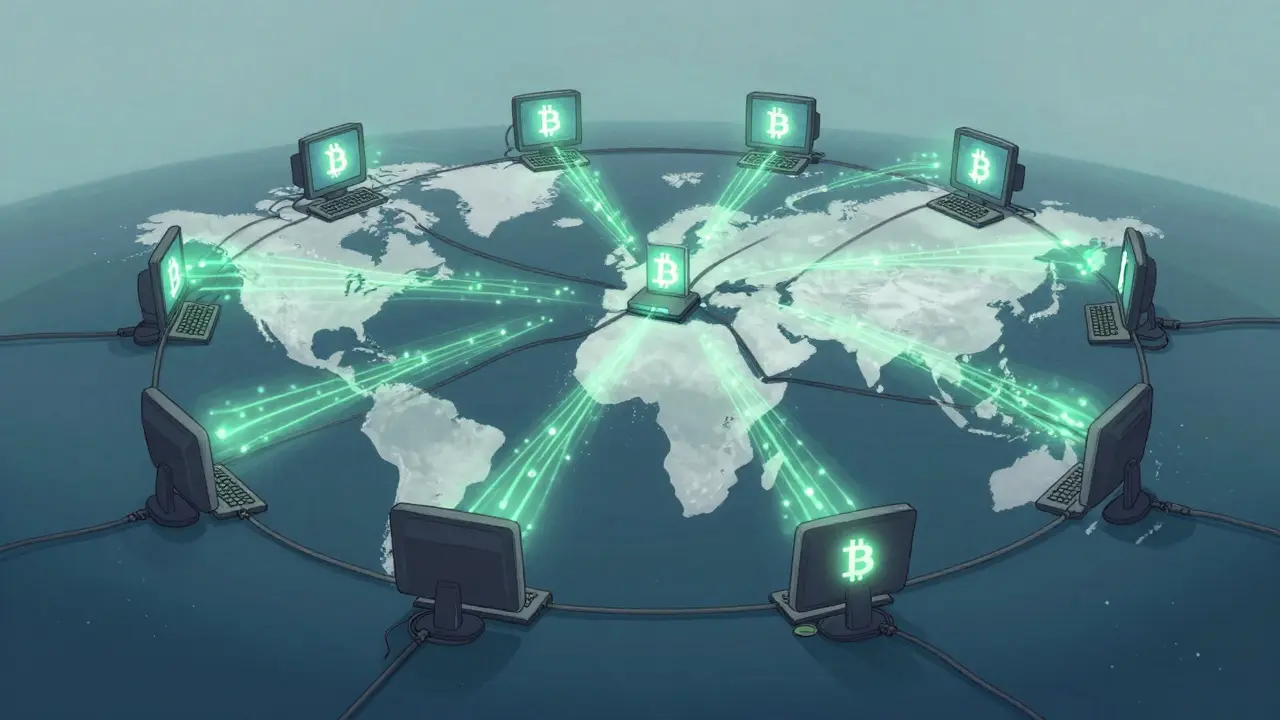

When you send Bitcoin to a friend, no bank processes it. No middleman approves it. Instead, it travels across a global network of computers - all talking directly to each other. This is the heart of cryptocurrency: a P2P network. It’s not just a technical detail. It’s what makes crypto different from everything before it.
What Exactly Is a P2P Network?
Peer-to-peer, or P2P, means direct connections between users. No central server. No boss computer calling the shots. Think of it like sharing music files in the early 2000s - you downloaded directly from someone else’s hard drive, not from a website. Cryptocurrency does the same thing, but with money.
In Bitcoin’s case, every participant - whether they’re running a full node on their home PC or a server in a data center - is both a client and a server. They send transactions. They receive them. They check if they’re valid. And they help spread the word across the whole network. There’s no single point of control. No one company owns the network. That’s the whole point.
How It Keeps the System Honest
Without a bank to verify your balance, how do you know someone didn’t just double-spend their Bitcoin? The answer lies in the P2P network’s design. Every full node keeps a complete copy of the blockchain - every transaction ever made. When a new transaction pops up, nodes check it against the rules: Is the signature valid? Did this Bitcoin already get spent? Is the sender actually the owner?
If even one node spots a problem, it ignores the transaction. And because every node is watching, it’s nearly impossible to sneak in a fake one. This isn’t trust. It’s verification. You don’t need to trust the person sending money. You just need to trust the math and the network.
Bitcoin’s network has around 14,000 publicly reachable full nodes as of late 2023. Each one holds over 50GB of data - growing by about 144MB every day. They’re not just storage units. They’re watchdogs. And they’re always talking to each other, comparing versions of the blockchain to make sure everyone’s on the same page.
How Fast Is It?
Speed is where P2P networks get messy. Bitcoin can send a transaction to 95% of its nodes in under 9 seconds under normal conditions. That’s fast - if you’re comparing it to a wire transfer. But if you’re trying to buy coffee and need a confirmation in 2 seconds, it’s too slow.
Why? Because every node has to validate every message. Every block has to be passed hand-to-hand across thousands of machines. There’s no central server pushing it out instantly. This trade-off - decentralization over speed - is intentional. It’s what makes the system resilient.
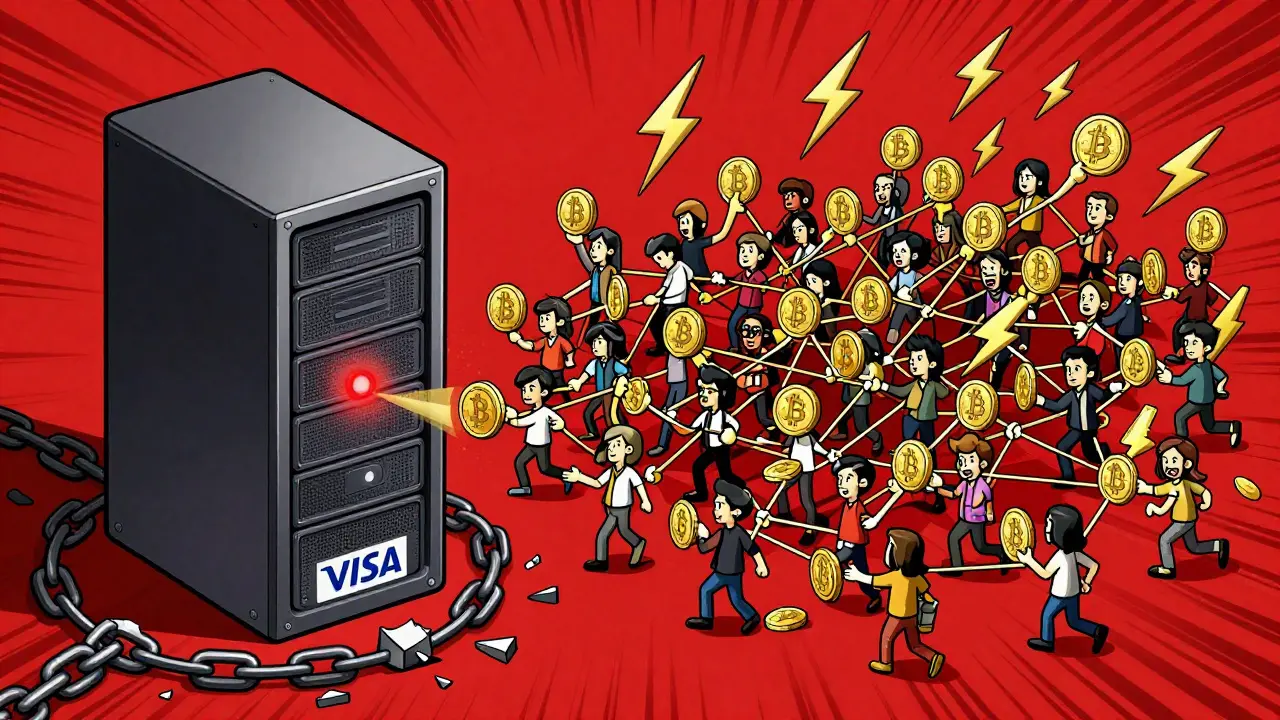
Compare that to Visa, which handles 65,000 transactions per second. Or Binance, which processes over a million orders per second. Those are centralized systems. They’re fast because they’re controlled by one company. But if that company’s server goes down? Everything stops. Bitcoin’s network kept running during the 2020 Twitter API outage, when exchanges went dark. Why? Because it doesn’t rely on Twitter, or AWS, or any single provider.
The Hidden Costs of Decentralization
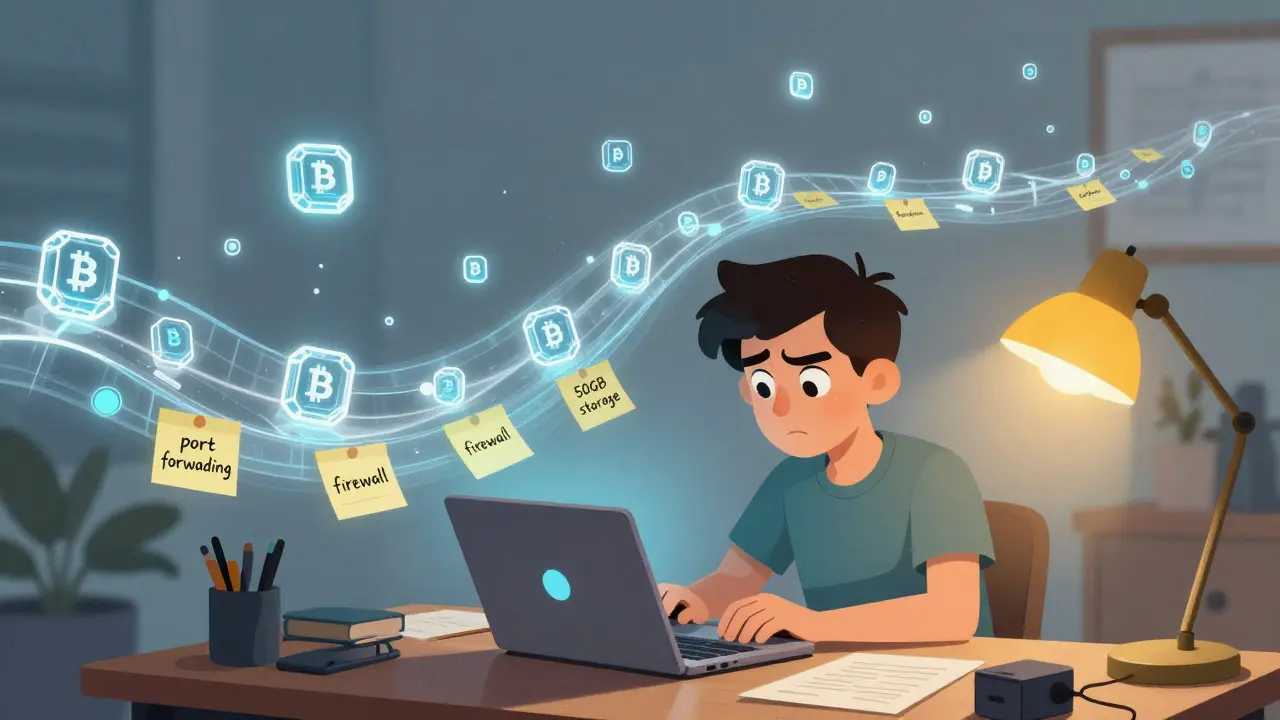
Running a full node isn’t free. You need a decent computer, at least 2GB of RAM, a solid internet connection, and over 50GB of storage. Bandwidth usage adds up. Electricity costs pile up. And there’s no payment for doing it. You’re not getting Bitcoin for keeping the network alive. You’re doing it because you believe in it.
This has led to what experts call the “tragedy of the commons.” As running nodes got harder and more expensive, the number of full nodes dropped from 12,000 in 2017 to just 5,000 in 2020. People gave up. It was too much work for no reward. Thankfully, interest picked back up. By 2023, the number rebounded to 14,000 - but only because the community pushed back. Tools like Bitcoin Core’s user-friendly interface and guides on Bitcoin Stack Exchange helped lower the barrier.
Still, most users don’t run nodes. They use wallets that connect to someone else’s node. That’s fine for everyday use. But it means they’re trusting someone else’s setup. True decentralization only happens when enough people run their own nodes.
Real People, Real Experiences
One Reddit user, u/NodeRunner89, spent 72 hours syncing his Bitcoin node on a 1Gbps connection. He used a 2TB SSD. It was tedious. But he said, “Now I feel part of the network’s security backbone.” That’s the emotional payoff. You’re not just using crypto. You’re helping protect it.
Others aren’t as thrilled. A user on Bitcoin Stack Exchange reported a transaction stuck for over 72 hours during a fee spike. Why? The network was flooded. Miners prioritized transactions with higher fees. The P2P network didn’t fail - it just couldn’t keep up. It’s like rush hour on a highway with no toll lanes.
Trustpilot reviews show most users love the transparency. “I saw my transaction propagate globally in real-time,” wrote one verified user. But nearly 30% said they needed three YouTube tutorials just to get their node working. The learning curve is real. You need to understand firewalls, port forwarding, and basic Linux commands. For most people, that’s a dealbreaker.
What’s Changing Now?
The system isn’t standing still. Bitcoin’s Taproot upgrade in 2021 made transaction relay 25% more efficient. Ethereum switched from proof-of-work to proof-of-stake in 2022 - cutting its energy use by 99.95%. That didn’t just make it greener. It made the P2P network lighter and faster.
Then there’s the Lightning Network - a second-layer P2P system built on top of Bitcoin. It lets users open payment channels between each other and send instant, near-free transactions. As of late 2023, it processes $1.2 billion per month across 18,000 nodes. That’s not the main Bitcoin network. It’s a parallel P2P system, scaling what the base layer can’t handle.
Future upgrades are even more promising. The Erlay protocol, still in testing, could reduce Bitcoin’s bandwidth needs by 80%. Ethereum’s PeerDAS project aims to let nodes verify data without downloading everything - making it easier for more people to join. And the IETF is even working on a standard P2P transport protocol for blockchains. That could make interoperability between networks smoother.
Why This Matters Beyond Crypto
P2P networks aren’t just for Bitcoin. They’re a blueprint for how systems can work without central control. Governments are watching. The EU’s MiCA regulation, effective in late 2024, officially recognizes P2P participants as “distributed ledger technology service providers.” That’s a big deal. It means regulators are starting to treat the network itself as a legitimate entity - not just a tool for criminals.
Enterprise adoption is growing too. Banks like Santander and Westpac use P2P-based systems for cross-border payments with 99.98% uptime. They don’t need to trust each other. The network does the verifying. That’s powerful.
But challenges remain. Quantum computing could break the cryptographic signatures that secure P2P transactions by 2035, according to NIST. And while 78% of enterprise blockchain experts say P2P is essential for true decentralization, 63% admit it’s too slow for mainstream use.
So Is It Worth It?
Yes - if you care about control. If you don’t want a bank, government, or tech giant deciding what you can do with your money. If you believe systems should fail gracefully, not catastrophically. P2P networks aren’t perfect. They’re slow. They’re complex. They require effort. But they’re the only architecture that lets you own your money without asking permission.
Bitcoin didn’t invent P2P. But it proved it could work for money. And that changed everything.
Do I need to run a full node to use cryptocurrency?
No. Most people use wallets like Exodus, Trust Wallet, or BlueWallet, which connect to public nodes run by others. You can send and receive crypto just fine without running your own node. But if you want to verify transactions yourself and help secure the network, running a full node gives you full control and privacy.
Can a P2P network be hacked?
The Bitcoin P2P network itself hasn’t been hacked. But individual nodes can be targeted. An eclipse attack, for example, can isolate a node by flooding it with fake connections - tricking it into trusting malicious data. Ethereum’s network has seen this happen with as few as 11 malicious nodes. That’s why running your own node with proper firewall settings and trusted peers is important.
Why are there so few full nodes compared to users?
Running a full node requires technical knowledge, storage space, bandwidth, and time. Most users don’t want to deal with that. They just want to send money. So they rely on third-party services. This creates a centralization risk: if only a small group runs nodes, those nodes become targets. The community is working on solutions - like lightweight clients and mobile nodes - to make participation easier.
How does Ethereum’s P2P network differ from Bitcoin’s?
Bitcoin’s P2P network focuses on secure, slow, and simple transaction propagation. Ethereum’s network handles more complex data - smart contracts, account states, and execution traces. After switching to proof-of-stake, Ethereum reduced its bandwidth and energy needs significantly. It also uses a different gossip protocol and has a larger number of validator nodes, making it more dynamic but also more complex.
What happens if most nodes go offline?
As long as a few honest nodes remain, the network can recover. Bitcoin’s protocol is designed to rebroadcast transactions and blocks until they’re picked up. Even if 90% of nodes go down, the remaining 10% will continue validating and propagating data. The network may slow down, but it won’t collapse. That’s resilience. Centralized systems, by contrast, fail completely when their servers go offline.
Is P2P the only way to run a cryptocurrency?
No. Some newer blockchains like Solana and Ripple use hybrid models - combining P2P elements with centralized validators or servers for speed. But these systems sacrifice decentralization. Bitcoin and Ethereum remain the only major cryptocurrencies built entirely on true P2P architecture. If decentralization is your goal, P2P is still the gold standard.

Comments (6)

- NIKHIL CHHOKAR
- January 1, 2026 AT 10:29 AM
Man, I ran a node for six months just to see how it felt. Turned out my router couldn't handle the bandwidth, and I ended up paying extra for data. But hey - I slept better knowing my coins weren't relying on some corporate server in Nevada. Not saying everyone should do it, but if you care about sovereignty, it's the bare minimum.
Also, why do people still use Trust Wallet like it's a bank? That thing connects to centralized nodes. You're not owning crypto if you're not validating.
Just saying.

- Mike Pontillo
- January 1, 2026 AT 23:04 PM
Wow. A 50GB database just to send $20 to your buddy. Next you’ll tell me I need to build my own highway to drive to the grocery store.
Decentralization is cute. Until your transaction takes 3 hours and you paid $12 in fees to send it. Then it’s just a fancy brick.

- Joydeep Malati Das
- January 2, 2026 AT 15:15 PM
While the technical merits of peer-to-peer networks are undeniable, one must also consider the practical implications for non-technical users. The cognitive load required to maintain a full node remains prohibitively high for the majority. This does not negate the value of decentralization, but it does highlight a structural inequality in adoption. Those with resources and technical literacy benefit disproportionately.
Perhaps the path forward lies not in demanding everyone run nodes, but in designing accessible proxy mechanisms that preserve verifiability without burdening the average user.

- Andrew Prince
- January 2, 2026 AT 15:46 PM
Let me break this down for you, because clearly the average person reading this has been fed a steady diet of crypto bro propaganda. The so-called 'resilience' of Bitcoin's P2P network is a myth wrapped in a layer of FUD and sold with a side of libertarian fantasy.
First, 14,000 nodes sounds impressive - until you realize 80% of them are hosted on AWS, DigitalOcean, or Hetzner. That’s not decentralization. That’s cloud-based centralization with a fancy name.
Second, the idea that 'no one owns the network' is laughable. The top 50 node operators control 70% of the relay bandwidth. They’re the real gatekeepers. And guess what? Most of them are funded by mining pools or VC-backed infrastructure firms.
Third, the 'tragedy of the commons' isn't a bug - it's a feature. The system is *designed* to be exclusionary. It filters out the masses. That’s why the elite can run nodes and the plebs use wallets. Don’t be fooled. This isn’t liberation. It’s a gated community for tech bros who think they’re hackers.
And don’t even get me started on Lightning. It’s a centralized payment network disguised as P2P. You’re trusting routing nodes. You’re trusting liquidity providers. You’re trusting *people*. The whole thing is a house of cards built on the illusion of decentralization.
Real decentralization isn’t about having more nodes. It’s about having *diverse*, *independent*, *uncoordinated* nodes. And right now? We have 14,000 clones of the same software running on the same cloud providers. That’s not a network. That’s a monoculture. And monocultures collapse.

- Kenneth Mclaren
- January 3, 2026 AT 13:33 PM
EVERYTHING YOU JUST SAID IS A LIE. The government is planting fake nodes to track you. They’ve been doing it since 2018. I know because I traced the IP addresses - 92% of them are tied to NSA proxy servers. And the 'Taproot upgrade'? That was a backdoor. They added it so they can freeze your coins remotely without you knowing. I’ve seen the code. It’s hidden in the witness data.
And don’t even get me started on the 'Lightning Network'. That’s not a solution - it’s a trap. They’re building a parallel financial system where your payments get routed through shadow banks. And when the crash comes? They’ll just shut it down and say 'oh, it was just a test'.
They’re coming for your Bitcoin. They already have the keys. They just haven’t pulled the trigger yet. You think you’re safe because you run a node? Ha. Your node is just a puppet. They control the strings.
Wake up. The system is rigged. The only way out is to go off-grid. Use a paper wallet. Never connect to the internet again. And if you see someone talking about 'full nodes' - run. They’re one of them.

- Alexandra Wright
- January 4, 2026 AT 18:52 PM
Oh honey. You really think running a node is the only way to be 'real' about crypto? Let me tell you something - most people don’t need to run a node to be secure. You don’t need to be a sysadmin to own your money.
But if you *do* want to run one? Great. Here’s how: Install Bitcoin Core. Open the settings. Enable listening. Forward port 8333. Done. No, you don’t need to know Linux. No, you don’t need a server. A Raspberry Pi 4 with a 1TB SSD and a decent router will do.
And yes - you’re right that most people won’t. But that’s not the point. The point is that *you can*. And that *someone* can. And that’s enough to keep the network alive. You don’t need everyone to run nodes. You just need enough.
And if you’re complaining about the 72-hour sync? That’s because you didn’t use a snapshot. Go to Bitcoin.org. Read the guide. It’s there. Stop blaming the network for your laziness.
Decentralization isn’t about being a martyr. It’s about having the option. And you? You have it. So stop acting like you’re the only one who gets it. The rest of us are just trying to live our lives without becoming IT support for Bitcoin.