
When a crypto project raises funds, it’s not uncommon for investors, team members, and advisors to receive large amounts of tokens upfront. But what stops them from selling everything the moment the token list on an exchange? The answer lies in smart contract vesting - a self-executing system that locks tokens and releases them gradually over time. This isn’t just a nice-to-have feature. It’s what keeps projects from crashing under the weight of early dumps.
How Vesting Contracts Actually Work
A smart contract vesting system is a piece of code on a blockchain that holds tokens and releases them based on pre-set rules. Once deployed, it can’t be changed. No one can override it. Not even the project founders. That’s the whole point. Think of it like a digital escrow account. You deposit tokens into it. The contract then follows a schedule: no tokens released for the first 6 months (the cliff), then 1/24th released every month for the next 2 years. All of this happens automatically. No emails. No manual transfers. No human error. The core parameters in most vesting contracts are simple but strict:- Vesting start time: When the lock-up begins (usually measured in Unix timestamp)
- Cliff duration: How long before the first release (e.g., 180 days)
- Total duration: How long the full vesting period lasts (e.g., 2 years = 63,072,000 seconds)
- Unlock period: How often tokens are released (e.g., every 30 days)
- Total amount: The number of tokens locked in the contract
Two Main Ways to Build Vesting
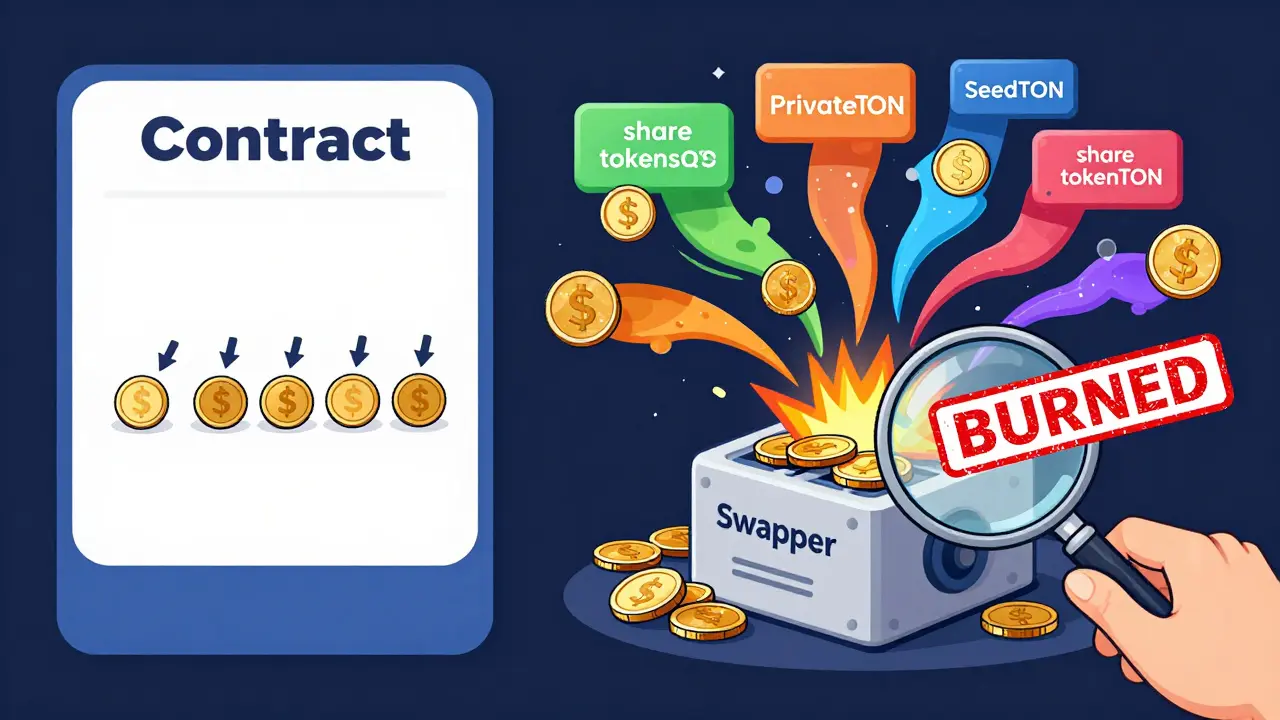
There are two common approaches to implementing vesting on-chain. The first is embedded vesting - where the vesting logic is written directly into the token contract itself. This is common in simpler projects. The token contract knows who owns what, when they can claim it, and how much gets released each time. It’s clean, efficient, and hard to tamper with. The second is separate vesting contracts, used by more complex ecosystems like the TON project. Here, the original token (TON) isn’t directly distributed. Instead, users get "share tokens" like SeedTON, PrivateTON, or StrategicTON. Each of these has its own vesting schedule. Later, a special "Swapper" contract lets users exchange these share tokens for the real TON token - and the share tokens are burned in the process. This adds flexibility: different investor groups can have different release terms without cluttering the main token contract.Why Vesting Matters - For Teams, Investors, and the Market
Vesting isn’t just about fairness. It’s about survival. Without vesting, imagine a team that gets 20% of the total supply at launch. If they cash out immediately, the token price crashes. Buyers who bought in early get burned. Trust evaporates. The project dies. With vesting:- Team members are locked in for 2-4 years, often with a 12-month cliff. This forces them to build the product, not just cash out.
- Seed investors might have a 2-year vesting with a 6-month cliff. They get rewarded for early risk, but can’t flood the market.
- Advisors usually get 1-2 years, with no cliff or a short one. Their contribution is advisory, not operational, so the schedule reflects that.
- Public sale participants often get 6-12 month vesting. Shorter, but still enough to prevent panic selling.
Custom vs. Standard: What’s Right for Your Project?
You can use a pre-built vesting template - like those from OpenZeppelin - or build your own. Pre-built templates are fast and secure. They’ve been tested across hundreds of projects. If your vesting needs are simple - linear release, one cliff, one duration - go with a standard contract. It saves time and money. But if you need something more complex? Maybe tokens unlock based on milestones - "30% after product launch, 20% after 10,000 users" - then you need custom code. Custom contracts give you total control. You can tie vesting to real-world metrics: revenue targets, user growth, partnership milestones. You can even build in DAO voting to adjust schedules later - within limits. But there’s a catch. Custom code = higher risk. A single bug can freeze funds or let someone steal everything. That’s why audits are non-negotiable. Firms like Trail of Bits or ConsenSys Diligence charge $15,000-$50,000 to audit a custom contract. And if you change the code later? You need another audit. That’s not a one-time cost. It’s ongoing.Gas Costs and Network Choices
Every time a token is released, a transaction happens. On Ethereum, that can cost $5-$20 per release. If you’re releasing monthly for 2 years? That’s 24 transactions. $120-$480 in gas - not terrible, but avoidable. Many projects now move vesting to Layer 2 networks like Arbitrum, Optimism, or Polygon. These cut gas costs by 90%. Some even batch releases - releasing all tokens for all users in one transaction instead of 100 separate ones. If you’re launching a new project, don’t default to Ethereum. Consider cheaper chains from day one. The user experience matters. If users can’t claim their tokens because gas is too high, they’ll walk away.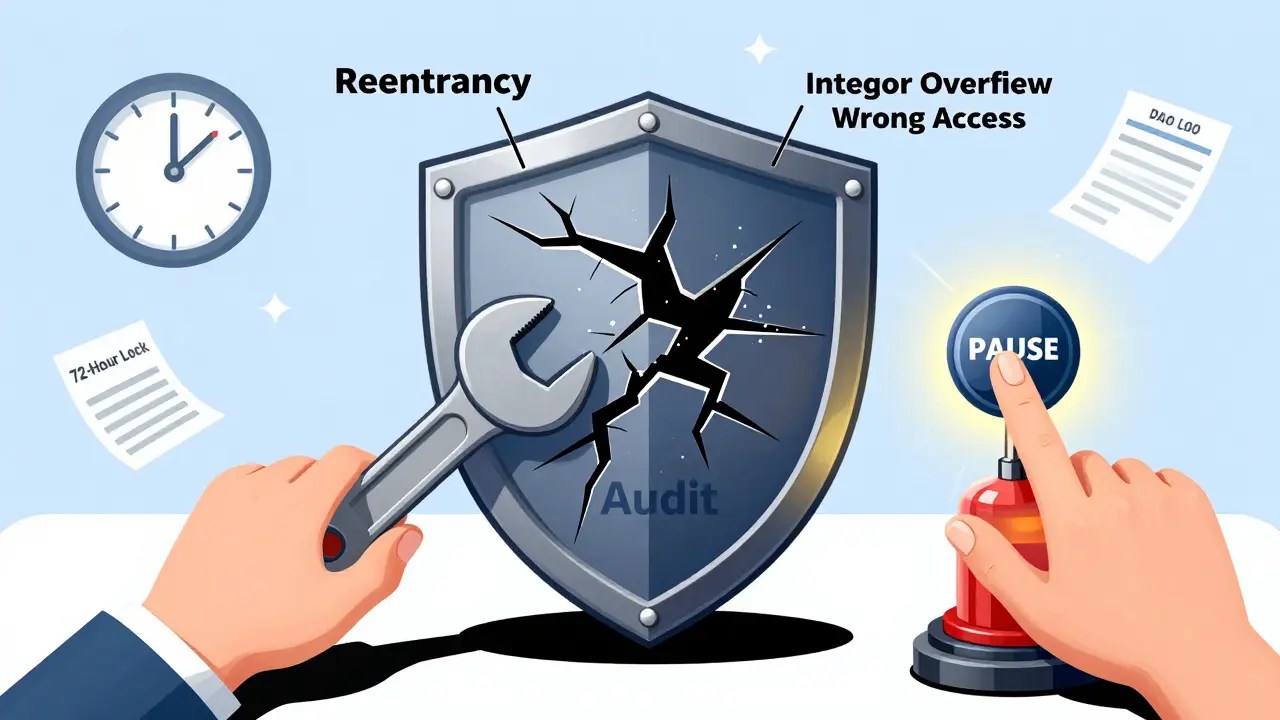
Security Risks You Can’t Ignore
Vesting contracts hold millions - sometimes billions - of dollars. That makes them prime targets. Common attack vectors:- Reentrancy: An attacker calls the contract repeatedly before the first transaction finishes, draining funds.
- Integer overflow: A calculation goes beyond the maximum number, causing the contract to reset to zero.
- Wrong access controls: If anyone can call the release function, your vesting is broken.
- Use multi-sig wallets for contract administration. Require 3 of 5 team members to approve changes.
- Build in an emergency pause - a kill switch that stops all releases if something goes wrong.
- Use time-locked upgrades. Even if you can update the contract, it can’t change for 72 hours. That gives the community time to react.
- Test everything on testnets. Deploy to mainnet only after 3+ rounds of testing.
What’s Next? Trends Shaping Vesting
The future of vesting is moving fast. DAO governance integration is one big shift. Instead of founders deciding vesting rules, token holders vote on changes. But not total freedom - limits are built in. For example: "You can extend vesting by up to 6 months, but not shorten it." This keeps control balanced. Cross-chain vesting is also emerging. Projects now distribute tokens across Ethereum, Solana, and Polygon simultaneously. Each chain has its own vesting contract, synced to the same schedule. It’s complex, but it gives users choice and reduces congestion. And then there’s regulation. The EU’s MiCA law requires investor verification and geographic restrictions. Future vesting contracts may need to check: "Is this user accredited? Are they in a banned jurisdiction?" Compliance is no longer optional.Final Thoughts
Smart contract vesting isn’t magic. It’s math, code, and discipline. Done right, it builds trust. Done wrong, it destroys projects. If you’re launching a crypto project, don’t treat vesting as an afterthought. It’s the backbone of your tokenomics. Use audited templates if you’re small. Build custom if you need flexibility. But always - always - audit before you deploy. The market rewards patience. Vesting makes patience possible.Comments (8)

- John Doyle
- February 13, 2026 AT 15:35 PM
This is exactly why I stopped trusting new crypto projects before. No vesting = guaranteed rug. I’ve seen teams cash out on day one and leave the community in the dust. Smart contracts locking tokens? That’s the bare minimum. If your project doesn’t have this, I’m not even looking at your whitepaper.

- monique mannino
- February 15, 2026 AT 13:01 PM
Love this breakdown 😊 Seriously, vesting isn’t just about fairness-it’s about keeping the whole ecosystem from collapsing. I’ve watched tokens crash because everyone dumped at launch. With vesting, you actually get to see the project grow. It’s the difference between a hype train and a real product.

- Peggi shabaaz
- February 15, 2026 AT 20:12 PM
i mean... it's kinda obvious right? like if you're giving out tokens and not locking them up, you're basically just printing money for yourself. why would anyone invest in that? lol

- Tammy Chew
- February 16, 2026 AT 04:42 AM
The real innovation here isn’t the vesting logic-it’s the cultural shift. We’ve moved from ‘get rich quick’ to ‘build and wait.’ That’s profound. The fact that we now accept delayed gratification in crypto? That’s the real revolution. And yet, most still treat it like a casino. The smart ones? They’re the ones reading this thread right now.

- Lindsey Elliott
- February 18, 2026 AT 04:26 AM
why do we even need this? like, if you're gonna dump anyway, the contract won't stop you. people just find ways around it. also, gas fees on eth for monthly claims? lol no thanks.

- Santosh kumar
- February 20, 2026 AT 01:41 AM
This is so well explained. I’m from India and we’ve seen too many projects vanish overnight. Vesting gives me hope that some teams actually care about long-term value. I hope more projects here adopt this. Not just for investors, but for the whole community.

- Claire Sannen
- February 20, 2026 AT 01:51 AM
I appreciate how you highlighted the difference between embedded and separate vesting contracts. It’s easy to overlook, but the flexibility of using share tokens like SeedTON is genius. It allows for layered incentives without bloating the core token contract. This is the kind of detail that separates amateur projects from professional ones.

- Christopher Wardle
- February 21, 2026 AT 19:49 PM
The philosophical underpinning here is worth noting: vesting enforces temporal discipline. It’s not just financial-it’s behavioral. By delaying access, the system coerces alignment between incentive and outcome. In a world of instant gratification, this is radical. And yet, it’s the only thing that prevents crypto from becoming a Ponzi of infinite recursion.