

When companies ask how much blockchain-as-a-service (BaaS) costs, they’re not just looking for a number. They want to know if it’s worth it. Is the $50,000 upfront fee going to save them $500,000 in fraud? Will that $250/month plan blow up when transaction volume spikes? The truth is, blockchain-as-a-service isn’t a single product with a fixed price. It’s a layered system where costs stack up in ways most people don’t expect.
What You Pay Upfront: Setup and Deployment
The starting price for a basic BaaS project is around $50,000. That’s for a simple proof-of-concept - maybe a supply chain tracker or a document verification tool on a private blockchain. But that number is misleading. It doesn’t include the real work: integrating with your ERP, connecting to legacy databases, or writing smart contracts that actually do something useful. For a full enterprise deployment - think multi-node network, role-based access, audit trails, and compliance layers - costs jump to $500,000 or more. ScienceSoft tracked 42 enterprise BaaS projects in 2024. The median cost was $785,000. One manufacturing client spent $78,500 on a supply chain app that cut fraud by 37% and saved 14 days of reconciliation time. They broke even in eight months. Another fintech startup chose a cheap provider, skipped smart contract audits, and got hacked for $2.3 million. The cleanup cost $185,000.Hourly Rates vs. Monthly Plans: Who’s Cheaper?
There are two main pricing models: hourly consulting and subscription plans. Hourly rates vary wildly. Rapid Innovation charges $30-$60/hour and guarantees deployment in 90 days. Paystand, focused on financial apps, charges $50-$70/hour. Blockstream, which only does Bitcoin-based solutions, starts at $75/hour. These aren’t just labor costs - they include architecture design, security reviews, and compliance checks. On the other end, Kaleido offers a consumption-based model. Start at $250/month for a basic network. Hit 10,000 transactions a day? You’re at $15,000/month. AWS and Microsoft Azure charge based on node usage, storage, and bandwidth - often adding up to $10,000-$30,000/month for mid-sized deployments. Here’s the catch: hourly rates give you control. Monthly plans give you predictability. But if you’re on a monthly plan and your app goes viral? You’ll get a surprise bill.Blockchain Network Choice Changes Everything
The blockchain you pick isn’t just a technical detail - it’s a financial decision. Ethereum’s mainnet? Transaction fees average $1.50-$5.00. That’s fine for a few hundred transactions a day. But if your app processes 100,000 daily payments? You’re paying $150,000-$500,000 a month just in fees. That’s why most enterprises avoid Ethereum mainnet. Instead, they use Layer-2 solutions like Polygon or Arbitrum. Those cut fees by 97-99%. Transactions cost $0.0001-$0.05. Solana, TON, and BNB Chain are even cheaper - $0.0001 to $0.01 per transaction. But here’s the trade-off: cheaper networks often lack smart contract depth. Nano and IOTA have near-zero fees, but you can’t build complex DeFi apps on them. For NFTs or DeFi, Solana and Algorand are the sweet spot: low fees, strong ecosystems. For enterprise supply chains, Ethereum-compatible chains like Polygon offer the best balance of security and cost.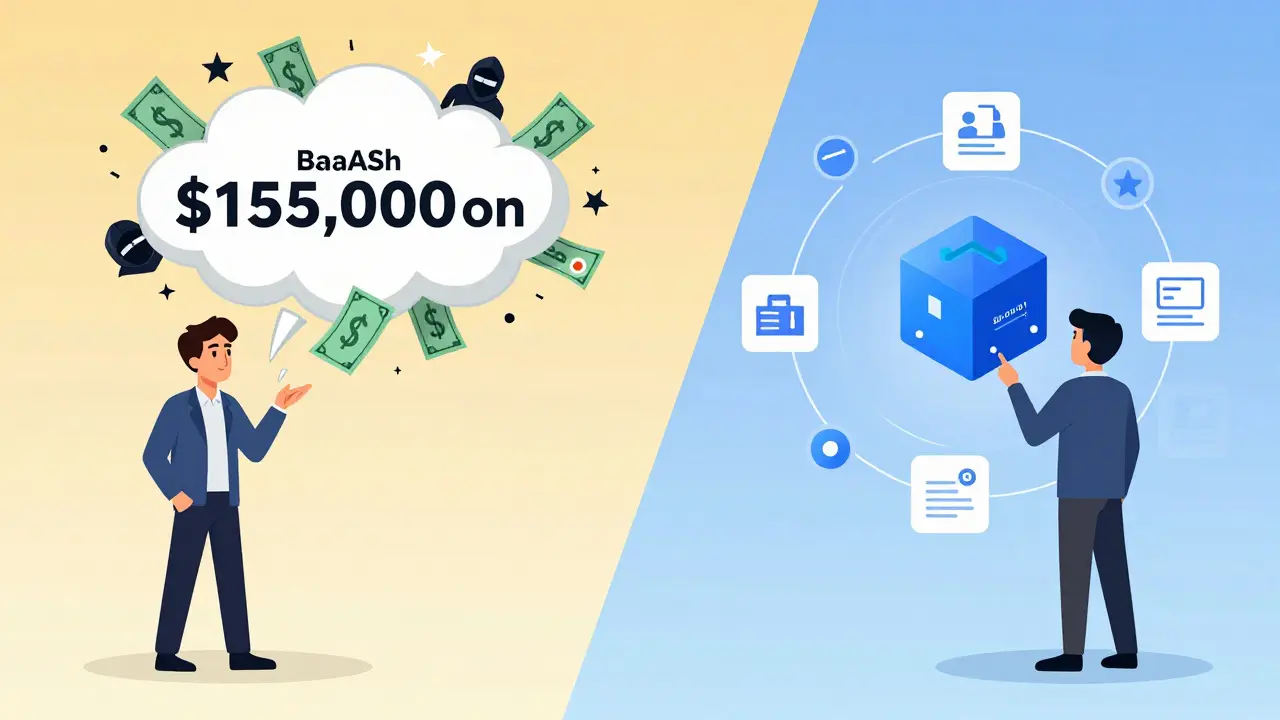
The Hidden Costs Nobody Talks About
Most companies budget for setup. Few budget for what comes after. Maintenance runs 15-20% of the initial cost every year. That’s monitoring, updates, bug fixes, and scaling. A 2025 McKinsey study found 42% of enterprises underestimated this. Transaction fee volatility is another silent killer. Solana fees can spike from $0.0001 to $0.01 during congestion. That’s a 100x jump. If your app depends on low-cost microtransactions, you need a contingency budget of 10-15%. Integration is expensive. Connecting your BaaS platform to SAP, Oracle, or a legacy accounting system adds $3,000-$8,000 per API. Most projects need 3-5 integrations. That’s $15,000-$40,000 right there. Compliance? Add $15,000-$50,000 if you’re operating across borders. The EU’s MiCA regulation adds 12-18 months and 15-25% to costs. Singapore’s sandbox cuts time by 20-30%.Who’s Winning the BaaS Market in 2025?
AWS and Microsoft Azure still dominate, holding 53% of the market between them. But specialized providers are eating into their share. Rapid Innovation leads in cost efficiency, with a 4.7/5 rating on G2 Crowd. Clients love their 90-day guarantee and transparent pricing. Paystand dominates fintech with deep compliance features, though it’s pricier. Kaleido’s subscription model appeals to startups, but enterprise users warn that costs balloon fast. Blockstream sticks to Bitcoin - great if you need Bitcoin’s security, terrible if you need smart contracts. Bloq excels in supply chain use cases. And then there’s the quiet player: ScienceSoft’s team augmentation model. Instead of hiring a full team, you keep your core staff and plug in 2-3 external specialists. That saves 25-35% compared to full in-house development.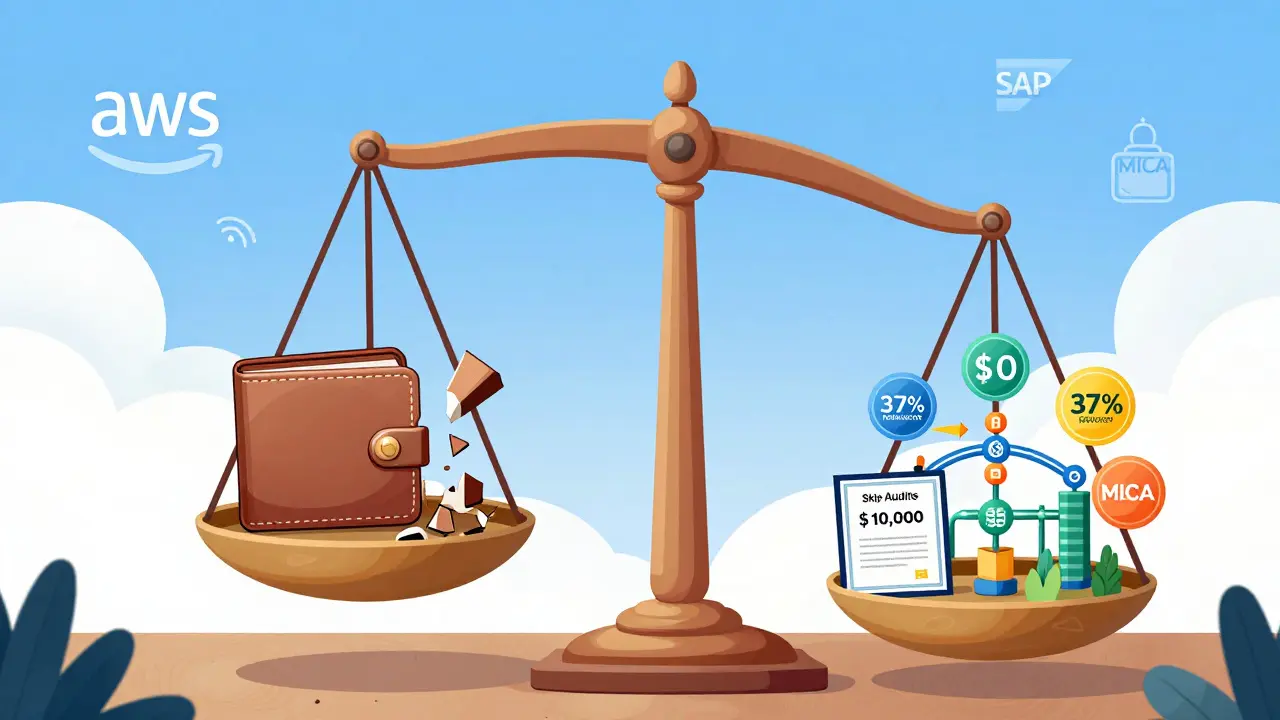
Who Should Skip BaaS?
BaaS isn’t for everyone. If you’re a small business with under 100 daily transactions, stick with a database. Blockchain adds complexity without value. If you don’t have internal staff who understand cloud infrastructure, you’ll be lost. ScienceSoft found that successful BaaS projects require 3-5 internal team members - even if they’re just coordinating with vendors. And if your goal is to “get on blockchain” for marketing buzz? You’re wasting money. The real ROI comes from solving real problems: reducing fraud, cutting reconciliation time, preventing counterfeit goods.What to Do Next
Start small. Build a proof-of-concept with a provider that offers a fixed-price, 90-day guarantee. Rapid Innovation, for example, will build you a working prototype for under $50,000. Choose a blockchain that matches your use case - not your budget. If you need smart contracts, pick Ethereum Layer-2. If you need micropayments, consider Solana or TON. Demand transparency. Ask for a breakdown: setup, monthly fees, transaction costs, integration, compliance. Get it in writing. Plan for maintenance. Budget 20% of your initial cost per year. Don’t wait until your network stops working to realize you forgot this. And never skip smart contract audits. A $10,000 audit is cheaper than a $2 million hack.Comments (5)

- vaibhav pushilkar
- December 27, 2025 AT 05:33 AM
Just ran a BaaS pilot last quarter - $48k upfront, 90-day deploy, cut invoice fraud by 40%. No drama, no surprises. If you're scared of costs, start here: fixed price, real results. Skip the hype, build something that actually works.

- SHEFFIN ANTONY
- December 29, 2025 AT 05:06 AM
Everyone’s acting like blockchain is the next big thing when 90% of these projects are just glorified Excel sheets with a fancy API. You don’t need a ‘multi-node network’ to track shipping crates. You need a damn database and a barcode scanner. The $785k median? That’s not innovation - that’s consulting firms milking Fortune 500 FOMO. Wake up.

- Lloyd Yang
- December 31, 2025 AT 01:39 AM
Let me tell you about the quiet horror of BaaS maintenance - it’s like having a pet dragon that only eats electricity and developer time. You think you’re done after launch? Nope. You’ve got smart contracts rotting in the corner because no one updated them after the Ethereum fork, transaction fees spike because some crypto influencer tweeted about ‘micro-payments,’ and suddenly your $250/month plan turns into a $12k monthly invoice overnight. And don’t get me started on integration hell - connecting to SAP is like trying to marry a 1998 fax machine. I’ve seen teams cry over WSDL files. Budget 20% for maintenance? Yeah, that’s the bare minimum. Realistically? You’re looking at 25-30% if you want to sleep at night. And if you skip audits? Honey, you’re not saving money - you’re just prepaying for a future where your CTO gets fired and your company’s name ends up on a blockchain ransomware leak site. Don’t be that guy.

- Craig Fraser
- January 1, 2026 AT 07:52 AM
It’s mildly concerning how casually people treat blockchain deployment as if it were ordering pizza. The notion that a $50,000 ‘proof-of-concept’ is somehow a responsible starting point for enterprise infrastructure is, frankly, irresponsible. Compliance isn’t an afterthought - it’s the foundation. And yet, here we are, treating sovereign regulatory frameworks like optional add-ons. If your legal team hasn’t reviewed the node jurisdiction before deployment, you’re not innovating - you’re exposing your company to existential risk. The real cost isn’t in the nodes. It’s in the lawsuits.

- Jacob Lawrenson
- January 1, 2026 AT 20:10 PM
YESSSSSS!!!! 💪 Blockchain isn’t magic - it’s muscle. Do the math, pick the right chain, audit like your job depends on it (it does), and boom - you’re cutting costs AND building trust. Stop overcomplicating it. Start small. Win fast. 🚀 #BaaSWithPurpose