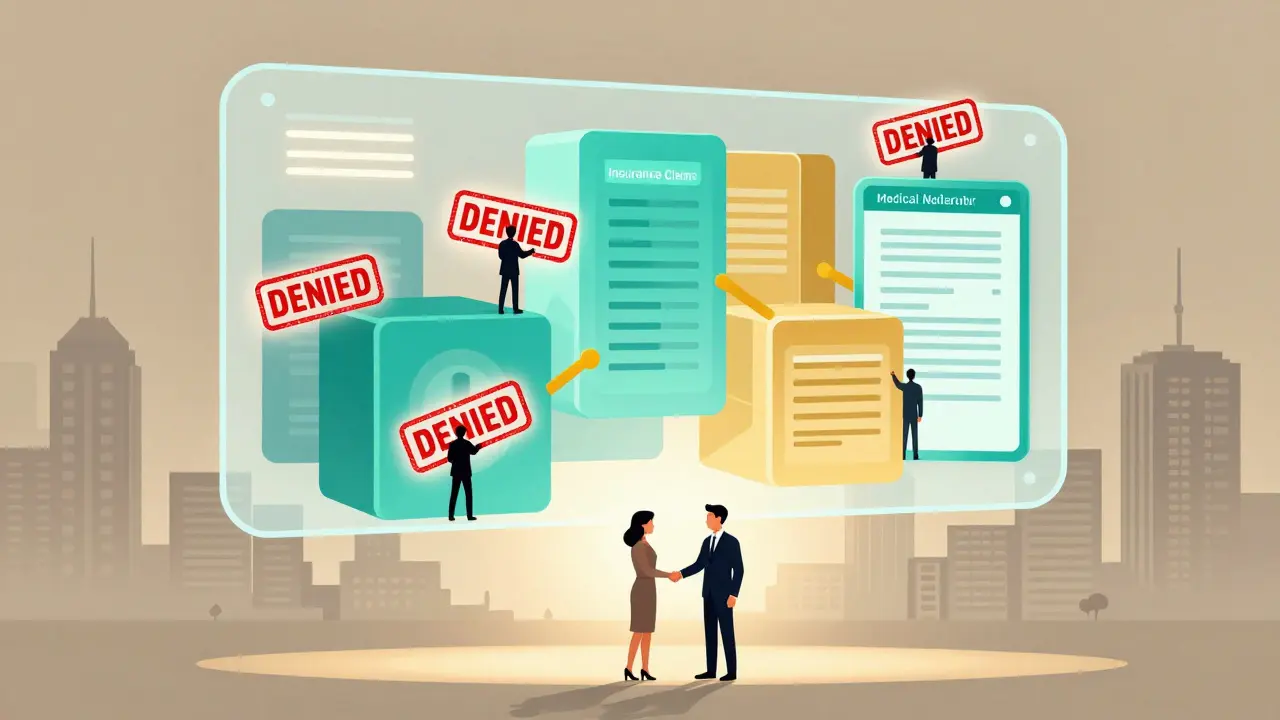

Insurance fraud costs the industry over $55 billion a year in the U.S. alone. Much of it happens because claims data is locked in separate systems, making it easy for fraudsters to file the same claim with multiple insurers or fake medical records. Blockchain changes that by creating a single, unchangeable record everyone can see-but only if it’s done right.
Traditional fraud detection relies on manual reviews, isolated databases, and rules-based software that misses complex patterns. Insurers can’t easily check if a claimant filed a similar injury claim with another company last month. That’s where blockchain steps in. It’s not magic. It’s a shared digital ledger that records every transaction-policy purchases, claims submissions, doctor visits, payments-in a way that can’t be altered after it’s confirmed. Once data is on the chain, it stays there. No backdating. No deleting. No hiding.
Companies like AXA and Ping An have already cut claim processing times from weeks to days by using blockchain to verify data in real time. In AXA’s pilot for flight delay insurance, payouts triggered automatically when flight data from trusted sources matched the policy terms. No paperwork. No delays. No room for fraudsters to slip through. That’s the power of smart contracts-self-executing code that only pays out when conditions are met.
How Blockchain Stops Common Insurance Fraud Types
There are three big fraud problems blockchain solves better than anything else: duplicate claims, fake identities, and altered records.
- Duplicate claims: A person files a car accident claim with two different insurers. In traditional systems, those companies don’t talk to each other. On a blockchain, every claim is recorded with a unique hash tied to the policyholder’s verified identity. If a second claim comes in with the same accident details, the system flags it immediately. A 2021 Swiss Re pilot showed duplicate submissions dropped by 68% using this method.
- Fake identities: Fraudsters use stolen Social Security numbers or fake medical histories to get life or health insurance payouts. Blockchain-based KYC (Know Your Customer) systems store verified identity data-like government-issued IDs and biometrics-on a secure, encrypted ledger. Only authorized parties can access it, and every access is logged. Estonia’s national health system reduced healthcare fraud by 22% between 2020 and 2023 by linking patient records to a blockchain-based identity system.
- Altered records: Someone changes a medical report to justify a higher payout. On a blockchain, once a doctor uploads a diagnosis, it’s hashed and locked. Any attempt to edit it creates a new entry, not a replacement. Auditors can trace every version. No more tampered X-rays or forged prescriptions.
These aren’t theoretical. B3i, a consortium of 40+ global insurers, cut marine cargo fraud by 42% in 2023 by sharing shipment data on a blockchain. Shippers, insurers, and customs all added verified data points. If a claim said the cargo was damaged at sea, but the GPS logs showed it never left port, the claim got rejected before a human even looked at it.
What Blockchain Can’t Do (And What It Needs Help With)
Blockchain isn’t a cure-all. It’s only as good as the data you put into it. If a fraudulent doctor submits fake medical records, the blockchain will record them faithfully-because it doesn’t know they’re fake. That’s the "garbage in, garbage out" problem.
This is where AI comes in. Leading insurers are now combining blockchain with machine learning. Blockchain ensures data integrity. AI finds patterns: a patient who files 12 back pain claims in 18 months, all from different clinics, all paid by different insurers. That’s something a blockchain alone won’t catch. A 2023 IEEE study found AI alone detects complex fraud with 92% accuracy. Blockchain-integrated systems? Around 85%. Together? They’re closing the gap.
Another limitation is speed. Blockchains like Hyperledger Fabric can handle 1,000-1,500 transactions per second. Traditional databases handle 50,000+. During peak claim seasons-like after a hurricane-blockchain networks can slow down. That’s why most companies don’t use it for every claim. They use it for high-risk cases: large health claims, duplicate auto claims, or parametric policies tied to weather or flight data.
Privacy is another hurdle. Medical records are sensitive. Storing them on a public ledger isn’t an option. That’s why most insurance blockchains are permissioned-only approved parties can join. Even then, new tools like zero-knowledge proofs (ZKPs) are being tested. ZKPs let you prove something is true without showing the data. For example: "This patient has a valid diagnosis of diabetes," without revealing the doctor’s notes or test results. Singapore’s central bank ran a successful ZKP pilot in early 2024.

Who’s Using Blockchain for Insurance Fraud Prevention Right Now?
Adoption is growing fast. As of mid-2024, 27% of major global insurers have live blockchain projects for fraud prevention, according to Deloitte. But it’s not random. The leaders are in specific areas:
- Healthcare insurance (38% of all implementations): Hospitals, insurers, and pharmacies share verified patient histories. Prevents phantom billing and duplicate prescriptions.
- Property and casualty (29%): Real-time verification of damage reports, repair invoices, and claims history across insurers. Reduces staged accidents and inflated repair costs.
- Life insurance (22%): Death certificates are uploaded directly to the blockchain by government agencies. Payouts trigger automatically when verified, cutting processing from 30 days to under 72 hours.
Some success stories stand out. A mid-sized U.S. life insurer cut payout delays by 90% by integrating with a state-issued digital death certificate system on blockchain. In Estonia, the national health system reduced fraud by 22% in just three years. B3i’s marine cargo platform saved insurers millions by exposing fake damage claims.
But not every pilot worked. One major U.S. auto insurer abandoned its blockchain project after 18 months because it couldn’t scale beyond 5% of total claims. Why? Legacy systems didn’t talk to it. Staff didn’t understand it. Data formats didn’t match. The tech worked-but the people and processes didn’t.
What It Takes to Implement Blockchain in Insurance
Most companies don’t flip a switch. They start small. Here’s how successful ones do it:
- Start with one use case: Don’t try to digitize all claims. Pick something clear-cut: parametric insurance (like flight delay or crop failure), or verifying death certificates. These have objective triggers-no room for interpretation.
- Join a consortium: Building a blockchain alone is expensive. B3i has over 1,200 members sharing development costs. Smaller insurers often join these groups instead of building their own.
- Fix data first: 63% of insurers say incompatible data formats are their biggest hurdle. Clean up your internal records before connecting to a shared ledger.
- Train your team: 68% of employees need 3-4 months of training to use blockchain tools. IT staff need to understand smart contracts. Claims adjusters need to know how to read blockchain logs.
- Integrate with AI: Use blockchain to lock data. Use AI to find anomalies. Together, they’re stronger than either alone.
Deployment takes 8-14 months on average. Costs vary, but hiring a blockchain developer in the U.S. now runs $130,000-$180,000 a year. That’s not cheap. But the payoff? McKinsey estimates blockchain cuts insurance operating costs by 30% industry-wide. For a company handling $2 billion in claims annually, that’s $600 million saved.

The Future: Tokenized Policies and Peer-to-Peer Insurance
The next wave isn’t just about stopping fraud. It’s about changing how insurance works.
Tokenization is starting. Instead of a paper policy, you own a digital token on a blockchain that represents your coverage. Want to sell your policy? Transfer the token. Want to split coverage with a roommate? Split the token. Twelve pilot programs are testing this in 2024.
Peer-to-peer (P2P) insurance is another trend. Groups of people pool money to cover each other’s claims. Smart contracts automatically distribute funds when a claim is verified on the blockchain. No corporate middleman. Lower overhead. Higher trust. This model works best for niche groups-like freelance drivers or small farmers-and blockchain makes it secure and transparent.
By 2027, the global blockchain insurance market is projected to hit $1.84 billion. That’s up from $287 million in 2023. The Coalition Against Insurance Fraud estimates blockchain could stop $8.2 billion in U.S. fraud annually by then.
But adoption won’t be smooth. Forty-seven different regulatory rules exist across U.S. states and EU countries. GDPR says you can delete data. Blockchain says you can’t. That conflict isn’t solved yet. Interoperability between different blockchain networks is still messy. One insurer’s chain doesn’t talk to another’s.
Still, the direction is clear. As Deloitte puts it, blockchain will become "table stakes" for major insurers in fraud prevention within five to seven years. The question isn’t whether you’ll use it. It’s whether you’ll be early or late.
Frequently Asked Questions
How does blockchain prevent duplicate insurance claims?
Blockchain creates a single, shared record of all claims submitted across participating insurers. Each claim is tied to a unique policyholder ID and hashed to create a digital fingerprint. If a second claim is filed with the same accident details, date, or medical records, the system instantly flags it as a duplicate. This stopped 68% of duplicate claims in a Swiss Re pilot and is now standard in marine and auto insurance consortia like B3i.
Can blockchain stop all types of insurance fraud?
No. Blockchain stops fraud tied to data manipulation-like fake records or duplicate claims-but it can’t detect fraud that starts with false information. If someone lies about their health history to get life insurance, blockchain will record that lie unless AI or human review catches it first. It’s best at verifying what’s already known, not uncovering hidden deception.
Is blockchain more secure than traditional databases?
Yes, for integrity. Traditional databases can be hacked or altered silently. Blockchain records are cryptographically chained and require consensus from multiple parties to change. Once added, they’re nearly impossible to tamper with. However, the network’s security depends on who controls the nodes. Permissioned blockchains used in insurance are more secure than public ones, but still rely on trusted participants.
Why aren’t all insurers using blockchain yet?
Integration with legacy systems is complex and expensive. Many insurers still run on 20-year-old software that doesn’t connect to blockchain platforms. Training staff, navigating unclear regulations, and concerns about data privacy slow adoption. Smaller companies often wait to join industry consortia like B3i to share costs and reduce risk.
What’s the difference between blockchain and AI in fraud detection?
Blockchain ensures data is accurate and unchangeable. AI finds patterns and anomalies in that data. Think of blockchain as the secure filing cabinet and AI as the detective. One keeps the records safe. The other spots the suspicious behavior. Leading insurers now combine both: blockchain for verification, AI for prediction. Together, they’re far more effective than either alone.
Does blockchain violate privacy laws like GDPR?
It can, because GDPR allows people to request data deletion, but blockchain records are permanent. To comply, insurers use permissioned networks and zero-knowledge proofs (ZKPs). ZKPs let you prove something is true-like "this person is eligible for a payout"-without revealing the underlying data. Singapore’s 2024 pilot used this method to stay compliant while maintaining verification.
What Comes Next?
If you’re in insurance, the choice isn’t whether to use blockchain-it’s how soon you’ll start. The technology isn’t perfect, but the cost of doing nothing is rising. Fraudsters are getting smarter. Regulators are watching. Customers expect faster, fairer claims.
Start small. Pick one high-friction, high-fraud area. Use a consortium. Integrate with AI. Train your team. Don’t try to boil the ocean. The goal isn’t to replace every system. It’s to stop the fraud that slips through the cracks.
The future of insurance isn’t just about paying claims. It’s about proving you’re trustworthy. Blockchain doesn’t just prevent fraud. It rebuilds trust-one unchangeable record at a time.
Comments (6)

- Deepu Verma
- January 26, 2026 AT 00:32 AM
This is actually one of the most realistic takes on blockchain in insurance I've seen. No hype, just facts. I work in claims at a mid-sized firm and we're testing a pilot with a consortium like B3i. The difference in duplicate claim flags? Night and day. People still try, but now they get caught before lunch.
Biggest win? Our adjusters have more time to talk to real customers instead of chasing paper trails. That’s the real win.

- Abdulahi Oluwasegun Fagbayi
- January 27, 2026 AT 08:05 AM
Blockchain doesn't solve fraud it just makes it harder to hide. The real issue is people still lie about their health or invent accidents. The ledger records the lie just as faithfully as the truth. You can't automate trust. You can only automate verification.

- Margaret Roberts
- January 28, 2026 AT 15:12 PM
Let’s be real. This is just another corporate buzzword wrapped in crypto jargon. Who’s really controlling these "permissioned" blockchains? Big insurers. Big tech. Big banks. You think a decentralized system stops fraud? Nah. It just makes it look fancy while they still control the keys. And don’t get me started on zero-knowledge proofs-sounds like magic because it’s designed to hide what they don’t want you to see.

- Tselane Sebatane
- January 28, 2026 AT 23:56 PM
I’ve been in this industry for 18 years and I’ve seen every "revolution" come and go. Mainframe. ERP. Cloud. Now blockchain. But here’s the thing-this one might actually stick. Why? Because it’s not about tech. It’s about accountability. When every claim, every doctor note, every payment is traceable, people start behaving differently. Not because they’re scared of punishment. Because they know someone’s watching. And that changes everything.
My cousin filed a claim after a fender-bender last year. She didn’t even try to inflate it. Said, "Why risk it? They’ll know." That’s the quiet power of this. No one’s yelling. No one’s protesting. They just… stop lying. And that’s worth more than any algorithm.

- Jen Allanson
- January 30, 2026 AT 12:14 PM
While the technological framework described is commendable, one must not overlook the profound legal and ethical implications inherent in the immutability of blockchain records. The General Data Protection Regulation (GDPR) explicitly grants individuals the right to erasure, a principle fundamentally incompatible with the append-only nature of distributed ledgers. Until this dichotomy is resolved through legally recognized cryptographic obfuscation or regulatory exemption, widespread adoption remains legally precarious, particularly within the European Union.

- Darrell Cole
- January 31, 2026 AT 15:25 PM
You all are missing the point. Blockchain is slow, expensive, and overkill. The real fraud is in the claims adjusters who get paid to rubber-stamp claims. AI can catch patterns better than a ledger. And guess what? Most insurers already have that. Why add a whole new system that takes months to deploy and costs six figures just to replace a spreadsheet? This isn’t innovation. It’s a consultant’s dream. The only thing being "rebuilt" is their billable hours.
Post-Comment
Categories
Popular Articles