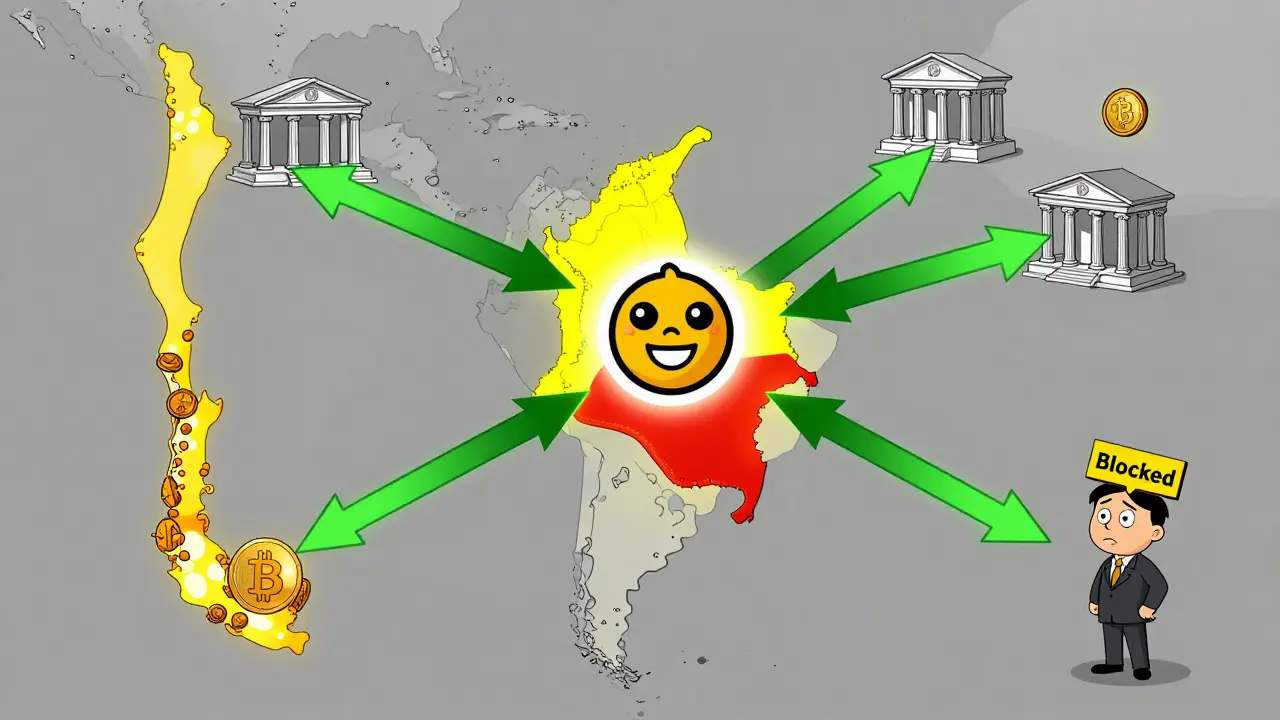

When you live in Chile, Colombia, Peru, or Argentina and want to buy Bitcoin without jumping through international banking hoops, Buda isn’t just an option - it’s often the only practical one. Launched in 2015 as SurBTC and rebranded to Buda in 2020, this exchange was built from the ground up for South America. It doesn’t try to be everything to everyone. It doesn’t offer 500 coins like Binance or staking like Coinbase. Instead, it does one thing extremely well: lets you trade crypto directly in your local currency - CLP, COP, PEN, or ARS - with real bank connections you can actually use.
What You Can Trade on Buda
Buda keeps it simple. You get six cryptocurrencies: Bitcoin (BTC), Ethereum (ETH), Litecoin (LTC), Bitcoin Cash (BCH), USDC, and Tether (USDT). That’s it. No Solana, no Dogecoin, no Shiba Inu. No meme coins. No obscure altcoins. Just the big four plus two stablecoins. Why? Because these are the coins people in Latin America actually trade. If you’re buying Bitcoin to hedge against inflation in Argentina or send money across borders in Colombia, you don’t need 200 options. You need reliability.
That simplicity extends to trading pairs. You can trade BTC/CLP, ETH/COP, LTC/PEN, and so on - 20 total pairs across the four local currencies. This is huge. On global exchanges, you’d have to convert your pesos to USD first, pay conversion fees, then buy crypto. Buda cuts out the middleman. Deposit 500,000 COP directly from your Colombian bank account. Buy ETH. Done. No foreign wire, no intermediary bank, no surprise fees.
Fees: High for Small Traders, Low for Heavy Ones
Trading fees start at 0.3% per trade. That’s higher than Binance’s 0.1% or Kraken’s 0.16%. But here’s the catch: Buda drops fees the more you trade. If you hit 100 BTC in monthly volume, your fee falls to 0.2%. And if you refer others? You earn 20% of their trading fees - a program that’s quietly helped thousands of users in Chile earn $15-$20 extra per month. One user on Reddit said he made enough from three friends to cover his phone bill for a year.
Withdrawal fees are transparent and low. For Bitcoin, it’s 0.00011 BTC. For Ethereum, it’s 0.00053418 ETH (normal) or 0.0006944 ETH (priority). USDC withdrawals cost 1.38 USDC normally. Compare that to global exchanges that charge fixed USD fees - Buda’s rates are tied to blockchain costs, not arbitrary markups. Deposits via bank transfer are free in most cases. Credit card deposits? Those cost up to 3%, but that’s still cheaper than using PayPal or Wise to move money into Binance.
Security: Cold Storage, Chainalysis, and No Insurance
Buda stores 90% of user funds in offline cold wallets. That’s the same level as Coinbase, which stores 98%. It’s not perfect, but it’s industry-standard. The platform uses Chainalysis to monitor suspicious transactions - a serious move that shows they’re serious about compliance. They also use Dynamic Key authentication, which adds a second layer of login security beyond passwords.
But here’s the trade-off: Buda doesn’t have insurance. Coinbase insures up to $255 million in digital assets. Buda? Nothing. If a hack happens, your money is at risk. No safety net. That’s a real concern, especially since the exchange shut down its bug bounty program in 2023. Before that, researchers could earn up to $5,000 for finding flaws. Now, there’s no public way to report vulnerabilities. That’s a red flag for advanced users.
Who Can Use Buda? (Spoiler: Not You If You’re Outside Latin America)
Buda only works in four countries: Chile, Colombia, Peru, and Argentina. If you’re in Mexico, Brazil, or the U.S., you can’t sign up. No VPN trick works. The platform blocks non-local IPs and requires local ID. This isn’t a bug - it’s intentional. Buda partners directly with banks in these countries. Transbank in Chile. Davivienda in Colombia. These aren’t global banks - they’re local institutions that only operate in South America. Buda built its entire system around them.
That’s why it dominates. In Chile, Buda controls 65% of the crypto exchange market. In Colombia, it’s 45%. In Peru, 30%. Those aren’t guesses - they’re Statista numbers from Q2 2025. Global exchanges like Binance are trying to enter, but they still rely on USD-based deposits. Buda lets you deposit in pesos. That’s the difference between a car that runs on gas and one that runs on diesel - same function, different fuel.
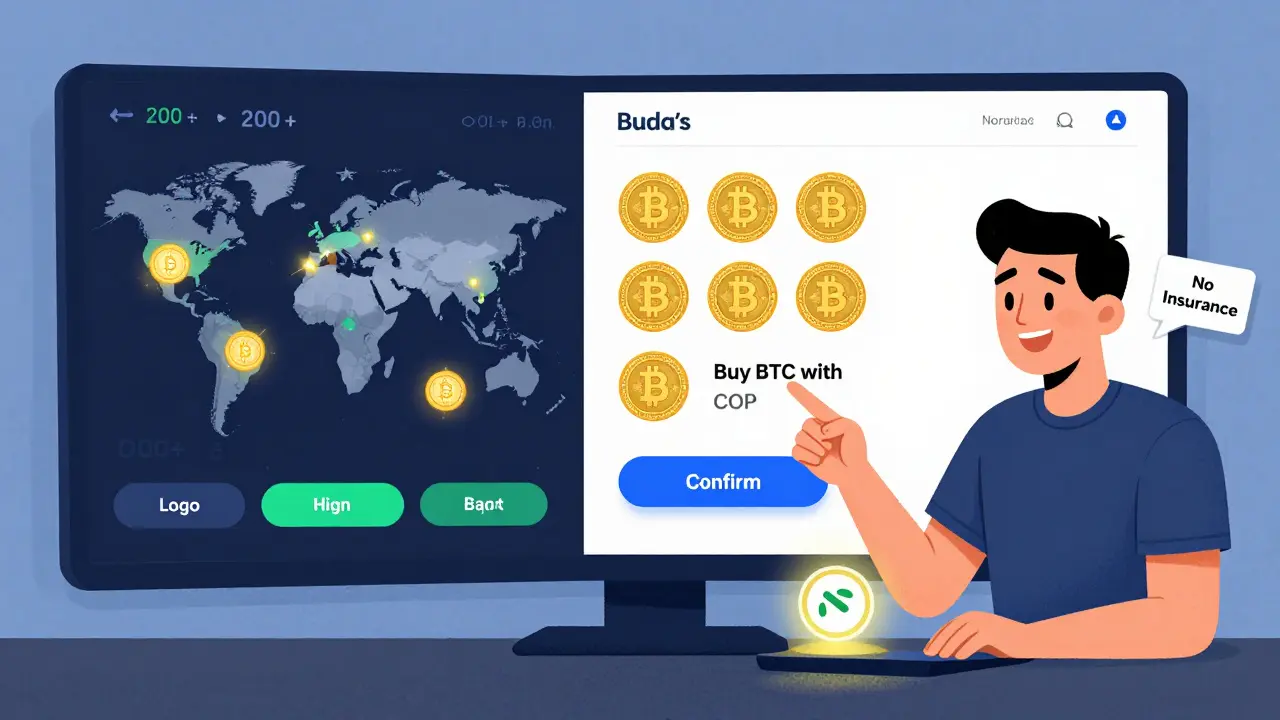
Mobile App and Trading Interface
The web interface is built on TradingView - the same platform professional traders use. That means advanced charting, technical indicators, drawing tools, and real-time data. It’s powerful. But it’s also overwhelming if you’ve never traded before. There’s no beginner mode. No tutorial. No demo account. You’re thrown into the deep end.
The mobile apps (iOS and Android) are clean, fast, and stable. You can buy crypto in two taps, check your balance, or set price alerts. The UI is in Spanish only. No English toggle. That’s fine if you’re a native speaker. If you’re not? You’re stuck using Google Translate. One user from Peru said it took him five trades to figure out how to place a limit order. Another from Chile said, “I didn’t know what ‘market’ meant until I lost $80 on my first try.”
KYC: Slow, Strict, and Required
You can’t trade without full KYC. That means:
- Email verification
- Government ID (passport or national ID)
- Proof of address (utility bill or bank statement)
- Biometric selfie (face scan)
This process takes 24 to 72 hours. No rush option. No live chat support. You submit, wait, and hope. Once approved, your monthly trading limit is $10,000. That’s enough for most retail users but too low for serious investors. If you need more, you’re out of luck - Buda doesn’t offer higher tiers.
Customer Support: Spanish-Only and Slow
Support is only available in Spanish. No English, no Portuguese. Email responses take 12-24 hours on weekdays. Phone support exists in Chile, but only for urgent issues. If you’re in Argentina and your withdrawal gets stuck? You’re on your own. Users report delays during market crashes - one person said their COP withdrawal took 48 hours during a peso spike. That’s not normal, but it’s happened.
There’s no 24/7 chat. No ticket system. No knowledge base. The only help comes from community forums - YouTube videos in Spanish with over 50,000 views, Reddit threads, and Discord groups. If you don’t speak Spanish, you’re essentially locked out of support.

What Buda Doesn’t Offer
Let’s be clear: Buda is not for everyone.
- No margin trading
- No futures or leverage
- No staking rewards
- No copy trading
- No NFT marketplace
- No API access for bots
If you’re an advanced trader looking to go long on ETH with 5x leverage, Buda is useless. If you want to earn interest on your USDC, look elsewhere. This isn’t a full-service exchange. It’s a local gateway. Think of it like a gas station that only sells fuel - no snacks, no restrooms, no car wash. You go there for one thing, and it does it well.
Who Should Use Buda?
You should use Buda if:
- You live in Chile, Colombia, Peru, or Argentina
- You want to buy crypto with your local bank account
- You don’t need 100 coins - just Bitcoin and Ethereum
- You value security over flashy features
- You’re okay with a learning curve and no English support
You should NOT use Buda if:
- You’re outside Latin America
- You want to trade altcoins or use leverage
- You need insurance on your funds
- You expect 24/7 customer support in English
The Verdict
Buda isn’t trying to beat Binance. It’s trying to beat the banking system. And in its corner of the world, it’s winning. For South Americans who’ve been shut out of global finance for decades, Buda is a lifeline. It’s fast, secure, and built for real people with real pesos and soles. The fees are high for small traders, the interface is tough for beginners, and the lack of insurance is risky. But if you’re in the right region, there’s no better option.
It’s not perfect. But it’s real. And in crypto, that’s rare.
Can I use Buda if I’m not in Chile, Colombia, Peru, or Argentina?
No. Buda only accepts users from Chile, Colombia, Peru, and Argentina. The platform blocks sign-ups from other countries and requires local government ID and proof of address. Even using a VPN won’t work - the system detects your real location through banking connections and IP routing.
Does Buda offer staking or earn interest on crypto?
No. Buda only offers spot trading. You can buy and sell Bitcoin, Ethereum, and other supported coins, but you cannot stake them to earn rewards. There are no savings accounts, yield programs, or interest-bearing products. If you want to earn passive income from crypto, you’ll need to use another platform like Coinbase or Kraken.
How long does KYC take on Buda?
KYC verification usually takes 24 to 72 hours. You need to submit your government ID, proof of address, and complete a biometric selfie. There’s no expedited option. If your documents are clear and match your identity, you’ll get approved within a day. If there’s a mismatch or blurry image, you’ll be asked to resubmit - which adds more time.
Is Buda safer than Binance or Coinbase?
Buda stores 90% of funds in cold wallets, which matches industry standards. But unlike Coinbase, which insures $255 million in assets, Buda offers no insurance. That’s a major risk. Binance has better global security infrastructure and a bug bounty program. Buda’s security is solid for its size, but it’s not as robust as the top global exchanges. If you’re storing large amounts, consider moving most of it to a hardware wallet.
Can I trade with USD on Buda?
Not directly. You can’t deposit USD or trade against USD pairs. But you can trade against USDC and USDT - two stablecoins pegged to the U.S. dollar. So if you want exposure to USD, you can buy USDT with your local currency and then trade it against BTC or ETH. It’s not the same as having USD as a base currency, but it’s the closest option Buda offers.
Does Buda have a demo account?
No. Buda has no paper trading or demo account. You have to use real money to learn. The interface is based on TradingView, which is powerful but complex. Beginners are expected to figure it out on their own or use third-party YouTube tutorials in Spanish. There’s no built-in guide or walkthrough.
What cryptocurrencies does Buda support?
Buda supports six cryptocurrencies: Bitcoin (BTC), Ethereum (ETH), Litecoin (LTC), Bitcoin Cash (BCH), USDC, and Tether (USDT). These are the only assets available for trading. No other coins - including Solana, Cardano, or Dogecoin - are listed. The platform focuses on liquidity and stability, not variety.
Comments (5)

- Fiona Monroe
- February 22, 2026 AT 11:05 AM
Buda's operational model represents a paradigmatic case study in regionalized fintech infrastructure. The exchange's decision to forego global scalability in favor of deep local banking integration is not a limitation-it is a strategic masterstroke. By anchoring itself within the regulatory and financial ecosystems of Chile, Colombia, Peru, and Argentina, Buda eliminates the friction inherent in cross-border fiat-crypto arbitrage. This is not merely convenience; it is structural sovereignty for users historically excluded from global capital markets. The absence of staking, leverage, or altcoin listings is not a deficiency-it is a deliberate prioritization of utility over spectacle. The 0.3% fee structure, while initially uncompetitive, functions as a dynamic pricing mechanism that rewards volume and network effects. The lack of insurance is a non-trivial risk, yes, but it is transparently disclosed, unlike the obfuscated liability models of many 'trusted' global platforms. This is fintech with integrity.

- Molley Spencer
- February 22, 2026 AT 13:02 PM
Let’s be real-Buda’s 6-coin limit is laughable. You’re telling me in 2025 someone’s still trading BTC/CLP without SOL or ADA? That’s like using a flip phone in Silicon Valley. And ‘reliability’? Please. The fact they shut down their bug bounty program is a red flag bigger than their withdrawal fees. No API? No staking? No futures? This isn’t a crypto exchange-it’s a glorified fiat on-ramp with a TradingView skin. And the ‘Spanish-only’ interface? That’s not localization, that’s exclusionary design. If you’re not fluent in Castilian, you’re not a user-you’re a footnote. Binance and Coinbase are playing 4D chess while Buda’s still stuck in checkers with a 2018 UI.

- John Fuller
- February 23, 2026 AT 08:42 AM
No staking. No leverage. No USD. Just BTC and ETH. That’s it. Done.

- maya keta
- February 24, 2026 AT 22:47 PM
OMG I LOVE BUDA SO MUCH. Like, seriously. I’m from Peru and I’ve tried EVERYTHING-Binance, Kraken, Coinbase-and nothing compares to just depositing soles directly. No more 5% fees from Wise. No more ‘we can’t verify your address’ nonsense. And the mobile app? So smooth. I didn’t even know what a limit order was until I watched a YouTube vid in Spanish and BOOM-made my first trade. Yeah, no insurance? Big deal. My money’s in cold storage. And if you’re mad about no Dogecoin? Bro. You’re not the target audience. Buda’s for people who actually need it. Not for crypto bros who want 500 coins to meme-trade. Also-20% referral fees? I paid for my vacation with that. #BudaLife

- Curtis Dunnett-Jones
- February 26, 2026 AT 19:19 PM
The structural brilliance of Buda cannot be overstated. It does not seek to compete on scale-it seeks to compete on relevance. In regions where banking infrastructure is fragmented and currency volatility is endemic, Buda provides a critical anchor: direct, low-friction, local-currency on-ramps. The absence of staking or leverage is not a failure of ambition-it is an acknowledgment of the primary need: stable, accessible, and immediate liquidity. The fee structure incentivizes volume and community growth, not speculative arbitrage. While the lack of insurance is a legitimate concern, it is mitigated by rigorous cold storage, Chainalysis compliance, and the absence of speculative asset listing-a deliberate curtailment of risk exposure. The language barrier is not exclusionary; it is contextual. The platform speaks the language of its users-not the language of global marketing decks. This is not a product designed for the Silicon Valley elite. It is a public utility for a region long ignored by the financial establishment. Buda doesn’t just serve its market-it redefines what a crypto exchange can be when it is rooted in real economic necessity rather than abstract innovation.