

Cross-Chain Bridge Security Risk Calculator
Assess Bridge Security Risk
Based on the article's analysis of $2.5 billion in bridge hacks, this calculator helps you understand the security risks of different bridges.
Every day, millions of dollars move between blockchains. You lock ETH on Ethereum, and suddenly you have wETH on Binance Smart Chain. Or you swap SOL for AVAX using a bridge that promises instant, trustless transfers. It feels like magic-until it isn’t. In 2022, cross-chain bridges lost over $2.35 billion to hacks. That’s more than all other DeFi exploits combined. And by May 2024, total losses crossed $2.5 billion. This isn’t a glitch. It’s the architecture.
How Cross-Chain Bridges Actually Work (And Why They Break)
At their core, cross-chain bridges are middlemen. They don’t move your crypto from one chain to another like a courier. Instead, they lock your asset on Chain A and mint a wrapped version on Chain B. Or they use a pool of liquidity that someone else’s funds are drawn from. Either way, they rely on external systems to verify what happened on the original chain.
Here’s the problem: blockchains don’t talk to each other. Ethereum can’t natively see what’s happening on Solana. So bridges build their own verification systems-often using a small group of validators, oracles, or centralized servers. That’s where things go wrong. If just one of those systems is compromised, the whole bridge collapses.
The Multichain hack in July 2023 wasn’t a smart contract bug. It was a CEO’s private key stolen. That single key controlled all transaction approvals across 15 blockchains. One breach. $125 million gone. No recovery. No insurance. Just silence.
The Five Biggest Security Flaws in Cross-Chain Systems
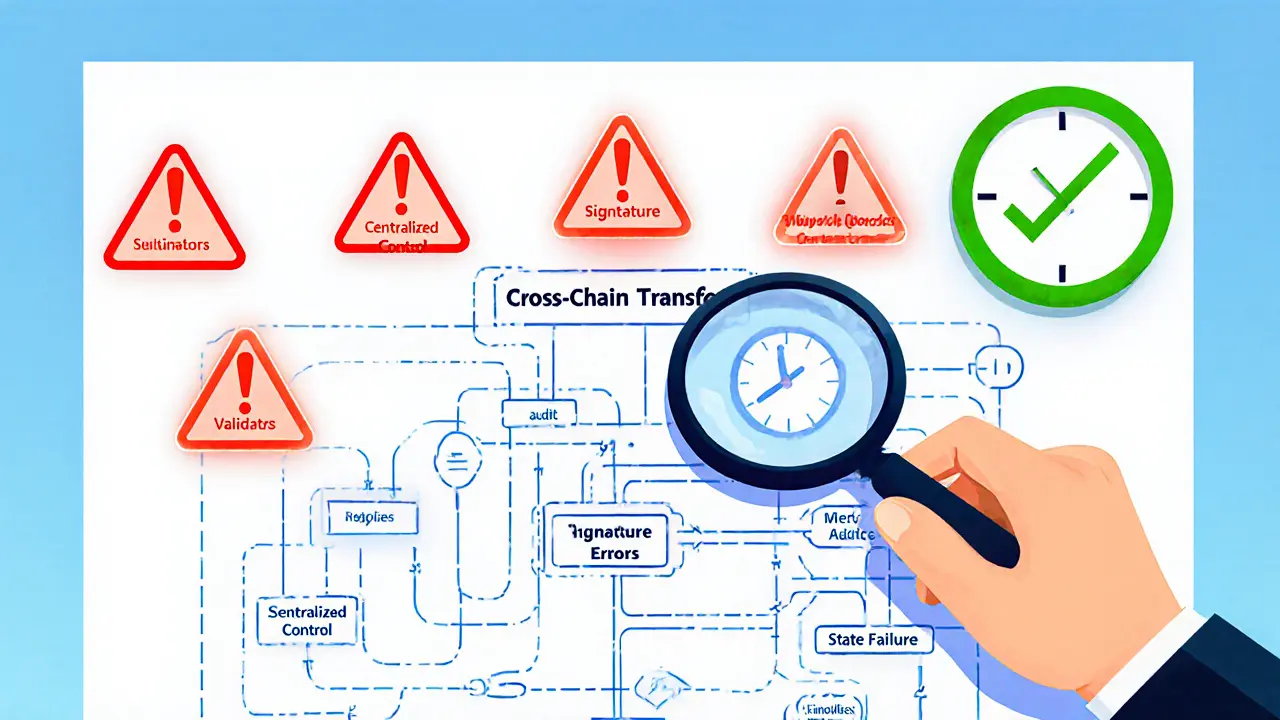
Not all bridges are built the same. But most share the same fatal weaknesses.
1. Centralized Control
73% of bridges rely on a small group of validators-or even a single company-to confirm transactions. That’s the opposite of decentralization. It’s a honeypot for hackers. If you’re trusting a bridge run by five people, you’re not using blockchain technology-you’re using a bank with a fancy UI.
Compare that to Chainlink’s CCIP, which uses over 50 independent node operators. No single entity can shut it down or steal funds. It’s slower. It’s more expensive. But since its September 2023 launch, it’s processed $1.7 billion with zero successful attacks.
2. Signature Validation Errors
Every blockchain signs transactions differently. Ethereum uses EIP-712. Solana uses ed25519. Polygon uses a modified version of Ethereum’s system. When a bridge tries to translate a signature from one chain to another, it’s like translating a legal contract from French to Mandarin using Google Translate.
Turnkey’s research found that signature mismatches increase human error by 37%. Attackers exploit this by sending malformed transactions that look valid to the bridge but are meaningless on the target chain. The result? The bridge mints fake tokens. You get nothing. The attacker walks away with real assets.
3. Replay Attacks
Imagine you send $5,000 from Ethereum to Polygon. The transaction is confirmed. But the bridge doesn’t properly track that you already used that signature. Later, someone copies that same transaction data and resubmits it. The bridge thinks it’s a new transfer. It sends another $5,000. You just lost double.
That’s a replay attack. And 43% of bridges don’t use unique nonces to prevent it. Webisoft documented 12 major replay attacks between 2021 and 2024, stealing $87 million. Most victims didn’t even realize they’d been hit until days later-when their balance vanished.
4. Oracle Manipulation
Many bridges use oracles to report data like token balances or transaction hashes. But if the oracle is compromised, it can lie. In January 2024, the Orbit Chain bridge was hacked because seven of ten multisig keys were stolen. The attackers fed false data to the oracle, making it look like $15 million in ETH had been deposited. The bridge minted fake tokens. The attackers cashed out.
Chainlink’s March 2024 report found that 41% of bridges are vulnerable to this kind of manipulation. The fix? Decentralized oracles with threshold signatures. But only a handful use them.
5. State Verification Failures
Some bridges skip full Merkle proofs. They don’t check every detail of the original transaction. They just look at a summary. That’s like verifying a bank transfer by checking the subject line of an email instead of the account number.
Webisoft’s data shows state verification failures caused 28% of all bridge exploits. Simple mistakes-like not checking the transaction nonce or skipping block height validation-let attackers forge fake deposits. The bridge thinks funds arrived. They didn’t. But the attacker still gets minted tokens.
Trustless vs. Trusted Bridges: Which Is Safer?
There are two main types of bridges: trusted and trustless.
Trusted bridges (like Wrapped Bitcoin) rely on a central custodian. They’re simple. Fast. And historically, less targeted. They process $4.2 billion monthly. But if the custodian is hacked, you lose everything. There’s no decentralization to fall back on.
Trustless bridges (like Wormhole) claim to be decentralized. But they’re not foolproof. Wormhole’s $325 million hack in February 2022 happened because of a flaw in signature validation-not because it was centralized. It had 11 validators. One was compromised. The whole system fell.
Here’s the hard truth: no bridge is truly trustless. Even the most decentralized ones still rely on a finite set of validators. The only difference is how many you’re trusting.
Halborn’s 2024 study found bridges with 50+ validators had 82% fewer exploits than those with fewer than 10. But they also took 3.7 times longer. A transaction that takes 34 seconds on a centralized bridge can take over two minutes on a secure one. Speed and safety are trade-offs. You can’t have both.

What Real Users Are Experiencing
Behind the headlines are real people who lost everything.
On Reddit, u/DeFi_Loser lost $8,200 during the ALEX bridge exploit. The interface showed “processing” for three hours. Then nothing. No error. No refund. No support. Just an empty wallet.
Trustpilot reviews for cross-chain bridges average 2.1 out of 5 stars. 67% say their funds got stuck. 42% say there’s zero customer support. Recovery takes an average of 19.4 days-if it happens at all.
But there are exceptions. Wormhole, after its 2022 hack, rebuilt with better security. Now, 92% of its transactions succeed. Chainlink’s CCIP has zero exploits. And in January 2024, u/EtherealSaver recovered $15,000 after the Orbit Chain hack by working with Chainalysis and coordinated validators.
Recovery is possible. But it’s rare. And it requires time, expertise, and luck.
How to Protect Yourself
If you must use a bridge, here’s how to reduce your risk:
- Use only major bridges-Wormhole, Chainlink CCIP, THORChain. Avoid obscure ones with no audits or community.
- Check the validator count. If a bridge uses fewer than 10 validators, walk away.
- Avoid bridges with “instant” transfers. Real security takes time. If it’s too fast, it’s too risky.
- Never send large amounts. Treat cross-chain transfers like a lottery ticket. Only risk what you can afford to lose.
- Use wallets with built-in safeguards. MetaMask and Rabby warn about known risky bridges. Enable them.
- Wait 24 hours after a major network upgrade. Forks and upgrades create replay attack windows.
And if you’re a developer? Audit everything. Use OpenZeppelin or Trail of Bits. Implement per-wallet rate limits. Add anomaly detection. Don’t cut corners. A $200,000 audit is cheaper than losing $20 million.
The Future: Is Cross-Chain Security Getting Better?
Yes-but slowly.
Chainlink’s CCIP is the first bridge to combine decentralized oracles, insured reserves, and a 50+ node validator set. It’s not the most popular. But it’s the most secure. And it’s growing.
The IETF just released draft standards for bridge security. Ethereum’s Verkle tree upgrade in 2025 may enable native cross-chain communication-eliminating bridges entirely. That’s the real endgame.
Right now, 64% of all crypto theft comes from bridges. Gartner predicts that will drop to 28% by 2026. But until then, treat every cross-chain transfer like walking through a minefield. You don’t have to avoid it. But you need to know where the mines are.
Most people think security is about encryption. It’s not. It’s about trust. And cross-chain bridges force you to trust things you can’t see, control, or verify. That’s the real risk-not the code. The human choice to believe in something broken.
Frequently Asked Questions
Are cross-chain bridges safe to use?
Most are not. Over 64% of all crypto theft in 2022 came from bridge hacks. Even the biggest ones like Multichain and Wormhole have been breached. Only a handful, like Chainlink CCIP, have maintained zero exploits since launch. If you must use one, stick to the top 5 with proven track records and large validator sets.
What’s the safest cross-chain bridge right now?
Chainlink’s CCIP is currently the most secure. It uses 50+ independent node operators, decentralized oracles, and $750 million in insurance via Proof of Reserve. Since its September 2023 launch, it’s processed $1.7 billion without a single successful hack. It’s slower and more expensive than others, but it’s the only one with enterprise-grade security.
Can I recover my funds if a bridge gets hacked?
Sometimes, but rarely. Recovery requires coordinated action from validators, blockchain investigators, and sometimes law enforcement. Only 1 in 5 victims recover any funds. The most successful cases involve working with firms like Chainalysis and having detailed transaction records. Most people lose everything permanently.
Why do bridges get hacked more than DeFi protocols?
Because bridges are the weakest link in the chain. DeFi protocols like Uniswap or Aave are built on a single, well-audited chain. Bridges have to connect two or more chains, each with different rules, signatures, and consensus mechanisms. That complexity creates more attack surfaces. A single flaw in a bridge’s verification system can compromise all connected chains.
How much does it cost to audit a cross-chain bridge?
A full security audit by firms like OpenZeppelin or Trail of Bits costs between $50,000 and $250,000. It takes 8 to 12 weeks. Many small bridges skip audits to save money-and end up losing millions. The cost of an audit is tiny compared to the cost of a single exploit.
Should I avoid cross-chain transfers entirely?
Not necessarily. Cross-chain transfers are essential for DeFi. But treat them like high-risk investments. Only move small amounts. Use only the most secure bridges. Never assume your funds are safe. And always assume the worst-case scenario: your money could disappear without warning.
Comments (5)

- Janice Jose
- November 28, 2025 AT 11:34 AM
Just lost $3k on a bridge last month. No support, no refund, just a spinning wheel and silence. Don't trust 'instant' transfers - if it feels too easy, it's a trap.

- Susan Dugan
- November 30, 2025 AT 08:16 AM
People act like bridges are magic portals, but they're just glorified middlemen with sketchy code. Chainlink CCIP is the only one I trust now - slower, yes, but I'd rather wait two minutes than lose my life savings. The $2.5B in hacks? That's not a bug. That's the business model for half these projects.
I've seen devs cut corners to hit launch deadlines. Audits? Optional. Validator count? Hidden. And users? They're the ones left holding the bag. It's not about tech - it's about incentives. If you're not being paid to secure it, you won't.
Wormhole got hacked because one validator went rogue. Multichain? CEO's key got phished. These aren't edge cases. They're predictable. And yet, people still throw big sums into bridges with five validators and a Discord mod as their 'customer service'.
Use MetaMask's risk alerts. Enable Rabby. Never send more than you'd comfortably burn. And if someone tells you 'it's decentralized' - ask how many nodes. If they can't answer, walk away.
The future? Native cross-chain via Verkle trees in 2025. Until then, treat every transfer like you're handing cash to a stranger at an ATM with no camera. You're not being paranoid. You're being smart.

- Ben Costlee
- December 1, 2025 AT 09:01 AM
I used to think bridges were the future. Now I see them as the wild west with a blockchain logo slapped on it. The fact that 73% rely on five people to approve everything? That’s not innovation - it’s centralized banking with a crypto buzzword.
I remember when I tried to move ETH to Arbitrum via a 'trustless' bridge. Took 40 minutes. The interface said 'processing.' I refreshed. It reset. I waited. Two hours later, it failed silently. No error. No email. Just gone. I spent three days trying to get help. Zero response.
People say 'do your own research' - fine. But where? The whitepaper? Most are written by marketing teams who think 'decentralized' means 'not my problem.' Real research means checking validator counts, audit reports, and whether the team has been hacked before.
Chainlink CCIP isn't flashy. It doesn't promise instant swaps. But it's the only one that treats security like a religion, not a checkbox. And that’s the difference between a bridge and a suicide pact.
If you're a dev reading this: stop cutting corners. A $200k audit isn't an expense - it's insurance. And if you're a user: your wallet isn't a game. It's your livelihood. Treat it like it.
There’s no shortcut to safety. Only patience, skepticism, and choosing the slow path.

- Grace Zelda
- December 2, 2025 AT 09:15 AM
Wait - so we're still letting people build bridges with 3 validators and call it 'decentralized'? This isn't crypto. This is a Ponzi scheme with smart contracts. The fact that we still have this conversation in 2024 is a national disgrace.
Chainlink CCIP has 50+ nodes, insurance, and zero breaches. Meanwhile, some guy in a Discord server launched a bridge called 'SolWarp' with 2 validators and a meme as its whitepaper. 12 hours later? $87M gone. The team vanished. Reddit thread? Dead.
Why do people keep falling for this? Because they want magic. They want to click a button and have their ETH turn into AVAX like it's a Netflix subscription. But crypto isn't Netflix. It's a minefield. And every bridge is a tripwire.
And don't even get me started on 'recovery.' You think Chainalysis is going to come save you? They track the money. They don't return it. You're not owed anything. You're just the sucker who believed the hype.
The only way this ends is when people stop rewarding bad behavior. No more funding bridges with 10 validators. No more clicking 'confirm' on something that says 'instant.' No more pretending speed is a feature instead of a red flag.
We need to stop romanticizing risk. This isn't gambling. It's financial negligence dressed up as innovation.

- Sam Daily
- December 3, 2025 AT 15:46 PM
Big respect to Chainlink CCIP - finally something that doesn't feel like a gamble. I’ve used it for $15k transfers and slept like a baby. No panic, no refreshes, no sweating over the blockchain explorer. It’s slow? Good. Slow means secure.
And yeah, I know some of you think I’m overreacting - 'it’s just crypto, right?' But when you’ve seen someone cry because they lost their kid’s college fund on a bridge that disappeared overnight, you stop treating this like a meme.
Use Rabby. Enable warnings. Check validator counts. If it’s under 10, don’t even open the tab. And if someone says 'but it’s on Etherscan!' - ask them if Etherscan can return your money. Spoiler: it can’t.
I’m not anti-bridge. I’m pro-survival. And right now, the only bridge worth crossing is the one that doesn’t need you to pray to make it work.
Post-Comment
Categories
Popular Articles