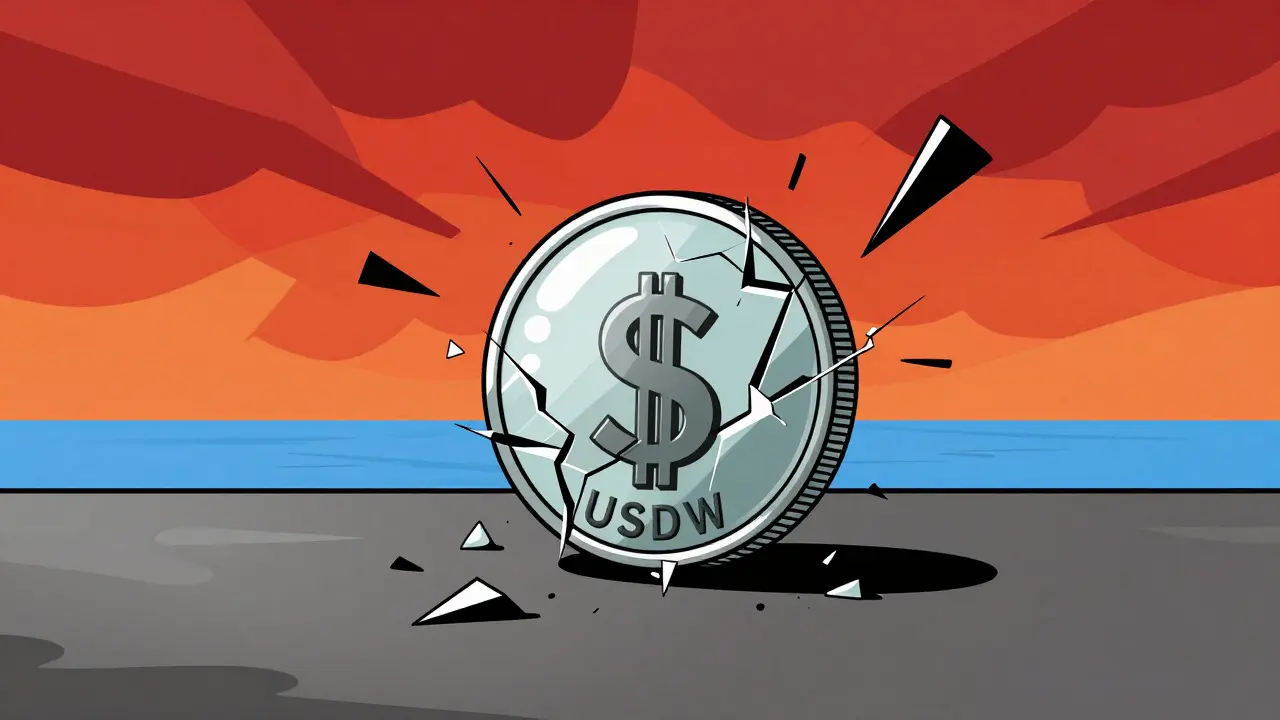

Stablecoins are supposed to be boring. They are meant to sit quietly in your wallet, holding their value steady against the US dollar while the rest of the crypto market goes wild. But what happens when a stablecoin crashes to $0.23? That is exactly what happened with USD DWIN (USDW), a digital asset that promises stability but has delivered some serious volatility. If you are looking at USDW on your screen today, you might see it trading near $1.00. You might assume it is safe because it claims to be backed by real dollars. However, digging deeper reveals a complex picture involving a Malaysian bank, limited liquidity, and a history of breaking its own peg. Before you swap your Bitcoin for USDW, you need to understand how this token actually works, who backs it, and why it behaves differently than giants like USDT or USDC.
The Core Concept: What Is USD DWIN?
At its simplest level, USD DWIN is a cryptocurrency stablecoin designed to maintain a 1:1 peg with the United States Dollar. The issuer, Dwin Intertrade Company Limited, created the token to provide a stable medium of exchange within the decentralized finance (DeFi) ecosystem. Unlike volatile assets like Ethereum or Solana, the goal here is predictability. One USDW should theoretically equal one US dollar, always. The technical backbone of USDW is the Binance Smart Chain (now often referred to as BNB Chain). This choice is significant because BSC offers low transaction fees and fast processing times compared to Ethereum. For users trying to move small amounts of money without getting eaten alive by gas fees, BSC is an attractive option. The token contract address you will need to interact with it is `0xabddb950f2ae8430c5a818f8bb4ec09e3ae41253`. Keep this handy if you plan to add it to your wallet manually. However, being on BSC doesn't automatically make a token safe. It just makes it cheap to trade. The safety comes from the collateral-the actual money backing the tokens. This is where things get interesting, and slightly concerning, depending on how much trust you place in offshore financial institutions.
The Backing Mechanism: QMIS Investment Bank
Every credible stablecoin needs a custodian. For Tether (USDT), it's a web of corporate entities. For Circle (USDC), it's regulated US banks. For USDW, the custodian is QMIS Investment Bank Limited, based in Malaysia. According to the project's documentation, every single USDW token in circulation is supposed to be fully collateralized by US dollars held in reserve by QMIS. To prove this, the system relies on a specific governance framework:
- Weekly Reporting: QMIS must submit reports to relevant regulatory authorities every week.
- Weekly Audits: Financial auditors are supposed to verify the reserves weekly to ensure transparency.

Market Reality: Liquidity and Trading Volumes
Here is where the rubber meets the road. A stablecoin is only useful if you can actually spend it or sell it. If you try to dump $10,000 worth of USDW, what happens? Does the price stay at $1.00, or does it crash? The answer lies in the liquidity. Currently, nearly all USDW trading happens on PancakeSwap V3, a decentralized exchange (DEX) on the BSC network. According to recent data, PancakeSwap accounts for over 99% of the token's 24-hour trading volume. Let's look at the numbers:
| Metric | Value |
|---|---|
| 24-Hour Volume | $30,921 |
| Bid-Ask Spread | 0.62% |
| Liquidity Depth (+/- 2%) | ~$450 |
| Total Supply Cap | 140 Million USDW |
The Volatility Problem: When the Peg Broke
Stablecoins are defined by their lack of volatility. But USDW has shown it can be anything but stable. Let's look at the historical price action, which tells a story of panic and recovery. In early 2025, USDW experienced a massive depegging event. The price dropped from its target of $1.00 to an all-time low of $0.2365 on February 11, 2025. That is not a slight fluctuation; that is a 76% loss of value overnight. For context, if you had $1,000 in USDW, it suddenly became worth $236. Where did the rest go? It vanished due to market panic and insufficient liquidity to absorb the sell pressure. Prior to that crash, the token had reached an all-time high of $1.10 in February 2025, likely driven by speculative trading rather than fundamental utility. Since hitting rock bottom, the price has recovered to hover around the $1.00 mark again. As of August 2026, it sits approximately 9.4% below its ATH and 322% above its ATL. Why did it crash? Likely a combination of low liquidity and a loss of confidence. When traders saw the price slipping, they rushed for the exit. Because there was only ~$450 of liquidity at the -2% level, the first few sellers crashed the price, triggering more panic selling. This is a classic death spiral in illiquid markets. The fact that it has recovered suggests that the underlying reserves *might* still be intact, or that arbitrageurs stepped in to buy the dip. But the memory of that crash lingers. Every time the market gets jittery, USDW is at risk of repeating that pattern.

How to Use USDW: Wallets and Integration
If you decide to take the risk and use USDW, the process is straightforward for anyone familiar with Web3. The primary way to hold and trade USDW is through non-custodial wallets like MetaMask or Trust Wallet. To add USDW to MetaMask:
- Open your MetaMask extension or app.
- Navigate to the "Tokens" tab and click "Import Tokens."
- Paste the contract address: `0xabddb950f2ae8430c5a818f8bb4ec09e3ae41253`.
- The symbol (USDW) and decimals (usually 18) should auto-fill.
- Click "Add Custom Token."
Risks and Considerations for Investors
Before you allocate any funds to USDW, consider these critical factors:
- Custodial Risk: Your trust is placed entirely in QMIS Investment Bank in Malaysia. If QMIS faces regulatory issues, freezes assets, or mismanages funds, your USDW becomes worthless paper.
- Liquidity Risk: With only $30k in daily volume, exiting large positions is difficult. You may face slippage far higher than expected.
- Regulatory Uncertainty: Unlike USDC or USDT, USDW lacks clear regulatory status in major jurisdictions like the US or EU. This makes it vulnerable to sudden bans or delistings.
- Historical Volatility: The precedent of dropping to $0.23 proves that the peg is fragile. Do not treat USDW as a risk-free savings account.
Is USD DWIN (USDW) a safe stablecoin?
Compared to major stablecoins like USDC or USDT, USDW carries higher risk. While it claims full dollar backing via QMIS Investment Bank, its history includes a severe depegging event where it dropped to $0.23. Low liquidity and limited public audit transparency mean it should be treated as a speculative asset rather than a safe store of value.
Where can I buy USDW?
USDW is primarily traded on PancakeSwap V3, a decentralized exchange on the Binance Smart Chain. It is not listed on major centralized exchanges like Binance Spot. You can also check LBank for potential listings, though liquidity there may be thin. Always verify the contract address before importing.
Who backs the USDW token?
USDW is issued by Dwin Intertrade Company Limited and backed by US dollar reserves held by QMIS Investment Bank Limited in Malaysia. The company states that weekly audits and reports are conducted to ensure transparency, though independent public verification of these reserves is limited.
Why did USDW drop to $0.23 in 2025?
The drop was likely caused by a combination of low liquidity and market panic. With very little buy-side depth on PancakeSwap, sell pressure quickly crashed the price. This event highlighted the fragility of the peg and the risks associated with illiquid stablecoins.
Can I use USDW on Ethereum?
No, USDW is native to the Binance Smart Chain (BNB Chain). To use it on Ethereum, you would need to bridge it, which adds complexity and cost. Most DeFi applications supporting USDW are built specifically for the BSC ecosystem.
Categories
Popular Articles
Aug 30 2026
Oct 4 2025