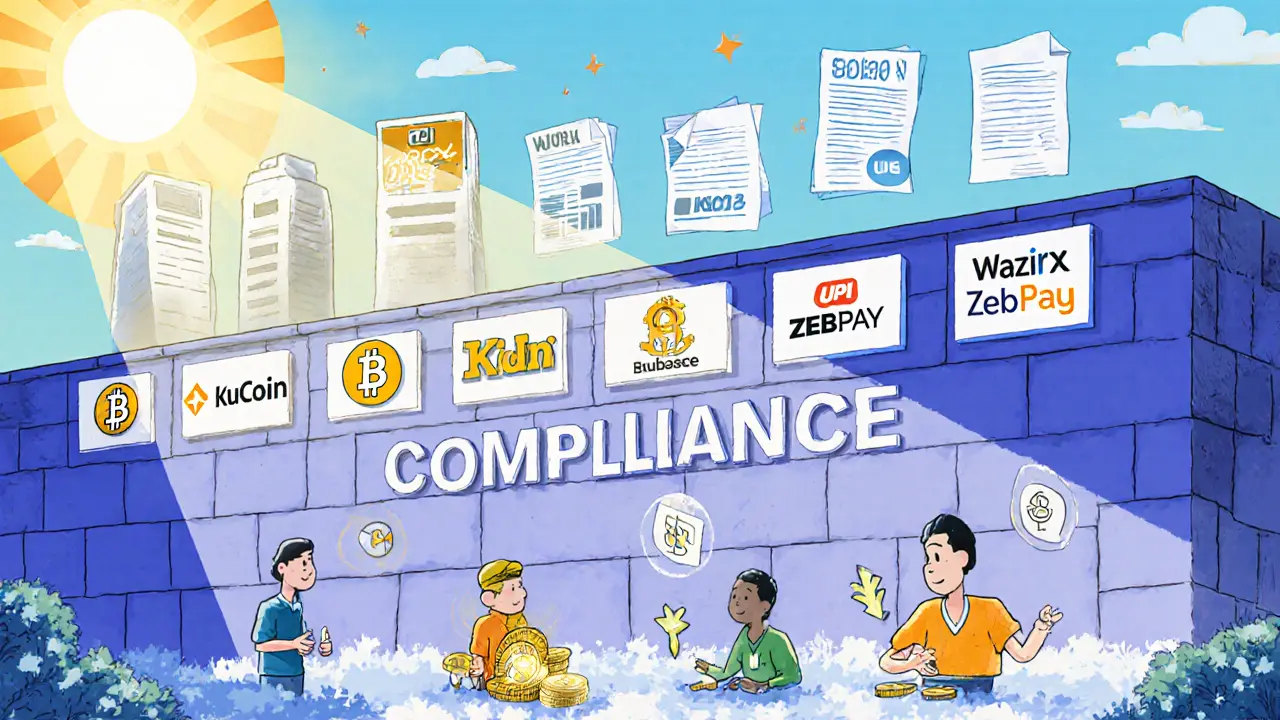

Compliant Crypto Exchange Checker
Check if your crypto exchange is compliant with Indian regulations. India has blocked unregistered international exchanges, but allows users to trade on FIU-IND registered platforms.
India hasn’t banned cryptocurrency - but it has shut the door on dozens of international crypto exchanges that refused to play by its rules. If you’re trying to trade crypto in India right now, you’re not fighting a legal gray zone. You’re navigating a clear, strict, and rapidly evolving regulatory system built around one agency: the Financial Intelligence Unit-India (FIU-IND).
What Actually Got Banned?
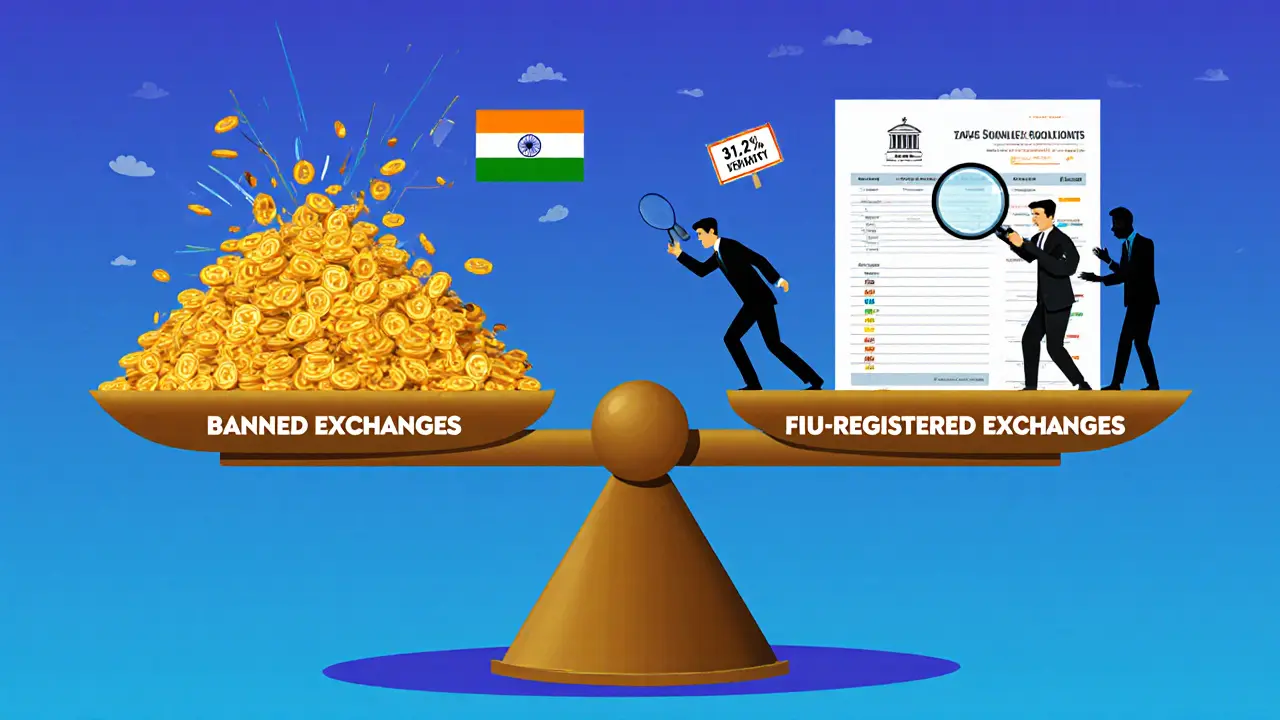
It’s not the coins. It’s not the tech. It’s the exchanges that didn’t register. As of early 2025, the Indian government blocked access to over 20 foreign crypto platforms that refused to comply with FIU-IND registration requirements. These aren’t small players - they’re giants like Binance, a global cryptocurrency exchange that was blocked in India for failing to register with FIU-IND, despite having millions of Indian users, KuCoin, an offshore exchange that lost access to Indian banking channels and was blocked by ISPs after ignoring FIU-IND compliance deadlines, and Coinbase, a U.S.-based exchange that temporarily suspended INR deposits for Indian users until it began the registration process.These platforms didn’t just get ignored - they were actively blocked. Indian ISPs stopped resolving their domain names. Banks cut off INR deposit routes. Payment processors like Razorpay and PayU refused to work with them. Users suddenly found their accounts frozen, withdrawals stalled, and apps no longer loading. There was no warning. No grace period. Just silence - and then a hard wall.
Why Did This Happen?
The root cause? FIU-IND registration, a mandatory requirement for any crypto exchange serving Indian users, designed to track transactions and prevent money laundering under the Prevention of Money Laundering Act (PMLA). Since 2022, the government made it clear: if you want to serve Indian customers, you must register with FIU-IND, keep detailed records of every trade, and submit them on demand. No exceptions.The February 1, 2025 amendment to Section 285BAA of the Finance Bill made it even stricter. Now, even if an exchange registers later, it must hand over all past transaction data - going back years. That’s a nightmare for offshore platforms that never tracked Indian user activity in a compliant format. Binance alone paid over $20 million in penalties in 2024 for failing to report Indian trades. KuCoin was fined $12 million. Many simply chose to walk away.
What’s Still Legal?
The good news? Crypto trading is still legal - if you use the right platform. The following exchanges are fully registered with FIU-IND and operate legally in India:- CoinDCX, India’s largest crypto exchange by volume, with over 12 million users and full FIU-IND compliance since 2022
- WazirX, a Binance-owned Indian exchange that pivoted to full compliance after the 2023 crackdown, now handling 60% of all INR-to-crypto trades in India
- ZebPay, one of India’s oldest crypto platforms, re-registered in 2023 and now offers tax reports and KYC-compliant withdrawals
- Unocoin, a pioneer in Indian crypto, with FIU registration since 2022 and direct bank integrations with HDFC and ICICI
- Mudrex, a tech-focused platform that saw over 10,000 new users in three weeks after foreign exchanges were blocked
- CoinSwitch, a popular aggregator that now only routes trades through FIU-registered partners
- BuyUcoin, a smaller exchange that offered cash bonuses to users migrating from banned platforms
These platforms aren’t just legal - they’re the only ones that can legally provide tax reports, support INR withdrawals, and work with Indian banks. If you’re using anything else, you’re on your own.

What Happens If You Use a Banned Exchange?
Let’s say you still have funds on Binance or KuCoin. What can you do?Nothing - legally. Indian authorities won’t help you recover funds from unregistered platforms. If your account gets frozen, there’s no customer support line that answers. No ombudsman. No dispute resolution. You’re outside India’s financial protection system.
And it gets worse. If you made profits on a banned exchange, you’re still required to pay taxes. The Indian Income Tax Department doesn’t care if the exchange is blocked - if you earned crypto gains, you owe 31.2% tax. But without a tax report from the exchange, you have to manually track every trade, every transfer, every fee. No automated CSV. No API. Just spreadsheets and guesswork.
Worse yet, if the Enforcement Directorate (ED) investigates you - and they’re actively doing so - they can demand transaction history from your bank. If they find crypto purchases linked to a banned exchange, you could face penalties up to 60% of the undisclosed amount under Section 158BA(7) of the Income Tax Act.
Why Domestic Exchanges Won
When the bans hit, Indian users didn’t flee crypto - they just switched platforms. CoinDCX saw deposits surge over 2,000% in six months. WazirX added 3 million new users in 2024. Mudrex, which had under 50,000 users before the crackdown, hit 150,000 by mid-2025.Why? Because these platforms built infrastructure for India. They integrated with UPI. They offer INR deposits via net banking. They generate tax reports in the format the IT department accepts. They have local customer support teams. They’re not trying to be global - they’re built for Indian users.
It’s not that they’re better. It’s that the banned ones were forced out. The market didn’t choose them. The law did.
What About Decentralized Exchanges (DEXs)?
You might think: “I’ll just use Uniswap or PancakeSwap. No registration needed.” But here’s the catch - India doesn’t regulate DEXs directly. But it does regulate you.If you use a DEX to buy Bitcoin with INR, and that INR came from a bank account, the government can still trace it. Your bank reports large transfers. Your wallet addresses can be flagged. If you don’t report gains, you’re still liable for tax penalties. DEXs don’t give you tax reports. They don’t help you comply. They just make it easier to hide - and that’s exactly what the government is cracking down on.
There’s no legal shield here. Just more risk.
The Bigger Picture
India isn’t trying to kill crypto. It’s trying to control it. The goal? To stop money laundering, ensure tax compliance, and protect retail investors from unregulated platforms. The result? A cleaner, more transparent market - but one where freedom comes with paperwork.For traders, this means: if you want to trade crypto in India, you have two choices. Use a FIU-registered exchange and play by the rules. Or use a banned one and risk losing your money, your tax compliance, and possibly your future.
There’s no third option. The rules are clear. The stakes are high. And the government isn’t backing down.
Are crypto exchanges completely banned in India?
No. Only exchanges that fail to register with FIU-IND are banned. Domestic platforms like CoinDCX, WazirX, and ZebPay are fully legal and operational. International exchanges like Binance and KuCoin are blocked because they refused to comply with Indian registration rules.
Can I still trade crypto in India?
Yes. You can legally buy, sell, and hold cryptocurrency using FIU-registered exchanges. Trading itself is not illegal - only operating an unregistered exchange is. As long as you use a compliant platform, your trades are legal.
What happens if I use Binance or KuCoin in India?
You can still access these platforms, but they’re blocked by Indian ISPs and banks. You won’t be able to deposit or withdraw INR. Your funds may be frozen, and you won’t get any support from Indian authorities. You’re also responsible for tracking your own taxes - these platforms won’t provide compliant reports.
Do I have to pay taxes on crypto made on banned exchanges?
Yes. The Indian Income Tax Department taxes all crypto gains at 31.2%, regardless of which exchange you used. If you made profits on Binance or any other unregistered platform, you’re still required to declare them. Failure to do so can lead to penalties up to 60% of the undisclosed amount.
Can I withdraw INR from a banned exchange?
No. Indian banks and payment processors have cut off all INR withdrawal routes to unregistered exchanges. Even if you can log in, you won’t be able to move money out. Your funds are effectively locked unless you transfer them to a compliant platform first.
Is it safe to use Indian crypto exchanges?
Yes - compared to banned platforms. FIU-registered exchanges must follow strict KYC and AML rules, maintain records for six years, and provide tax reports. They’re also more likely to have insurance, customer support, and legal accountability within India. While no platform is 100% risk-free, registered exchanges offer far more protection.
Will Binance ever return to India?
Possibly. Binance can resume operations in India if it registers with FIU-IND and submits all past transaction data as required by the 2025 law. But it would need to overhaul its systems, pay penalties, and accept full regulatory oversight - which so far, it has avoided.
What’s the future of crypto in India?
The future is regulated. India is moving toward a model where crypto trading is legal, but only through licensed platforms. Expect more rules around taxation, data retention, and reporting. Decentralized exchanges will remain in a gray zone. The government is not banning crypto - it’s bringing it under the financial system.
What Should You Do Now?
If you’re trading crypto in India, here’s your action plan:- Check if your exchange is on the FIU-IND registered list. If not, move your funds.
- Transfer your crypto to a compliant platform like CoinDCX or WazirX.
- Download your transaction history and calculate your gains manually if needed.
- File your crypto taxes by July 31, 2025 - no extensions, no excuses.
- Never use a banned exchange for INR deposits or withdrawals.
India’s crypto rules aren’t going away. They’re getting stronger. The safest move isn’t to fight them - it’s to adapt to them.

Comments (6)

- Michael Labelle
- November 26, 2025 AT 23:23 PM
Interesting breakdown. I’ve been watching India’s crypto scene from afar - it’s wild how they’re forcing compliance without banning the tech itself. Kinda like how Japan handles fintech: strict rules, but if you play nice, you get to stay in the game.
Also, the fact that WazirX grew so fast after Binance got blocked says a lot about local adaptation. Global platforms assume everyone wants the same UX. Turns out, people just want to deposit INR without jumping through 17 hoops.

- Joel Christian
- November 27, 2025 AT 15:10 PM
yo i used binance for 3 years and now i cant even log in?? like wtf man?? i still have 2 btc stuck there and no one cares?? i tried emailing but their support is ghosted and now my bank says they cant help either?? this sucks so bad

- jeff aza
- November 28, 2025 AT 06:37 AM
This is a textbook case of regulatory arbitrage failure - the FIU-IND’s enforcement under PMLA Section 285BAA effectively nullifies extraterritorial jurisdictional claims by unregistered VASPs. Binance’s $20M penalty? A rounding error if they’d just onboarded compliance infrastructure pre-emptively. The real failure? Their hubris in assuming Indian retail would tolerate non-compliant liquidity sinks.
Also - DEXs? Please. The ED’s new wallet-mapping algorithms are already flagging UPI-to-ETH bridges. You think you’re anonymous? Your bank’s AML module just pinged your KYC profile. You’re not hiding - you’re just delaying the audit.

- Vijay Kumar
- November 29, 2025 AT 13:40 PM
India doesn’t ban crypto - it bans laziness. If you want to trade, do the paperwork. No one owes you convenience. The exchanges that survived? They built for India - not for Silicon Valley fantasies.
And yes, you still pay 31.2% tax. Even if your coins are locked on some offshore ghost site. The IT department doesn’t care about your excuses.

- Vance Ashby
- November 30, 2025 AT 16:17 PM
so like... if i use uniswap and buy btc with my indian bank account... is that illegal? or just... risky? 😅
i mean, i'm not using binance, so i'm good right? ...right??

- Brian Bernfeld
- December 1, 2025 AT 08:30 AM
Let me be real for a second - this isn’t about control. It’s about protection.
For years, Indian retail investors got burned by offshore platforms that vanished overnight. No refunds. No recourse. No transparency. The FIU-IND didn’t create chaos - it ended a free-for-all where your life savings could disappear because some offshore CEO didn’t feel like filing paperwork.
Yes, it’s annoying to track your own taxes. Yes, it’s frustrating to migrate funds. But compared to losing everything? That’s a small price.
The winners here? The local exchanges. They didn’t just survive - they evolved. They added UPI, built local support teams, and even printed PDF tax reports you can hand to your CA. That’s not compliance for compliance’s sake - that’s service.
And to anyone still clinging to Binance because ‘it’s better’ - show me the customer service line that answers in Hindi. Show me the bank transfer that clears in 30 seconds. Show me the tax form that doesn’t require a PhD in crypto accounting.
It doesn’t exist. And that’s the point.
India didn’t kill crypto. It made it responsible. And honestly? That’s the future everywhere else is going to have to face too.