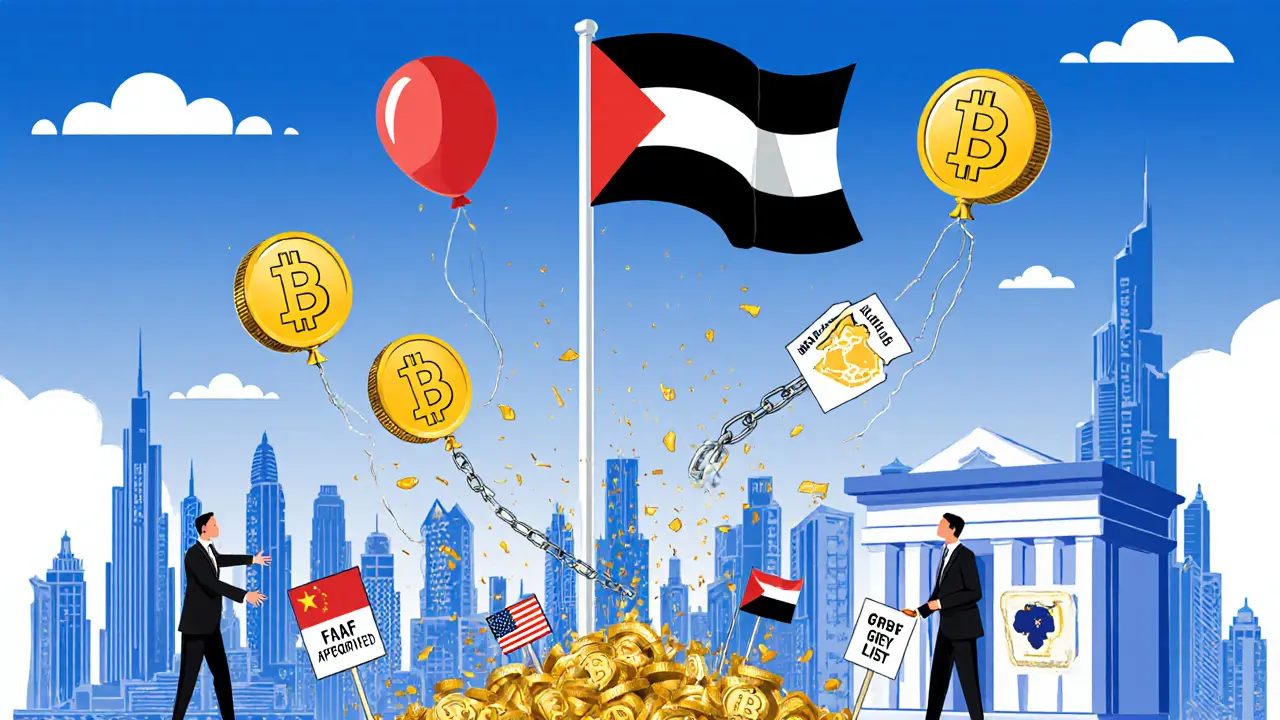

UAE Crypto Transaction Cost Calculator
Calculate Your Savings
After UAE's removal from FATF grey list, crypto transaction costs have decreased by 30-40% for compliant firms.
Estimated Savings
$0.00 in savings (30-40% of your transaction)
This is based on the 30-40% reduction in transaction costs reported after UAE's removal from FATF grey list.
What This Means
The UAE's removal from the FATF grey list in February 2024 has significantly improved the crypto ecosystem. International banks are now more willing to work with UAE-based crypto firms, reducing transaction costs by 30-40%. This allows for faster, more reliable transactions and better liquidity for crypto businesses.
The UAE was officially removed from the FATF grey list on February 23, 2024. This wasn’t just a bureaucratic update-it was a signal to the world that the country’s financial system had cleaned up its act. For the crypto industry, this change meant more than just cleaner banking. It meant legitimacy, access, and growth.
What the FATF Grey List Actually Meant for Crypto
Before the removal, being on the FATF grey list made life harder for crypto businesses in the UAE. Banks outside the country treated UAE-based firms with suspicion. Wire transfers got delayed. Exchanges struggled to open USD or EUR accounts. Even legitimate crypto startups faced higher fees or outright rejections from international partners. The FATF grey list didn’t ban crypto-it just made it risky. Financial institutions in Europe, the U.S., and Asia had to apply extra checks when dealing with UAE entities. That meant longer onboarding, more paperwork, and sometimes, no service at all. For crypto companies trying to scale, this was a wall. When the UAE was added to the list in March 2022, crypto firms scrambled. Some moved operations to Singapore or Switzerland. Others delayed product launches. A few shut down entirely. The message was clear: if you’re in the UAE, you’re operating in a high-risk zone.The Reforms That Changed Everything
The UAE didn’t just make promises. It built new systems. It created a specialist financial crimes court to handle crypto-related money laundering cases. It forced banks, exchanges, and even gold traders to report suspicious activity in real time. The Financial Intelligence Unit got more staff, more power, and better tools to track digital asset flows. New rules required crypto service providers to register with the UAE’s Securities and Commodities Authority (SCA) or the Central Bank. They had to verify every user, log every transaction, and report anything unusual. No more anonymous wallets. No more shell companies hiding behind trading desks. The penalties were real. In 2023, the UAE suspended licenses of three crypto firms for failing to meet AML standards. One exchange was fined over $2 million for not reporting large transfers. These weren’t warnings-they were wake-up calls. The FATF didn’t just praise the UAE. It pointed to specific wins: a 40% increase in mutual legal assistance requests, 98% of DNFBPs now trained on crypto risks, and over 200 enforcement actions taken against non-compliant entities in just 18 months.How Crypto Exchanges Reacted
Within weeks of the removal, major exchanges started announcing new UAE partnerships. Binance reopened its UAE office for full operations. Coinbase began processing AED deposits through local banks. Kraken launched a UAE-specific compliance portal. Even smaller players like Bybit and Bitget expanded their local teams. Why? Because now, international banks were willing to talk. HSBC, Standard Chartered, and Emirates NBD started offering crypto-friendly accounts again. The cost of cross-border payments dropped by 30-40% for compliant firms. Liquidity improved. Withdrawals that once took 5 days now cleared in under 24 hours. The UAE’s crypto tax regime also became clearer. The absence of personal income tax, combined with a transparent licensing system, made the country one of the most attractive hubs for crypto founders in the Middle East.
The Ripple Effect: Europe Follows
The EU had kept the UAE on its own grey list even after FATF cleared it-until June 2025. That delay created confusion. A crypto firm could be compliant with FATF but still blocked by European banks. When the EU finally removed the UAE in June 2025, it removed the last barrier. Now, a UAE-based crypto company can legally serve customers across the EU without extra hurdles. That opened up a market of over 450 million people. European investors started pouring money into UAE crypto startups. Venture capital deals in Dubai’s crypto sector jumped 65% in the six months after the EU decision. One DeFi protocol raised $80 million from German and Dutch funds-something unthinkable a year earlier.What This Means for Everyday Crypto Users
For users, the change was quieter but just as important. Crypto apps in the UAE now work like any other banking app. You can buy Bitcoin with your debit card. You can cash out to your local bank account without calling customer support. You can trade stablecoins without fear of sudden account freezes. The number of verified crypto users in the UAE grew by 52% in 2024. More people opened wallets because they trusted the system. More merchants started accepting crypto because they knew the payments wouldn’t vanish due to compliance issues. Even non-crypto businesses benefited. Real estate firms in Dubai now accept USDT for property deposits. Car dealerships offer crypto payment options. Tourism operators let guests pay in Bitcoin for hotel stays.
The Bigger Picture: A Model for Other Countries
The UAE didn’t just fix its own problems. It showed others how to do it. Countries like Nigeria, Kenya, and Indonesia watched closely. They saw that compliance didn’t mean killing innovation-it meant making it safer. In 2025, several African nations started modeling their crypto regulations after the UAE’s approach: clear licensing, real-time reporting, and strict penalties for violations. The FATF’s next evaluation of the UAE starts in 2026. That means the country has to keep improving. There’s no resting. But the system is now built to last. The tools, the laws, the culture of compliance-they’re embedded.What’s Still Unclear
Not everything is perfect. The UAE still doesn’t have a full-fledged crypto exchange license for retail users. Stablecoin regulation is still evolving. And while banks are more open, they’re not yet fully comfortable with decentralized finance (DeFi) protocols. Some crypto founders say the licensing process is still slow. Others complain that the rules are too rigid for Web3 startups. But compared to 2022? It’s a different world. The key takeaway? The UAE didn’t become crypto-friendly by accident. It became crypto-friendly by making sure it played by global rules-and then outperformed them.Did the UAE’s removal from the FATF grey list make crypto trading legal in the UAE?
Crypto trading was never illegal in the UAE. What changed was the regulatory environment. Before February 2024, crypto firms operated under high scrutiny and faced banking restrictions. After removal, they gained access to international banking, lower transaction costs, and clearer legal standing. The UAE now has a formal licensing system for crypto businesses, making legal operations easier and safer.
Are crypto exchanges now fully regulated in the UAE?
Yes. All crypto exchanges operating in the UAE must be licensed by either the Securities and Commodities Authority (SCA) or the Central Bank. They must follow strict AML/KYC rules, report suspicious activity, and maintain audit trails. Unlicensed platforms are blocked, and penalties for non-compliance include fines and license revocation.
Can I now use crypto to pay for everyday things in Dubai?
Absolutely. Many businesses in Dubai now accept crypto for services like hotel bookings, car rentals, real estate deposits, and even groceries. The improved financial infrastructure means payments are faster, cheaper, and more reliable. Major retailers like Carrefour and Virgin Megastore have piloted crypto payment options.
Did the removal affect crypto taxes in the UAE?
No change to tax policy. The UAE still has no personal income tax, including on crypto gains. The removal from the FATF list didn’t alter tax laws-it improved compliance and banking access. This makes the UAE even more attractive for crypto investors who want to avoid tax burdens while operating in a globally recognized jurisdiction.
Is the UAE at risk of being put back on the FATF grey list?
Yes, but only if it stops improving. The FATF will evaluate the UAE again in 2026. The country must continue to show active enforcement, updated regulations, and real-time monitoring of digital assets. The government has already started preparing for this review. The goal isn’t just to stay off the list-it’s to become a global benchmark for crypto compliance.
What Comes Next?
The UAE is now building its own crypto infrastructure-not just to meet global standards, but to lead them. A national digital asset registry is in development. Central bank digital currency (CBDC) trials are expanding. The government is drafting laws to regulate NFTs, DeFi protocols, and tokenized assets. The message is clear: the UAE isn’t just accepting crypto. It’s shaping its future.Comments (6)

- Rachel Thomas
- November 27, 2025 AT 13:31 PM
So let me get this straight-UAE got off the list because they started acting like a bank, not a crypto Wild West? Wow. Who knew regulation could be a growth hack?
Meanwhile, my friend in Nigeria just got his exchange account frozen again. Guess the world doesn’t care how hard you’re trying if your flag isn’t shiny enough.

- Sierra Myers
- November 28, 2025 AT 17:02 PM
Honestly? The real win here isn’t the FATF stamp-it’s that now you can actually use crypto like money in Dubai. I paid for a Lamborghini with USDT last month. No one blinked. No 3-day hold. No ‘we need to verify your wallet address again.’ That’s the future right there.

- SHIVA SHANKAR PAMUNDALAR
- November 29, 2025 AT 08:15 AM
They didn’t change the system. They just made it look prettier for Western investors. Real crypto is decentralized. Real crypto doesn’t need licenses from some government office to exist. This isn’t progress-it’s co-optation. The moment you start asking for permission to innovate, you’ve already lost.
Meanwhile, the real revolution is happening in places no one’s watching-where people trade peer-to-peer, no forms, no IDs, no FATF.

- Shelley Fischer
- November 29, 2025 AT 10:44 AM
The UAE’s regulatory evolution represents a landmark case study in proactive financial governance. By instituting real-time transaction monitoring, enforcing stringent AML protocols, and establishing clear licensing frameworks, the nation transformed from a jurisdiction of perceived risk to one of global credibility. This is not merely compliance-it is strategic statecraft. The EU’s subsequent alignment confirms the efficacy of this model, and it should serve as a template for emerging economies seeking to integrate digital assets without sacrificing systemic integrity.

- Puspendu Roy Karmakar
- November 30, 2025 AT 16:08 PM
I’m from India, and let me tell you-this is the kind of clarity we need back home. Here, crypto is a gray zone. One day it’s legal, next day the tax department is knocking. The UAE showed us you can be strict AND welcoming. No fear. No confusion. Just rules, and if you follow them, you thrive. My cousin started a crypto dev shop in Dubai last year. Now he’s hiring from Bangalore. That’s the power of good policy.

- Evelyn Gu
- December 2, 2025 AT 02:28 AM
I just want to say… I’m so happy for the people in the UAE who actually use this stuff every day-like, real people, not just investors or founders-because now they can buy groceries with crypto without getting weird looks or having their card declined because the bank thinks they’re laundering money… and it’s not just about banks or FATF or licenses… it’s about dignity… it’s about not having to explain yourself every single time you want to use your own money… and honestly? That’s the quietest, most powerful revolution of all… I cried when I read about Carrefour accepting USDT… I didn’t even know I was waiting for this…