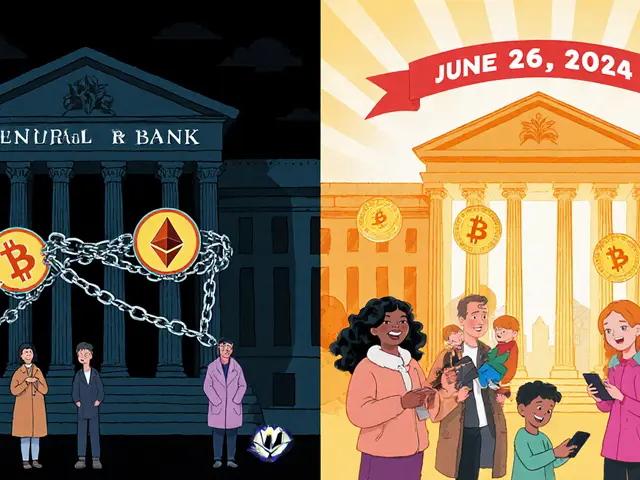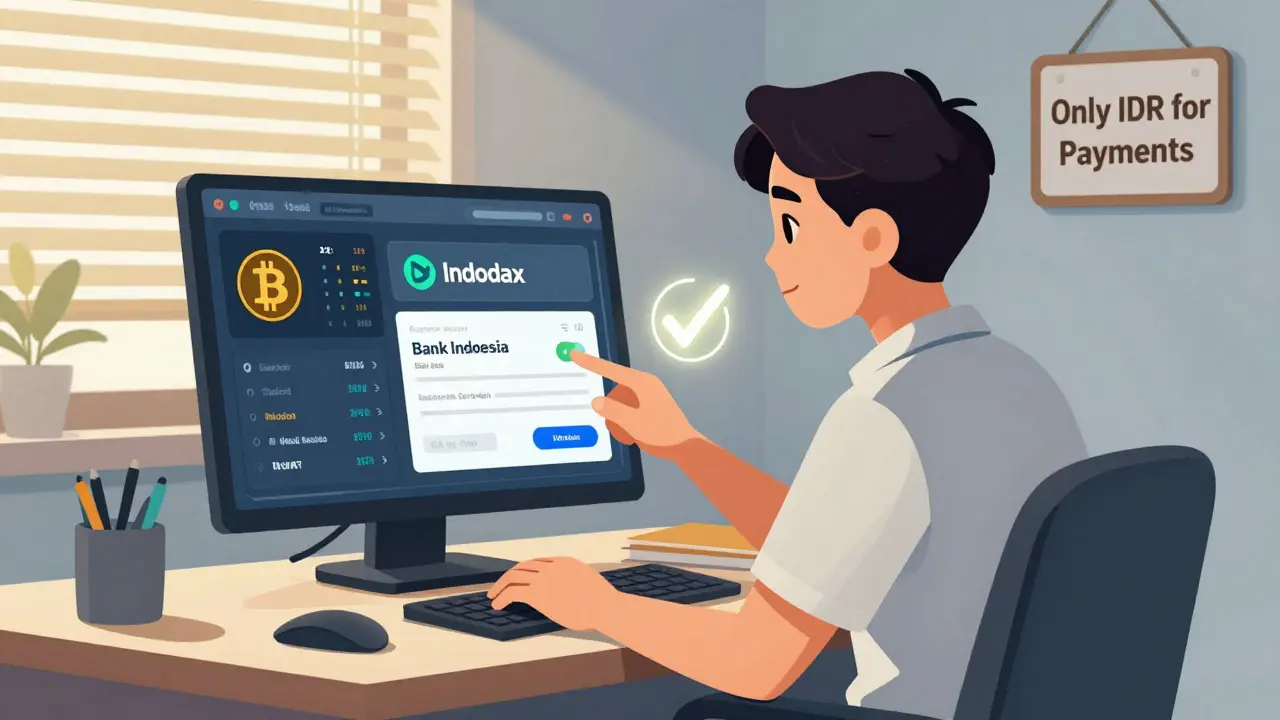

Indonesia doesn’t ban cryptocurrency - but it doesn’t let you use it like cash either. If you’re an Indonesian trader, you can legally buy, sell, and hold digital assets, but you can’t pay for coffee, groceries, or even a ride-hailing app with Bitcoin. The rules changed sharply in 2025, and now the path to legal trading is clearer - but also more rigid.
What’s Legal and What’s Not
Cryptocurrency in Indonesia is classified as a financial asset, not a currency. That means you can trade it like stocks or gold, but you can’t use it to settle debts or make purchases. This distinction isn’t just bureaucratic - it’s enforced. Bank Indonesia’s Regulation No. 20/6/PBI/2018 and the 2023 Payment Systems Law make it clear: only the Indonesian Rupiah (IDR) is legal tender. Violating this can lead to fines or even criminal charges.So if you’re trading Bitcoin, Ethereum, or Solana on a licensed platform, you’re in the clear. If you’re trying to buy a phone from a local vendor using Dogecoin? That’s a problem. The government wants crypto to stay in investment portfolios, not in everyday wallets.
The Regulatory Shift: From BAPPEBTI to OJK
Before January 2025, cryptocurrency oversight was handled by BAPPEBTI, the commodity futures agency. It was a rough system - limited in scope, slow to adapt, and focused mostly on futures trading. Then came Government Regulation No. 49 of 2024, which moved all crypto supervision to the Financial Services Authority (OJK). This wasn’t just a name change. It meant stricter rules, better oversight, and a direct link to Indonesia’s broader financial system.Under OJK, every crypto exchange operating in Indonesia must now hold a formal license. As of June 2025, only 22 exchanges met the requirements. The bar is high: minimum capital of IDR 5 billion (about $325,000), ISO 27001 cybersecurity certification, real-time AML monitoring, and integration with OJK’s Digital Financial Innovation Monitoring System (SIM-LKD). If you’re using an unlicensed platform - even one based overseas - you’re trading without legal protection.
The New Tax Rules: 0.21% vs. 1%
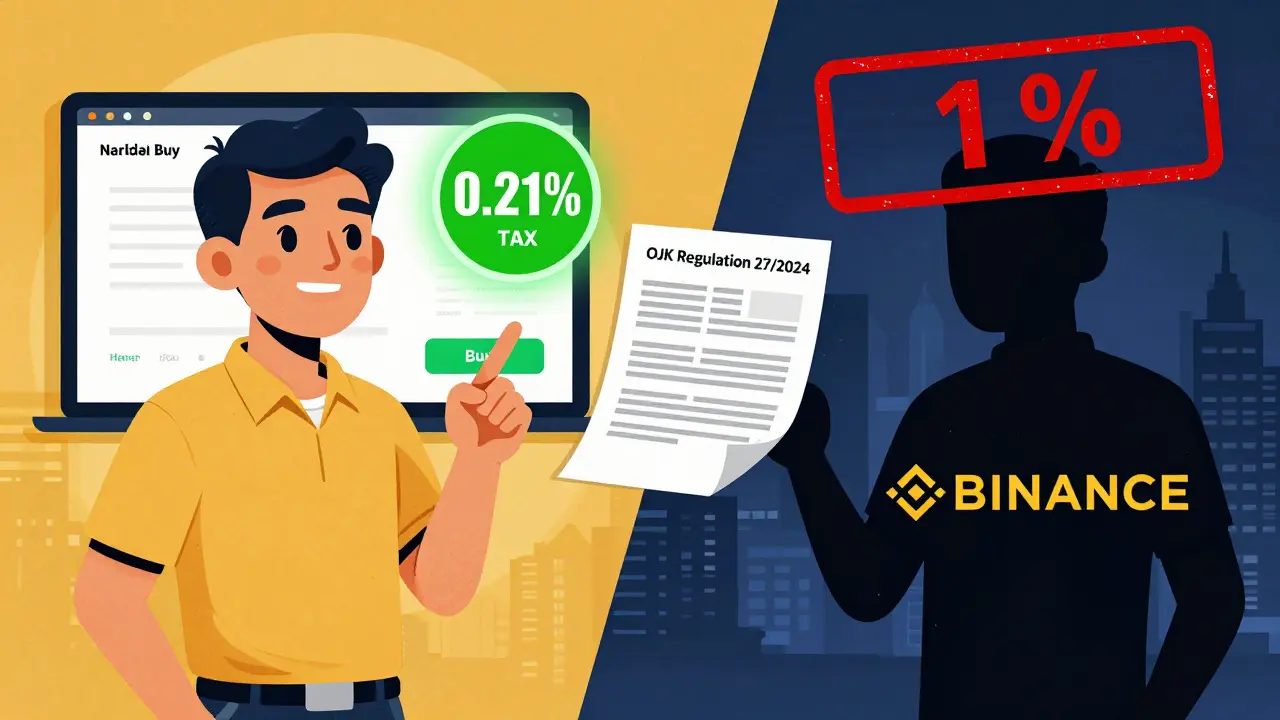
The biggest change in 2025 came with Minister of Finance Regulation No. 50/2025 (PMK 50/2025), which took effect on August 1, 2025. This replaced the old tax system and created a two-tiered structure:- 0.21% final income tax for trades made through licensed Indonesian exchanges (PMSE)
- 1% final income tax for trades on foreign platforms or self-reported transactions
This gap - nearly five times higher for foreign platforms - was designed to push traders toward local exchanges. The government removed VAT entirely, recognizing crypto as a financial asset, not a commodity. But the 1% rate on foreign platforms has backfired slightly. According to OJK’s Crypto Market Stability Report (September 2025), domestic trading volume dropped 15.3% in the first 30 days after the new tax law launched. Many traders, especially high-volume ones, switched to offshore platforms to avoid the 1% fee - even though they’re now legally at risk.
Here’s the catch: if you trade on Binance, KuCoin, or Coinbase and don’t report it, you’re still liable. The Directorate General of Taxes (DGT) now requires exchanges to report transaction data through Indonesia’s National Single Window (NSW). If you’re caught, you’ll owe the 1% tax plus penalties. One Jakarta trader lost $2,850 in Bitcoin because he thought the 1% tax was optional.
How to Get Started: The 4-Step Process
To trade legally today, you need to follow a strict onboarding process:- Choose a licensed exchange - Only 22 are approved. Top ones include Indodax (8.7 million users), Tokocrypto (acquired by Huobi), and Pintu. Check the full list at ojk.go.id.
- Submit documents - You’ll need your KTP (national ID), NPWP (tax ID), and a selfie with your ID. No exceptions.
- Pass the financial literacy test - A 15-question exam on crypto risks. You must score at least 80%. Topics include volatility, wallet security, and regulatory changes.
- Link a local bank account - Your fiat deposits must come from a Bank Indonesia-registered bank. No PayPal, no foreign wire transfers unless approved.
Onboarding now takes 3 to 7 business days - up from 1-2 days under the old system. Many users complain about delays, especially with KYC verification. Indodax’s Q2 2025 report says 42% of new users experienced at least one verification hiccup.
Who’s Trading - And Why
As of June 2025, Indonesia has 14.3 million active crypto users - nearly 5% of the population. The market is young, male-dominated, and urban-heavy:- 68.3% of users are aged 18-35
- 76.4% are male
- 54.2% live in Java (Jakarta, Bandung, Surabaya)
Most are drawn by speculation - not payments. Bitcoin and Ethereum make up 72% of trading volume. Stablecoins like USDT are used mostly for bridging trades, not spending. The average user trades once every 8 days, according to Nielsen’s 2025 Digital Asset Demographics Study.
Indodax alone handles 47.2% of all local volume. Tokocrypto and Pintu split the rest. Smaller platforms are struggling to meet the new capital requirements. Experts predict the number of licensed exchanges will shrink to 12-15 by 2026.
What’s Coming Next
The OJK has signaled two major changes ahead:- Proof-of-reserves audits - Starting January 1, 2026, every licensed exchange must prove it holds enough assets to cover user balances. This is meant to prevent another FTX-style collapse.
- Possible stablecoin payments - Bank Indonesia is quietly exploring whether select stablecoins (like USDT or BUSD) could be used for cross-border remittances. No decision yet, but if approved, it could be the first crack in the “no crypto as payment” rule.
There’s also talk of taxing staking rewards in 2026. Right now, earning interest on crypto through lending or staking is in a gray zone. The DGT has hinted it will soon classify these as taxable income - similar to dividends.
Common Pitfalls and How to Avoid Them
Even legal traders run into trouble. Here are the most common mistakes:- Using foreign exchanges without reporting - The 1% tax applies whether you know it or not. If you trade on Binance and don’t declare it, you’re at risk.
- Confusing tax rates - 0.21% is for domestic platforms. Anything else = 1%. Don’t assume the lower rate applies if you’re using a “global” app.
- Missing the financial literacy test - It’s mandatory. No second chances. Study the 15 topics on OJK’s portal.
- Trying to bypass bank limits - Transferring over IDR 100 million (about $6,500) requires OJK approval. Many users get locked out trying to move large sums.
- Ignoring tax statements - Exchanges must send quarterly tax reports by the 10th business day of the next quarter. Keep them. The DGT audits.
Over 34% of users in a Sanction Scanner survey admitted to misreporting trades because they didn’t understand how multi-leg transactions (e.g., BTC → ETH → IDR) are taxed. Use the OJK’s Crypto Asset Trading Portal (portal.lkd.ojk.go.id) for calculators and guides.
Final Reality Check
Indonesia’s crypto rules aren’t perfect. The tax gap between local and foreign platforms is creating a black market for compliance. Customer service on licensed exchanges has slowed. Onboarding is frustrating. But compared to Vietnam (which bans advertising) or Thailand (which allows crypto payments), Indonesia’s framework is one of the clearest in Southeast Asia.If you’re serious about trading, stick to licensed platforms. Pay your 0.21%. Report everything. Keep records. The government isn’t trying to stop you - it’s trying to bring you into the system. And for now, that system works - if you follow the rules.
Can I use cryptocurrency to pay for goods in Indonesia?
No. Under Bank Indonesia’s Regulation No. 20/6/PBI/2018 and the 2023 Payment Systems Law, only the Indonesian Rupiah (IDR) is legal tender. Using Bitcoin, Ethereum, or any other cryptocurrency to pay for goods or services is illegal and can lead to penalties.
Which crypto exchanges are legal in Indonesia?
As of June 2025, only 22 exchanges hold OJK licenses. The largest are Indodax, Tokocrypto, and Pintu. You can find the full, updated list on the OJK website at ojk.go.id. Any platform not on this list is operating without legal authorization.
Do I have to pay tax on my crypto trades?
Yes. Under PMK 50/2025, you pay a final income tax of 0.21% if you trade on a licensed Indonesian exchange, or 1% if you use a foreign platform or self-report. VAT on crypto transactions was eliminated in 2025, but income tax still applies. Exchanges automatically withhold the tax - but if you trade off-platform, you must report it yourself.
What documents do I need to start trading?
You need your KTP (national ID card), NPWP (tax identification number), and a Bank Indonesia-registered bank account. You’ll also need to pass a 15-question financial literacy test with at least 80% correct answers. These are mandatory under OJK Regulation No. 27/2024.
What happens if I trade on Binance or Coinbase?
You’re not breaking the law by holding crypto on foreign platforms - but you are breaking the tax law if you don’t report your trades. The 1% final income tax applies to all transactions, even those on foreign exchanges. The Directorate General of Taxes now receives data from exchanges and can match your transactions. Failure to report can result in fines, back taxes, and audits.
Will staking rewards be taxed in 2026?
Yes, it’s highly likely. The Director General of Taxes has publicly stated that staking rewards and other crypto income will be classified as taxable income, similar to dividends. While no formal regulation has been issued yet, the DGT is preparing guidelines for 2026. If you earn interest on crypto, prepare to report it.
Comments (7)

- Rachel Rowland
- March 7, 2026 AT 16:06 PM
I love how Indonesia is trying to bring crypto into the formal economy instead of just banning it like some countries. The 0.21% tax on local exchanges is actually pretty fair, especially compared to the US where you have to track every single trade. The financial literacy test is a smart move too - too many people treat crypto like a lottery ticket. Kudos to OJK for not making it a total nightmare to comply with.
Also, the move to require proof-of-reserves next year? Long overdue. We need more regulators who actually care about protecting users, not just collecting fees.

- Bonnie Jenkins-Hodges
- March 8, 2026 AT 11:15 AM
USA still lets people use crypto like money??? 😱 Indonesia is the only country that gets it. No more crypto for coffee. No more crypto for Uber. Rupiah is the ONLY thing that matters. 🇮🇩💪

- Melissa Ritz
- March 9, 2026 AT 18:01 PM
Honestly? The whole thing feels like a performative regulatory gesture. You’re telling people they can’t use crypto as money, then you make them jump through hoops to pay 0.21% tax on trades they’re not even allowed to spend? The irony is thick enough to spread on toast.
And don’t get me started on the 'financial literacy test' - it’s just a way to gatekeep access to what’s essentially a speculative casino. I’m not impressed. I’m just bored.

- Basil Bacor
- March 11, 2026 AT 02:20 AM
Lmao 0.21% tax? Thats nothing. In the uk we pay like 28% on capital gains and no one complains. At least indonesians arent being fleeced. Also why is everyone still using binance? The 1% tax is basically a tip jar for the state. If you can afford to trade crypto you can afford 1% tax. Stop being cheap.

- Emily Pegg
- March 12, 2026 AT 07:05 AM
I just don’t understand why people are so mad about the tax system. Like… you’re trading digital assets. You’re not growing tomatoes in your backyard. You’re making money. Pay your fair share. 💔
Also, I’m so proud of Indonesia for not letting crypto become a free-for-all. We need more countries like this. My cousin in Brazil just got audited for $12k in unreported crypto. At least in Indonesia, they give you a clear path. Thank you OJK. 🙏

- Ethan Grace
- March 12, 2026 AT 12:08 PM
There’s something deeply poetic about a nation that says: 'You can own this thing… but you can’t use it.'
It’s not about regulation. It’s about control. The Rupiah is the last relic of a state that still believes in borders, in paper, in hierarchy. Crypto doesn’t care about borders. But Indonesia? Indonesia wants you to bow to the Rupiah before you bow to Bitcoin.
And maybe… that’s the real revolution.

- Jamie Hoyle
- March 13, 2026 AT 16:43 PM
Oh wow. 22 exchanges. That’s cute. Let me guess - they’re all owned by the same 3 conglomerates with ties to the military-industrial complex? Classic. The 'licensed' ones are just front companies. The real action is on offshore platforms. And guess what? The government knows. They don’t care. They want you to pay the 1% so they can fund their next infrastructure project while pretending they’re 'protecting consumers.'
The tax gap? It’s not a bug - it’s a feature. They want people to get burned on foreign exchanges so they can swoop in with 'compliance counseling.' And the 'financial literacy test'? It’s a 15-question trap designed to scare off anyone who doesn’t have a finance degree and three family members working in banking.
Don’t be fooled. This isn’t regulation. It’s extraction with a smile.