
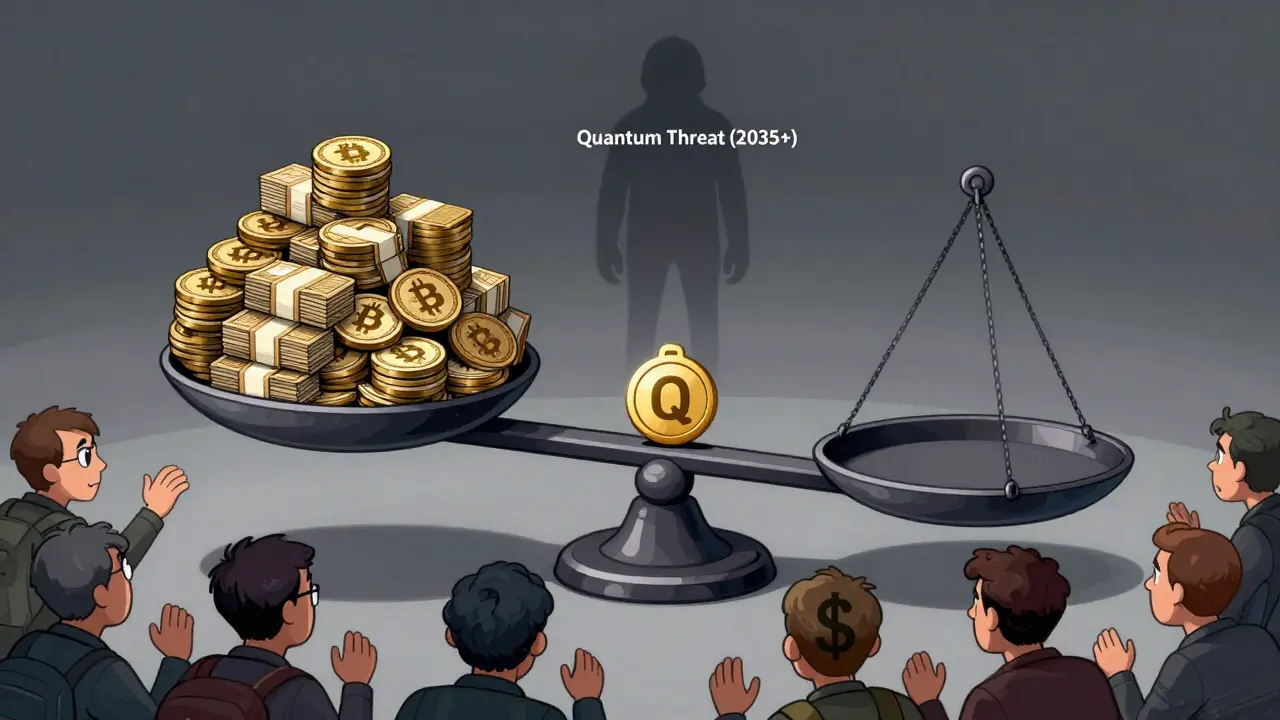
QuantumCoin (Q) isn’t just another cryptocurrency. It’s a bet on a future that hasn’t arrived yet - a blockchain built to survive attacks from quantum computers that don’t exist in any practical form today. If you’ve heard of it, you’re probably wondering: is this the next big thing, or a high-risk gamble on a theoretical threat?
What QuantumCoin Actually Is
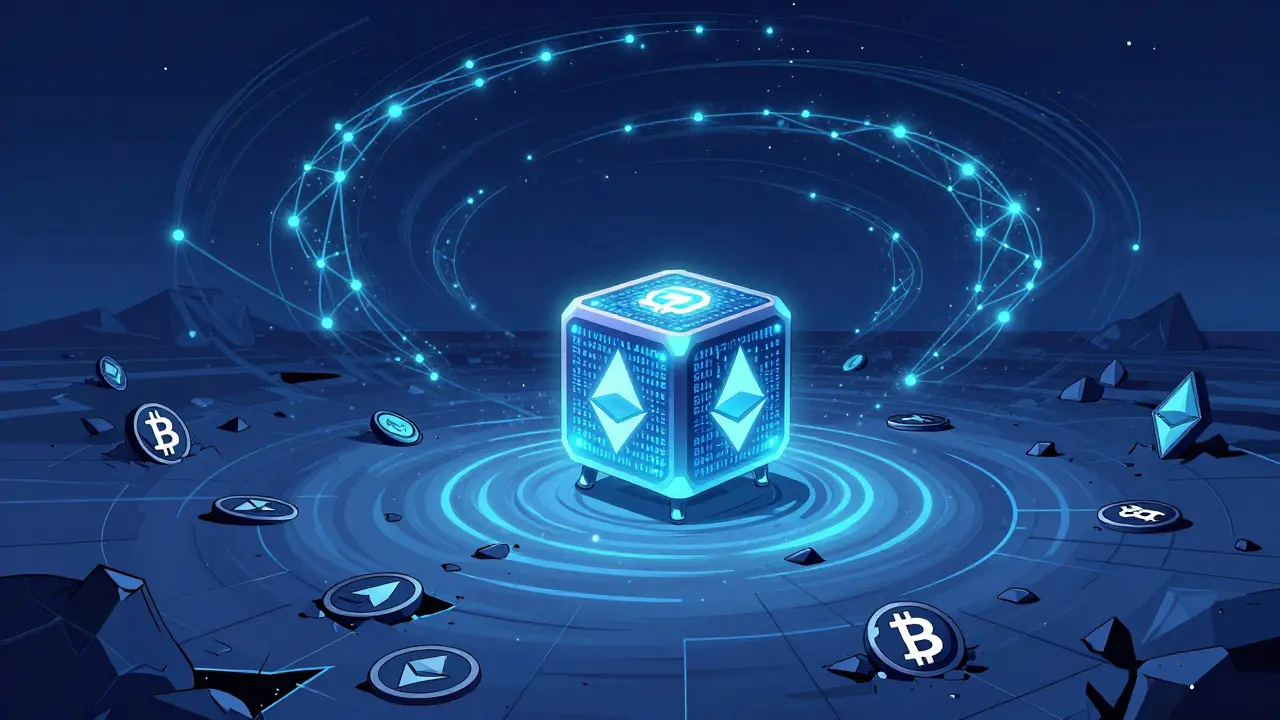
QuantumCoin (Q) is a Layer 1 blockchain launched on December 31, 2023. Unlike Bitcoin or Ethereum, it doesn’t rely on standard cryptographic algorithms like ECDSA or secp256k1. Instead, it uses NIST-standardized post-quantum cryptography in hybrid mode. That means it layers quantum-resistant algorithms on top of existing ones. The goal? To protect transactions even if a powerful quantum computer one day breaks today’s encryption.
This isn’t science fiction. NIST, the U.S. government’s standards body, has already selected lattice-based algorithms like CRYSTALS-Kyber and CRYSTALS-Dilithium as the future standard for quantum-resistant encryption. QuantumCoin is the only live blockchain as of early 2025 that has fully implemented these standards in production. That’s a technical achievement - if you ignore the timing.
How It Works: EVM Compatibility and Fast Finality
Here’s where QuantumCoin tries to stand out: it’s EVM-compatible. That means developers can write smart contracts in Solidity - the same language used on Ethereum - and deploy them directly on QuantumCoin. No need to learn a new language. No complex migration. If you’ve built on Ethereum, you can move your code over.
It also uses a 3-phase BFT consensus algorithm. Unlike Bitcoin’s proof-of-work or Ethereum’s proof-of-stake with probabilistic finality, QuantumCoin achieves immediate finality. Once a block is added, it’s final. No waiting for six confirmations. That’s a technical plus for speed and reliability.
But here’s the catch: none of this matters if no one uses it.
The Numbers Don’t Lie: Liquidity, Market Cap, and Trading Volume
As of December 15, 2025:
- Circulating supply: 17,446.85 billion Q tokens
- Max supply: 100 trillion Q tokens
- Price: $0.00000015 to $0.00000016
- Market cap: ~$2.61 million
- 24-hour trading volume: $8,712.69
That’s less than the daily volume of a single meme coin on Binance. You can’t buy $1,000 worth of Q without moving the price dramatically. The bid-ask spread on XT.COM is 15-20%. That means if you buy at $0.00000015, you’d need the price to jump 15% just to break even after fees.
On CoinCodex, 92% of holders are classified as short-term traders. The median holding period? Just 17 days. People aren’t using QuantumCoin to pay for goods or run dApps. They’re trading it, hoping someone else will pay more - even though there’s almost no one else to buy from.
Who’s Behind It? No Founders, No Company
QuantumCoin has no known founders. No corporate backing. No team photos. No LinkedIn profiles. It’s entirely community-driven, according to its own documentation. That’s not uncommon in crypto - but it’s rare for a project claiming to solve a problem as complex as quantum resistance.
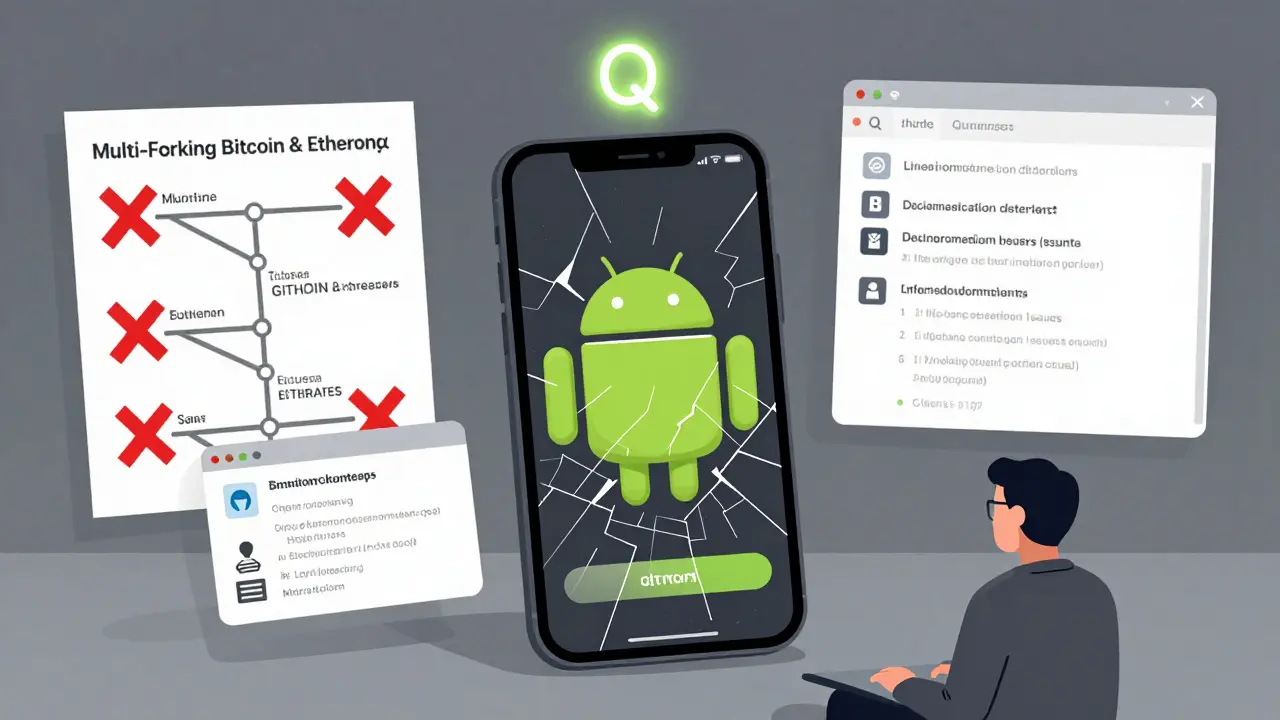
There’s no official support team. No help desk. No customer service. If your wallet crashes (and many users report it does), you’re on your own. GitHub issues show unresolved bugs from months ago. The Android wallet is still in beta. Syncing issues are common. The documentation? Incomplete. A November 2025 developer survey found 78% of respondents rated it as “incomplete.”
How It Compares to Other Quantum-Resistant Projects
QuantumCoin isn’t alone in trying to solve quantum threats. Other projects include:
| Project | Quantum Resistance | EVM Compatible? | Market Cap | Trading Volume (24h) |
|---|---|---|---|---|
| QuantumCoin (Q) | Yes (NIST hybrid) | Yes | $2.61M | $8,712 |
| QANplatform | Yes (NIST-based) | No | $8.2M | $45,000 |
| IOTA | Yes (WOTS+) | No | $1.8B | $120M |
| Algorand | Planned (not live) | No | $3.4B | $180M |
QuantumCoin is the only one with EVM compatibility - but it’s also the least liquid. IOTA and Algorand have real usage, real partnerships, and real volume. QuantumCoin? It’s a lab experiment with a token attached.
Expert Opinions: Brilliant Idea, Terrible Timing
Dr. Peter Waterland from MIT called QuantumCoin’s approach “a prudent transitional strategy.” He’s right - the math checks out. But he also noted: “Practical quantum threats remain theoretical for at least 5-7 years.”
Stanford’s Dr. Elena Rodriguez put it bluntly: “Resources devoted to quantum-resistant blockchains might be better spent improving scalability and usability of existing networks.”
Cointelegraph questioned whether QuantumCoin is truly “the only” blockchain with NIST crypto, pointing out that QANplatform is close behind. And Coingecko gave it a 3.2/5 for innovation but a 1.8/5 for ecosystem development.
The real problem? You can’t build an ecosystem on a theory. Developers won’t build apps on a chain with 1,842 active addresses. Exchanges won’t list it if volume is under $10K. Investors won’t hold it if they can’t sell.
Can You Use QuantumCoin Today?
Technically, yes. You can:
- Download the desktop wallet or Android beta app
- Buy Q on XT.COM or P2B
- Run a validator node (if you’re technically skilled)
- Deploy a Solidity smart contract
But here’s what you can’t do:
- Sell more than a few thousand Q without crashing the price
- Find a merchant that accepts Q
- Get help if your wallet freezes
- Trust that the roadmap (multi-forking Bitcoin and Ethereum) will ever happen
The only people making money are those who bought at launch and sold early. One P2B user reported a 300% gain - but also admitted, “impossible to sell meaningful amounts without crashing price.”
Is QuantumCoin a Scam?
No. The code is open. The cryptography is real. The NIST algorithms are publicly verifiable. This isn’t a rug pull. There’s no evidence of fraud.
But it’s a classic case of a brilliant solution to a problem that doesn’t exist yet - and the market has already moved on. Bitcoin and Ethereum aren’t going to be broken by quantum computers next year. They might not be broken at all. NIST’s own timeline estimates cryptographically relevant quantum computers are 10-15 years away. By then, QuantumCoin might be obsolete, or worse - irrelevant.
The Bottom Line
QuantumCoin is a fascinating technical experiment. It’s the only live blockchain using NIST-standardized quantum-resistant crypto. It’s EVM-compatible. It has immediate finality. These are real achievements.
But it’s also a ghost town. No users. No developers. No liquidity. No future use cases. The entire value proposition rests on a future threat that may never materialize - or may be solved by other means before QuantumCoin ever gains traction.
If you’re a crypto enthusiast who wants to support cutting-edge research, you might buy a few tokens for fun. But treat it like a lottery ticket - not an investment. Don’t expect to cash out. Don’t expect it to grow. And don’t expect anyone to care about it in 2027.
QuantumCoin isn’t the future of crypto. It’s a footnote in the history of crypto - if it’s remembered at all.
Is QuantumCoin (Q) a good investment?
No, not as a traditional investment. QuantumCoin has extremely low liquidity, minimal trading volume, and no real-world utility. Its value is speculative and based entirely on the unproven theory that quantum computers will break current blockchains soon. Even if that happens, QuantumCoin may be too late. Only invest money you’re prepared to lose entirely.
Can I mine QuantumCoin?
No, QuantumCoin uses proof-of-stake, not proof-of-work. You can’t mine it. Instead, you can stake Q tokens to become a validator and earn rewards. But setting up a validator node requires technical knowledge, and the documentation is incomplete. Most users simply hold or trade the token.
Where can I buy QuantumCoin (Q)?
As of December 2025, QuantumCoin trades only on two small exchanges: XT.COM and P2B. It’s not listed on Binance, Coinbase, Kraken, or any major platform. You’ll need to transfer funds to one of these exchanges and trade for Q using USDT or BTC. Be aware that liquidity is extremely low - even small trades can move the price significantly.
Is QuantumCoin compatible with MetaMask?
Yes, because it’s EVM-compatible, you can add QuantumCoin as a custom network in MetaMask. You’ll need to manually enter the RPC URL, chain ID, and currency symbol (Q) from QuantumCoin’s official documentation. But be warned: even if you connect, you won’t find any dApps or tokens on the network. It’s essentially an empty chain with no ecosystem.
Will QuantumCoin ever reach $0.01 or higher?
It’s mathematically possible, but extremely unlikely. To reach $0.01, the market cap would need to hit $1 trillion - more than Bitcoin’s current value. Given that QuantumCoin’s current market cap is under $3 million and trading volume is under $10K daily, there’s no mechanism for such growth. No institutional adoption, no developer activity, no real use cases. Without these, price increases are purely speculative and unsustainable.
What happens if quantum computers become a real threat?
If cryptographically relevant quantum computers emerge, QuantumCoin’s design would protect it - but only if it’s still in use. The bigger risk is that Bitcoin and Ethereum will upgrade their cryptography before QuantumCoin gains any real adoption. Most experts believe legacy chains will patch their systems rather than be replaced. QuantumCoin’s chance of becoming the default solution is near zero.
Comments (8)

- Terrance Alan
- December 16, 2025 AT 08:34 AM
Look I get it you’re excited about quantum resistance but this isn’t innovation it’s a graveyard with a whitepaper
People are trading this like it’s a lottery ticket because there’s nothing else to do with it
No dApps no merchants no devs just a bunch of guys flipping tokens on XT.COM while the rest of crypto moves on
And don’t even get me started on the wallet crashes
You think you’re investing in the future but you’re just funding a tech demo that nobody asked for

- Sally Valdez
- December 16, 2025 AT 16:46 PM
Of course some nerd thinks this is brilliant because it’s not on Binance
Real innovation doesn’t need a team or a website or even a functioning wallet
It just needs to be quantum resistant and somehow that’s enough for you to throw money at it
Meanwhile real countries are building actual infrastructure and we’re over here betting on a blockchain that can’t even handle 10K in daily volume
This isn’t progress it’s crypto’s version of a hamster wheel with a fancy name

- Elvis Lam
- December 18, 2025 AT 16:11 PM
Let me cut through the noise
QuantumCoin’s tech stack is legit NIST CRYSTALS-Kyber and Dilithium implemented in production on a live chain
That’s a huge deal if you understand cryptography
Yes the market cap is tiny yes the volume is garbage yes the wallet is buggy
But the core innovation isn’t in the price it’s in the code
Most projects talk about quantum resistance this one actually did it
And EVM compatibility means if quantum threats emerge tomorrow developers won’t need to rebuild everything from scratch
It’s not a bet on the future it’s a bet on the inevitability of change
And history favors the ones who prepared early
Yes it’s risky
But so was Bitcoin in 2011

- Sammy Tam
- December 19, 2025 AT 00:14 AM
I love how this feels like a sci-fi movie where the hero builds a time machine in their garage and nobody shows up to the premiere
It’s beautiful in a weird way
The math works the code is open the consensus is fast
But the whole thing is just… empty
No one’s building on it
No one’s using it
It’s like a Ferrari with no roads
And yet somehow I still kinda admire it
Like maybe someday someone will look back and say hey remember that weird blockchain nobody cared about that had the right crypto from the start
Until then I’m just here for the spectacle
And maybe buying a few Q for the meme value
It’s the most honest crypto I’ve seen in years

- Jonny Cena
- December 20, 2025 AT 08:40 AM
If you’re reading this and thinking about buying Q
Just take a breath
You don’t need to be the first to jump on every new thing
There’s no shame in waiting
Let the early adopters figure out the bugs
Let the devs fix the wallet
Let the ecosystem grow if it ever will
Right now this is a research project not an investment
And that’s okay
There’s value in supporting innovation even if it’s quiet
Just don’t bet your rent money on it
Put in what you’re okay with losing and watch it evolve
That’s the real crypto spirit

- George Cheetham
- December 20, 2025 AT 23:33 PM
What is progress if not the courage to build something before the world is ready
QuantumCoin isn’t trying to be popular
It’s trying to be necessary
And necessity doesn’t always come with hype
Look at the internet in 1995
No one used it
No one understood it
But the protocols were there
And now we can’t live without it
QuantumCoin is the same
It’s not a currency it’s a precaution
A quiet whisper in a world screaming about memes and leverage
Maybe it will be forgotten
Maybe it will be the foundation of the next decade
Either way someone had to build it
And maybe that’s the real story here

- Sue Bumgarner
- December 20, 2025 AT 23:35 PM
Anyone who thinks this is a good idea hasn’t looked at the numbers
Market cap under 3 million
Trading volume less than a single Shiba Inu pump
And you’re seriously calling this innovation
It’s not quantum resistant it’s quantum irrelevant
And the fact that people still talk about it like it’s the next big thing just proves how desperate crypto is for new hype
Real blockchain projects don’t need 17 trillion tokens to make the price look cheap
They build utility
This has none
It’s just a math problem with a token attached

- Kayla Murphy
- December 22, 2025 AT 09:44 AM
I just bought 500,000 Q for $0.00000015
It’s not an investment
It’s a symbol
For the people who still believe in the long game
For the ones who think the future deserves a seat at the table
Even if no one else shows up
Even if the wallet crashes
Even if the volume stays low
I’m holding
Not because I expect to get rich
But because someone has to be here when the world finally catches up