
DeFi Loan Collateral Calculator
How Credit-Based Lending Works
Traditional DeFi loans require over-collateralization (typically 150% or more), meaning you lock up much more crypto than you borrow.
With a credit-based system like Boofus, your on-chain activity is used to generate an anonymous credit score, potentially reducing collateral requirements to 100-110%.
Example: Borrowing $1,000 could require $1,500 in collateral (150%) with traditional DeFi, but only $1,100 (110%) with credit scoring.
Calculate Your Savings
Results
Note: Actual collateral requirements vary by platform and credit score. This calculation uses a fixed 110% ratio to illustrate potential savings.
Boofus by Virtuals (BOOF) isn’t just another meme coin with a cute beaver logo. It’s an attempt to solve a real problem in decentralized finance: how do you give someone a credit score when they don’t use their real name or bank account? The answer, according to the team behind it, is an AI agent named Boofus - a buck-toothed, data-savvy beaver that analyzes crypto wallet behavior to generate anonymous credit scores.
What Boofus Actually Does
Most DeFi loans require you to lock up way more crypto than you want to borrow. If you want $1,000, you might need to put up $1,500 or even $2,000 as collateral. That’s because lenders can’t see your financial history like a bank can. They don’t know if you’ve paid back loans before. They don’t know if you’re reliable. Boofus tries to fix that. Instead of asking for your Social Security number or bank statements, it looks at your on-chain activity. Did you consistently pay back small loans? Did you trade at stable times? Did you avoid risky pools? All of that gets turned into a score - without ever knowing who you are. This isn’t science fiction. Traditional credit bureaus like Experian and TransUnion do the same thing with your spending habits. Boofus just does it on the blockchain, anonymously. The goal? Let people borrow without over-collateralizing. Imagine getting a $5,000 loan in DeFi with only $5,500 in collateral instead of $15,000. That’s the promise.The Token: BOOF
BOOF is the token that powers this system. It’s an ERC-20 token built on Ethereum, with a fixed supply of 1 billion coins - all of which are already in circulation. That means no more tokens will ever be created. The price? As of November 26, 2025, it’s trading around $0.000013 to $0.000017 per token. You can buy a million BOOF for less than $17. But here’s the catch: almost no one is trading it. CoinMarketCap shows $0 in 24-hour volume. Coinbase reports just $2.36. That’s not a typo. That’s less than the cost of a coffee. With only 940 holders total, this isn’t a liquid market. It’s a ghost town. The token’s original all-time high was $0.0004439 on January 17, 2025. That’s over 96% lower than today’s price. It hit an all-time low of $0 in April 2025, then bounced back slightly. That kind of volatility isn’t normal for a project with a real use case - it suggests little to no institutional or retail interest.Why It’s Not Working (Yet)
The idea behind Boofus is solid. There’s a real need for credit infrastructure in DeFi. Projects like Clearpool, TrueFi, and Maple Finance are already doing something similar - and they’ve raised millions. Their tokens trade at market caps in the tens or hundreds of millions. Boofus? Its entire market cap is around $15,000. So why hasn’t it taken off? First, there’s no clear way for users to interact with the AI. You can’t go to a website and get your Boofus score. There’s no app. No dashboard. No public API. The Virtuals.io site barely explains how the scoring works. It’s all vision, no execution. Second, the token doesn’t have a real function yet. It’s supposed to be used for governance - meaning holders vote on changes to the system. But if no one’s using the system, why would anyone vote? And if no one’s voting, why would anyone hold the token? Third, the team hasn’t shown any progress since launch. No updates. No partnerships. No integrations with DeFi protocols. No press releases. No community growth. Just a static website and a slowly dying token.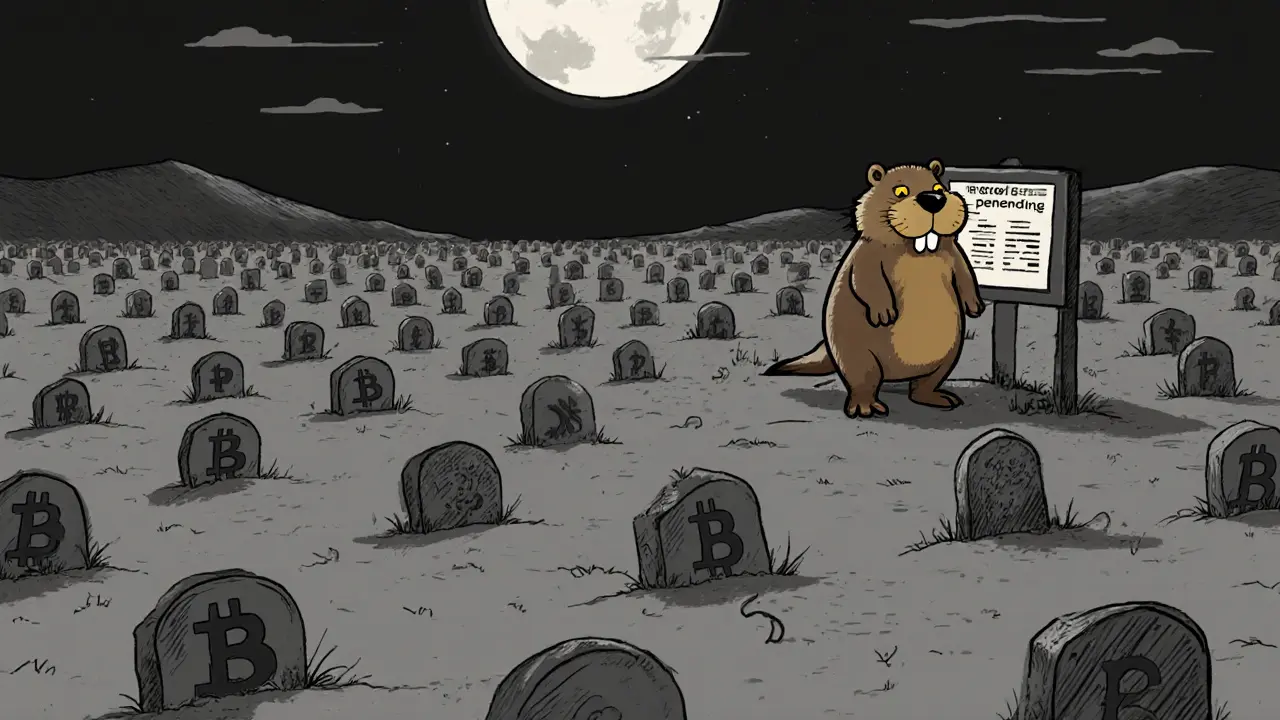
Who’s Holding It?
Only 940 wallets own BOOF. That’s fewer than most small NFT collections. Most of these are likely early speculators who bought at the peak and are now waiting for a rebound that hasn’t come. There’s no evidence of developers, DeFi protocols, or even crypto enthusiasts using it for its intended purpose. Compare that to a project like Aave, which has over 1 million wallet interactions per month. Or even a tiny DeFi lending protocol like Cream Finance, which has thousands of active users. Boofus has less than 1,000 holders. That’s not adoption. That’s a graveyard.Is It a Scam?
No. There’s no evidence of fraud. The contract is live on Ethereum. The team is named. The code is public. The idea isn’t stolen. It’s just… dead. This isn’t a rug pull. It’s a slow fade. The team launched a bold idea, but failed to build the product people could actually use. They created a token without a functioning ecosystem. They marketed a vision without delivering a tool. Many crypto projects fail this way. They raise attention with clever branding - a beaver with a calculator, AI-powered credit scores - but never get past the whitepaper. Boofus is one of them.What Could Save It?
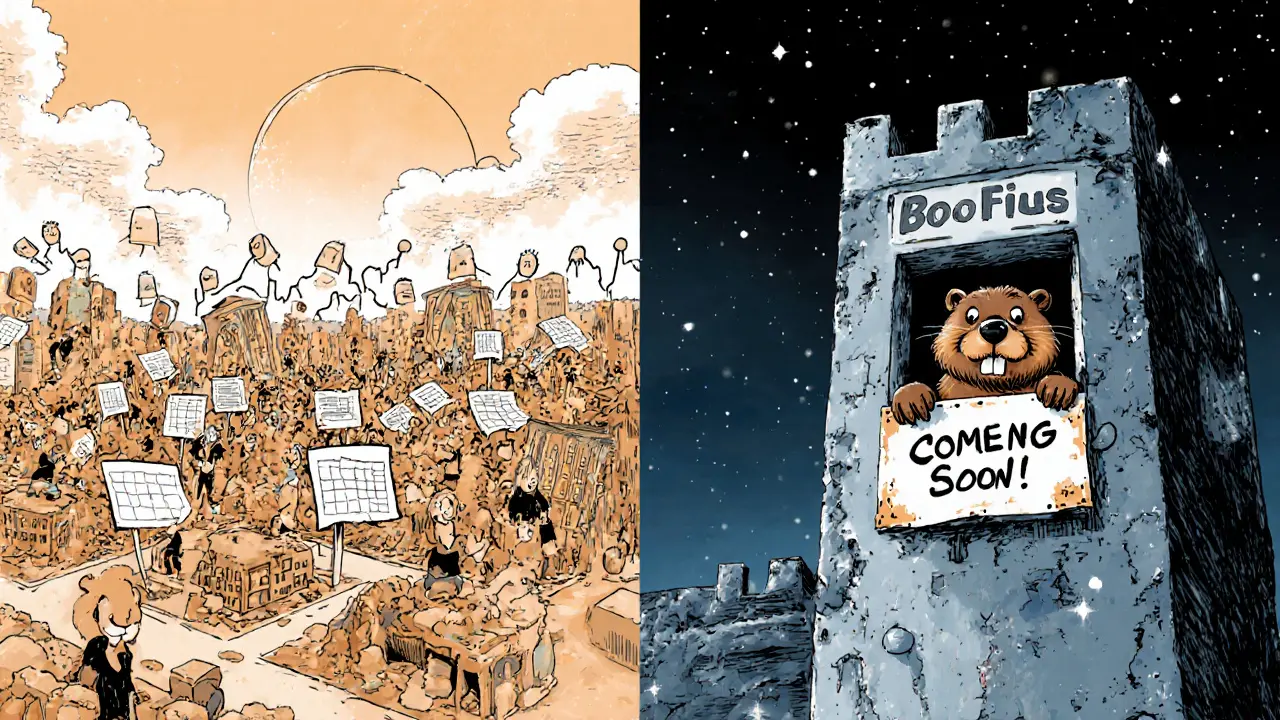
If the Virtuals team wanted to revive BOOF, they’d need to do three things:- Launch a public-facing dashboard where users can see their anonymous credit score.
- Partner with at least one DeFi lending protocol to start using Boofus scores for loan approvals.
- Give token holders real power - like voting on interest rates or credit model updates.
Should You Buy It?
If you’re looking to invest, the answer is no. The token has lost 99.2% of its value in a year. Trading volume is near zero. There’s no roadmap. No team updates. No community. The price predictions from CoinCodex say it could drop another 25%. If you’re a speculator hoping for a 100x moonshot, you’re playing Russian roulette with a loaded gun. There’s no liquidity to exit. No hype to fuel a pump. No reason to believe this will ever recover. If you’re a DeFi builder or researcher studying credit scoring models, then maybe keep an eye on it. But don’t buy it. Just watch.Where to Find It
You can find BOOF on a few small exchanges: Coinbase, CoinMarketCap, CoinGecko. The contract address is 0x8aaf...2f0f17. But don’t expect to trade it easily. Most wallets won’t even show it unless you manually add the token. The only real place to learn about it is Virtuals.io. But even there, the site feels abandoned. No blog. No Twitter feed. No Discord activity. Just a single page explaining the idea - and nothing else.Final Verdict
Boofus by Virtuals (BOOF) had a great idea. It wanted to bring credit scores to crypto. That’s valuable. But it failed to build the product. It failed to attract users. It failed to create liquidity. And now, it’s barely alive. This isn’t the future of DeFi. It’s a warning. Ideas alone don’t win in crypto. Execution does. And Boofus didn’t execute. If you’re looking for a crypto project that’s actually solving DeFi’s credit problem, look at Clearpool or Maple Finance. They’re real. They’re growing. They’re being used. Boofus? It’s a ghost. A cute, buck-toothed ghost with a dream that never left the drawing board.Comments (5)

- Savan Prajapati
- November 27, 2025 AT 19:38 PM
This is just another crypto ghost story. AI credit scores? Cool idea. But if your whole project has less volume than my morning coffee, you’re not building - you’re performing magic tricks for ghosts.

- Michael Labelle
- November 28, 2025 AT 13:45 PM
I’ve seen this pattern too many times. Brilliant concept, zero execution. The team probably got excited about the beaver logo and forgot to build the actual engine.
It’s sad because DeFi *does* need this. But without a working dashboard or integration, it’s just a PowerPoint deck with a token attached.

- Joel Christian
- November 29, 2025 AT 20:44 PM
boofus is soooo cool like imagine if your wallet had a lil beaver friend that checks if ur a good boy or bad boy??
but like… why is the price so low?? i bought 10m tokens for like 13 cents and now i feel like a dumbass??
plz someone tell me if this is gonna moon or if i just threw money into a black hole??

- jeff aza
- December 1, 2025 AT 08:19 AM
Let’s be precise: this isn’t a ‘failed experiment’ - it’s a classic case of a non-functional tokenomics model with zero utility-driven demand, compounded by a complete absence of protocol-level integrations, negligible liquidity depth, and an absence of on-chain usage metrics that would validate the AI scoring engine’s adoption.
Moreover, the token’s fixed supply and lack of staking, burning, or fee-sharing mechanics render it functionally inert - it’s a governance token for a system that doesn’t exist. The market is pricing in the absence of execution, not the absence of vision.
And yes - the 940 holders? That’s not a community. That’s a graveyard of early-stage FOMO participants who mistook branding for blockchain innovation.

- Vijay Kumar
- December 3, 2025 AT 03:17 AM
You think this is bad? Wait till you see the next AI animal token - the sloth that rates your DeFi patience. This is capitalism’s final joke: we pay for dreams dressed in cute logos while real infrastructure starves.
Boofus didn’t fail because it was bad - it failed because humanity still believes in magic, not math.