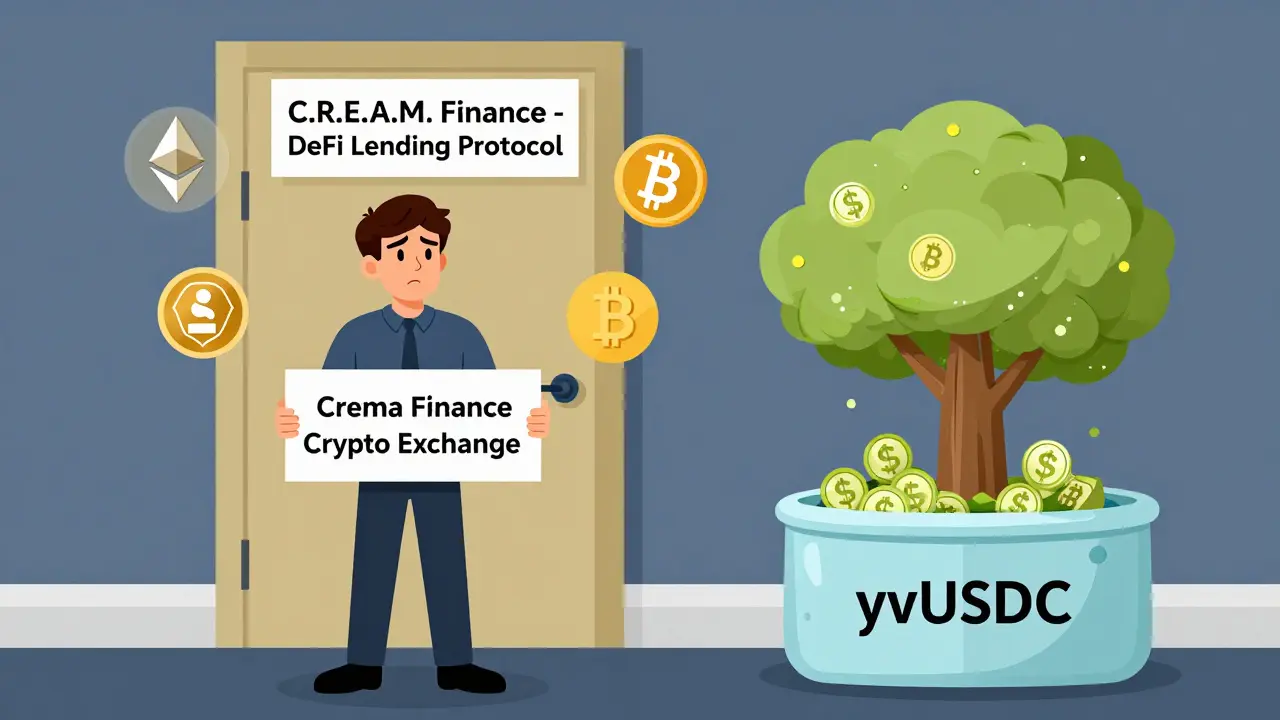

When you search for "Crema Finance crypto exchange," you're likely looking for a place to trade cryptocurrencies like Bitcoin or Ethereum. But here's the catch-there isn't a crypto exchange called "Crema Finance." What you're actually finding is C.R.E.A.M. Finance (Crypto Rules Everything Around Me). And while it sounds like a trading platform, it’s not an exchange in the way Binance or Coinbase is. It’s a DeFi lending protocol built on Ethereum and other blockchains. If you’re hoping to buy, sell, or swap coins directly, C.R.E.A.M. won’t let you do that. But if you want to lend, borrow, or earn interest on crypto assets, it might be worth your time.
What Is C.R.E.A.M. Finance Really?
C.R.E.A.M. Finance isn’t a startup that popped up last year. It was launched in August 2020 by Jeffrey Huang and a small team of four developers. Three of them had serious blockchain backgrounds-two worked on Ethereum, and one helped build OmiseGo. That’s not your average anonymous team. They didn’t build everything from scratch. Instead, they took proven code from Compound Finance, Balancer Labs, Curve, and Uniswap, and improved it. Think of it like modifying a reliable car engine to run on cheaper fuel and handle rougher roads.
Its main job? Lending and borrowing crypto without a bank. You deposit assets like yvDAI, yvUSDC, or LP tokens from Curve, and others borrow them. In return, you earn interest. Borrowers pay fees, and those fees get distributed to lenders and liquidity providers. That’s the same model as Compound, but C.R.E.A.M. added support for riskier, less liquid assets that other platforms ignore. That’s both its strength and its weakness.
Why It’s Not a Crypto Exchange
A real crypto exchange lets you trade one coin for another. You pick BTC/USDT, click buy, and it’s done. C.R.E.A.M. doesn’t have order books or matching engines. It doesn’t have a trading interface like KuCoin or Kraken. What it does have are automated market maker (AMM) pools borrowed from Balancer. These let users add liquidity to pools and earn fees from trades-but those trades happen between users, not through C.R.E.A.M. itself. So technically, you can trade via its pools, but it’s not designed for active trading. It’s designed for passive income.
If you’re a day trader, you’ll be frustrated. If you’re someone who holds crypto and wants to put idle assets to work, C.R.E.A.M. might be a good fit. But don’t confuse liquidity provision with spot trading. They’re not the same thing.
Multi-Chain Support: Where It Operates
As of 2025, C.R.E.A.M. Finance runs on six EVM-compatible blockchains: Ethereum, BNB Chain, Polygon, Fantom, Arbitrum, and Base. That’s not just a marketing buzzword-it’s a real strategy. Each chain has lower fees than Ethereum mainnet. So if you’re using Polygon, you can lend yvUSDC for pennies in gas. If you’re on BNB Chain, you can borrow ETH without waiting 10 minutes for confirmation.
This multi-chain approach lets users access lending across networks without bridging assets manually. The protocol syncs interest rates and collateral ratios across chains. That’s rare. Most DeFi projects stick to one chain. C.R.E.A.M. made it work across six. That’s why it once locked over $200 million in total value.
CREAM Token: Price, Supply, and Market Performance
The CREAM token is the backbone of governance and incentives. As of February 2026, it trades at $1.09 USD. That’s down from its all-time high of over $1,000 in 2021. The circulating supply is 1,855,660 tokens, with a market cap of just over $2 million. It ranks #1855 in the entire crypto space-meaning it’s a very small player now.
Over the last 24 hours, the price dropped $0.03. Over the past week, it fell 4.36%. In the last month, it lost another $0.04. That’s a clear downtrend. But here’s where it gets interesting: some analysts are predicting a rebound. One forecast suggests CREAM could hit $47.06 by the end of 2025, with a range between $45.47 and $48.67. That’s a 40x increase from current levels. Is that realistic? Probably not. But it shows how volatile and speculative this asset has become.
Why the disconnect? Because CREAM’s value isn’t tied to trading volume or user growth anymore. It’s tied to speculation. Most holders aren’t using the protocol-they’re just holding, hoping for a pump. That’s risky.
Security Risks: Past Exploits and Fixes
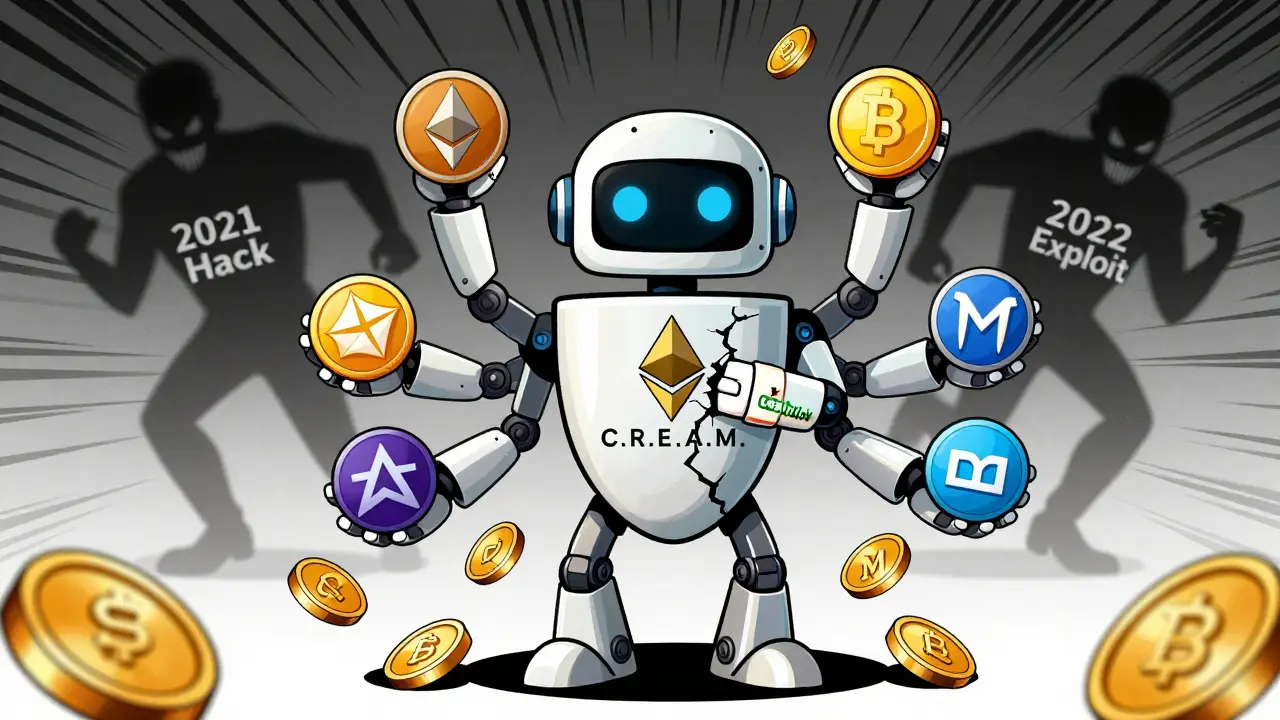
C.R.E.A.M. Finance has been hit hard by hacks. In 2021, attackers drained over $3 million by exploiting a flaw in the price oracle. Then in 2022, another exploit took $7 million. These weren’t small losses. They shook confidence in the project.
But here’s what they did right: they responded. Instead of hiding, they patched the system. They added redundancy by integrating Chainlink, Band, and their own internal price feeds. They capped flash loans to prevent sudden asset drains. They added whitelisting so new assets couldn’t be listed without approval. They even started regular audits with SlowMist and MixBytes-two respected security firms.
Still, the founder Jeffrey Huang once claimed C.R.E.A.M. didn’t need external audits because it was just a fork of Compound. That’s a red flag. Forking code doesn’t mean it’s safe. It means you copied it. And if the original had a flaw, you inherited it. The fact that they’ve improved since then is good. But their early attitude didn’t inspire trust.

How It Compares to Other DeFi Lending Platforms
| Feature | C.R.E.A.M. Finance | Compound | Aave |
|---|---|---|---|
| Supported Chains | 6 (Ethereum, BNB, Polygon, Fantom, Arbitrum, Base) | 1 (Ethereum, with limited Layer 2) | 4 (Ethereum, Polygon, BNB, Avalanche) |
| Asset Support | Highly flexible-supports yvTokens, LP tokens, aTokens | Standard stablecoins and major cryptos | Wide range, including collateralized NFTs |
| Price Oracle | Multi-source (Chainlink, Band, internal) | Chainlink only | Chainlink + internal fallback |
| Flash Loan Caps | Yes | No | Yes |
| Security Audits | Bi-monthly (SlowMist, MixBytes) | Occasional | Regular (Hacken, CertiK) |
| Token Utility | Governance + yield farming | Governance | Governance + staking rewards |
Compared to Compound, C.R.E.A.M. is more flexible. Compared to Aave, it’s less polished but more aggressive in asset support. If you want to lend obscure tokens like yvCRV or LP tokens from SushiSwap, C.R.E.A.M. is one of the few places that lets you.
Who Should Use C.R.E.A.M. Finance?
It’s not for beginners. If you’ve never interacted with a wallet like MetaMask, you shouldn’t touch this. It’s not for casual traders. If you’re looking to flip ETH for USDC, go to Uniswap.
It’s for experienced DeFi users who:
- Hold long-tail assets like yvDAI or LP tokens and want to earn interest on them
- Use multiple blockchains and want to lend across chains without bridging manually
- Understand the risks of smart contract exploits and accept them
- Want to participate in governance and vote on protocol changes
If you’re asking yourself, "Can I just deposit my Bitcoin and get paid?"-then no. C.R.E.A.M. doesn’t support Bitcoin. Only EVM-compatible assets.
Final Verdict: Is It Worth It?
C.R.E.A.M. Finance is not a crypto exchange. It never was. It’s a niche DeFi lending protocol that fills a gap others ignore. It supports weird, under-the-radar assets. It runs across six chains. It’s been hacked twice-but it learned.
Its token is in a deep slump. The community is small. The future is uncertain. But if you’re deep into DeFi and have assets sitting idle on Polygon or Arbitrum, C.R.E.A.M. might be the only place that lets you earn on them.
Don’t invest because someone says CREAM will hit $45. Do it because you understand the mechanics, you’ve tested the interface, and you’re comfortable with the risks. For most people, it’s too complicated. For a few, it’s still useful.
Is Crema Finance the same as C.R.E.A.M. Finance?
Yes. "Crema Finance" is a common misspelling or mispronunciation of C.R.E.A.M. Finance (Crypto Rules Everything Around Me). There is no separate crypto exchange called "Crema Finance." All search results and data refer to C.R.E.A.M., which is a DeFi lending protocol, not a traditional exchange.
Can I trade crypto on C.R.E.A.M. Finance like on Binance?
No. C.R.E.A.M. Finance does not have order books or a trading interface. You cannot buy or sell crypto directly on the platform. However, it hosts liquidity pools based on Balancer’s AMM model, so users can swap tokens within those pools-but this is not designed for active trading. It’s meant for earning fees by providing liquidity, not for buying low and selling high.
Is C.R.E.A.M. Finance safe to use?
It’s safer now than it was in 2021-2022, but it still carries risk. Two major exploits occurred, totaling over $10 million in losses. Since then, C.R.E.A.M. added multi-source price oracles, flash loan caps, and permissioned asset listing. It now undergoes bi-monthly audits by SlowMist and MixBytes. Still, it’s a DeFi protocol with complex smart contracts. Never deposit more than you can afford to lose.
What blockchains does C.R.E.A.M. Finance support?
As of 2025, C.R.E.A.M. Finance operates on six EVM-compatible blockchains: Ethereum, BNB Chain, Polygon, Fantom, Arbitrum, and Base. This multi-chain approach lets users lend and borrow across networks with low fees and fast transactions, without needing to bridge assets manually.
Why is the CREAM token price so low?
The CREAM token price dropped from over $1,000 in 2021 to around $1.09 in 2026 due to reduced protocol usage, lack of major updates, and loss of investor confidence after exploits. While some analysts predict a rebound to $45-$48 by end of 2025, these are speculative forecasts. The current low price reflects low demand and minimal trading activity-not fundamental collapse.
Can I stake CREAM tokens to earn rewards?
Yes, but not directly. CREAM tokens are used for governance voting, not staking for yield. To earn rewards, you need to provide liquidity to C.R.E.A.M. lending pools (e.g., deposit yvUSDC or LP tokens) and earn interest or farming incentives. Holding CREAM alone doesn’t generate passive income-it only lets you vote on protocol changes.


Comments (9)

- Ifeanyi Uche
- February 25, 2026 AT 11:34 AM
Y'all keep calling it "Crema Finance" like it's some latte shop for degens. C.R.E.A.M. stands for Crypto Rules Everything Around Me - not "Creme Brûlée Finance." You're not here to sip espresso, you're here to get liquidated. If you don't know the difference between an AMM pool and a spot exchange, maybe stick to Coinbase and let the real players handle the riskier stuff. This isn't a game - it's a battlefield with smart contracts as weapons.

- Danny Kim
- February 25, 2026 AT 21:48 PM
So let me get this straight - you're telling me people are still holding CREAM tokens hoping for a 40x? Bro. The protocol got hacked for $10M total and now it's basically a ghost town with a token ticker. I love DeFi, but this feels like buying a used car with a "mechanic approved" sticker... signed by the guy who totaled it last Tuesday.

- Cathy Sunshine
- February 26, 2026 AT 16:48 PM
Oh, how quaint. A DeFi protocol that dares to support "obscure" assets like yvCRV and LP tokens - as if the entire ecosystem isn't already drowning in yield farming garbage. C.R.E.A.M. isn't innovative; it's a graveyard for failed experiments that couldn't even make it onto Aave. And yet, here we are, pretending this is some underground genius. No - it's just the last stop before the rug pull. The token's at $1.09? Good. That's the price of admission to the existential void.

- Shannon Black
- February 27, 2026 AT 04:57 AM
While the technical architecture of C.R.E.A.M. Finance presents an interesting multi-chain approach to decentralized lending, one must consider the broader implications of protocol fragmentation. The integration of six EVM-compatible chains, while operationally efficient, introduces significant composability risks. Furthermore, the reliance on legacy codebases from Compound and Balancer - however improved - raises questions regarding long-term auditability and regulatory alignment. This is not a product for retail users; it is a sophisticated instrument for institutional-grade actors with deep risk tolerance and technical literacy.

- Vishakha Singh
- February 27, 2026 AT 14:31 PM
For those new to DeFi, don't be scared off by the hacks - every major protocol had a rough start! Look at Aave - they had issues too. C.R.E.A.M. has improved so much since 2021: multi-oracle feeds, audit partners, flash loan caps - these are serious upgrades. If you have idle yvUSDC on Polygon or LP tokens on Arbitrum, this is one of the few places that actually lets you earn from them. Try it with a small amount first - learn the interface, read the docs, and then scale up. DeFi is about building, not just betting!

- Don B.
- February 28, 2026 AT 01:40 AM
So like… C.R.E.A.M. is just… a fancy way to say "I lost my money on Compound and now I'm mad?" Like bro, if you're still holding CREAM, you're basically donating to the guy who wrote the code while drunk. And don't even get me started on that $47 prediction. That's not a forecast - that's a cry for help.

- Arya Dev
- March 1, 2026 AT 02:51 AM
Let’s be real: the fact that people still type "Crema Finance" instead of C.R.E.A.M.… it’s not a typo. It’s a symptom. A symptom of a generation that consumes DeFi like TikTok trends - no context, no research, just vibes. And now, we have a protocol that literally survived two $5M+ hacks… and people are still asking if it’s "safe." Safe? No. Interesting? Maybe. Worth your time? Only if you’re ready to lose it all… and still post about it on Twitter.

- Leslie Cox
- March 1, 2026 AT 18:46 PM
It’s funny how people act like C.R.E.A.M. is some dangerous outlier - but honestly, it’s the most honest DeFi project left. Compound? They act like they’re angels. Aave? They slap on a "security audit" like a sticker on a lemon. C.R.E.A.M.? They got robbed, admitted it, fixed it, and kept going. They didn’t hide behind VC money or a whitepaper full of buzzwords. They just coded. And yes - the token’s trash. But the protocol? It’s still running. It’s still lending. It’s still letting people earn on assets no one else touches. If you’re not supporting this kind of grit, you’re not supporting DeFi - you’re just gambling.

- Robert Conmy
- March 1, 2026 AT 22:02 PM
Leslie, you’re delusional. "Honest”? This thing got drained by flash loans because they thought copying Compound code was enough. That’s not grit - that’s negligence. And now they’re pretending their multi-chain setup is genius? It’s just a desperate scramble to stay relevant. The only reason it still has $200M in TVL is because lazy yield farmers don’t know any better. You think this is innovation? It’s a house of cards built on expired contracts and hope. If you’re still holding CREAM, you’re not a DeFi believer - you’re a sucker.