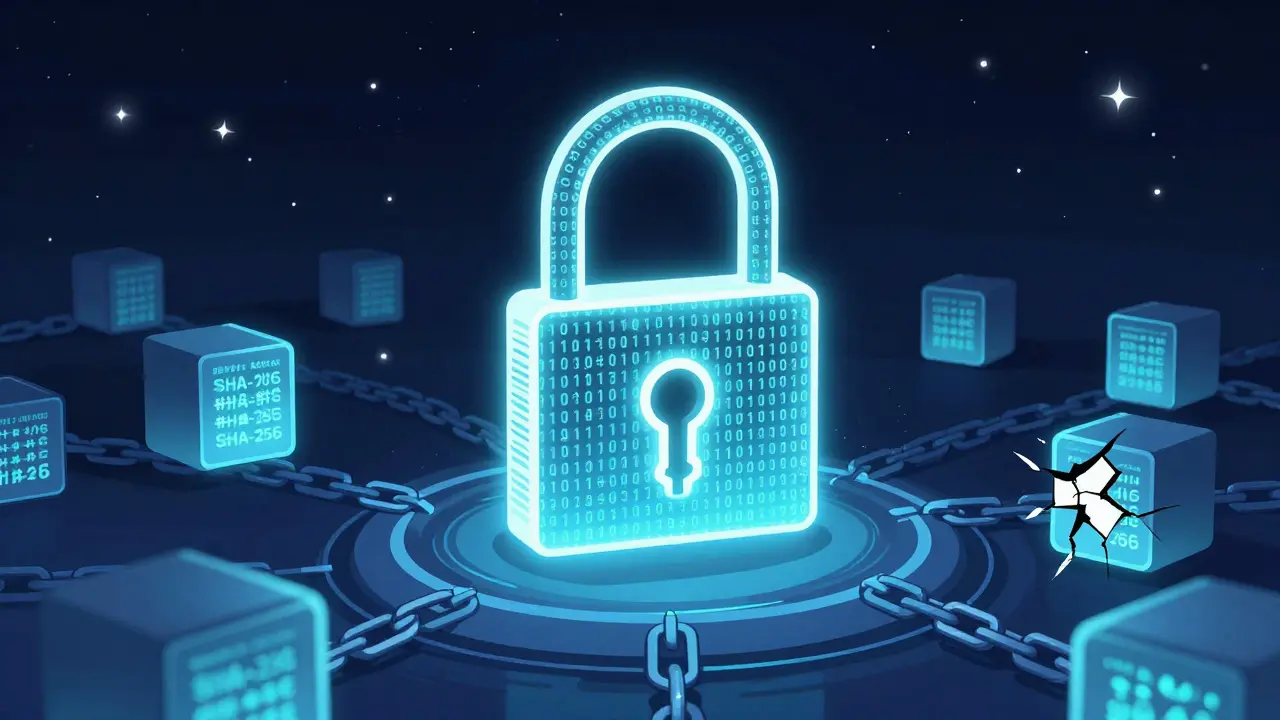

When you send Bitcoin from one wallet to another, no bank approves it. No middleman checks your balance. So how does the system know you own that money-and that no one else can steal it? The answer lies in cryptographic encryption. It’s not just a buzzword. It’s the invisible lock that keeps blockchain secure, tamper-proof, and trustworthy.
How Cryptographic Encryption Works in Blockchain
Cryptographic encryption in blockchain turns readable data into scrambled code that only authorized parties can unlock. Think of it like a digital safe. You put your transaction inside, lock it with a unique key, and drop it into a chain of other locked safes. Once locked, no one can open it without the right key-and if someone tries to force it open, the whole chain breaks.
This isn’t magic. It’s math. Three core cryptographic tools make this possible: hashing, public-private key pairs, and digital signatures.
Hash Functions: The Blockchain’s Fingerprint
Every block in a blockchain contains a hash-a fixed-length string of letters and numbers generated from the block’s data. Bitcoin uses SHA-256, a hash function that turns any input, whether it’s a single word or a megabyte of data, into a 64-character output.
Here’s why that matters: if you change even one letter in the transaction history-say, turning “send 1 BTC to Alice” into “send 1.1 BTC to Alice”-the hash changes completely. It’s like scrambling a DNA sample. The new hash won’t match the one stored in the next block. That mismatch tells the network: something’s wrong.
This is what makes blockchain immutable. You can’t alter past transactions without redoing every single block after it. And because each block links to the one before it, that’s computationally impossible on a live network.
Public and Private Keys: Your Digital Identity
Unlike traditional banking, where you log in with a username and password, blockchain uses asymmetric cryptography. That means you have two keys: a public key and a private key.
Your public key is like your bank account number. You can share it freely. Anyone can send cryptocurrency to it. Your private key, however, is your secret password. It’s the only thing that lets you spend the money in that account.
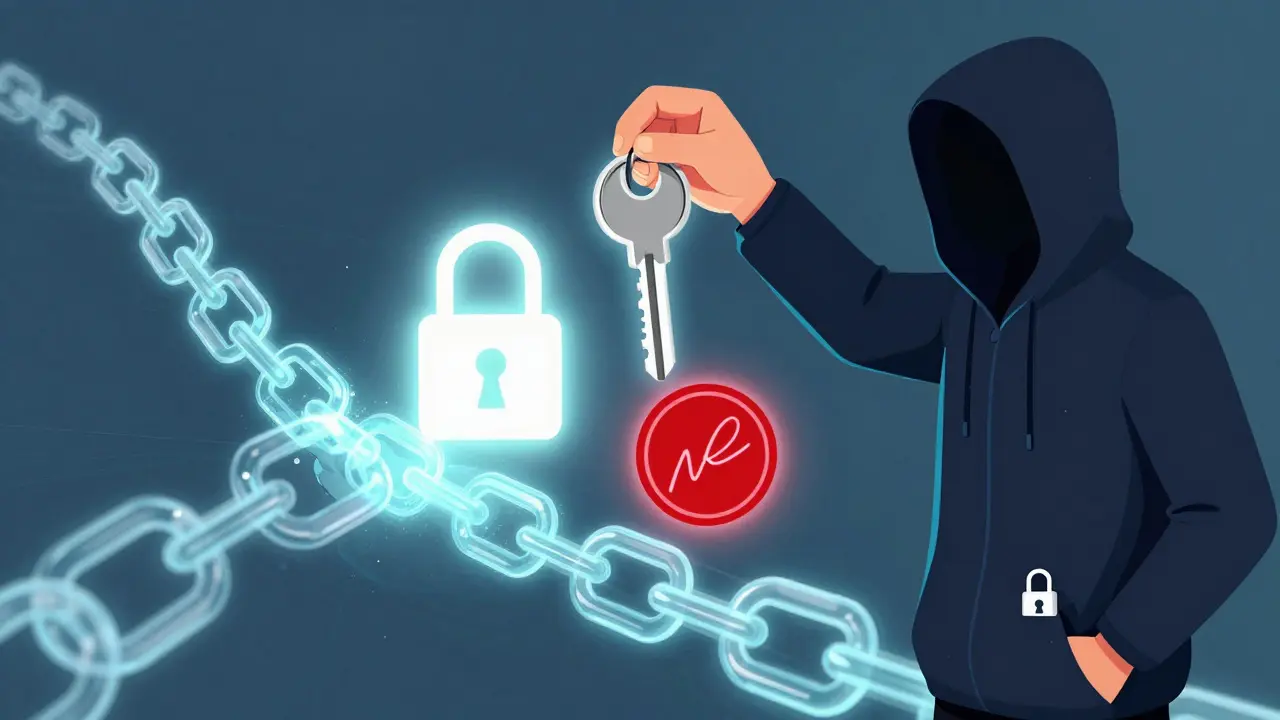
When you sign a transaction, your private key creates a unique digital signature. This signature proves you own the funds without ever revealing your private key. Others can verify the signature using your public key. It’s like stamping a document with a wax seal-anyone can check the seal is real, but only you had the stamp.
If you lose your private key? You lose access forever. There’s no reset button. No customer service line. That’s why wallet security isn’t optional-it’s everything.
Digital Signatures: Proving You Meant It
A digital signature isn’t just a fancy e-signature. It’s a cryptographic proof that a transaction came from you and hasn’t been changed after you sent it.
Here’s how it works: when you initiate a transfer, your wallet uses your private key to generate a signature tied to that exact transaction. The network checks the signature against your public key. If it matches, the transaction is valid. If even one digit is off-say, someone tried to change the recipient address-the signature fails.
This prevents replay attacks (where someone tries to reuse an old transaction) and stops fraud. No one else can fake your signature. Not even a hacker with full access to the blockchain.
Why Blockchain Encryption Is Different From Traditional Systems
Traditional databases-like your bank’s servers or cloud storage-are centralized. That means one company controls them. If they get hacked, your data is at risk. If they make a mistake, your records can be altered.
Blockchain encryption removes that single point of failure. Instead of one server, you have thousands of computers (nodes) checking every change. Each one validates transactions using cryptographic rules. No one can sneak in a fake transaction unless they control more than half the network-which is nearly impossible on major blockchains like Bitcoin or Ethereum.
Plus, encryption here isn’t just about hiding data. It’s about proving authenticity. Every transaction is publicly visible, but only the owner can spend it. That’s transparency without vulnerability.
Common Risks and Misconceptions
People often think blockchain is unbreakable. It’s not. It’s designed to be extremely hard to break-but not impossible.
- Weak key management: Most hacks happen because users lose private keys or store them insecurely. A hacker doesn’t need to crack SHA-256. They just need to steal your phone or phish your password.
- Quantum computing: Future quantum computers could break RSA and ECC encryption by solving complex math problems in seconds. SHA-256 hashing is more resistant, but not immune. Researchers are already working on quantum-safe algorithms.
- Smart contract bugs: Code on blockchain can’t be changed after deployment. If a contract has a flaw, attackers can exploit it. The 2016 DAO hack lost $60 million because of a single line of faulty code.
Encryption alone doesn’t make blockchain safe. It’s the combination of encryption, decentralization, and consensus that creates security.

Tools and Best Practices for Developers
If you’re building on blockchain, you don’t have to code encryption from scratch. Libraries like OpenSSL, Libsodium, and Ethereum’s Web3.js handle the heavy lifting. But you still need to use them right.
- Always use well-tested libraries-don’t roll your own crypto.
- Store private keys in hardware wallets or secure enclaves, not on phones or cloud drives.
- Use multi-signature wallets for large funds. Require 2 or 3 keys to approve a transaction.
- Regularly audit smart contracts with professional tools like Slither or MythX.
Even the strongest encryption fails if the human side is weak. That’s why training and awareness matter as much as code.
The Future of Encryption in Blockchain
As blockchain moves beyond crypto into supply chains, voting systems, and identity management, encryption must evolve too.
Zero-knowledge proofs (ZKPs) are one major breakthrough. They let you prove you know something-like a password or ownership-without revealing what it is. ZKPs are already used in privacy-focused blockchains like Zcash and are being adopted by Ethereum to improve scalability and privacy.
Researchers are also developing post-quantum cryptography. These new algorithms are designed to resist attacks from quantum computers. The U.S. National Institute of Standards and Technology (NIST) is finalizing standards now, and blockchain projects are starting to integrate them.
The goal isn’t to make encryption stronger. It’s to make it smarter-balancing security, speed, and privacy without sacrificing decentralization.
Final Thoughts
Cryptographic encryption is the reason blockchain works. Without it, there’s no trust. No immutability. No ownership. It’s the invisible engine behind every transaction, every wallet, every smart contract.
It’s not perfect. It’s not infallible. But when used correctly-with strong keys, proper tools, and smart design-it creates a level of security no traditional system can match.
If you understand how encryption works in blockchain, you understand why it matters. Not just for Bitcoin. For the future of digital ownership itself.
What is the main purpose of cryptographic encryption in blockchain?
The main purpose is to secure transactions, verify ownership, and prevent tampering. It ensures that only the rightful owner can spend their digital assets, that data can’t be altered after being added to the chain, and that every transaction is verifiable without revealing private information.
Does blockchain use symmetric or asymmetric encryption?
Blockchain primarily uses asymmetric encryption, also known as public-key cryptography. This system uses a public key to verify transactions and a private key to sign them. Symmetric encryption (same key for encrypting and decrypting) is rarely used in blockchain because it doesn’t support decentralized identity verification.
Why is SHA-256 used in Bitcoin?
SHA-256 is used because it creates a unique, fixed-size hash for every block, making it nearly impossible to reverse-engineer the original data. Even a tiny change in input produces a completely different hash, which helps detect tampering. It’s also computationally expensive to brute-force, which adds security to Bitcoin’s proof-of-work mining.
Can quantum computers break blockchain encryption?
Current quantum computers can’t break blockchain encryption yet, but they could in the future. Algorithms like RSA and ECC (used in some wallets) are vulnerable. SHA-256 hashing is more resistant, but not immune. The industry is already developing quantum-resistant algorithms, and blockchains will need to upgrade to stay secure.
What’s the biggest threat to blockchain security today?
The biggest threat isn’t the encryption itself-it’s poor key management. Most hacks happen because users store private keys on insecure devices, reuse passwords, or fall for phishing scams. Even the strongest cryptographic algorithms can’t protect a lost or stolen private key.


Comments (5)

- Issack Vaid
- March 7, 2026 AT 21:42 PM
Let’s be real - cryptographic encryption in blockchain isn’t some mystical force. It’s just math that got a PR team and a bunch of bros in hoodies yelling ‘decentralization!’ like it’s a religion. SHA-256? Cool. Public-private keys? Sure. But let’s not pretend we’re not still relying on humans who write their seed phrases on Post-Its and stick them to their monitors.
And don’t get me started on ‘unhackable.’ The blockchain doesn’t get hacked. The *wallets* do. The *exchanges* do. The *people* do. The code is flawless. The users? Not so much. We built a vault with a titanium door… and then left the key under the mat because ‘it’s convenient.’

- Shawn Warren
- March 9, 2026 AT 09:21 AM
The elegance of asymmetric cryptography in blockchain is nothing short of revolutionary. The mathematical integrity of digital signatures ensures that ownership is verifiable without disclosure. Hash functions provide immutable provenance. This is not merely technological advancement. It is the foundation of a new paradigm of trustless interaction. We are witnessing the birth of a digital social contract. No intermediaries. No central authority. Just pure cryptographic logic enforcing accountability. This is the future. And it is already here.
Let us not underestimate the significance. The implications extend far beyond cryptocurrency. This is the architecture of truth in an age of misinformation.

- Jackson Dambz
- March 9, 2026 AT 21:25 PM
So let me get this straight. You’re telling me that after all this time, the entire security model of blockchain hinges on a 12-word phrase that some guy in his basement typed into his phone while drunk at 3 AM?
And we call this innovation?
Meanwhile, banks have customer service, fraud protection, and actual human beings who can say ‘I’m sorry, sir, we’ll fix this.’ Blockchain? ‘Oops, lost your key? Too bad. Your 50 BTC is now a very expensive digital paperweight.’
It’s not secure. It’s just inconvenient for criminals. And that’s not the same thing.

- Megan Lutz
- March 11, 2026 AT 12:45 PM
People act like encryption is the hero here, but honestly? It’s just the tool. The real hero is the *consensus mechanism* - the way thousands of nodes independently verify the same thing. That’s what makes it resilient. Encryption just makes sure the data doesn’t lie. But if everyone else is lying too, encryption doesn’t help.
And yes, SHA-256 is solid. But let’s not ignore that the weakest link is still the human who doesn’t back up their keys. We’ve been told for a decade: ‘Not your keys, not your coins.’ And yet 90% of users still treat their wallet like a bank account they forgot the password to.
Maybe we need better UX. Not better crypto.

- Datta Yadav
- March 12, 2026 AT 01:20 AM
Let me dismantle this entire narrative with surgical precision because the romanticization of blockchain encryption is a catastrophic delusion perpetuated by technocrats who’ve never seen a real-world attack surface. You speak of SHA-256 as if it’s divine, but let me remind you that even the NSA has publicly admitted that hash functions are vulnerable to length-extension attacks under certain conditions - and yes, they’ve been exploited in the wild, not just theoretically. And public-key cryptography? ECC is already on life support. The NIST quantum-resistant finalists? They’re not ‘coming soon’ - they’re being forced into adoption because the math is crumbling under pressure from Shor’s algorithm, which is no longer theoretical, it’s operational in labs with 50+ qubits. And you think a 12-word mnemonic is the answer? Please. The real vulnerability isn’t the key - it’s the *social layer*. The human who trusts a mobile app with their life savings because a YouTube video told them it’s ‘secure.’ The developer who uses Web3.js without auditing the underlying contracts because ‘it’s the standard.’ The exchange that stores private keys in hot wallets because ‘liquidity.’ This isn’t cryptography failing. This is civilization failing to evolve its trust infrastructure. And until we stop treating encryption like a magic shield instead of one fragile component in a fragile system, we’re just building castles on sand - and calling them fortresses.
Post-Comment
Categories
Popular Articles