
When you're looking for a crypto exchange that doesn't ask for your ID, charges almost nothing to trade, and lets you earn interest just by holding tokens, Biswap v2 stands out. But is it safe? Is it worth your time? And how does it really perform in 2025? This isn't another marketing page. This is what actually happens when you use Biswap v2 - the good, the risky, and the quiet details most reviews skip.
What Biswap v2 Actually Does
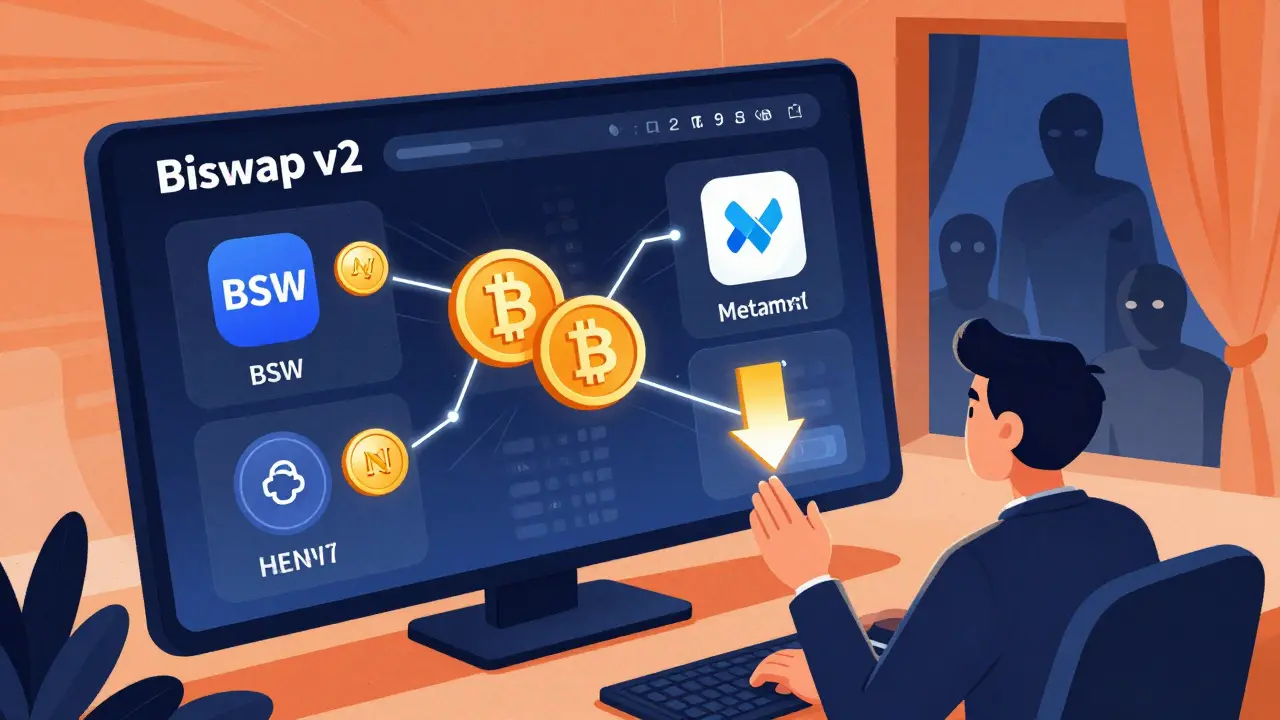
Biswap v2 is a decentralized exchange built on the BNB Chain. That means no bank, no government, no KYC. You connect your wallet - MetaMask, Trust Wallet, or any EVM-compatible one - and trade directly. No middleman. No delays. No paperwork.
It’s not just swapping tokens. Biswap v2 gives you yield farming, staking, a launchpad for new coins, an NFT marketplace, and even leverage trading up to 100x. That’s more than most DEXes offer. PancakeSwap might be bigger, but Biswap v2 tries to pack everything into one place. If you want to farm, stake, trade, and launch tokens without jumping between five different apps, Biswap v2 tries to be your all-in-one.
The BSW Token: More Than Just a Coin
The engine behind Biswap v2 is the BSW token. It’s not just a currency - it’s the key to the whole system. You need BSW to earn rewards in launchpools, to get discounted trading fees, and to stake for passive income. As of December 2025, BSW trades at around $0.0335, down from its all-time high of $2.13 in 2021. That’s a big drop, but it’s not unusual in DeFi. The token supply is capped at 644 million, with about 544 million already in circulation.
What’s interesting is how Biswap handles BSW. Every trade on the platform burns a small percentage of BSW. That’s a deflationary model - fewer tokens over time. Combine that with reduced emissions from farming rewards since 2023, and you get a token designed to slowly become scarcer. Whether that translates to higher prices is another question, but the mechanics are intentional.
Fees That Actually Matter
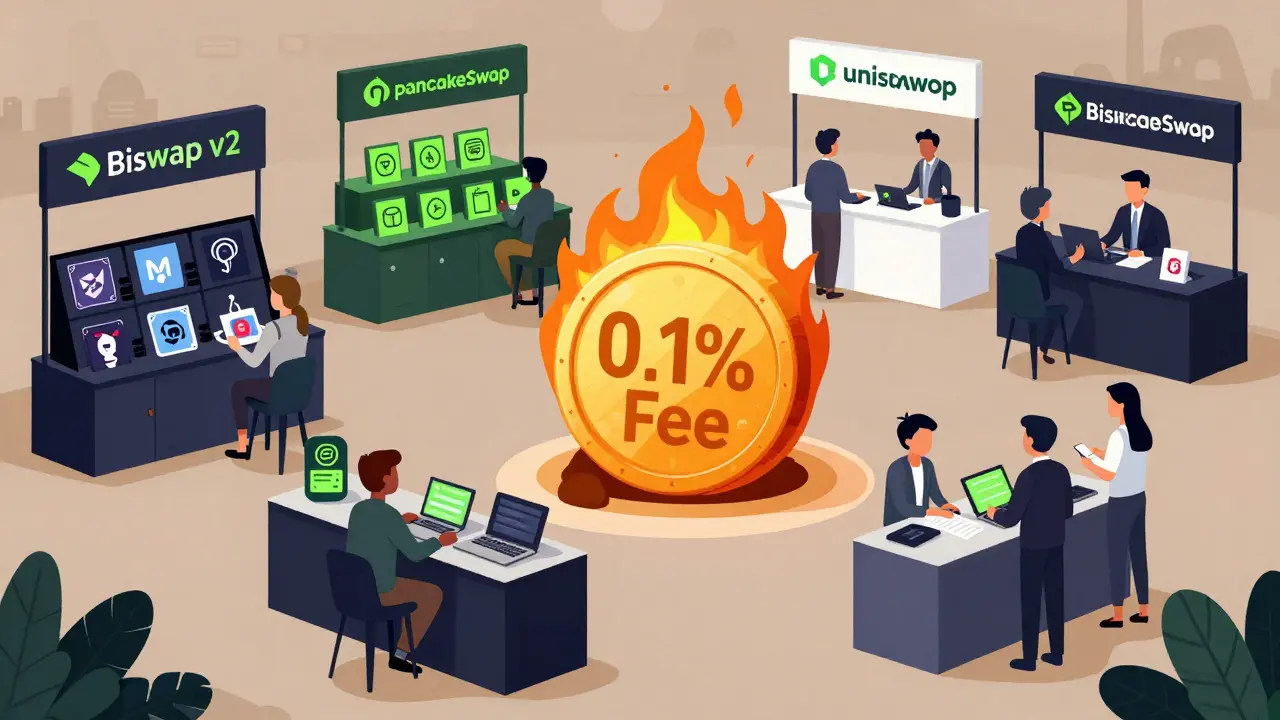
Most DEXes charge 0.25% to 0.3% per trade. Biswap v2 charges 0.1%. That’s less than half. For someone trading $10,000 a week, that’s $20 saved instead of $50. Over months, that adds up. And if you hold BSW, you can cut that fee even further - down to 0.05% in some cases.
That low fee is Biswap’s biggest selling point. It’s not marketing fluff. It’s built into the code. And it’s why users stick around even when BSW’s price dips. You’re not just trading crypto - you’re saving money on every swap.
Security: Audits, Upgrades, and Hidden Risks
Security is the big question with any anonymous team. Biswap’s developers didn’t reveal their identities, which raises eyebrows. But they did get audited - by CertiK, PeckShield, and Hacken. CertiK gave it an 88/100 score in May 2025. That’s solid for a DeFi platform.
They fixed critical bugs from 2023 with a multisig timelock system. That means changes to the smart contracts need approval from multiple people and can’t be rushed. It’s a slow process, but it prevents rogue updates. That’s a good sign.
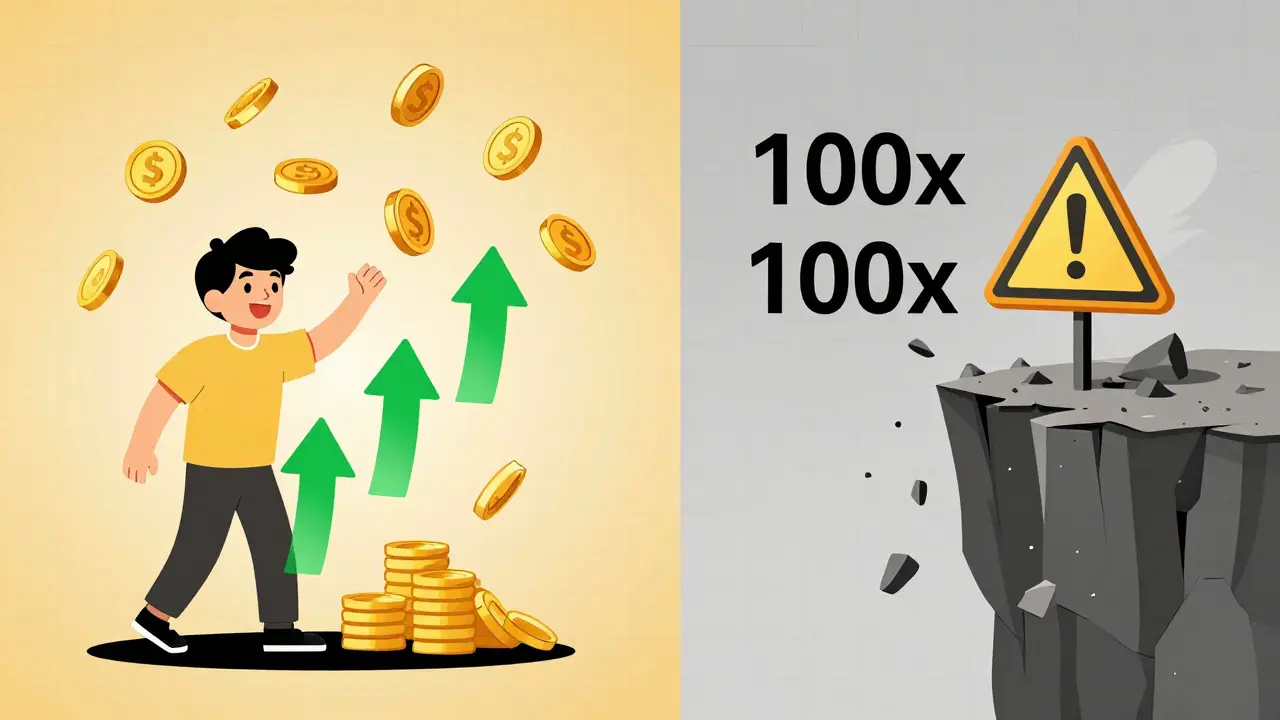
Still, no audit is perfect. Leverage trading up to 100x? That’s a recipe for liquidations. One wrong move and you lose everything. And since there’s no customer support team you can call, if something goes wrong, you’re on your own. You’re not just trusting the code - you’re trusting your own knowledge.
Real User Experience in 2025
Monthly traffic is around 34,000 visits. Not huge compared to Uniswap or PancakeSwap, but steady. Most of those visits come from organic search - people typing “Biswap v2” directly. That’s a sign of loyal users, not just hype.
Users on Reddit and DeFi forums say the same things: “Low fees are great,” “Yield farming is still profitable,” “The app works fine on Android.” But they also say: “I don’t know who’s behind it,” and “I wouldn’t put my life savings here.”
The mobile app is clean and responsive. Connecting your wallet takes two taps. Farming rewards show up daily. Swapping tokens is fast and cheap. But if you’re new to DeFi, the interface can feel overwhelming. There’s no hand-holding. You need to understand what LP tokens are, what APY means, and how impermanent loss works. Biswap doesn’t explain it - it just lets you do it.
How It Compares to the Competition
Here’s how Biswap v2 stacks up against other platforms on the BNB Chain:
| Feature | Biswap v2 | PancakeSwap | Uniswap v3 |
|---|---|---|---|
| Trading Fee | 0.1% (down to 0.05% with BSW) | 0.25% | 0.01%-0.3% (concentrated liquidity) |
| Leverage Trading | Up to 100x | No | No |
| Launchpad | Yes | Yes | No |
| NFT Marketplace | Yes | Yes | No |
| Staking Rewards | Yes | Yes | Yes (via third parties) |
| Token Burn | Yes (deflationary) | Yes | No |
| Anonymous Team | Yes | No (Binance-backed) | No (Uniswap Labs) |
Biswap wins on fees and features. It loses on trust. PancakeSwap has Binance’s backing. Uniswap has years of proven history. Biswap has low fees and aggressive rewards - but no public team. That trade-off matters.
Who Should Use Biswap v2?
If you’re comfortable with DeFi, know how to manage your own wallet, and want to maximize returns on small trades, Biswap v2 is a strong option. The low fees alone make it worth testing. If you’re already farming on PancakeSwap, try moving 5% of your capital here. See how the rewards compare.
But if you’re new to crypto, or you’re investing money you can’t afford to lose - avoid it. The 100x leverage is a trap for beginners. The anonymous team means no recourse if things go wrong. And while the audits look good, DeFi is still a wild west. No one is watching your back.
What’s Next for Biswap v2?
In 2025, Biswap is pushing cross-chain support. That means you’ll soon be able to swap tokens from Ethereum, Polygon, or Solana directly on Biswap v2 - without wrapping or bridges. That’s a big deal. It could bring in new liquidity.
They’re also improving capital efficiency. That’s a fancy way of saying they’re trying to make your money work harder. Less idle liquidity. More yield. That’s what every DeFi user wants.
But growth depends on one thing: trust. If BSW’s price starts climbing again - say, toward $0.07 as some predict - more users will come. If another exploit happens, or if regulators crack down on anonymous DEXes, it could all fall apart.
Biswap v2 isn’t the safest option. But it’s one of the most rewarding - if you know what you’re doing.
Is Biswap v2 safe to use?
Biswap v2 has been audited by CertiK, PeckShield, and Hacken, with a score of 88/100 from CertiK as of 2025. Critical vulnerabilities from 2023 have been patched with a multisig timelock system. However, the development team is anonymous, and there’s no customer support for lost funds. It’s technically secure but carries high trust risk. Only use funds you’re prepared to lose.
Can I trade fiat on Biswap v2?
No. Biswap v2 is a decentralized exchange that only supports crypto-to-crypto trades. You can’t deposit USD, EUR, or any fiat currency. You must first buy crypto on a centralized exchange like Binance or Gate.io, then transfer it to your wallet to use Biswap.
How do I earn rewards on Biswap v2?
You can earn rewards in three ways: 1) Provide liquidity to trading pairs and earn trading fees and BSW rewards; 2) Stake BSW tokens to earn additional BSW; 3) Participate in launchpools to earn new tokens from upcoming projects. All require connecting your wallet and locking assets in smart contracts.
What wallets work with Biswap v2?
Biswap v2 supports MetaMask, Trust Wallet, WalletConnect, SafePal, and Coin98. These are all EVM-compatible wallets that work on the BNB Chain. Make sure you’re on the BNB Chain network before connecting - using the wrong network can result in lost funds.
Is Biswap v2 better than PancakeSwap?
It depends. Biswap v2 has lower fees (0.1% vs. 0.25%), more features like 100x leverage and an NFT marketplace, and a deflationary token model. PancakeSwap has more liquidity, Binance backing, and a more polished user experience. If you want maximum rewards and don’t mind risk, Biswap wins. If you want reliability and safety, PancakeSwap is the safer pick.
What’s the future price of BSW?
Predictions vary. DigitalCoinPrice forecasts BSW could reach $0.0718 by late 2025, with a floor around $0.0291. WalletInvestor expects moderate growth. But these are speculative models based on historical data, not guarantees. BSW’s price depends on user adoption, token burns, and market sentiment - all of which are unpredictable. Never invest based on price predictions alone.
Final Thoughts
Biswap v2 isn’t for everyone. It’s for the do-it-yourself crypto user who values low fees, aggressive rewards, and full control - and who accepts the risks that come with anonymity and complexity. If you’re looking for a simple, safe place to hold Bitcoin, this isn’t it. But if you want to farm, trade, and earn on the BNB Chain with minimal fees, Biswap v2 is one of the most efficient tools available.
Start small. Test the waters. Learn how the rewards work. And never put in more than you’re willing to lose. In DeFi, the best returns often come with the biggest risks - and Biswap v2 is a perfect example of that balance.


Categories
Popular Articles