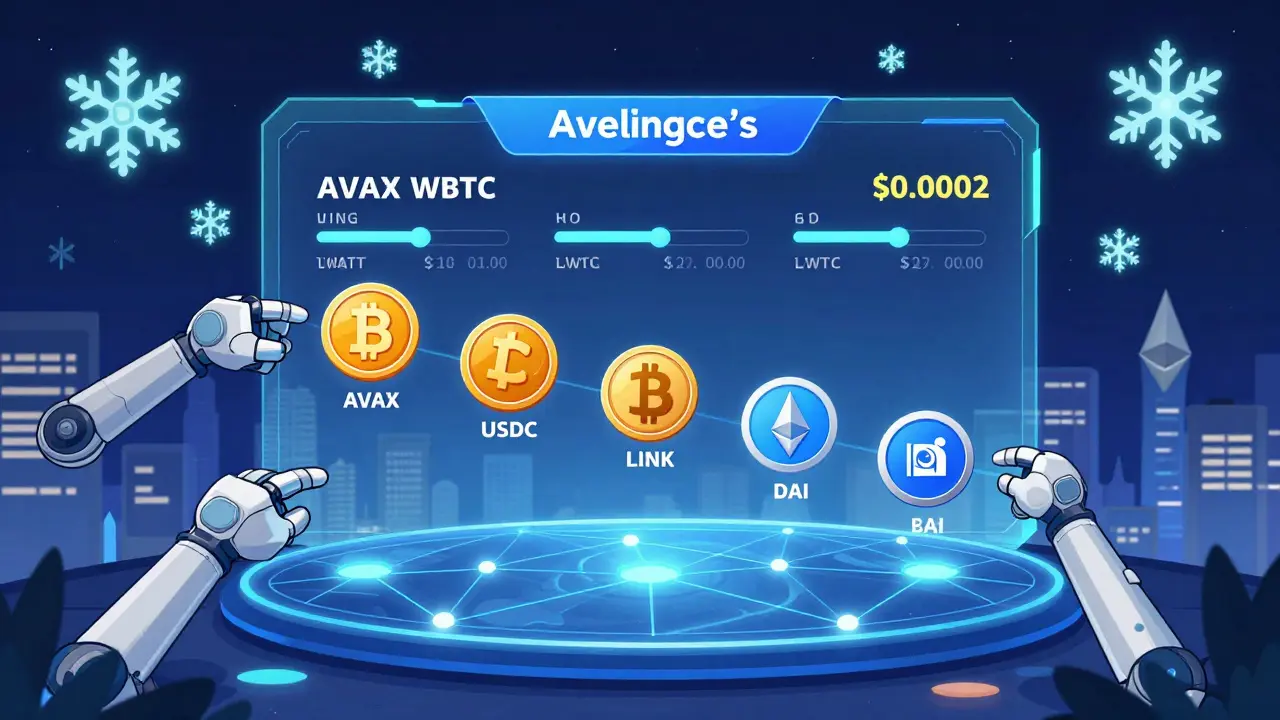

Most crypto traders think of decentralized exchanges as simple swap tools-buy ETH, sell USDC, done. But what if you’re holding a portfolio of five different tokens and need to rebalance them daily without paying $20 in gas and 3% slippage? That’s where Balancer V2 on Avalanche steps in. It’s not a typical DEX. It doesn’t compete with Trader Joe for volume. It competes with institutional portfolio tools, and it does it with math, not marketing.
What Makes Balancer V2 Different?
Balancer V2 on Avalanche isn’t built for quick trades. It’s built for precision. Unlike Uniswap’s fixed 50/50 pools, Balancer lets you create pools with up to eight tokens, each with custom weights. Think 60% AVAX, 20% WBTC, 10% USDC, 5% LINK, 5% DAI. You set the ratios. The protocol keeps them balanced automatically. Every time someone swaps in or out, the weights shift slightly-and the protocol adjusts by selling or buying tokens to restore your target allocation. This is called a weighted pool. It’s powerful if you’re managing a portfolio like a fund. A hedge fund might use it to maintain exposure to specific assets. A retail trader might use it to avoid manually rebalancing every week. The math behind it is elegant, but the implementation? That’s where things got messy.Why Avalanche? Speed, Cost, and the Trade-Off
Balancer chose Avalanche because it’s fast and cheap. On Ethereum, a single swap costs $1.27. On Avalanche C-Chain, it’s $0.0002. Block times are under a second. That’s why Balancer V2 launched there in June 2024. It’s the perfect environment for frequent, low-cost rebalancing. But speed isn’t everything. Avalanche’s C-Chain gets congested during peak hours. When it does, slippage spikes from 0.8% to 2.7%. That’s not a glitch-it’s a systemic risk. If you’re trading large amounts during a surge, your order might execute at a terrible price. And unlike centralized exchanges, you can’t pause trading. The protocol keeps running.The $125 Million Exploit and What Changed
On November 3, 2025, a vulnerability in Balancer’s invariant calculation led to a $125.7 million exploit. Attackers found a way to manipulate token scaling-specifically in stablecoin pools like USDT/USDTe-by exploiting how the protocol rounded numbers during conversions. They drained liquidity by creating fake BPT (Balancer Pool Token) values, then cashed out. This wasn’t a hack of the wallet. It was a flaw in the code’s arithmetic. The fix? A 3-day timelock on governance changes, an emergency pause button (active for 90 days after launch), and new circuit breakers. Balancer also added stricter checks for non-18-decimal tokens like USDTe (which has 6 decimals). But the damage was done. Trust took a hit. Today, the protocol is safer. But the scars remain. Experts like Chainalysis’s Katie Song still warn against using Balancer for stablecoin pairs until further audits confirm precision handling. And users? Reddit threads are split. One trader saved $187 in gas by rebalancing a 5-token portfolio. Another lost $2,300 in the exploit.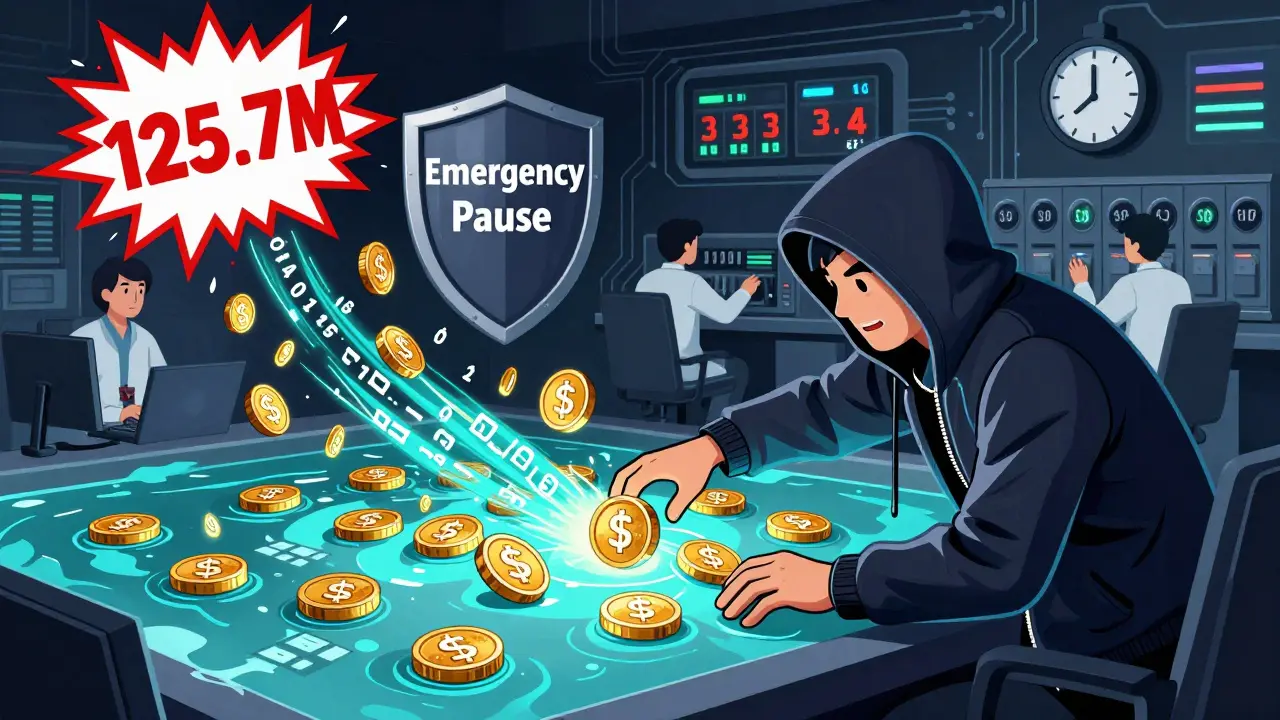
How It Stacks Up Against Other Avalanche DEXs
As of February 1, 2026, Balancer V2 holds just 2.3% of the Avalanche DEX market. Trader Joe leads with 41.7%. Pangolin is at 28.5%. Balancer isn’t even in the top two. Why? Liquidity. Trader Joe pays 15.3% APY in JOE tokens. Balancer pays 6.8% in BAL. That’s a huge incentive gap. Most users chase yield, not precision. So Balancer’s pools are thinner. Its 24-hour trading volume? $3.1 million. Trader Joe does $287 million. But here’s the twist: Balancer’s slippage on stablecoin trades is lower. At a $50,000 trade size, Balancer’s slippage is 0.02%. Uniswap V3’s 0.3% fee tier? 0.3%. That’s 15 times worse. If you’re moving large amounts of USDC or USDT, Balancer wins. If you’re flipping AVAX for 10 minutes? Trader Joe is faster and cheaper.Who Should Use Balancer V2?
You should use Balancer V2 on Avalanche if:- You hold multiple tokens and want to auto-rebalance them without manual trades
- You’re trading large stablecoin pairs and need minimal slippage
- You understand gas costs, token decimals, and slippage tolerance
- You’re not trading during peak Avalanche congestion (usually 12-4 PM UTC)
- You’re new to DeFi and don’t know what a BPT is
- You’re trading volatile assets with high frequency
- You expect 24/7 liquidity like on a centralized exchange
- You’re using non-standard tokens without checking their decimal places
How to Get Started
First, connect your wallet. MetaMask or WalletConnect works. Make sure you’re on Avalanche C-Chain. Chain ID: 43114. RPC URL:https://api.avax.network/ext/bc/C/rpc.
Next, go to app.balancer.fi and select Avalanche. You’ll see pools. Don’t pick the first one. Look at the token weights. Check the fees. Look for pools with high liquidity (over $1 million TVL).
Set your slippage tolerance:
- Stablecoin pairs: 0.3%-0.8%
- Volatile assets: 1.0%-2.5%

Security and Risks
The emergency pause is active. If another exploit happens, the team can freeze new deposits. But withdrawals still work. That’s a safety net. Still, risks remain:- Front-running: MEV bots snipe trades in low-liquidity pools. $412,000 was lost to sandwich attacks in January 2026.
- Oracle manipulation: OpenZeppelin’s January audit found three medium-risk issues in stable pool price feeds. Fixes are coming February 15, 2026.
- Tokenomics decay: BAL emissions are dropping. By December 2026, rewards could fall to 0.8% APY. That’s not enough to attract LPs.
What’s Next? Balancer V3 on Avalanche
Balancer’s next version, V3, is planned for Q2 2026. It’ll bring concentrated liquidity-like Uniswap V3-so you can pin your liquidity to a price range. That could fix the volume problem. It’ll also fix the precision bugs that caused the exploit. If V3 delivers, Balancer could grow to 5% market share on Avalanche, according to Messari. If it doesn’t? Delphi Digital predicts it’ll shrink to 1.4%. The difference? Execution.Final Verdict
Balancer V2 on Avalanche isn’t the best DEX for most people. It’s not the fastest. It’s not the cheapest. It’s not the most liquid. But if you need to manage a multi-token portfolio with surgical precision, it’s the only DEX that does it well. It’s the Swiss watch of decentralized finance-expensive to maintain, complex to use, but unmatched in accuracy. Use it if you’re an advanced user with a strategy. Avoid it if you’re just swapping AVAX for USDT. The tools are there. The risks are real. The math is sound. The bugs? They’re being fixed. But you still have to watch your back.Is Balancer V2 on Avalanche safe to use in 2026?
Balancer V2 on Avalanche is safer than it was after the November 2025 exploit, but it’s not risk-free. The protocol now has an emergency pause, 3-day timelocks, and improved precision checks. However, vulnerabilities in stablecoin pools and MEV risks still exist. Use it only if you understand the risks and avoid large trades during peak network congestion.
How does Balancer V2 compare to Trader Joe on Avalanche?
Trader Joe is faster, has more liquidity, and pays higher yields (15.3% APY vs. Balancer’s 6.8%). It’s better for quick swaps and high-volume trading. Balancer V2 is better for portfolio rebalancing with custom token weights and lower slippage on stablecoin trades. They serve different purposes. Most users pick Trader Joe. Advanced users pick Balancer.
What’s the minimum amount to use Balancer V2?
There’s no minimum to swap, but small trades (under $100) often lose more to slippage than they gain from low fees. For meaningful rebalancing, aim for $1,000 or more. For liquidity provision, most pools require $5,000+ to be worth the gas and complexity.
Can I lose money even if I don’t trade?
Yes. If you’re a liquidity provider, you can suffer impermanent loss if token prices shift dramatically. You can also lose money if the protocol is exploited (as happened in November 2025). Even if you don’t trade, your assets in a pool are exposed to smart contract risk.
Do I need to stake BAL tokens to use Balancer V2?
No. You can swap tokens and provide liquidity without holding BAL. But if you want to earn extra rewards from protocol fees or governance rights, you’ll need to stake BAL. The rewards are low compared to other DEXs, so staking is optional for most users.
What wallets work with Balancer V2 on Avalanche?
MetaMask, WalletConnect, and Coinbase Wallet all support Avalanche C-Chain. Make sure your wallet is configured for Chain ID 43114 and the correct RPC URL. Avoid using exchanges or custodial wallets-they don’t support direct DEX interactions.
Why do some transactions fail on Balancer V2?
Failed transactions usually happen because of incorrect token decimals (like using USDTe with 6 decimals instead of 18), too-low slippage tolerance, or Avalanche C-Chain congestion. Always check token details before swapping and increase slippage to 1% if you’re trading volatile assets.
Is Balancer V2 regulated?
Balancer is a decentralized protocol, so it’s not regulated like a centralized exchange. However, the BAL token is classified as a utility token under MiCA (EU’s crypto regulation), and transactions over €1,000 may be subject to FATF travel rules. Users in regulated jurisdictions should consult local laws before using it.
Comments (9)

- Katie Haywood
- February 4, 2026 AT 09:32 AM
I used Balancer to rebalance my 5-token portfolio last week. Saved $192 in gas vs. doing it manually on Trader Joe. The slippage was literally 0.01% on my USDC swap. But yeah, I set slippage to 0.8% and prayed. 🤞

- Paul Gariepy
- February 5, 2026 AT 05:06 AM
I'm sorry but I have to say this: the $125M exploit was NOT just a rounding error. It was a failure of input validation on non-18-decimal tokens. And yes, USDTe is 6 decimals, not 18. This is basic. You don't just assume decimals. You check. And if you don't? You deserve to lose money. Also, MEV bots are still eating lunch on Balancer. Don't be naive.

- Paul Jardetzky
- February 5, 2026 AT 19:30 PM
This is why I love DeFi. It’s not about making quick cash. It’s about building systems that work like clockwork. Balancer V2 is the closest thing we have to a robo-advisor for crypto. Yeah, it’s clunky. Yeah, it’s risky. But when it works? It’s poetry. I’ve automated my rebalancing now. No more manual trades. Just set it and forget it. (Unless Avalanche congests. Then I panic. 😅)

- perry jody
- February 5, 2026 AT 19:43 PM
I tried it. Lost $400 in one transaction because I didn’t check the token decimals. USDTe is 6 decimals. I thought it was 18. Rookie mistake. But hey, I learned. Now I double-check every pool. And I only use it for stablecoin rebalancing. No more AVAX flipping on this thing. Too risky. 😅

- Sharon Lois
- February 7, 2026 AT 07:38 AM
They say 'the math is sound.' Funny. The same people said that about Terra. And Mt. Gox. And FTX. The math always looks perfect until the rug gets pulled. And guess what? The emergency pause is active... but only for new deposits. Withdrawals still work. So who's really in control here? Just saying.

- mahikshith reddy
- February 7, 2026 AT 09:06 AM
This is why Westerners overcomplicate everything. You have Trader Joe - simple, fast, profitable. But you? You want 'precision.' You want 'weighted pools.' You want 'Swiss watch of DeFi.' Meanwhile, I made 14% in a week on JOE. You're overthinking. Crypto isn't engineering. It's gambling with better odds.

- Brendan Conway
- February 8, 2026 AT 07:59 AM
I don't get why people make this so hard. You got a wallet. You got some tokens. You want them to stay balanced? Use Balancer. It's not magic. It's just code. Yeah, it broke once. So did my toaster. I still use it. You don't have to be a genius. Just don't trade during peak hours. And don't use USDTe without double-checking decimals. That's it.

- Udit Pandey
- February 9, 2026 AT 06:23 AM
I find it deeply concerning that Western financial institutions are promoting such complex, unregulated instruments to retail investors. This is not innovation. This is financial colonialism disguised as decentralization. The fact that users are expected to understand token decimals and slippage tolerance is a moral failure. True financial inclusion requires simplicity. Not this.

- Jim Laurie
- February 11, 2026 AT 01:57 AM
I came in after the exploit and thought I was done with DeFi. But then I saw what Balancer did - they didn't just patch. They rebuilt. Added timelocks. Added circuit breakers. Added checks. That’s not just tech. That’s responsibility. And yeah, the APY is low. But I’m not here for the yield. I’m here because I have a portfolio that needs to stay aligned. I don’t want to babysit it. I want it to breathe on its own. And for that? Balancer’s the only one that gets it. I’m not rich. But I’m not stupid. I know what I’m doing. And I trust the math now. Even if it’s quiet. Even if it’s slow. It’s honest.