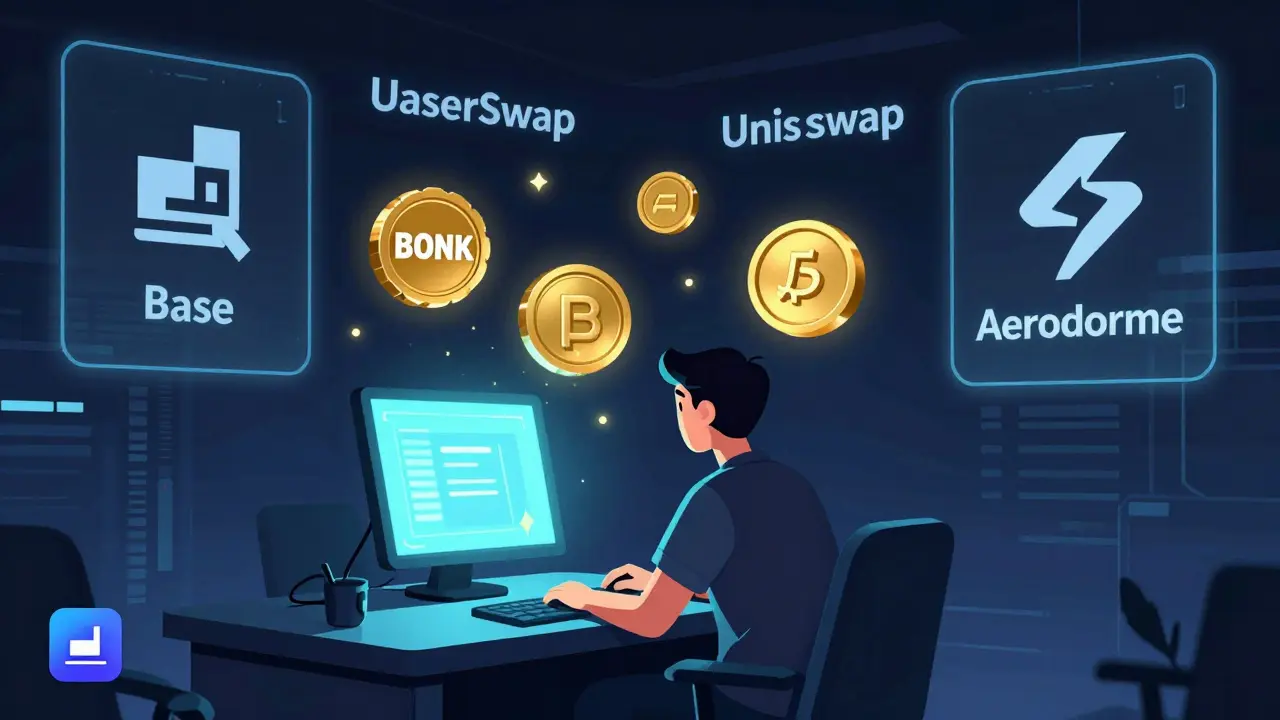

When you're trading crypto on the Base blockchain, you don't need a centralized exchange like Coinbase or Binance. You need something built for the network itself. That's where LaserSwap comes in. It's not the biggest decentralized exchange out there, but if you're trading new tokens on Base, it might be one of the few places you can actually do it.
What Is LaserSwap?
LaserSwap is a decentralized exchange (DEX) that runs entirely on the Base blockchain. Unlike centralized platforms, it doesn’t hold your money. Instead, it uses smart contracts to let users swap tokens directly with each other. No middleman. No KYC. Just you, your wallet, and the blockchain.
Launched in 2024, LaserSwap was built specifically for Base users - people who want fast, cheap trades without the congestion of Ethereum mainnet. It’s not trying to compete with Uniswap or PancakeSwap. It’s trying to be the go-to spot for early-stage tokens that haven’t made it to bigger exchanges yet.
How LaserSwap Works
LaserSwap uses the Automated Market Maker (AMM) model. That means instead of matching buyers and sellers like a stock exchange, it uses liquidity pools. Users deposit pairs of tokens - say, USDC and a new memecoin - into a pool. Other users then trade against that pool. In return, the depositors earn a share of the 0.3% trading fee.
Here’s how the fee breaks down:
- 0.25% goes to liquidity providers
- 0.05% goes to LaserSwap’s protocol treasury
Transactions on Base cost between $0.01 and $0.05 per swap. That’s a fraction of what you’d pay on Ethereum mainnet, where fees can spike to $3 or more during busy times. This makes LaserSwap ideal for small traders who do frequent swaps.
What You Can Trade
LaserSwap supports around 1,200 trading pairs. That sounds like a lot, but compare it to Uniswap’s 15,000+ - you’re looking at a much smaller selection. The real strength isn’t in volume. It’s in access.
Many new Base-native tokens launch on LaserSwap before they show up anywhere else. Projects like Bonk Live (BONK) got their first liquidity here. If you’re hunting for the next big memecoin or a new DeFi token that’s barely on CoinMarketCap, LaserSwap is one of the few places to find it.
But here’s the catch: if you want to trade USDT, WETH, or other major stablecoins, you’ll find tight spreads on Uniswap or Aerodrome. On LaserSwap, liquidity for those pairs is thin. Slippage for a $10,000 trade averages 1.2%, while Uniswap barely hits 0.4%. That means you could lose more money just from price movement during your trade.
Security and Audits
LaserSwap’s smart contracts were audited by BlockSec in March 2025. That’s good. But it’s not enough. Top DEXs like Curve Finance or Uniswap have been audited multiple times by firms like OpenZeppelin and Trail of Bits. LaserSwap has one audit, and no public report details what was found or fixed.
GitHub shows 127 open issues, with 43 classified as critical. One major front-running vulnerability was patched in August 2025. Front-running is when someone sees your trade before it executes and slips in ahead of you to profit. It’s a real risk on DEXs, and while it’s been fixed, the fact that it existed at all raises questions.
There are no reported scams tied directly to LaserSwap on CryptoScamDB. That’s a plus. But no security audit report means you’re trusting code you can’t fully verify. You’re not just trusting the team - you’re trusting the blockchain itself.

Interface and Usability
The interface is clean. It’s got three tabs: Swap, Pool, and Earn. If you’ve used Uniswap or SushiSwap before, you’ll feel right at home. You connect your wallet - MetaMask or Coinbase Wallet work fine - and start swapping.
But here’s where it gets tricky. LaserSwap doesn’t have fiat on-ramps. You can’t buy crypto with a credit card here. You need to get ETH or USDC on Base first, through another exchange or bridge. That’s a barrier for beginners.
Users report it takes 2-3 hours to complete their first trade. Why? Because you need to understand:
- How to approve token spending
- What slippage tolerance means
- Why your transaction might fail if the deadline is too short
- How gas fees work on Base
Documentation is weak. The GitHub wiki helps, but it’s not beginner-friendly. And if you get stuck? There’s no 24/7 customer support. You’re stuck in the Discord server - 12,340 members, but responses take an average of 4.7 hours.
Liquidity and Trading Volume
As of November 2025, LaserSwap processes about $8.7 million in daily volume. That’s tiny. Uniswap does $1.2 billion. BaseSwap, another DEX on Base, does $220 million. LaserSwap holds just 4.3% of the Base DEX market.
Most users trade less than $10,000 per month. The platform is clearly built for retail traders, not institutions. If you’re trying to move $50,000 in a single trade, you’ll get wrecked by slippage. The liquidity just isn’t there.
But for small trades - $100, $500, even $2,000 - it works. Especially if you’re buying a new token that’s not listed anywhere else.
Comparison to Other DEXs on Base
Here’s how LaserSwap stacks up against its main rivals on Base:
| Feature | LaserSwap | Aerodrome Finance | BaseSwap | Uniswap V3 (on Base) |
|---|---|---|---|---|
| 24h Trading Volume | $8.7M | $1.2B | $220M | $950M |
| Market Share on Base | 4.3% | 62.1% | 18.7% | 26.5% |
| Slippage ($10k trade) | 1.2% | 0.3% | 0.5% | 0.4% |
| Token Pairs | ~1,200 | ~8,000 | ~6,500 | ~15,000+ |
| Fiat On-Ramp | No | No | No | No |
| Advanced Order Types | No | Yes | Yes | Yes |
| Customer Support | Discord only | Discord + email | Discord + help center | Community forums |
Bottom line: LaserSwap is the underdog. It doesn’t have the tools, the volume, or the support. But it has something the others don’t - early access.

Who Is LaserSwap For?
It’s not for everyone. If you’re new to crypto, stick with Coinbase or Kraken. If you want to trade BTC, ETH, or USDT with low slippage, go to Aerodrome or Uniswap.
LaserSwap is for one type of user: the early adopter. The person who wants to buy a new token before it blows up. The trader who doesn’t mind a little risk for the chance of a 10x return. The one who’s already got a Base wallet, understands slippage, and knows how to check contract addresses.
If you’re trading Base-native memecoins, new DeFi projects, or tokens that haven’t hit major exchanges yet - LaserSwap is one of your only options. And right now, that’s valuable.
Future Outlook
LaserSwap is working on a v2 upgrade for Q1 2026. It’ll introduce concentrated liquidity - like Uniswap V3 - which could improve capital efficiency and reduce slippage. That’s a smart move.
But the odds are stacked against it. Twelve smaller Base DEXs shut down or merged in 2025. Messari predicts only 3-4 specialized DEXs will survive per Layer 2 chain by 2027. LaserSwap is betting it can be one of them.
Its survival depends on two things:
- Staying ahead of bigger DEXs as they expand into Base
- Keeping its user base engaged with new token listings
If it fails, users will flee to Aerodrome or BaseSwap. If it succeeds, it could become the go-to launchpad for Base’s next big projects.
Final Verdict
LaserSwap isn’t perfect. It’s slow to respond to issues. Its liquidity is thin. Its documentation is lacking. But it’s real. It’s active. And for a specific group of traders - the ones chasing early-stage tokens on Base - it’s one of the few places that still matters.
Use it if:
- You’re trading new Base-native tokens
- You’re comfortable with DEX mechanics
- You don’t need customer support
- You’re okay with higher slippage for access
Avoid it if:
- You’re a beginner
- You want to trade major stablecoins
- You need fast support
- You’re moving large amounts
It’s not the best DEX. But for its niche? It’s still one of the only ones.
Is LaserSwap safe to use?
LaserSwap is non-custodial, so your funds aren’t held by the platform. Its smart contracts were audited by BlockSec, but no public audit report is available. There are open GitHub issues, including a patched front-running vulnerability. It’s safer than a scam project, but not as secure as top-tier DEXs like Uniswap or Curve. Only use it if you understand the risks.
Can I buy crypto with fiat on LaserSwap?
No. LaserSwap has no fiat on-ramp. You need to buy crypto on another exchange like Coinbase or Kraken, then bridge it to the Base network before trading on LaserSwap.
What wallets work with LaserSwap?
LaserSwap supports MetaMask, Coinbase Wallet, and any other Web3 wallet that connects to Base. Make sure your wallet is set to the Base network before connecting.
How much does it cost to trade on LaserSwap?
Trading fees are 0.3% per swap. Gas fees on Base are typically $0.01-$0.05 per transaction. This makes it one of the cheapest DEXs for frequent traders.
Is LaserSwap better than Uniswap?
Only if you’re trading new Base-native tokens. Uniswap has far more liquidity, lower slippage, and better tools. But if the token you want isn’t listed on Uniswap, LaserSwap might be your only option. For most users, Uniswap is the better choice.
What happens if LaserSwap shuts down?
Your funds are safe. Since LaserSwap is non-custodial, your tokens are stored in your own wallet. You can still access them using your private key or seed phrase. You just won’t be able to trade on the platform anymore.
Does LaserSwap have a mobile app?
No. LaserSwap is a web-based platform only. You can access it through your mobile browser using MetaMask or Coinbase Wallet, but there’s no official app.
If you're hunting for the next big thing on Base, LaserSwap is still one of the few places where it might appear before anyone else. Just know what you're getting into.