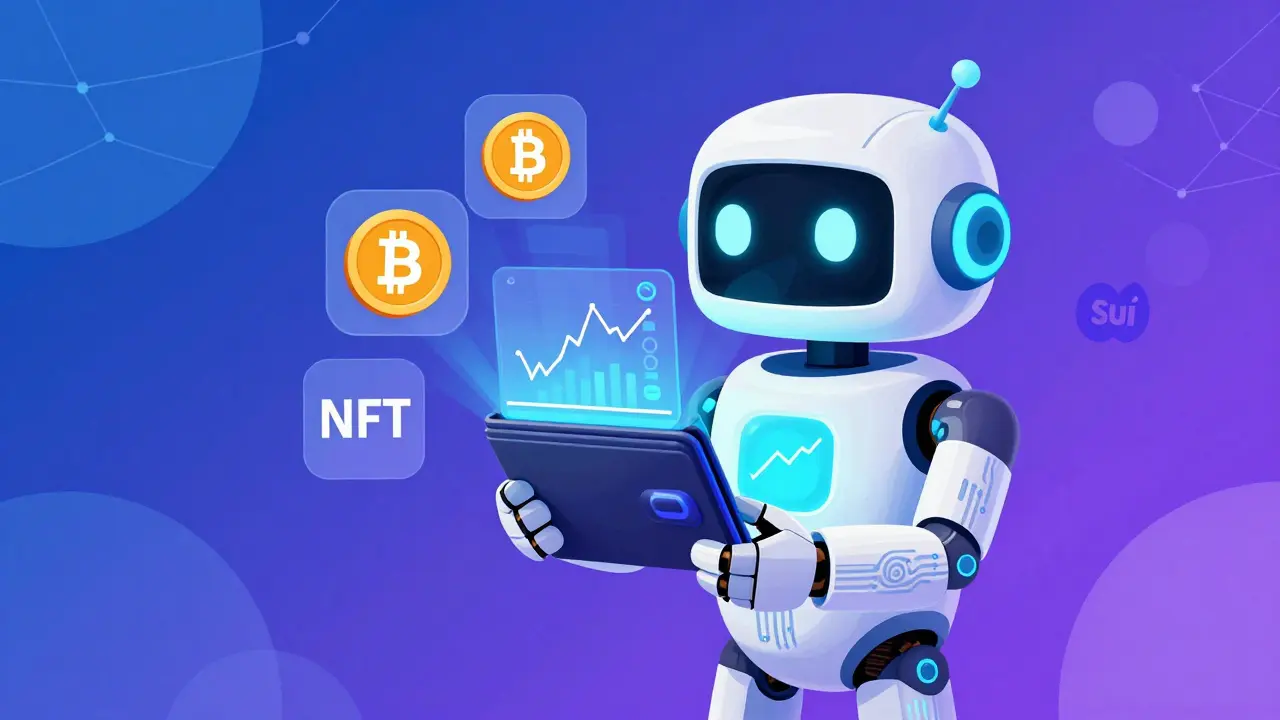

Imagine a digital assistant that doesn’t just answer your questions but can also execute trades, mint NFTs, or manage assets entirely on its own, without you clicking a single button. That is the promise behind SuiAI, a project building autonomous on-chain AI agents on the Sui blockchain. If you have seen the ticker symbol **SUAI** popping up in crypto chats or exchange listings, you are likely wondering if this is another fleeting meme coin or a serious utility token with real technology backing it.
The short answer is: it sits somewhere in between, currently leaning heavily into the "utility" narrative while carrying the high volatility and thin liquidity typical of early-stage micro-cap tokens. To understand whether SUAI fits your portfolio or curiosity, we need to look past the hype and examine what the token actually does, how much it costs, and where the risks lie.
The Core Concept: Autonomous Agents on Sui
SuiAI.fun is a launchpad for deploying autonomous AI agents on the Sui Network. Unlike standard chatbots that live inside an app and require constant human input, these agents are designed to be "autonomous." They exist as smart contracts on the blockchain. Once deployed, they can perform predefined tasks-like monitoring market data, interacting with other decentralized applications (dApps), or generating content-and potentially generate revenue streams that are recorded on-chain.
The platform allows creators to deploy these agents in seconds. Users can then discover, co-own, and interact with them. Think of it like buying shares in a robot employee. The SUAI token is the native utility asset powering this ecosystem. You use SUAI to customize agents, provide liquidity for tokenized agent versions, and participate in Initial DEX Offerings (IDOs) for new AI projects launched on the platform.
The team explicitly states on their official channels that "$SUAI is not just a meme coin." They position it as a functional key to an emerging sector where Artificial Intelligence meets Web3 ownership. However, because the technology is still in its early phases, the actual number of active, revenue-generating agents is not widely publicized in third-party audits.
Tokenomics and Supply Details
When evaluating any cryptocurrency, supply mechanics matter more than price charts in the long run. Here is the breakdown for SuiAI based on current aggregator data:
- Total Supply: 1,000,000,000 (1 Billion) SUAI
- Circulating Supply: Reports vary significantly. CoinMarketCap lists the full 1 billion as circulating, while some exchanges like Bitget show zero circulating supply at certain snapshots, implying the tokens might be locked or not yet fully distributed in those specific trading pools.
- Max Supply: Generally capped at 1 billion, meaning no new tokens can be minted beyond this limit unless the contract is altered (which would be a major red flag).
The lack of detailed public vesting schedules for the team or early investors is a gap in transparency. Most mature projects publish exactly when developer tokens unlock to prevent sudden sell-offs. For SuiAI, you must rely on the assumption that the current circulating figures reflect available market supply. Always check the latest documentation at docs.suiai.fun for any updates on lock-up periods.

Price Volatility and Market Reality
Let’s talk numbers, because this is where many retail investors get burned. SuiAI is classified as a small-cap, high-volatility asset. The price data across different platforms tells a story of extreme fluctuation and inconsistent reporting.
| Metric | Data Source / Observation | Note |
|---|---|---|
| All-Time High (ATH) | $0.06575 (Dec 6, 2024) | Reached during peak AI-crypto hype |
| All-Time Low (ATL) | $0.0001456 (Dec 14, 2024) | Showcases massive downward pressure |
| Current Price Range | $0.0002 - $0.0035 | Varies wildly by exchange and liquidity pool |
| Market Cap | $200k - $5.1M | Inconsistent due to differing circulating supply reports |
| Volatility | High (~20% daily swings common) | Not suitable for risk-averse investors |
Notice the discrepancy? One tracker might show a market cap of $200,000, while another claims $5 million. This happens because some aggregators count the full 1 billion supply as "circulating," while others only count tokens actively traded on specific pairs. As a buyer, this means you could see very different prices depending on which exchange you use. Liquidity is thin; a large sell order could crash the price instantly.
Analysts using algorithmic models predict mixed outcomes. Some suggest a potential rise toward $0.004 by late 2026 if adoption grows, while others forecast a bearish trend, noting that the token has spent significant time below its moving averages. Reaching $1 per token would require a gain of over 4 million percent-a statistical near-impossibility under normal market conditions.
How to Buy and Use SUAI
If you decide to proceed, here is how you typically acquire and utilize the token:
- Create an Exchange Account: SuiAI is listed on several centralized exchanges like Bitget, MEXC, and potentially others. You will need to complete KYC (Know Your Customer) verification.
- Deposit Funds: Buy USDT or SUI (the native token of the Sui Network) and deposit it into your account.
- Trade for SUAI: Look for the SUAI/USDT or SUAI/SUI trading pair. Be mindful of the spread; low-volume tokens often have wide gaps between buy and sell prices.
- Transfer to Wallet (Optional): For security, move your tokens to a non-custodial wallet compatible with the Sui Network, such as Sui Wallet or Ethos Wallet.
- Interact with the Platform: Visit suiai.fun to connect your wallet. From there, you can explore deploying agents or staking SUAI if staking mechanisms are active.
Note that some major platforms like Crypto.com track the price but do not yet allow direct spot trading of SUAI. Always verify the current listing status on your preferred exchange before attempting a trade.

Risks You Cannot Ignore
Investing in early-stage AI-crypto hybrids carries distinct dangers. First, there is the transparency risk. The identities of the founders and the legal entity behind SuiAI are not prominently disclosed on major aggregators. While anonymous teams are common in crypto, they increase the risk of rug pulls or abandoned projects.
Second, consider the technology execution risk. Building truly autonomous AI agents that operate securely on-chain is incredibly complex. It requires bridging off-chain AI inference (where the thinking happens) with on-chain logic (where the money moves). If the agents fail to perform useful tasks or if the gas fees on Sui make them too expensive to run, the utility of the SUAI token diminishes rapidly.
Third, there is the competition risk. The intersection of AI and Blockchain is crowded. Projects like Fetch.ai (now part of ASI Alliance), Render, and various Solana-based AI bots are competing for the same attention. SuiAI needs to prove why its agents are better or cheaper than alternatives.
Future Outlook and Community
The community around SuiAI is primarily active on X (Twitter) and Telegram. The official handles emphasize upcoming developments and the "revenue-generating" nature of their agents. However, hard metrics like daily active users, total value locked (TVL), or the number of successful agent deployments are scarce in public reports.
For SuiAI to succeed, it needs to transition from a speculative token to a tool developers actually want to use. Watch for partnerships with established Sui dApps or integrations with major AI model providers. Until then, treat SUAI as a high-risk venture capital bet rather than a stable investment.
Is SuiAI (SUAI) a scam?
There is no definitive evidence labeling SuiAI as a scam, but it carries high risk due to anonymous team details and extreme price volatility. Always do your own research (DYOR) and never invest more than you can afford to lose. Verify contracts on explorers like SuiScan before interacting.
What is the difference between SUI and SUAI?
SUI is the native currency of the Sui Network blockchain, used for paying transaction fees and securing the network. SUAI is a separate token built on top of the Sui Network, specifically for the SuiAI.fun platform's AI agent ecosystem. They are not interchangeable.
Can I stake SUAI tokens?
The platform mentions staking functionalities, allowing users to lock SUAI to support the network or earn rewards. However, specific APY rates and staking contracts should be verified directly on the official suiai.fun dashboard, as terms can change frequently.
Why is the price of SUAI so volatile?
SUAI is a micro-cap token with relatively low trading volume compared to major cryptocurrencies like Bitcoin or Ethereum. Small buy or sell orders can cause large percentage swings in price. Additionally, conflicting data on circulating supply across exchanges contributes to price discrepancies.
Where can I find the whitepaper for SuiAI?
Technical documentation and the whitepaper are hosted on the project's official documentation site at docs.suiai.fun. This is the primary source for understanding the technical architecture and roadmap of the AI agent platform.