
When you send money through Bitcoin or Ethereum, anyone can see who sent it, who received it, and how much was transferred. It’s public by design. But what if you want to keep that private? That’s where privacy coins come in - and two technologies make them work: ring signatures and zk-SNARKs.
What Makes a Coin Private?
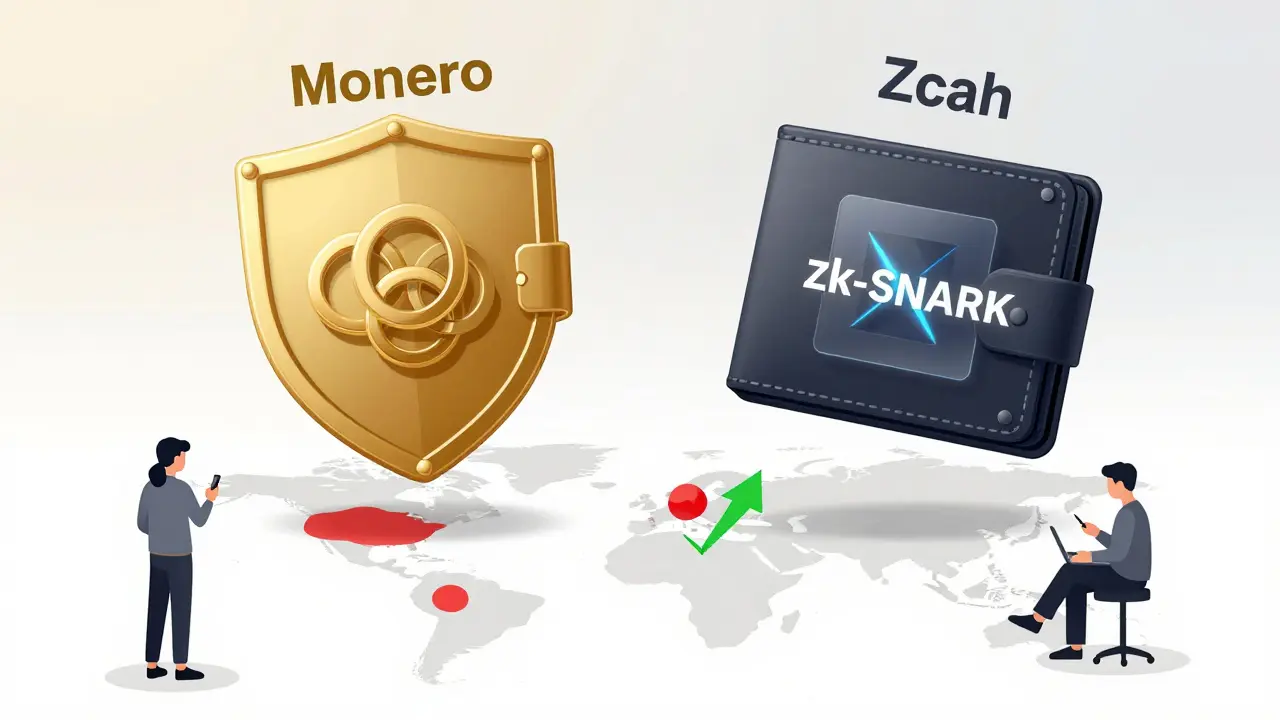
Not all cryptocurrencies are created equal when it comes to privacy. Bitcoin’s ledger is like an open book. Every transaction is recorded forever, and with enough tools, you can trace money from one wallet to another. Privacy coins change that. They use advanced cryptography to hide who sent the money, who got it, and how much was sent. Two main methods do this: ring signatures and zk-SNARKs.Monero (XMR) and Zcash (ZEC) are the two biggest players. Monero uses ring signatures. Zcash uses zk-SNARKs. They solve the same problem in completely different ways.
Ring Signatures: Hiding the Sender in a Crowd
Ring signatures were first proposed in the early 2000s, but they didn’t become practical until Monero launched in 2014. Here’s how they work: when you send a Monero transaction, your signature doesn’t stand alone. It’s mixed with signatures from at least 10 other past transactions - called decoys. Together, they form a “ring.”Anyone looking at the blockchain sees a group of possible senders. But there’s no way to tell which one is the real one. It’s like walking into a room with 10 people who all look identical and saying, “One of us made the purchase.” No one knows which.
Monero doesn’t stop there. It also uses Stealth Addresses - each transaction gets a one-time address for the receiver, so even if you know someone’s public wallet, you can’t track what they receive. And RingCT (Ring Confidential Transactions) hides the transaction amount. So, no one sees how much was sent. Together, these three layers make Monero one of the most private coins in existence.
The downside? Size. A typical Monero transaction is 15 to 20 times larger than a Bitcoin transaction because of all those decoy signatures. That means more data on the blockchain, slower processing, and higher fees during busy times. Monero’s block time is 2 minutes, and it handles about 1,000 transactions per block. That’s not bad, but it’s not as fast as Bitcoin’s 7 transactions per second.
As of late 2023, Monero’s developers plan to increase the minimum ring size from 11 to 16. That makes it even harder to guess the real sender - but it also makes each transaction even bigger. Users who care about privacy accept this trade-off.
zk-SNARKs: Proving Without Revealing
zk-SNARKs - short for Zero-Knowledge Succinct Non-Interactive Argument of Knowledge - are a different beast entirely. They were first used in Zcash when it launched in 2016. Instead of hiding the sender in a group, zk-SNARKs prove that a transaction is valid without showing any details.Think of it like this: you want to prove you’re over 21 without showing your ID. A zk-SNARK lets you say, “Yes, I’m old enough,” and the system accepts it - without knowing your birthdate, name, or anything else. That’s what happens with Zcash transactions. The network verifies that the sender has enough funds and that the transaction is balanced - but sees nothing else.
Zcash offers two types of addresses: transparent (like Bitcoin) and shielded (private). When you use a shielded address, the entire transaction - sender, receiver, amount - is encrypted. Only the people involved can see the details. And the proof is tiny: just 100 to 400 bytes, regardless of how complex the transaction is. Verification takes less than 6 milliseconds on a regular laptop.
But zk-SNARKs had a big problem at first: the trusted setup. When Zcash launched, a group of people had to come together to generate cryptographic keys. If even one of them was dishonest and kept a copy of the secret, they could forge money. It was a vulnerability, even if unlikely.
That changed with Zcash’s Network Upgrade 5 (NU5) in May 2022. They replaced the old system with Halo 2 - a new zero-knowledge proving system that doesn’t need a trusted setup. Now, anyone can verify Zcash transactions without trusting anyone else. It’s a major leap forward.
The trade-off? Speed. Generating a zk-SNARK proof on a standard computer takes about 40 seconds. That’s fine for desktops, but it’s too slow for phones or low-end devices. Many Zcash users complain about confusing address types - accidentally sending to a transparent address breaks privacy. And the complexity means developers need 120 to 150 hours of training just to implement it properly.
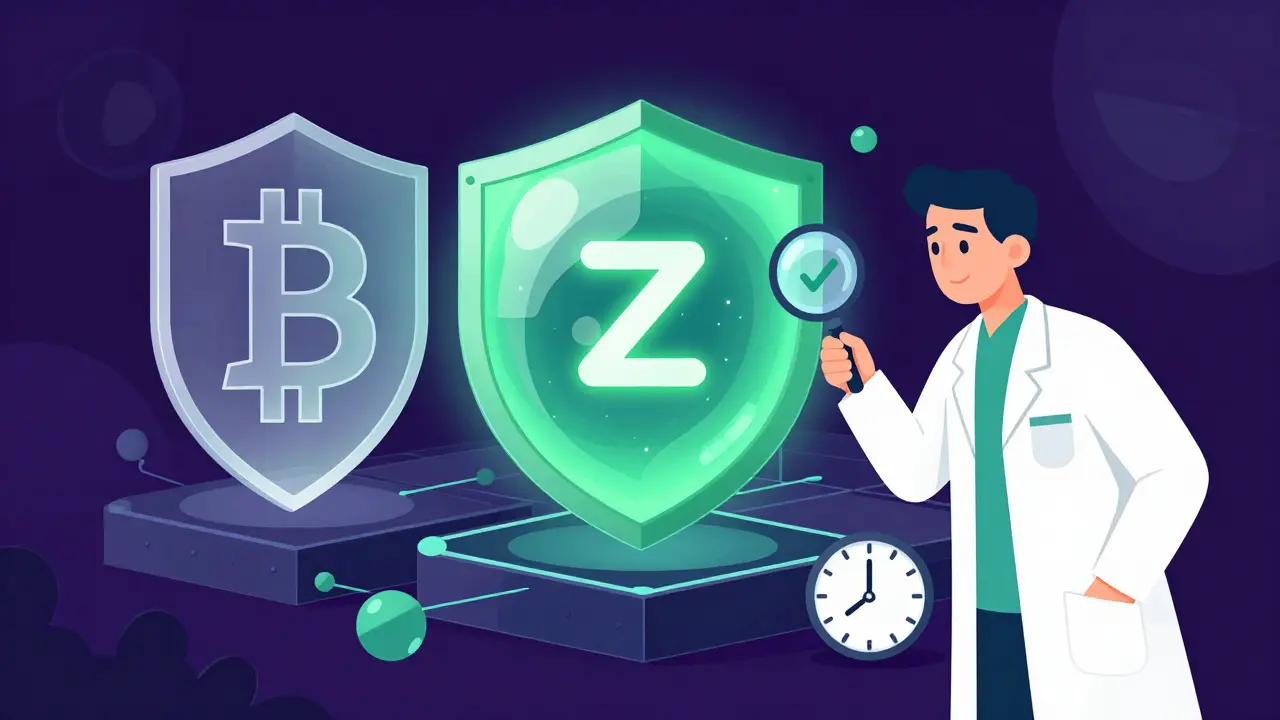
Ring Signatures vs. zk-SNARKs: A Side-by-Side Look
| Feature | Ring Signatures (Monero) | zk-SNARKs (Zcash) |
|---|---|---|
| What it hides | Sender identity (with additional tech, amount and receiver too) | Sender, receiver, and amount |
| Transaction size | 15-20x larger than transparent | Similar to transparent (proofs are tiny) |
| Verification speed | Fast - same as regular crypto | Very fast - under 6 milliseconds |
| Proof generation | Instant | ~40 seconds on standard hardware |
| Trusted setup required? | No | No (since Zcash NU5/Halo 2) |
| Implementation difficulty | Medium - 80-100 hours of training | High - 120-150 hours of training |
| Market cap (Q3 2023) | $2.1 billion | $1.8 billion |
Monero wins on simplicity and default privacy. You install the wallet, and you’re private. Zcash wins on efficiency and stronger theoretical privacy - but only if you use shielded addresses correctly.
Real-World Use and Problems
User feedback tells the real story. On Reddit’s r/Monero, 78% of users say Monero’s privacy is excellent. One user wrote: “I can’t believe exchanges can’t track my withdrawals anymore.” That’s the power of ring signatures.But Zcash users aren’t as happy. A 2023 survey found 62% had accidentally sent funds to a transparent address, ruining their privacy. Another complained: “I spent 20 minutes trying to figure out why my transaction didn’t go through - turns out I used the wrong address type.”
Regulators are watching. Japan and South Korea banned privacy coins in 2020 and 2021. Major exchanges like Coinbase and Binance removed Monero from their platforms. In the EU, MiCA regulations that took effect in 2024 require identity checks for all crypto transactions - a direct challenge to privacy coins.
Still, there’s progress. Panther Protocol, a startup launched in 2021, uses zk-SNARKs to let users prove compliance without revealing data. One fintech firm used it to process $47 million in DeFi transactions while staying within legal rules. That’s the future: privacy that works with regulation, not against it.
The Road Ahead
Monero’s upcoming “Oxygen Orion” hard fork will raise ring sizes to 16, making deanonymization attacks even harder. Meanwhile, Zcash’s Halo 2 is already live, removing the last major flaw in zk-SNARKs.Both teams are preparing for quantum computing. Monero is researching quantum-resistant ring signatures. Zcash is testing lattice-based zk-SNARKs - a new kind that could survive attacks from quantum computers.
Market share is small - privacy coins make up just 1.7% of the entire crypto market. But their growth rate is 8.2% per year, faster than Bitcoin or Ethereum. People want privacy. And as surveillance capitalism grows, that demand won’t disappear.
Ring signatures and zk-SNARKs aren’t perfect. But they’re the best tools we have right now to protect financial privacy on a public ledger. One hides you in a crowd. The other proves you’re honest without saying a word. Both are revolutionary. And both are here to stay.
Are privacy coins illegal?
No, privacy coins are not illegal in most countries. But some governments - like Japan and South Korea - have banned exchanges from listing them. In the EU, MiCA regulations require identity verification for crypto transactions, which makes privacy coins harder to use on regulated platforms. They’re legal to own and use privately, but not always easy to trade on major exchanges.
Can you trace Monero transactions?
Not reliably. Monero’s ring signatures mix your transaction with others, and RingCT hides the amount. Even with advanced chain analysis tools, experts can’t determine the real sender or receiver with certainty. Some attacks have been attempted with small ring sizes, but Monero’s move to 16-signature rings makes those nearly impossible. For now, Monero remains one of the most untraceable coins.
Why is Zcash slower than Bitcoin?
Zcash shielded transactions require generating a zk-SNARK proof, which takes about 40 seconds on standard hardware. Bitcoin transactions don’t need this step - they’re just signed and broadcast. That’s why transparent Zcash transactions are fast, but shielded ones are slower. The trade-off is stronger privacy. Newer systems like Halo 2 help, but the math is still complex.
Do I need to use both ring signatures and zk-SNARKs?
No. Each privacy coin uses one primary method. Monero uses ring signatures. Zcash uses zk-SNARKs. You don’t need both. Some projects like Panther Protocol combine elements of both, but for most users, choosing one coin with strong implementation is enough.
Is Monero or Zcash more private?
Monero offers stronger default privacy. Every transaction is private by design. Zcash requires you to use shielded addresses - if you accidentally use a transparent one, your privacy is gone. In theory, zk-SNARKs are more powerful, but in practice, Monero’s all-or-nothing approach gives most users better protection without needing to understand complex settings.
Can quantum computers break these privacy technologies?
Not yet, but they could. Both Monero and Zcash are researching quantum-resistant upgrades. Monero is working on ring signatures based on new cryptographic math that won’t fall to quantum attacks. Zcash is exploring lattice-based zk-SNARKs. Prototype versions are expected by mid-2024. For now, today’s systems are safe - but the industry is preparing for tomorrow.
What Comes Next?
The future of privacy coins isn’t about choosing between ring signatures and zk-SNARKs anymore. It’s about hybrid systems. Projects like Panther Protocol show how privacy can work with regulation - proving you’re compliant without revealing your data. That’s the real innovation.As more people demand financial privacy, these technologies will keep evolving. The goal isn’t to hide from the law - it’s to protect your right to control your own money. Ring signatures and zk-SNARKs aren’t just crypto tricks. They’re tools for a more private, more free financial system.
Comments (5)

- Julie Potter
- March 5, 2026 AT 17:36 PM
OMG I JUST LOST $800 because I sent Zcash to a transparent address and now everyone can see my wallet history. Like... how is this even a thing? I thought privacy coins were supposed to be private. I spent 45 minutes on Reddit trying to figure out if I could recover it. Turns out? No. Just... no. Zcash users are basically playing Russian roulette with their financial privacy and calling it innovation. Monero? At least it doesn’t make you a crypto detective just to send a transaction. 🤦♀️

- prasanna tripathy
- March 6, 2026 AT 02:00 AM
honestly, i've been using monero for 3 years now and never once had an issue. the transaction sizes are big? yeah. but that's the price of real privacy. i don't care if my phone takes 2 seconds to sync - i care that no one can trace my rent payments or my crypto purchases. zcash feels like a luxury car with a broken lock. you think it's secure until you realize you left the key in the ignition. monero? it's like a vault with a motion sensor. no one gets in. no one knows who you are. simple.

- Jonathan Chretien
- March 7, 2026 AT 10:52 AM
Let’s be real - ring signatures are just obfuscation with extra steps. It’s not true zero-knowledge. It’s *probabilistic* anonymity. Meanwhile, zk-SNARKs are mathematical perfection. You’re not hiding in a crowd - you’re proving you belong to a class of valid actors without revealing identity. It’s like saying ‘I have a passport’ without showing your face. That’s elegance. That’s philosophy. That’s cryptography as art. 🤓
And yes, the 40-second proof generation? That’s not a bug - it’s a feature. It forces users to think. To pause. To consider the weight of their financial sovereignty. Monero users? They’re just clicking ‘send’ and hoping. Zcash users? They’re engaging with the architecture of trustless systems. There’s a difference.

- Bill Pommier
- March 9, 2026 AT 08:12 AM
Regulators are not wrong. Privacy coins are not tools for financial freedom - they are tools for money laundering, tax evasion, and ransomware payments. Monero’s 16-signature ring size? That’s not privacy. That’s criminal obfuscation. Zcash’s shielded transactions? Same thing. The fact that these technologies are being adopted by darknet markets and sanctioned entities should be a red flag, not a feature. This isn’t about ‘financial sovereignty’ - it’s about avoiding accountability. The EU’s MiCA regulations are the bare minimum. We should be banning these coins outright. If you need privacy so badly, use cash. Or a bank. Or something that doesn’t require cryptographic obfuscation to function.

- Shawn Warren
- March 9, 2026 AT 20:36 PM
I’ve been mining Monero since 2019 and I’ll tell you something - the community is the real MVP. No hype. No influencers. Just people who care about real privacy. The devs are grinding 24/7 on Oxygen Orion and quantum resistance. Meanwhile Zcash devs are still explaining to users why they can’t use their phone wallet. Monero wins. Period. End of story.