
For over a decade, if you tried to buy Bitcoin or Ethereum using a Jordanian bank card, the transaction would fail. The Central Bank of Jordan had strictly prohibited financial institutions from dealing with cryptocurrencies since 2014. That era of prohibition ended dramatically in September 2025. With the enactment of Law No. 14 of 2025, also known as the Virtual Assets Transactions Regulation Law, Jordan flipped its script entirely. The country moved from being one of the most restrictive nations in the Middle East to a regulated hub for digital assets. But what does this actually mean for your bank account, and how do you trade legally now?
The End of the Banking Prohibition
To understand where we are, you have to look at where we started. Since 2014, the Central Bank of Jordan (CBJ) issued warnings that effectively banned banks from processing crypto transactions. The fear was volatility, fraud, and money laundering. If you were a trader in Amman back then, you couldn't use your standard debit card on Binance or Coinbase. You had to rely on peer-to-peer deals, cash exchanges, or informal networks. It was risky, unregulated, and often expensive.
That changed with Law No. 14 of 2025. This legislation didn't just tweak the rules; it rebuilt them. Enacted on September 14, 2025, this law explicitly allows licensed banking institutions to engage in specific virtual asset activities. Under Article 11, banks can now exchange virtual assets for fiat currency (like the Jordanian Dinar) and offer custodial services. Yes, you read that right. Your bank can hold your crypto, provided they get prior approval from the CBJ and meet strict conditions.
However, there is a catch. Banks are not authorized to provide transfer services for virtual assets. Why? It’s a monetary policy safeguard. The government wants to ensure that capital movements remain trackable and linked to the existing banking infrastructure. They don’t want a shadow economy running parallel to the Jordanian Dinar. So, while you can buy and store crypto through your bank, moving it around freely outside the system remains restricted.
Who Regulates What? The New Oversight Structure
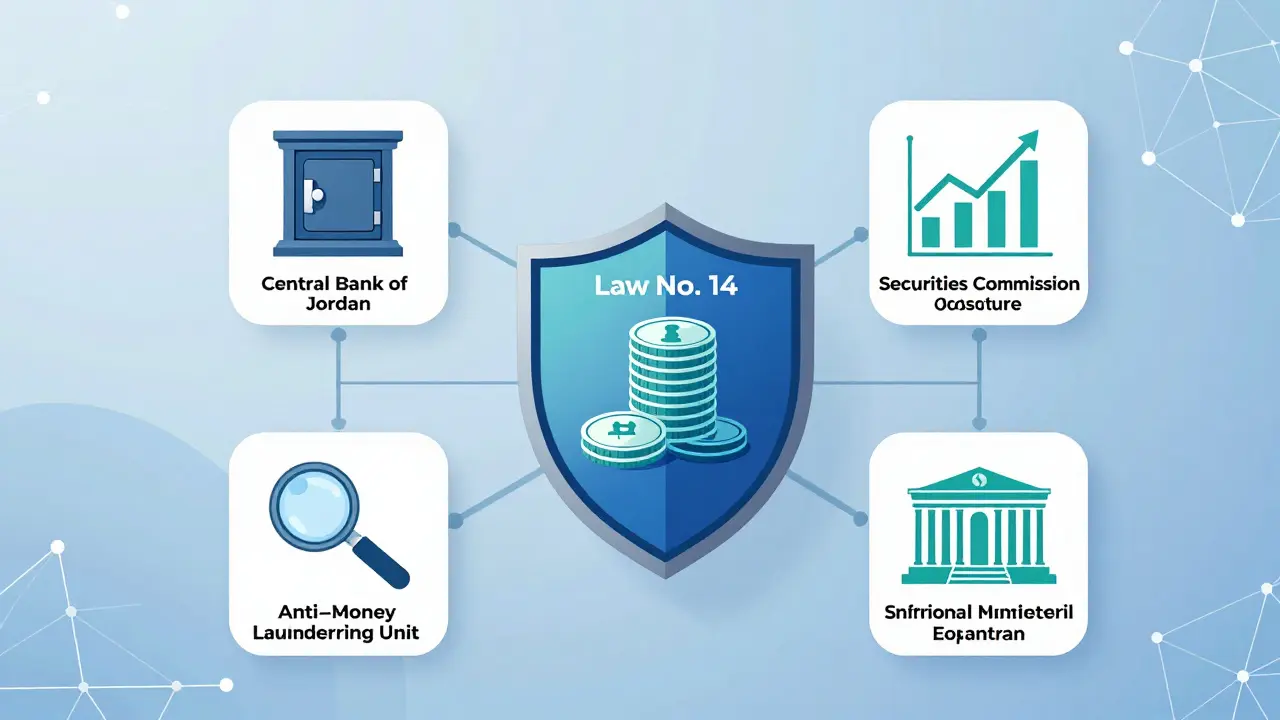
You might wonder who watches the watchers. In the old days, it was mostly the CBJ saying "no." Now, oversight is distributed across multiple agencies to cover different angles of risk.
- Central Bank of Jordan (CBJ): Handles monetary policy aspects and approves banks for crypto services.
- Jordan Securities Commission (JSC): Oversees the investment side of things. If you’re buying tokens that act like stocks, they’re involved.
- Anti-Money Laundering Unit: Ensures compliance protocols are tight. They watch for suspicious activities.
- Ministerial Committee: Headed by the Minister of Digital Economy and Entrepreneurship, this group coordinates the big-picture policy implementation.
This whole-of-government approach signals high-level commitment. When Deputy Governor Ziad Ghanma participated directly in Senate approval processes, it showed this wasn’t just a bureaucratic checkbox exercise. It was a strategic pivot. The goal is to balance innovation with financial stability.
Licensing Requirements for Service Providers
If you want to run a business involving crypto in Jordan, you can’t just set up a website and start taking orders. You need to become a Virtual Asset Service Provider (VASP). The bar for entry is high, intentionally so.
VASPs must maintain comprehensive Know Your Customer (KYC) procedures. This means verifying identities rigorously. You also need to conduct enhanced due diligence for high-risk transactions. Think large transfers or connections to high-risk jurisdictions. Reporting suspicious activities is mandatory, and regular compliance audits are part of the job description.
Why such strict rules? Because Jordan recently cleaned up its international reputation. In October 2023, Jordan was removed from the Financial Action Task Force (FATF) grey list. This was a huge win. It meant global banks could deal with Jordan without fearing regulatory penalties. To keep that status, Jordan had to prove it could handle virtual assets without becoming a haven for illicit finance. The new licensing requirements are their proof.
Penalties for Breaking the Rules
Let’s talk about what happens if you ignore these rules. The consequences are severe. Under Article 15 of Law No. 14 of 2025, engaging in virtual asset activities without proper licensing is a criminal offense.
| Violation Type | Imprisonment | Fines (JOD) | Additional Actions |
|---|---|---|---|
| Operating without license | Minimum 1 year | 50,000 - 100,000 JOD | Closure of premises, confiscation of equipment |
This is a sharp pivot from the past. A few years ago, buying Bitcoin from a friend via WhatsApp was common and largely ignored. Today, facilitating informal crypto exchanges carries serious criminal consequences. There is still some ambiguity about whether individual users face liability if they use unlicensed services, but the message to businesses is clear: get licensed or shut down.
How Jordan Compares to Its Neighbors
Context matters. If you look at the wider Middle East and North Africa (MENA) region, Jordan’s move is bold. Countries like Kuwait, Egypt, and Iraq continue to prohibit virtual asset use entirely. In those places, the banking ban remains absolute.
Then there is the United Arab Emirates (UAE). The UAE has positioned itself as the region’s digital finance capital, hosting over 500,000 daily crypto traders. They adopted vigorous multi-layered legal frameworks early on, with federal-level regulation through the UAE Securities and Commodities Authority. Jordan may be later to the party, but it’s not alone in recognizing the potential. By creating comprehensive frameworks rather than just bans, Jordan aims to attract fintech innovation and global investment.
Industry experts have responded positively. Prominent crypto entrepreneurs have praised the CBJ and the Prime Minister's Office for consulting with industry stakeholders before finalizing the law. This collaborative policymaking sets a strong example. It suggests Jordan isn’t just copying Western models but adapting them to local needs.

What Is Excluded From the Law?
Not everything digital falls under Law No. 14 of 2025. The legislation explicitly excludes three categories:
- Digital securities: These are treated differently, likely under the purview of the Jordan Securities Commission.
- Digital financial assets: Another distinct category awaiting separate treatment.
- Central Bank Digital Currencies (CBDCs): If Jordan ever launches a digital Dinar, it won’t fall under this commercial framework.
This exclusion shows a nuanced understanding of the technology. Not all tokens are created equal. Some are currencies, some are investments, and some are utilities. Treating them all the same would be inefficient and potentially harmful.
Challenges Ahead for Banks and Users
Even with the law in place, implementation is tricky. Traditional financial institutions face a steep learning curve. Bankers need to understand blockchain technology, digital wallet management, and cryptocurrency market dynamics. It’s not just about updating software; it’s about changing mindsets.
There’s also the challenge of integrating decentralized systems with traditional finance. How do you audit a smart contract? How do you freeze funds on a permissionless ledger? These are technical hurdles that regulators and banks are still working through. The FinTech Regulatory Sandbox, which Jordan has maintained since 2018, will play a crucial role here. It provides a testing ground for these innovations without risking the broader financial system.
For users, the biggest change is clarity. No more guessing if a transaction will be blocked. If you use a licensed VASP or a participating bank, you know you’re operating within the law. Consumer protection improves because there’s an entity responsible if something goes wrong. Trust is built on accountability, and this law provides that structure.
Future Outlook: A Gateway for Compliant Digital Assets?
Jordan is positioning itself strategically. With its FATF clean bill of health and a robust legal framework, it could emerge as a gateway for compliant digital assets in the region. International firms looking for a stable, regulated environment in the Middle East might choose Jordan over less predictable markets.
The prospect of increased institutional adoption is real. As banks gain experience with custodial services, we might see more mainstream products emerging-crypto-linked savings accounts, perhaps, or hedging tools for businesses exposed to currency fluctuations. The key will be maintaining the balance between innovation and control. If Jordan can keep money laundering out while letting innovation in, it will have cracked a code that many countries struggle with.
Can I still buy Bitcoin in Jordan?
Yes, but only through licensed channels. Since the enactment of Law No. 14 of 2025, you can buy and sell cryptocurrencies through licensed Virtual Asset Service Providers (VASPs) and certain approved banking institutions. Informal peer-to-peer trades without proper licensing are now illegal and carry heavy penalties.
Will my Jordanian bank accept crypto payments?
Some banks may, but not all. Under Article 11 of the new law, banks can offer crypto-fiat exchange and custodial services if they receive prior approval from the Central Bank of Jordan. However, they are not allowed to provide transfer services for virtual assets. Check with your specific bank to see if they have applied for and received this license.
What happens if I trade crypto illegally?
The penalties are severe. Operating without a license can result in at least one year of imprisonment, fines between 50,000 and 100,000 Jordanian Dinars, closure of your business premises, and confiscation of equipment. While individual user liability is still somewhat ambiguous, facilitating unlicensed exchanges is definitely a crime.
Is Jordan safer for crypto than neighboring countries?
Does this law cover NFTs or CBDCs?
No. Law No. 14 of 2025 explicitly excludes digital securities, digital financial assets, and Central Bank Digital Currencies (CBDCs). These categories will be subject to separate regulatory treatments in the future.
Why did Jordan lift the ban after 10 years?
Jordan lifted the ban to align with global fintech trends, attract foreign investment, and strengthen its financial ecosystem. After being removed from the FATF grey list in 2023, Jordan needed a robust regulatory framework to maintain its international standing and prevent illicit finance while fostering innovation.
Comments (8)

- Joshua Alcover
- May 28, 2026 AT 02:50 AM
It is fundamentally absurd to assume that the Jordanian state possesses the moral or intellectual fortitude to regulate a decentralized ledger system without succumbing to the inherent corruption of centralized fiat institutions. The notion that Law No. 14 of 2025 represents progress is a delusion propagated by those who fail to understand the ontological shift required for true financial sovereignty. By allowing banks to act as custodians, they are merely grafting a digital tumor onto a dying host organism, ensuring that the very volatility and fraud they claim to mitigate are now embedded within the core infrastructure of their economy. This is not innovation; it is institutionalized hypocrisy. One must question whether the Central Bank of Jordan is truly interested in 'financial stability' or simply seeking to monetize the illicit flows that previously existed in the shadows. The exclusion of CBDCs suggests a fear of total loss of control, yet the inclusion of VASPs invites the exact same regulatory capture seen in Western markets. We are witnessing the death of privacy under the guise of security.

- Craig Swanson
- May 29, 2026 AT 02:05 AM
Listen up, because I’m only going to say this once: if you think this changes anything for the average guy trying to move money around, you’re dead wrong. Banks are slow, they’re greedy, and now they want a cut of your crypto trades too? Absolutely ridiculous. I’ve been trading since 2013, and I don’t need some bureaucrat in Amman telling me how to manage my assets. If you’re relying on these new 'licensed' channels, you’re just handing over your keys to people who have no idea what blockchain actually does. Stay off the grid, use P2P, and keep your nose clean. This law is just another way for the elites to squeeze more fees out of regular folks while pretending they’re protecting us from ourselves. Don’t be a sheep.

- Bill Gunn
- May 29, 2026 AT 20:20 PM
Hey everyone! 👋 So excited to see Jordan finally getting with the program! 🚀 It’s wild to think that just a few years ago, buying Bitcoin was basically illegal here. Now we have actual rules and regulations, which honestly makes me feel a lot safer about investing. 📈 I know some people hate the idea of banks getting involved, but having custodial services means if something goes wrong, there’s actually someone to blame instead of just losing everything into the void. Plus, being removed from the FATF grey list is huge news for international trade! 🌍 Let’s hope this brings in some serious fintech innovation and jobs for our local devs. Who else is ready to try out these new bank-linked crypto features? 💸✨

- Dana Rapoport
- May 30, 2026 AT 03:24 AM
The philosophical implications of this shift are profound. We are moving from a state of anarchy to one of structured order, but at what cost to individual autonomy? The removal of the ban is not merely a legal adjustment but a redefinition of trust in a digital age. By centralizing custody through banks, Jordan is reinforcing the traditional power structures rather than dismantling them. It raises the question: are we building a future where technology serves humanity, or where humanity is forced to adapt to the rigid constraints of legacy financial institutions? The silence of the dissenting voices is deafening. We must remain vigilant against the erosion of privacy under the banner of compliance.

- Hadleigh Edwards
- May 30, 2026 AT 13:25 PM
I mean, when you really stop to think about the sheer magnitude of what has happened here in Jordan over the last decade, it is absolutely mind-boggling to consider how far we have come from the days when even talking about Bitcoin could get you in trouble with the authorities, let alone actually trying to buy it with your debit card, which would just fail every single time no matter how many times you tried, and now suddenly we have this entire legal framework that allows banks to hold your crypto for you, which sounds crazy but also kind of reassuring if you ask me because at least you aren't just trusting some random website anymore, and although I know some people might worry about the government watching too closely, I personally think that having clear rules and penalties for bad actors is exactly what we needed to make this whole industry respectable and safe for everyday people like you and me who just want to save a little money or invest in the future without worrying about our accounts getting frozen for no reason, so I am definitely looking forward to seeing how this plays out in the next few years and hoping that more banks join in soon so we can all benefit from this new era of financial freedom.

- mark valmart
- May 30, 2026 AT 21:58 PM
honestly i was pretty skeptical at first but reading through the details it seems like they actually did their homework this time. knowing that p2p trades are now risky makes sense though. gotta play it safe i guess.

- Crystal Davis
- June 1, 2026 AT 07:39 AM
Your analysis is superficial and ignores the critical geopolitical nuances. Jordan's move is not about 'innovation' but about survival in a hostile regional landscape. While the UAE has established itself as a crypto hub with robust federal regulation, Jordan is merely scrambling to catch up, likely driven by economic desperation rather than strategic foresight. The exclusion of digital securities and CBDCs indicates a fragmented regulatory approach that will inevitably lead to loopholes exploited by sophisticated actors. Furthermore, the reliance on banks for custody undermines the very essence of decentralization, creating a single point of failure that contradicts the purported benefits of blockchain technology. This is a half-measure designed to appease international regulators like the FATF while doing little to foster genuine technological advancement. Do not mistake regulatory compliance for progress.

- Christina Pearce
- June 2, 2026 AT 16:14 PM
I appreciate the detailed breakdown here. It’s interesting to see how the oversight is split between the CBJ and the JSC. I’m curious to see how the Jordan Securities Commission handles the investment side of things, especially with tokens acting like stocks. It seems like a smart move to have multiple agencies involved to cover different risks. I’ll definitely be keeping an eye on how the licensing process unfolds for VASPs. Thanks for sharing this info!
Post-Comment
Categories
Popular Articles