
Most cryptocurrency projects promise high returns, but few can explain exactly where that money comes from. Usually, it’s just new tokens being printed to pay early investors-a cycle that often collapses under its own weight. Orizon (ORI) is a decentralized finance protocol that integrates artificial intelligence to generate real-world revenue and distribute it as yield to token holders. It was launched in July 2025 with a bold goal: to break the monopoly of big tech companies on AI profits by sharing those earnings directly with the community.
If you’ve heard the term "DeFAI"-which stands for Decentralized Finance plus Artificial Intelligence-Orizon is one of the first protocols putting that concept into practice. Instead of relying on speculation or inflationary emissions, this system uses actual income generated by AI tools like chatbots and image generators. Let’s look at how this machine works, why it matters, and what it means for your wallet.
The Core Problem: Who Owns AI Profits?
Right now, the artificial intelligence industry is heavily centralized. A handful of massive corporations build the models, host the servers, and keep nearly all the profits. If you use an AI tool, you are paying them, not helping anyone else share in the success. This centralization creates a bottleneck where innovation is controlled by boardrooms rather than open communities.
Orizon flips this model on its head. It operates as an AI-powered financial reserve system designed to capture value from AI services and redistribute it. The idea is simple: if AI generates wealth, that wealth should be accessible to everyone who holds the native token, not just shareholders of private companies. By creating an on-chain link between real-world AI utility and decentralized yield, Orizon aims to democratize access to the economic benefits of automation.
How the DeFAI Flywheel Works
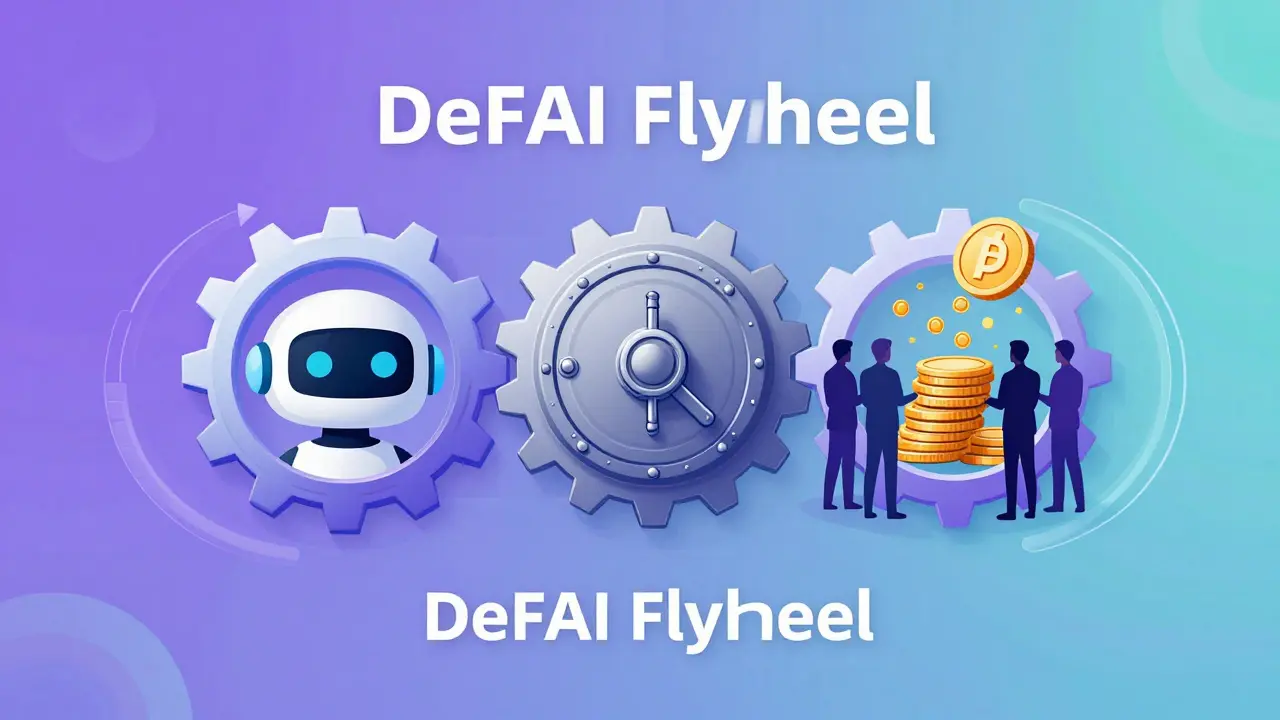
To understand Orizon, you need to look at its three-layer architecture, which the team calls the "DeFAI Flywheel." These layers don’t just sit next to each other; they feed into one another to create a self-reinforcing loop.
- The AI Product Layer: This is the engine. It consists of proprietary AI services such as customer service chatbots, image generation tools, and APIs that businesses can integrate. When external customers pay to use these tools, that is real, fiat-backed revenue entering the ecosystem.
- The Treasury Vault: Think of this as the safe. It is an on-chain gateway made of smart contracts that collects, secures, and manages the revenue coming from the AI products. This treasury holds the assets that back the ORI token. Because it is on-chain, anyone can audit the funds. There are no hidden accounts or opaque accounting practices.
- The DeFi Protocol Layer: This is the distribution mechanism. It handles the financial mechanics, including staking, yield distribution, and token utility. Smart contracts here ensure that when revenue hits the vault, it is automatically allocated to reward the people holding and staking ORI tokens.
This structure ensures that every dollar earned by the AI tools has a clear path to the user. It transforms passive holding into active participation in a growing business.
Understanding the $ORI Token
The $ORI token is not a stablecoin pegged to the US Dollar, nor is it a standard meme coin driven purely by hype. It is described as a next-generation algorithmic non-stablecoin. Its value is managed by protocol-driven mechanisms rather than being fixed to an external asset.
Here is where the AI integration gets interesting. Traditional algorithmic tokens struggled because they relied on simple rules to adjust supply. Orizon uses advanced AI algorithms to analyze market conditions in real-time. These algorithms identify optimal investment strategies and dynamically adjust the token supply to maintain price stability while allowing for appreciation over time. The system monitors demand for $ORI and automatically tweaks the supply to keep the price within a target range.
As of February 2026, data from CoinMarketCap showed a total supply of approximately 133,460 tokens, with the entire supply already in circulation. This means there is no hidden inflation waiting to dilute your holdings later. The token has attracted roughly 256,750 holders, indicating a broad base of interest despite its relatively small market capitalization of around $7.28 million.
Real Yield vs. Inflationary Rewards
In the world of DeFi, "yield" usually means rewards paid in newly minted tokens. This is inflationary. If a protocol prints 10% APY, it is creating more tokens out of thin air, which increases the supply and often lowers the price per token unless demand grows exponentially faster.
Orizon promotes the concept of real yield. This yield comes from tangible business performance. When a company pays for an API key or a user subscribes to an image generator, that cash goes into the Treasury Vault. The protocol then distributes a portion of that actual revenue to stakers. This makes the income sustainable because it is tied to the product’s usefulness, not just the token’s price action.
This distinction is critical for long-term viability. Protocols reliant on inflationary emissions eventually run out of steam when growth slows. Revenue-backed models can continue to pay out as long as the underlying AI products remain useful and profitable.
Automated Risk Management and Yield Optimization
Managing a portfolio in DeFi is hard. You have to monitor liquidity pools, check for impermanent loss, and decide where to stake your assets for the best return. Orizon automates much of this through its Dynamic Risk Management system.
AI algorithms constantly assess risk across the ecosystem. They analyze market data, identify potential vulnerabilities in smart contracts or market trends, and implement proactive mitigation strategies. For the average user, this means less stress and fewer chances of losing money due to manual errors or slow reactions to market shifts.
Furthermore, the protocol features Automated Yield Optimization. When you stake your $ORI tokens, the AI identifies the most profitable yield farming opportunities available at that moment. It automatically allocates your tokens to those strategies. You don’t need to be a DeFi expert to benefit from complex arbitrage or lending spreads; the AI does the heavy lifting for you.
Governance and Future Roadmap
Currently, Orizon operates with a degree of centralization typical of early-stage projects. However, the roadmap clearly outlines a transition to full decentralization. Governance features are slated for implementation in 2027. Once live, this will empower ORI token holders to propose and vote on critical protocol parameters, treasury management strategies, and development priorities.
This shift to a Decentralized Autonomous Organization (DAO) model is essential for credibility in the crypto space. It ensures that no single entity can unilaterally change the rules of the game. Until then, the current team focuses on expanding the AI Product Layer and refining the algorithmic supply controls. The phased approach allows them to stabilize the core economics before handing over the keys to the community.

Market Performance and Adoption
Let’s look at the numbers. As of early February 2026, ORI was trading around $54.88 USD. The 24-hour trading volume hovered near $200,000, which indicates moderate activity. While this is small compared to giants like Ethereum or Solana, it is significant for a niche protocol focused on AI-integrated DeFi.
| Metric | Value | Source/Context |
|---|---|---|
| Price | ~$54.88 USD | CoinMarketCap |
| Market Cap | $7.28 Million | Relatively small cap |
| Total Supply | 133,460 ORI | Fully circulated |
| Holders | 256,750 | Growing community |
| Launch Date | July 2025 | New entrant |
The low market cap suggests that the project is still in its early adoption phase. This presents both opportunity and risk. On one hand, early adopters could see significant upside if the AI products gain widespread enterprise adoption. On the other hand, small caps are more volatile and susceptible to market sentiment swings.
Risks and Considerations
No investment is without risk, and Orizon is no exception. First, there is execution risk. The protocol relies on its AI products actually generating revenue. If businesses do not find value in the chatbots or APIs, the yield dries up. Second, there is smart contract risk. Like any DeFi protocol, bugs in the code could lead to exploits. Third, regulatory uncertainty surrounding AI and cryptocurrencies could impact operations in various jurisdictions.
Additionally, the reliance on AI algorithms for supply control introduces complexity. If the algorithms fail to predict market conditions accurately, it could lead to volatility or instability in the token price. Investors should monitor the transparency reports and on-chain data closely to ensure the treasury remains healthy.
Who Is Orizon For?
Orizon appeals to a specific type of investor. If you are looking for quick pumps and dumps, this might not be the right fit. However, if you believe in the long-term convergence of AI and blockchain, Orizon offers a unique proposition. It is ideal for users who want exposure to the AI boom without buying shares in Big Tech. It also suits DeFi enthusiasts who prefer real yield over inflationary rewards and appreciate automated risk management.
By staking ORI, you become a partial owner of the revenue stream generated by these AI tools. It is a way to participate in the digital economy’s evolution while earning passive income backed by actual work done by machines.
Is Orizon (ORI) a stablecoin?
No, ORI is not a stablecoin. It is an algorithmic non-stablecoin. Its value is not pegged to a fiat currency like the US Dollar. Instead, its price is managed by AI algorithms that adjust the supply based on market demand and conditions, aiming for stability while allowing for appreciation.
Where does the yield come from in Orizon?
The yield comes from real-world revenue generated by Orizon's AI products, such as chatbots, image generators, and APIs. When customers pay for these services, the money goes into the Treasury Vault and is distributed to stakers as "real yield," rather than being created through inflationary token emissions.
When will Orizon launch its governance features?
According to the development roadmap, decentralized governance features are planned for implementation in 2027. This will allow ORI token holders to vote on protocol parameters and treasury management, transitioning the project into a fully decentralized DAO.
What is the total supply of ORI tokens?
As of early 2026, the total supply of ORI tokens is approximately 133,460. All of these tokens are currently in circulation, meaning there is no hidden supply left to be released later.
How does Orizon manage risk?
Orizon uses Dynamic Risk Management powered by AI algorithms. These systems continuously analyze market data and identify potential vulnerabilities, automatically adjusting strategies to mitigate risks. Additionally, Automated Yield Optimization ensures that staked tokens are allocated to the most profitable and secure opportunities available.
Comments (9)

- robert Whitehead
- May 12, 2026 AT 18:32 PM
You people really fall for this 'AI yield' nonsense every time. It's just a Ponzi scheme with better marketing copy. The fact that they claim to have 'real revenue' is laughable because there is zero transparency on the actual contracts feeding into that vault. I've seen enough rug pulls in DeFi to know that when the music stops, you're holding the bag. Don't be a sucker.

- Gavin Wonnacott
- May 13, 2026 AT 09:36 AM
Oh please, spare me the lectures from the bottom feeders. You clearly don't understand the nuance of algorithmic stabilization combined with real-world asset backing. This is high finance, not your cheap meme coin casino. If you can't grasp the concept of value capture through AI utility, perhaps you should stick to saving money under your mattress. Ignorance is no excuse for poverty.

- Jerry CUNNINGHAM SR
- May 14, 2026 AT 18:09 PM
I appreciate the passion here, but let us keep the discourse respectful. While skepticism is healthy in crypto, attacking individuals does not help anyone. The point about transparency is valid, and we should all demand better auditing standards regardless of the project. Let's focus on the mechanics rather than personal attacks.

- Tricia Alach
- May 16, 2026 AT 08:01 AM
i think its actually pretty cool tho! like who doesnt want ai to pay them? i mean sure it sounds sus but if the math checks out why not? im just gonna hodl and see what happens lol. maybe ill get rich or maybe ill lose it all. life is risk right?

- Caique Muniz
- May 17, 2026 AT 12:15 PM
another day another scam. honestly im too lazy to even read this garbage but the title gave me a headache. just pump it bro.

- Bradley Geldenhuys
- May 18, 2026 AT 04:35 AM
Look at this mess of a comment section. People are so quick to dismiss innovation without doing their own research. It’s pathetic. The idea of democratizing AI profits is revolutionary, yet you lot sit there typing insults instead of buying in. Wake up sheeple! The future is decentralized and automated, and you’re missing out because you’re too busy being cynical. Get educated or get left behind!

- Sheldon Friesen
- May 19, 2026 AT 07:06 AM
Wow. Just wow. Can we all take a deep breath? Seriously. The amount of negativity here is staggering. Look. If you are going to criticize. Please do it constructively. Or don't bother at all. It is exhausting. I am just here for the potential upside. And the memes. Mostly the memes.

- H F
- May 20, 2026 AT 07:32 AM
I’m genuinely excited about this! 🚀 The concept of DeFAI is huge and if Orizon pulls it off, it changes everything. I’ve been staking since launch and the yields are looking solid. Let’s support each other and build this community together! 💪

- Michael Berggren
- May 20, 2026 AT 15:18 PM
The technical architecture described here is fascinating. 🧠 The three-layer flywheel creates a self-sustaining ecosystem that addresses the centralization problem head-on. I particularly like the dynamic risk management aspect; having AI optimize yield farming strategies removes a lot of human error. As long as the team delivers on the 2027 governance roadmap, this could be a major player. Keep learning and stay safe out there! 👍📈
Post-Comment
Categories
Popular Articles