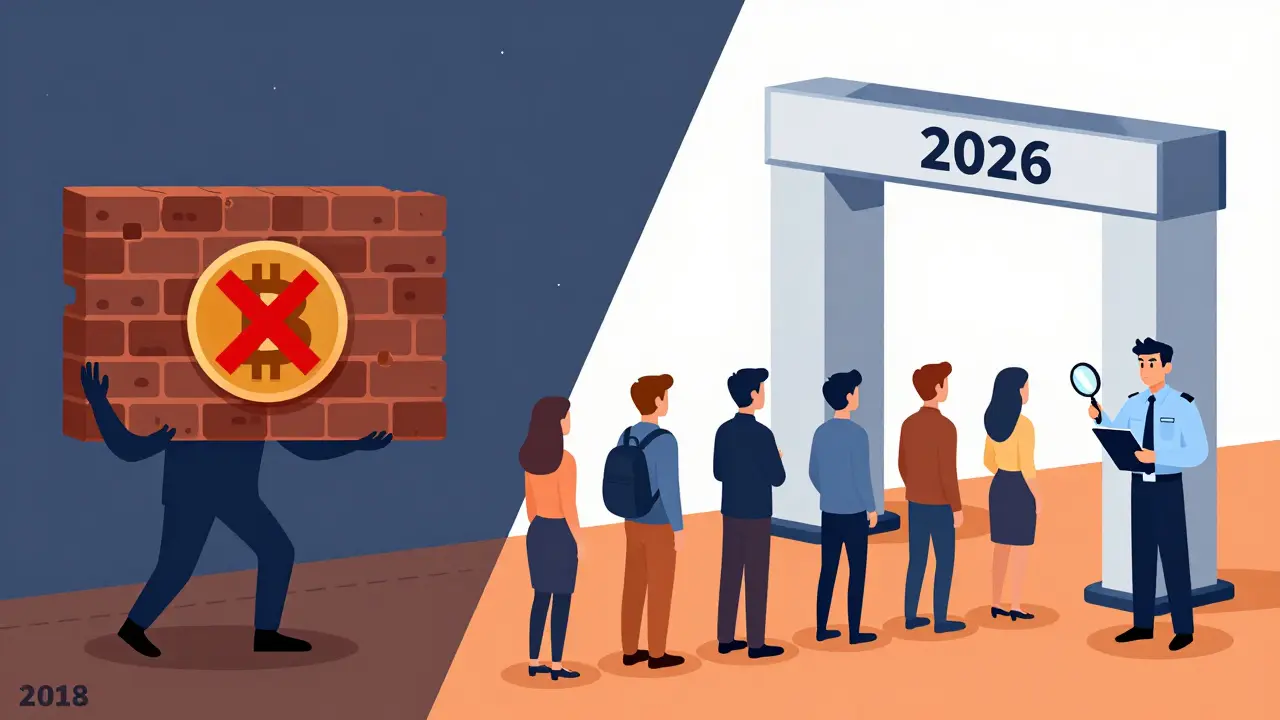

For years, the Bank of Namibia stood as a fortress against cryptocurrency. If you asked them in 2018 whether Bitcoin was money, they would have told you no. In fact, they were more blunt than that. They stated clearly that they did not recognize cryptocurrencies as commodities and did not support trading on any exchange. For anyone trying to build a crypto business in Namibia back then, it felt like hitting a brick wall.
But times change, especially in Africa, where digital adoption is outpacing traditional banking infrastructure. By 2026, the landscape has shifted dramatically. The Bank of Namibia (BON) has moved from outright skepticism to a structured, albeit cautious, regulatory framework. They haven't thrown open the gates, but they have installed a security checkpoint. This article breaks down exactly what that means for traders, businesses, and investors navigating the current rules.
The Turning Point: From Ban to Regulation
To understand where we are today, you need to look at the legislative pivot that happened in 2023. That year marked the end of the "wild west" era and the beginning of formal oversight. The National Assembly passed two critical pieces of legislation: the Virtual Assets Act (Act No. 10 of 2023) and the Payment System Management Act (Act No. 14 of 2023).
These laws created the foundation for everything happening now. Before this, there was no clear rulebook. Now, there is a specific legal structure for how virtual assets operate within the country. It’s important to note one major distinction right away: while these laws regulate the *businesses* that handle crypto, they do not make crypto legal tender. You still cannot pay your taxes in Bitcoin, and banks are not required to accept it. However, the door for private merchants to accept it has been left ajar.
How the Licensing Process Actually Works
If you are looking to launch a crypto exchange or payment service in Namibia, you cannot just register a company and start taking deposits. The process is strict and involves a unique "sandbox" period that catches many entrepreneurs off guard.
The regulator here isn't just the central bank; it's a joint effort involving the Namibia Financial Institutions Supervisory Authority (NAMFISA). Here is how the path to legality looks:
- Provisional Authorization: You apply for provisional status. If granted, you get a six-month window.
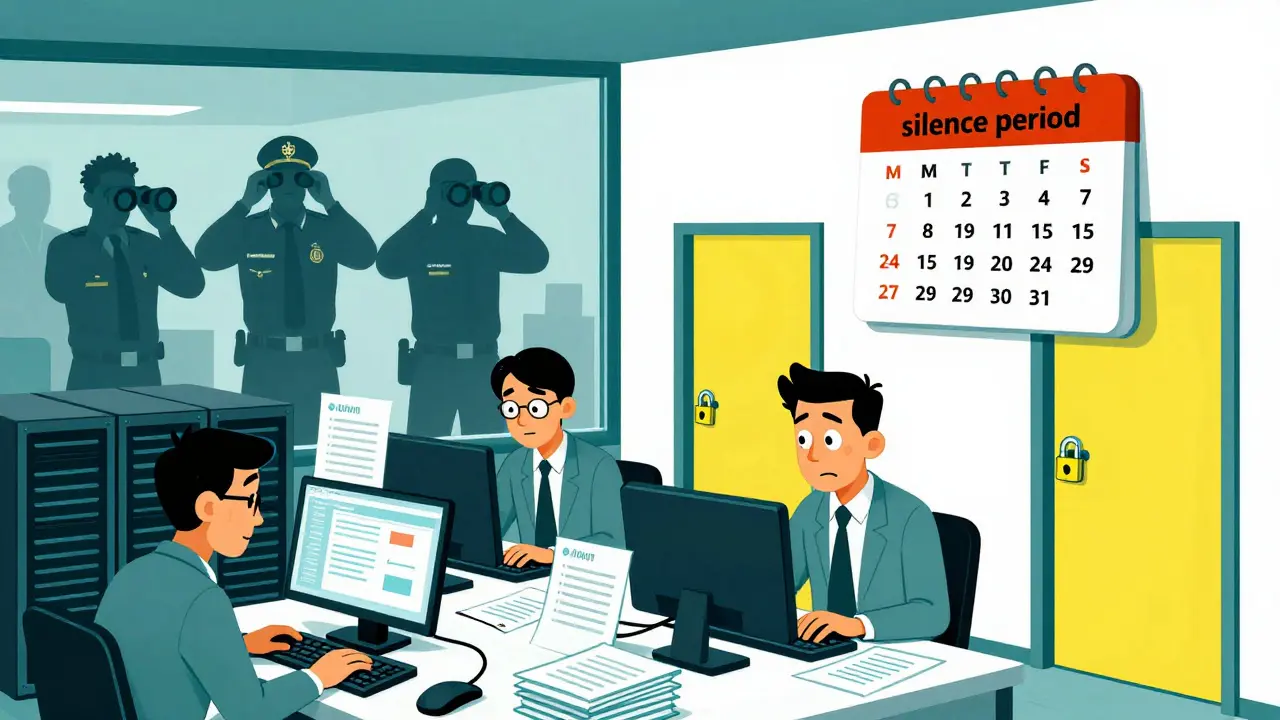
- The Silence Period: During these six months, you are strictly forbidden from conducting business with the public. You cannot trade, you cannot onboard users, and you cannot move funds for clients. Your job is purely internal: hire staff, buy servers, install software, and set up compliance teams.
- Inspection: Once you believe you are ready, BON inspects your setup. If they approve, you move to full operational licensing.
- Full Operation: Only then can you engage with individuals or entities in Namibia.
This model is designed to prevent fraud. By forcing companies to prove their technical and operational readiness before touching a single customer dollar, the regulators aim to eliminate the "runaway" schemes common in less regulated markets. However, it does mean a significant delay in revenue generation for new startups compared to countries like Mauritius or Singapore.
Key Restrictions and Compliance Requirements
Even after you get licensed, the rules remain tight. The Bank of Namibia has implemented several mechanisms to ensure transparency and prevent illicit activities. These aren't just suggestions; they are hard requirements enforced by law.
| Regulatory Requirement | Details & Thresholds |
|---|---|
| Travel Rule Compliance | For transactions over NAD 20,000 (~USD 1,000), providers must share sender/receiver data including names and IDs. |
| Local Presence Mandate | Crypto exchanges not based in Namibia are banned. Services must be hosted and operated locally under license. |
| AML/CTF Standards | Strict adherence to international Anti-Money Laundering and Counter-Terrorist Financing protocols is mandatory. |
| ICO Prohibition | Initial Coin Offerings are effectively banned due to high risks of fraud and misrepresentation. |
| Merchant Discretion | Merchants may accept crypto for goods/services, but it holds no legal tender status. |
The "Travel Rule" is particularly impactful. It means anonymity is dead for larger transactions. If you send more than NAD 20,000, your identity travels with the money. This aligns Namibia with global standards set by the Financial Action Task Force (FATF). Additionally, the ban on foreign-based exchanges ensures that all tax and regulatory oversight happens within Namibian borders. You can't just use an app from overseas without consequence if you are operating a business here.
Current Market Status: Who Is Playing?
As of early 2025, the market is still in its infancy. The Bank of Namibia granted provisional authorization to four key entities in January 2025. Two were payment service providers-Finatic Technologies and United PayPoint-and two were Virtual Asset Service Providers (VASPs): Mindex Virtual Asset Exchange and Landifa Bitcoin Trade CC.
However, the rollout hasn't been seamless. By mid-2025, reports indicated that some of these firms requested extensions to their provisional periods. Landifa Bitcoin Trade CC and United PayPoint sought extra time to meet compliance conditions, while Mindex also applied for an extension until late 2025. This highlights a reality check for the industry: meeting BON's technical and compliance standards takes time. The regulators are not rushing approvals. Kazembire Zemburuka, a spokesperson for the bank, emphasized that due diligence is ongoing and strict. The message is clear: speed is secondary to security.
Namibia vs. The Rest of Africa
How does Namibia stack up against its neighbors? The African continent is becoming a patchwork of different approaches, ranging from total bans to progressive hubs.
- Nigeria: Has faced volatility, banning banks from facilitating crypto transactions at times, though grassroots usage remains high.
- South Africa: Generally considered more advanced, with VASP registration requirements in place since 2022, creating a more mature market.
- Botswana: Maintains a complete prohibition on crypto trading, making it a closed market.
- Ghana: Was planning comprehensive regulations for late 2025, placing it slightly behind Namibia in implementation timeline.
Namibia sits in the middle. It is more progressive than Botswana or Tanzania (which maintains a ban) but more cautious than South Africa or Kenya. Its unique selling point is the structured sandbox approach. It offers a clear path to legitimacy, which attracts serious institutional players rather than fly-by-night operators. However, critics, including notes in the U.S. Department of State's 2025 Investment Climate Statement, have pointed out a "reluctance" regarding broader blockchain technology implementation, suggesting that while they want to control crypto finance, they might be slow to embrace other Web3 innovations.
The Future: rCBDC and Beyond
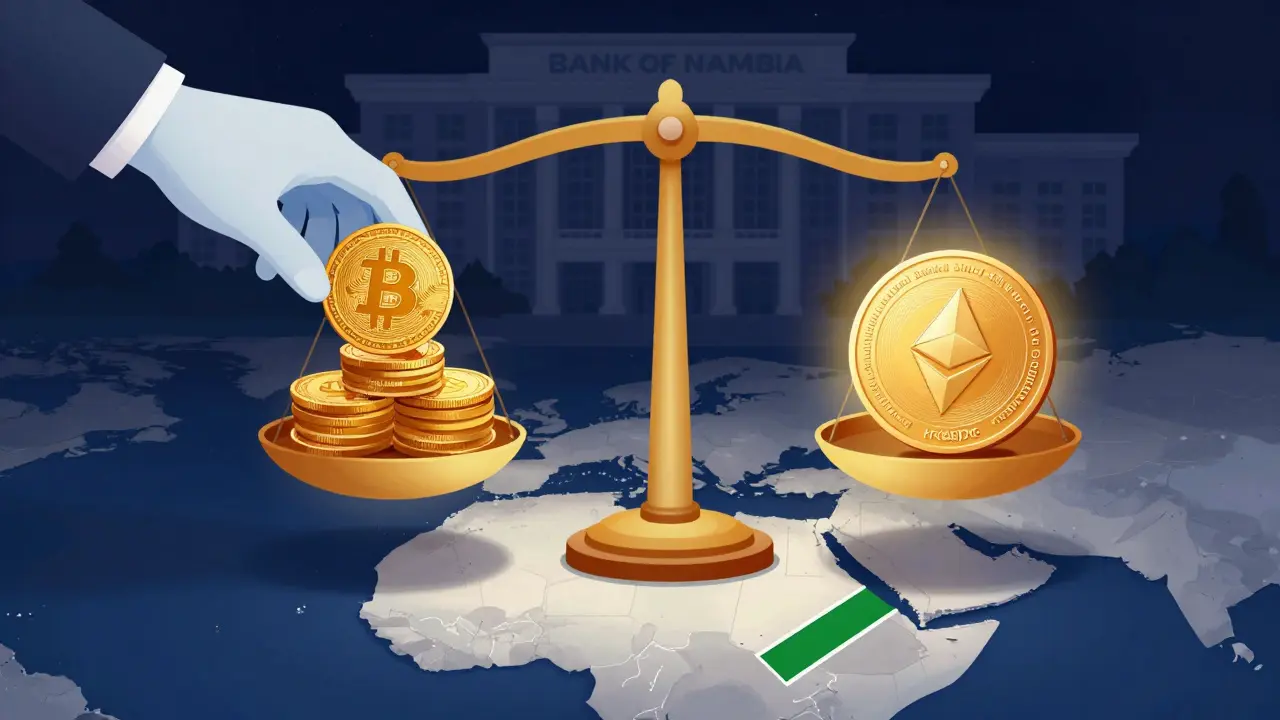
While regulating private crypto, the Bank of Namibia is also looking inward. They are actively exploring a Retail Central Bank Digital Currency (rCBDC). Why? Three main drivers: financial inclusion, modernizing the payment system, and improving cross-border payments.
This creates an interesting dynamic. On one hand, you have private VASPs fighting for licenses to trade Bitcoin and Ethereum. On the other, the central bank is potentially building its own digital currency. This isn't necessarily contradictory. Many central banks worldwide view CBDCs as a way to maintain monetary sovereignty in a digital age. For Namibia, this could mean a hybrid future where regulated private crypto exists alongside a state-backed digital rand (or naira equivalent, depending on final naming conventions).
For now, however, the focus remains on getting the current VASP framework right. The IMF has praised BON's "cohesive and coordinated approach," noting that they are carefully analyzing payment systems to balance risk with innovation. But don't expect rapid deregulation anytime soon. The Bank's stance on Initial Coin Offerings (ICOs) remains hostile, citing fraud risks. If you are an entrepreneur hoping to raise capital via token sales in Windhoek, you will likely find the doors closed.
Practical Advice for Users and Businesses
If you are a resident of Namibia wanting to trade crypto, you need to be aware of the limitations. You cannot simply sign up for any international exchange and assume you are safe. The ban on non-local exchanges means that using offshore platforms might leave you without local consumer protection. Ideally, you should wait for fully licensed local VASPs to go live.
For businesses, the advice is patience. The six-month silent period is real. Budget accordingly. Do not plan your cash flow assuming you will generate revenue in month one. Use that time to build robust KYC (Know Your Customer) and AML systems. The regulators will inspect every line of code and every policy document. Hiring local legal counsel familiar with the Virtual Assets Act is not optional; it is essential.
Mercants who want to accept Bitcoin can do so, but remember: it is at your discretion and risk. There is no government guarantee if the price crashes or if a transaction fails. Treat it like accepting a foreign currency without hedging-high reward, high risk.
Is Bitcoin legal in Namibia?
Bitcoin is not illegal to own or use as a payment method between consenting parties, but it is not recognized as legal tender. Trading and exchanging it requires a license from the authorities. Unlicensed trading is restricted.
Can I use Binance or Coinbase in Namibia?
The regulations ban crypto-exchanges that are not based in Namibia. While individuals might technically access global sites, operating a business through them is prohibited. Licensed local VASPs are the compliant route for commercial activity.
What is the Travel Rule threshold in Namibia?
The Travel Rule applies to transactions exceeding NAD 20,000 (approximately USD 1,000). Above this amount, service providers must collect and share detailed information about both the sender and the receiver.
Are ICOs allowed in Namibia?
No. The Bank of Namibia explicitly discourages and effectively bans Initial Coin Offerings (ICOs) due to the high potential for fraud, manipulation, and misrepresentation.
Who regulates cryptocurrency in Namibia?
Regulation is a joint effort. The Bank of Namibia sets the policy and oversees payment systems, while the Namibia Financial Institutions Supervisory Authority (NAMFISA) handles the actual licensing and supervision of Virtual Asset Service Providers (VASPs).
Comments (8)

- Autumn Story
- July 10, 2026 AT 21:36 PM
Oh my gosh, this is such a huge step forward for Namibia!!! I am so happy to see them finally embracing the future instead of just banning everything like some other countries do... it gives me hope that regulation can actually work without killing innovation!!
The part about the six-month silence period is really interesting though. It seems strict but maybe necessary to keep the bad actors out? I think it’s great they are being cautious! 🌟

- Ella Collinson
- July 11, 2026 AT 06:37 AM
The regulatory framework described here exhibits classic characteristics of premature institutionalization within an emerging asset class. The imposition of a 'silence period' prior to operational licensing introduces significant opportunity costs and capital inefficiencies for early-stage VASPs. Furthermore, the prohibition on non-local exchanges creates an artificial scarcity in liquidity provision, likely leading to market fragmentation and reduced price discovery mechanisms. This approach prioritizes regulatory comfort over market maturation, effectively stifling the very innovation it claims to support while failing to address the underlying technological agnosticism required for sustainable fintech ecosystems.

- Andrew Schneider
- July 12, 2026 AT 00:49 AM
Hahahaha! You guys are taking this way too seriously 😂😂😂 Like, who cares if you have to wait six months to trade Bitcoin? It’s not like the world is ending! 🤡 But seriously, the idea that Namibia is going to be the next crypto hub is laughable. They’re playing catch-up with South Africa which has been doing this since 2022. And don’t get me started on the rCBDC thing-central banks always want their own digital leash around our necks. It’s all a big control freak move disguised as 'innovation.' 🙄💸

- Eric Braddock
- July 13, 2026 AT 11:19 AM
You naive fools. Do you really think this is about 'protecting consumers'? Please. The Travel Rule threshold of NAD 20,000 is just a data harvesting mechanism designed to feed into the global surveillance state. By forcing local presence and banning foreign exchanges, they aren't securing the market; they're ensuring that every transaction is traceable back to a physical identity tied to your biometric data. The rCBDC isn't for 'financial inclusion'; it's for programmable money where the central bank can freeze your assets at will. Wake up. This is the end of privacy. The jargon-heavy reports from the IMF are just propaganda to make you feel safe while they build the cage. 🕵️♂️👁️

- Ray Arney
- July 15, 2026 AT 04:25 AM
I guess we'll see how it plays out. Seems pretty standard for a new regulatory environment.

- Mark Tuason
- July 15, 2026 AT 18:26 PM
It is important to acknowledge the structured approach taken by the Bank of Namibia. While the six-month provisional period may seem lengthy, it serves a critical function in establishing robust compliance frameworks before public engagement begins. This methodical progression helps mitigate systemic risks associated with virtual assets, particularly concerning anti-money laundering protocols. The distinction between legal tender status and permissible commercial use is also a nuanced but necessary clarification for stakeholders operating within the jurisdiction.

- Nick G
- July 16, 2026 AT 18:12 PM
I find myself deeply intrigued by the cultural shift occurring within Namibian financial institutions, as it reflects a broader global narrative regarding the tension between traditional monetary sovereignty and the decentralized ethos of blockchain technology. One must consider the historical context of African banking infrastructures, which have often lagged behind digital adoption rates among the populace, thereby creating a vacuum that cryptocurrencies naturally fill. The Bank of Namibia’s decision to implement a sandbox model rather than an outright ban demonstrates a willingness to engage with these complex socio-economic dynamics, albeit cautiously. However, one cannot overlook the potential implications for cross-border payments, especially when juxtaposed against the more aggressive stances taken by neighboring nations like Botswana or Tanzania. It is a delicate balancing act, indeed, and I wonder how this will impact the everyday citizen who simply seeks financial autonomy in an increasingly digitized world.

- Nick Wengel
- July 18, 2026 AT 09:32 AM
Interesting read. Good to know the rules are changing.
Post-Comment
Categories
Popular Articles