
Colombians don’t need to bypass restrictions to use crypto exchanges-because there aren’t any. The idea that crypto access in Colombia is blocked or heavily restricted is a myth. In reality, Colombia has one of the most open and growing cryptocurrency markets in Latin America. Over 5 million people actively trade, hold, or mine digital assets. In 2024 alone, more than $6.7 billion in crypto transactions took place within the country. That’s not the behavior of a population fighting against bans. That’s the behavior of a market that’s being embraced.
There’s no ban-just rules
You won’t find a law in Colombia that says, "You can’t buy Bitcoin." You won’t find banks refusing to process crypto-related payments because the government outlawed them. What you will find is a regulatory system that’s catching up with a fast-moving industry. The Financial Superintendency of Colombia (SFC) doesn’t block access. It requires transparency. If you run a crypto exchange, you need to register. If you process payments above $150 in crypto, you must report suspicious activity to the Financial Intelligence Unit (UIAF). These aren’t barriers. They’re guardrails.Compare that to countries where crypto is outright banned, like Egypt or Nigeria (at times), and Colombia looks like a haven. There’s no need for VPNs, peer-to-peer smuggling, or offshore accounts to get started. You can sign up for a local exchange like LuloX or Wenia-both licensed and operating openly-with just your ID and a selfie. Wenia, backed by Bancolombia, Colombia’s largest bank, even offers a peso-backed stablecoin called COPW. That’s not circumvention. That’s integration.
What about banks?
Some people think banks won’t let you move money to crypto platforms. That’s partly true-but not because of a government ban. The SFC told traditional banks they can’t hold crypto, invest in it, or act as custodians. That’s about protecting the banking system, not punishing users. It doesn’t stop you from transferring pesos from your Bancolombia account to LuloX. You just can’t do it through a "crypto deposit" button inside your bank app. You’ll use a regular bank transfer, P2P payment, or digital wallet like Nequi or DaviPlata to send funds to an exchange. It’s one extra step, not a roadblock.And here’s the kicker: many Colombians don’t even use banks for crypto. They use fintech apps that are built for this. Apps like Bitso, Binance, and Coinbase work fine in Colombia. You don’t need a special trick. You just need a Colombian phone number, a government-issued ID, and a few minutes to complete KYC. No underground networks. No hacking. No risky workarounds.
Miners are thriving
If you think crypto mining is illegal in Colombia, you’re wrong. Mining is not just legal-it’s growing. In 2023, the government released clear rules for crypto mining: register your operation, follow environmental standards, pay taxes, and report energy use. That’s it. No permits needed from the central bank. No seizures. No raids.Startups in Bogotá and Medellín are setting up mining farms using cheap hydroelectric power. One company in Antioquia runs a 500-kilowatt operation powered entirely by renewable energy. They pay taxes. They report profits. They’re on the books. And they’re hiring. Mining isn’t a gray-market hustle anymore-it’s a legitimate business with permits, invoices, and payroll.
Taxes? Yes. But they’re fair
You pay taxes on crypto in Colombia, but not because it’s illegal. You pay because it’s income. If you trade and make a profit, that gain is taxed under existing income tax rules. If you’re a business selling crypto services, you pay corporate tax. The government doesn’t treat crypto as magic money-it treats it like stocks or real estate. That’s normal.There’s no 50% crypto tax. No special reporting form just for Bitcoin. You report it on your annual income tax return, just like you would with dividends or rental income. The SFC and DIAN (the tax agency) don’t chase small traders. They focus on large operators, unreported gains over $10,000, and suspicious patterns. If you’re making $500 a month trading, you’re not on their radar.

Why the myth persists
So why do people still think Colombians need to "get around" restrictions? Partly because of outdated news. In 2021, the SFC did shut down a few unlicensed platforms. But that wasn’t a crackdown on users-it was a cleanup of shady operators. Think of it like closing down unregistered street vendors, not banning food trucks.Also, some international exchanges list Colombia as "restricted" because they don’t have local compliance teams. That’s their problem, not Colombia’s. Binance, for example, works perfectly in Colombia. So does Kraken. Coinbase? Yes. You just need to use the right version of the site-Colombia’s version, not the one meant for the U.S. or EU.
Another reason? Fear. People hear "regulation" and think "banned." But regulation doesn’t mean prohibition. It means safety. In Colombia, regulation means you can file a complaint if an exchange freezes your funds. It means you can verify a platform is licensed. It means you’re not gambling with a random Telegram group.
What’s changing in 2025
Bill 510 of 2025 is the biggest sign that Colombia isn’t restricting crypto-it’s formalizing it. This law, passed in its first legislative debate, will create a legal framework for Virtual Asset Service Providers (VASPs). That means exchanges, wallets, and custodians will need to be licensed. But here’s the key: it’s not about stopping people. It’s about protecting them.Once this law passes, Colombian crypto users will have even more rights. Dispute resolution. Insurance for cold storage. Clear rules on asset recovery. Right now, if a platform vanishes, you’re on your own. After Bill 510, you’ll have legal recourse. That’s progress.
Real people, real access
Meet Ana, 28, from Cali. She buys Bitcoin every month with her salary to protect against peso inflation. She uses LuloX. She pays taxes. She doesn’t use a VPN. She doesn’t know anyone who does.Then there’s Diego, 35, who runs a small crypto mining operation in Pereira. He leases space in a warehouse, uses solar panels, and reports his earnings to DIAN. He’s not hiding. He’s expanding.
These aren’t exceptions. They’re the norm. Over 5 million Colombians are doing the same thing. No hacks. No workarounds. Just access.
What you actually need to get started
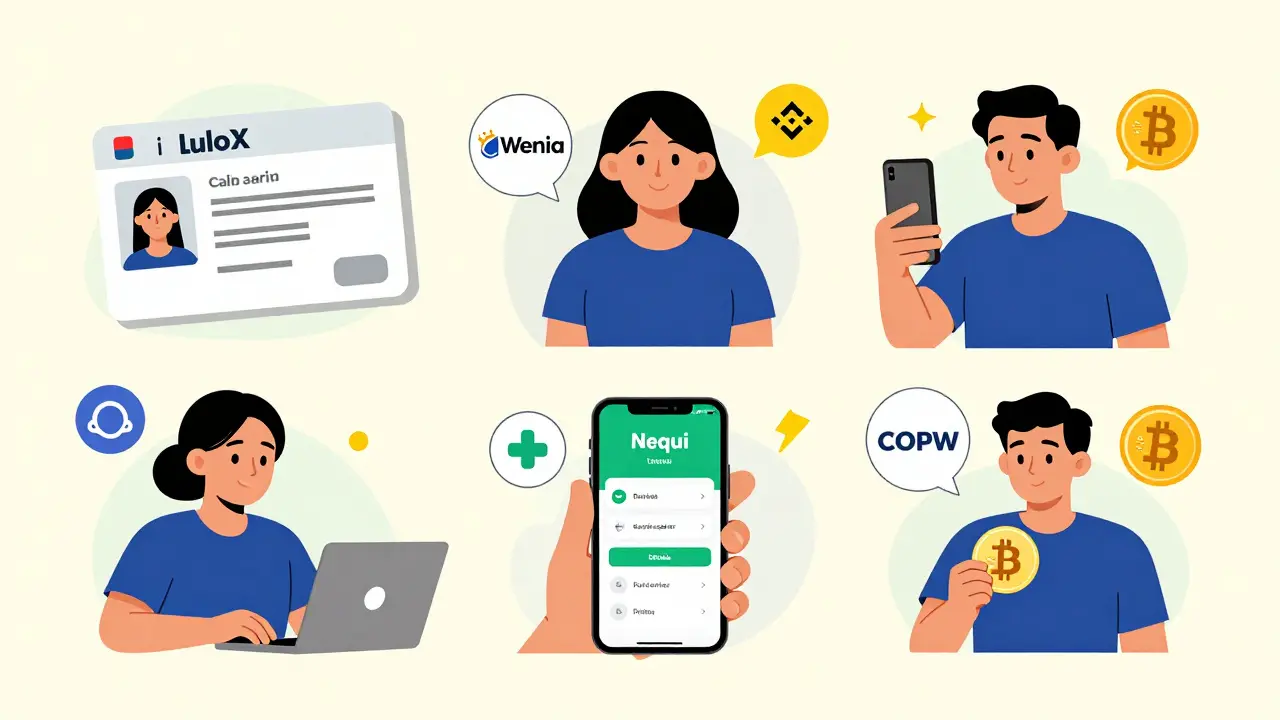
If you’re in Colombia and want to use crypto, here’s what you do:- Choose a licensed exchange: LuloX, Wenia, Bitso, Binance, or Coinbase.
- Sign up with your Colombian ID and phone number.
- Complete the KYC-upload a photo of your cédula and a selfie.
- Deposit pesos via bank transfer, P2P app, or digital wallet.
- Buy Bitcoin, Ethereum, or any other asset.
That’s it. No special tools. No hidden steps. No illegal methods.
What to avoid
Don’t use unlicensed platforms. Don’t trust Telegram groups promising "10x returns." Don’t send money to strangers. The system works-so don’t break it.And don’t listen to people who say you need a VPN or a foreign account. You don’t. Those stories are either outdated or made up to sell courses or tools.
Final thought
Colombia isn’t fighting crypto. It’s embracing it. The government sees it as a tool for financial inclusion, economic growth, and innovation. The people are using it. The banks are partnering with it. The miners are growing it. The regulators are shaping it.You don’t need to outsmart the system. You just need to use it.
Is it legal to buy Bitcoin in Colombia?
Yes, it’s completely legal to buy, sell, and hold Bitcoin and other cryptocurrencies in Colombia. There is no law banning crypto ownership. The government regulates exchanges and service providers to ensure transparency, not to block access.
Can Colombian banks block crypto transactions?
Banks can’t directly process crypto purchases, but they can’t block you from sending pesos to a crypto exchange. You can use bank transfers, P2P apps like Nequi or DaviPlata, or digital wallets to fund your exchange account. The restriction applies to banks holding crypto-not to users sending money.
Do I need a VPN to use Binance or Coinbase in Colombia?
No, you don’t need a VPN. Binance, Coinbase, and other major exchanges operate legally in Colombia. You just need to select Colombia as your country during sign-up. Using a VPN can trigger security flags and lead to account suspension.
Is crypto mining legal in Colombia?
Yes, crypto mining is legal and regulated. Miners must register their operations, comply with environmental standards, and pay taxes on income earned. There are no bans or permits required beyond standard business registration.
Do I have to pay taxes on crypto profits in Colombia?
Yes, capital gains from crypto trading are taxable under Colombia’s income tax laws. If you make a profit, you report it on your annual tax return. Small traders under $10,000 in annual gains rarely face audits, but large operators must comply fully.
Are there Colombian crypto exchanges I can use?
Yes, Colombia has several local exchanges, including LuloX and Wenia (backed by Bancolombia). These platforms are licensed, offer COPW stablecoin, and support peso deposits. They’re safer and easier to use than foreign platforms for most Colombians.
What’s Bill 510 of 2025 and how will it affect me?
Bill 510 is a new law that will formally regulate Virtual Asset Service Providers (VASPs) in Colombia. Once passed, it will require exchanges and wallets to be licensed, improve consumer protections, and create legal pathways for dispute resolution. It won’t restrict you-it will protect you.
Comments (6)

- Amit Kumar
- December 24, 2025 AT 07:38 AM
Colombians don’t need VPNs? Bro, I’ve seen guys in Medellín trading BTC on their phones while riding moto-taxis like it’s normal. And it is. You think Nigeria’s crypto scene is wild? Try watching a Colombian abuela buy Dogecoin with her pension and pay for arepas with COPW. This ain’t rebellion-it’s evolution. The US government still treats crypto like a cult. Colombia? They made it part of the economy. Respect.

- Helen Pieracacos
- December 24, 2025 AT 09:00 AM
Oh wow. So the fact that you have to use a P2P app instead of a ‘crypto deposit’ button is ‘integration’? Cute. Next you’ll tell me that having to file taxes on your crypto gains is ‘fair’ because it’s ‘like stocks.’ Tell that to the guy who lost $20k when LuloX glitched and vanished for 72 hours. Regulation isn’t safety-it’s bureaucracy with a smiley face.

- Dustin Bright
- December 25, 2025 AT 11:47 AM
Man this is actually so cool 😍 I didn’t know Colombia was this far ahead. I live in the US and my bank still freezes my account if I send $50 to Coinbase. Meanwhile, Colombians are just… doing it? Like normal people? I’m jealous. Also, mining with solar panels?? That’s next level. Someone send me a ticket to Bogotá. 🌞💰

- chris yusunas
- December 26, 2025 AT 12:40 PM
Colombia be turning crypto into a vibe not a crisis. No drama no panic just people using tech to survive inflation like it’s Tuesday. Banks ain’t your friend? Cool. Use Nequi. Mining? Use hydro. Taxes? Pay ‘em. No cap. No VPN. No fuss. The real flex ain’t the coin-it’s the peace of mind. And yeah, I’m from Nigeria where crypto’s a daily war. Colombia? They turned the battlefield into a marketplace. Respect.

- Sophia Wade
- December 27, 2025 AT 21:07 PM
The normalization of cryptocurrency as a legitimate asset class in Colombia represents a profound sociopolitical shift-one that transcends mere regulatory pragmatism. It signals a reconfiguration of financial sovereignty at the grassroots level, wherein informal economic actors are granted institutional legitimacy without coercion. The absence of overt prohibition, paired with transparent compliance mechanisms, reflects a rare equilibrium between innovation and civic responsibility. This is not merely policy-it is cultural maturation.

- Brian Martitsch
- December 28, 2025 AT 13:01 PM
LOL. 'No restrictions'? You're telling me using a P2P app instead of a bank button is 'integration'? 🤡 You think this is progress? It's just a workaround with more paperwork. And don't get me started on 'fair taxes'-if you're making $500/mo, you're still paying 25% on gains. That's not freedom. That's exploitation dressed up as regulation. 🙄