
Money is changing, but it isn't disappearing. If you look at your wallet today, you likely see a mix of cash, cards, and maybe a crypto app on your phone. This isn't just a habit; it's the new reality of global finance. The strict line between government-issued money and digital assets has blurred into a complex ecosystem where fiat and digital currencies operate side by side.
In 2026, we are no longer asking if cryptocurrencies will replace the dollar or the euro. We are asking how they work together. Central banks have launched their own digital versions of national currencies, while private companies use stablecoins to move money across borders faster than ever before. This dual system offers speed and efficiency, but it also brings new risks that regulators are still trying to manage.
The Rise of Central Bank Digital Currencies (CBDCs)
To understand this coexistence, you first need to know what a Central Bank Digital Currency (CBDC) is. It is simply digital cash issued directly by a country's central bank. Unlike Bitcoin, which is decentralized and volatile, a CBDC is backed by the full faith and credit of the government, just like the paper bills in your pocket.
The push for CBDCs accelerated after the 2008 financial crisis and gained serious momentum following Facebook's 2019 proposal for Libra (now Diem). That moment scared central banks into action. By 2025, the Bank for International Settlements (BIS) reported that 90% of the world's central banks were actively researching or developing their own digital currency.
Some countries have already crossed the finish line. The Bahamas launched the Sand Dollar in 2020, Jamaica followed with JAM-DEX in 2022, Nigeria introduced the e-Naira in 2021, and Zimbabwe rolled out the ZiG in 2024. These aren't just pilots anymore; they are live systems used by millions.
China leads the pack in scale. Their digital yuan pilot spans 26 regions and involves over 261 million users. As of the second quarter of 2025, the People's Bank of China processed $26.4 billion in transactions using this system. The goal here isn't to create a speculative asset but to improve payment efficiency and maintain control over monetary policy.
Stablecoins: The Private Alternative
While governments build CBDCs, the private sector relies on stablecoins. These are digital tokens pegged to the value of fiat currencies, usually the US dollar. The most famous examples are USDT (Tether) and USDC.
Stablecoins run on public blockchains like Ethereum and Solana. They offer a distinct advantage: speed and cost. According to McKinsey's April 2025 analysis, stablecoin transactions can process 100 to 1,000 times faster than traditional cross-border payments, costing up to 90% less. For example, sending money via SWIFT might take 1-5 business days with fees of 3-5%. In contrast, USDC transactions settle in under 30 seconds for an average cost of $0.05.
This efficiency has made them popular for remittances. MoneyGram, a major player in international transfers, adopted USDC in 2022. The result? Average transfer times dropped from three days to under 10 minutes, and costs fell from 6.3% to just 1.8% of the transfer value. By June 2025, the global stablecoin market reached $250 billion in circulation, growing at a staggering 107% year-over-year.
| Feature | Traditional Fiat (SWIFT) | CBDCs (e.g., e-Naira) | Stablecoins (e.g., USDC) |
|---|---|---|---|
| Settlement Time | 1-5 Business Days | Instant (Domestic) | <30 Seconds |
| Average Cost | 3-5% of Value | Low/Negligible | $0.05 per tx |
| Issuer | Commercial Banks | Central Banks | Private Companies |
| Cross-Border Use | Standard | Limited (Pilots only) | Dominant |

Why They Coexist: Complementary Roles
You might wonder why we need both. Why not just pick one? The answer lies in their strengths. CBDCs excel in domestic retail payments and monetary sovereignty. They give governments a direct way to implement policy without relying on commercial banks as intermediaries. In Jamaica, JAM-DEX boasts a 98.7% transaction success rate, significantly higher than mobile money alternatives.
However, CBDCs struggle with cross-border applications. Only 37% of CBDC pilots had cross-border functionality as of early 2025. This is where stablecoins shine. They are borderless by design. Multinational corporations are increasingly using them for international transactions; a 2025 survey by J.P. Morgan found that 68% of these firms now use stablecoins for some part of their treasury operations.
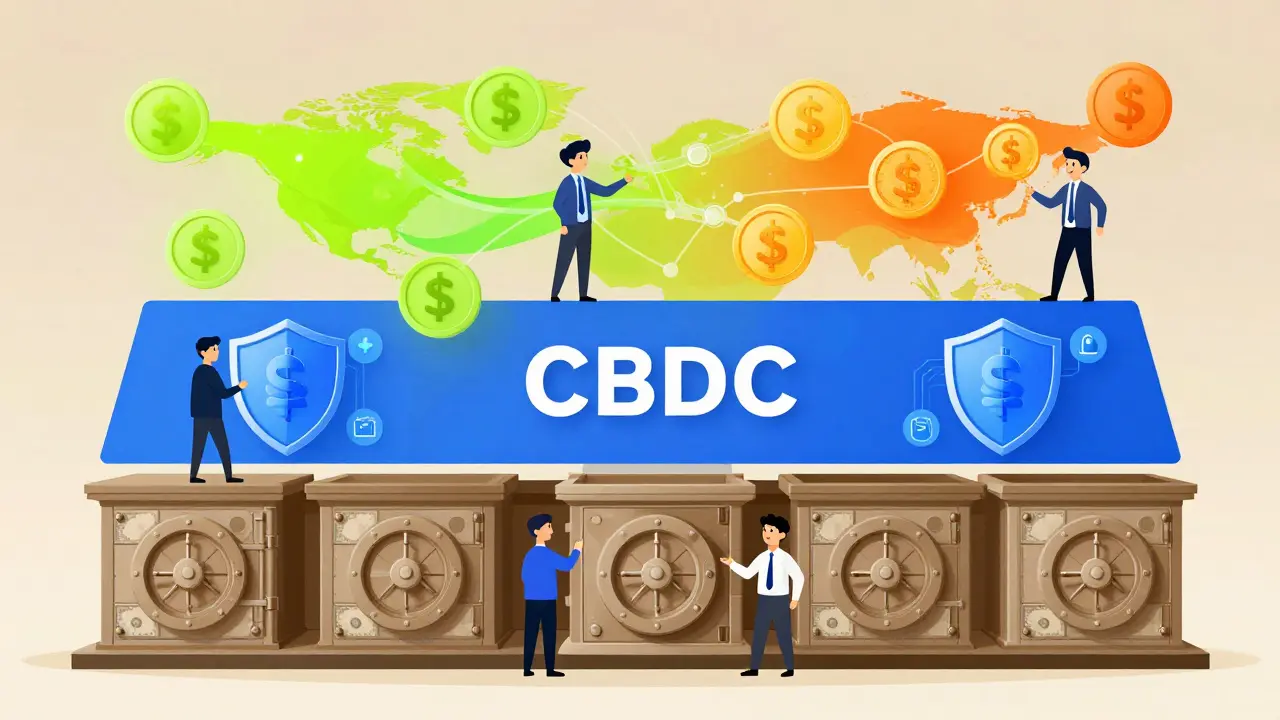
The coexistence model allows each system to play to its strengths. CBDCs handle local commerce and tax collection, ensuring the government retains control over its economy. Stablecoins handle global trade and remittances, providing liquidity and speed that legacy banking systems cannot match. Projects like mBridge, which connects China, the UAE, Thailand, and Hong Kong, show promise for bridging these worlds, having processed $22 billion in cross-border transactions since 2023.
Regulatory Challenges and Risks
This hybrid system isn't without friction. Regulators are worried about two main things: stability and sovereignty. If too much money moves from bank deposits to stablecoins, it could trigger bank runs during crises. The Bank of England warned in May 2025 that a rapid shift to stablecoins could lead to deposit outflows of 15-25% in a severe stress scenario.
Then there's the issue of regulation. The European Union implemented the MiCA framework, requiring stablecoin issuers to hold 1:1 reserves and provide daily attestations. The United States, however, lacks comprehensive federal regulation, creating a patchwork of rules that complicates compliance for global operators. The Basel Committee stepped in with a July 2025 implementation of reserve requirements, mandating 100% high-quality liquid assets for stablecoins. This is expected to reduce issuance costs slightly but adds a layer of bureaucracy.
Experts remain divided. Agustín Carstens of the BIS warned that unregulated stablecoins could undermine monetary policy if they reach critical mass. On the other hand, IMF Managing Director Kristalina Georgieva argued that CBDCs could boost financial inclusion by 15-20 percentage points in emerging markets. Nobel laureate Joseph Stiglitz added another caution, noting that CBDCs risk "financial repression" if designed with features like negative interest rates.
Implementation Hurdles in the Real World
Even when the technology works, adoption can be tough. User experience is a major barrier. In Jamaica, despite 63% of consumers registering for JAM-DEX, only 42% of merchants accepted it. Why? Point-of-sale integration costs averaged $280 per terminal, a steep price for small businesses.
Training is another hurdle. Central bank staff need an average of 172 hours of specialized training to manage CBDC infrastructure, compared to 89 hours for traditional systems. Documentation quality varies wildly; developers rated the Eurosystem's technical docs highly (4.2/5) but criticized Nigeria's resources (2.8/5).
Despite these challenges, progress is accelerating. Nigeria updated its e-Naira in April 2025, adding offline functionality and loyalty programs, which boosted monthly active users by 37%. MoneyGram expanded beyond USDC to include EURC and GBPt, processing $4.2 billion in quarterly stablecoin remittances. The market is finding its footing, even if the path isn't perfectly smooth.
The Future Landscape: A Three-Layer System
Where is this all heading? The IMF projects that by 2027, the global monetary system will feature three distinct layers. First, CBDCs will serve as the backbone for sovereign monetary policy. Second, regulated stablecoins will dominate cross-border commerce. Third, traditional fiat will persist for legacy systems and those who prefer physical cash.
The transition period is expected to last through 2030. During this time, we'll see more integration efforts like the BIS Innovation Hub's "unified ledger" concept, which aims to combine tokenized reserves, commercial bank money, and financial assets on integrated infrastructure. Twelve major central banks are already testing prototypes.
For the average person, this means more choices. You might pay your local coffee shop with a CBDC-linked app, receive your salary in dollars, and send money to family abroad using a stablecoin-all within the same week. The key is understanding that these tools are not enemies; they are parts of a larger, more efficient financial puzzle.
Will CBDCs replace cash completely?
Not necessarily. While CBDCs aim to digitize cash, many countries plan to keep physical notes for accessibility and privacy reasons. The coexistence model suggests a gradual shift rather than an immediate replacement, with legacy systems remaining relevant through 2030.
Are stablecoins safe to use?
Regulated stablecoins like USDC are considered safer due to reserve requirements and audits. However, risks remain regarding counterparty failure and regulatory changes. Always check if the issuer complies with frameworks like the EU's MiCA or upcoming Basel standards.
Which countries have launched CBDCs?
As of 2026, fully launched retail CBDCs exist in Jamaica (JAM-DEX), the Bahamas (Sand Dollar), Nigeria (e-Naira), and Zimbabwe (ZiG). China has an advanced pilot phase involving hundreds of millions of users.
How do stablecoins help with cross-border payments?
Stablecoins settle transactions in seconds for fractions of a cent, bypassing the slow and expensive SWIFT network. Companies like MoneyGram have reduced transfer times from days to minutes and cut fees significantly by using USDC.
What is the role of the Bank for International Settlements (BIS)?
The BIS acts as a coordinator for central banks, facilitating research and projects like mBridge and Project Agorá. They track CBDC development globally and propose standards for interoperability and stability in the digital currency landscape.
Comments (7)

- Madhu Menon
- June 6, 2026 AT 08:53 AM
The philosophical shift here is profound. We are moving from a system of trust in institutions to a system of trust in code and mathematics, yet we still cling to the old guard for stability. It's a strange duality where the most advanced technology serves the oldest human need: security. The article touches on this but misses the existential dread many feel about losing anonymity. When every transaction is traceable by a central bank, do we truly have freedom? Or just convenience wrapped in surveillance? 🤔

- Karthikeyan S
- June 8, 2026 AT 01:04 AM
omg another boring finance post 😒 nobody cares about cbdc unless its making them rich quick. the author thinks he knows everything but really he just copied wikipedia. why do people write these long essays when no one reads past the first sentence? i hate how everyone pretends to understand blockchain when they dont even know what a hash is. stop wasting my time with your 'analysis' it is so toxic and draining. i feel like screaming every time i see this word stablecoin. 🙄📉

- Narendra Kulkarni
- June 8, 2026 AT 17:37 PM
Hey there! I think this is a really interesting perspective. I agree that the coexistence model makes sense for now. In India, we are seeing similar things with UPI and crypto apps trying to find their place. It's not about one replacing the other immediately. People like familiarity. But yes, the speed of stablecoins is undeniable. Thanks for sharing this detailed breakdown. It helps clarify the confusion around CBDCs vs private coins. Hope you have a great day! :)

- Dinesh Pattigilli
- June 10, 2026 AT 16:46 PM
Typical mainstream narrative designed to keep the masses complacent while the elites consolidate control through CBDCs. You clearly don't grasp the geopolitical implications of China's digital yuan dominance. While you sit there typing these mediocre comments, the real power players are manipulating the mBridge project to bypass the US dollar hegemony. It is pathetic how easily people accept government issued digital shackles as 'convenience'. Wake up sheeple. The financial repression Stiglitz warned about is already happening in pilot zones. Your 'efficiency' is their surveillance tool.

- verna kennedy
- June 11, 2026 AT 17:37 PM
You are all missing the point entirely. This isn't about ideology or conspiracy theories. It is about regulatory compliance and risk management. If you cannot handle the basic mechanics of reserve requirements under MiCA, you have no business commenting on macro-finance. The data presented regarding SWIFT inefficiencies is irrefutable. Stablecoins are simply a better technological solution for cross-border liquidity. Stop whining about privacy and start understanding market forces. It is elementary economics.

- Kelly Tenney
- June 13, 2026 AT 06:01 AM
I appreciate everyone sharing their thoughts here. It's important to remember that change can be scary, but it also brings opportunity. For those worried about adoption hurdles, let's look at the progress in Nigeria and Jamaica. Real people are benefiting from faster remittances. Let's focus on how we can support financial inclusion rather than fear the unknown. We can learn together and adapt. There is room for both innovation and caution. Keep the conversation positive and constructive please.

- Caralee Robertson
- June 14, 2026 AT 14:39 PM
i mean honestly the part about training hours was wild. 172 hours?? thats like a full semester course just to manage the software. no wonder small businesses are struggling to adopt it. the cost barrier mentioned earlier seems huge too. $280 per terminal is nothing for big corps but for a mom and pop shop in canada or wherever its a lot. maybe the tech works but the human side is being ignored. feels like they are rushing without thinking about the actual users experience. hope it gets easier soon though.