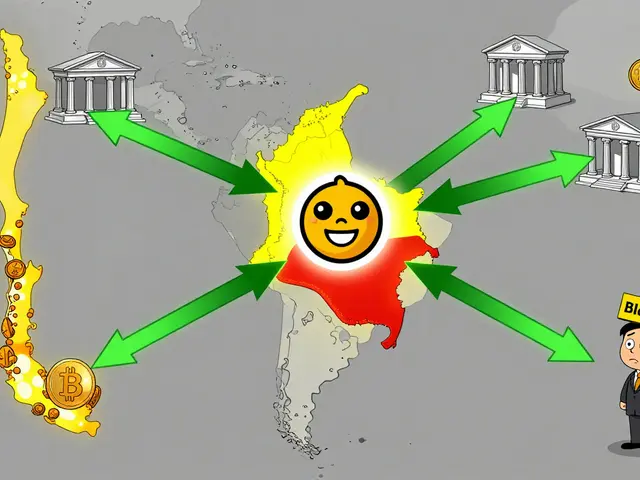

Imagine you see a small cryptocurrency token skyrocket by 500% in a single day. Your heart races. You buy in, hoping to catch the next wave of gains. Hours later, the price crashes back down, leaving you with worthless digital dust. This isn’t bad luck; it’s often a calculated trap known as market cap manipulation, which is the deliberate distortion of a cryptocurrency's market capitalization through deceptive trading practices to mislead investors.
In traditional stock markets, strict regulations and surveillance systems make it difficult for individuals to rig prices without getting caught. The cryptocurrency world, however, operates differently. It is largely unregulated, anonymous, and fragmented across hundreds of exchanges. These characteristics create a playground for manipulators-often called "whales" or organized syndicates-to exploit retail investors who lack the tools to detect these schemes.
The Anatomy of a Pump and Dump Scheme
The most recognizable form of manipulation is the pump and dump scheme. This tactic relies on hype rather than technology. A group of coordinators buys a large amount of a low-liquidity token at a low price. They then launch a coordinated marketing campaign, using social media platforms like Telegram, Discord, and Twitter to spread exaggerated claims about the project’s potential.
Retail investors, seeing the sudden price spike and positive chatter, rush to buy in. This buying pressure drives the price higher, allowing the initial buyers (the manipulators) to sell their holdings at a profit. Once they dump their tokens, the demand evaporates, and the price collapses. Latecomers are left holding the bag.
- The Setup: Manipulators accumulate tokens quietly before any public announcement.
- The Pump: Coordinated promotion creates artificial FOMO (Fear Of Missing Out).
- The Dump: Insiders sell off their positions, crashing the price.
The scale of this problem is staggering. In 2023 alone, over 90,000 tokens were flagged for involvement in pump-and-dump activities, generating an estimated $241.6 million in illicit profits for the perpetrators. Law enforcement has begun cracking down on these operations. For instance, in October 2024, the FBI executed "Operation Token Mirrors," creating a fake cryptocurrency called NexFundAI to entrap fraudsters. This operation led to charges against 18 individuals for conspiracy and market manipulation, highlighting the severity of the issue.
Wash Trading: Creating Illusionary Volume
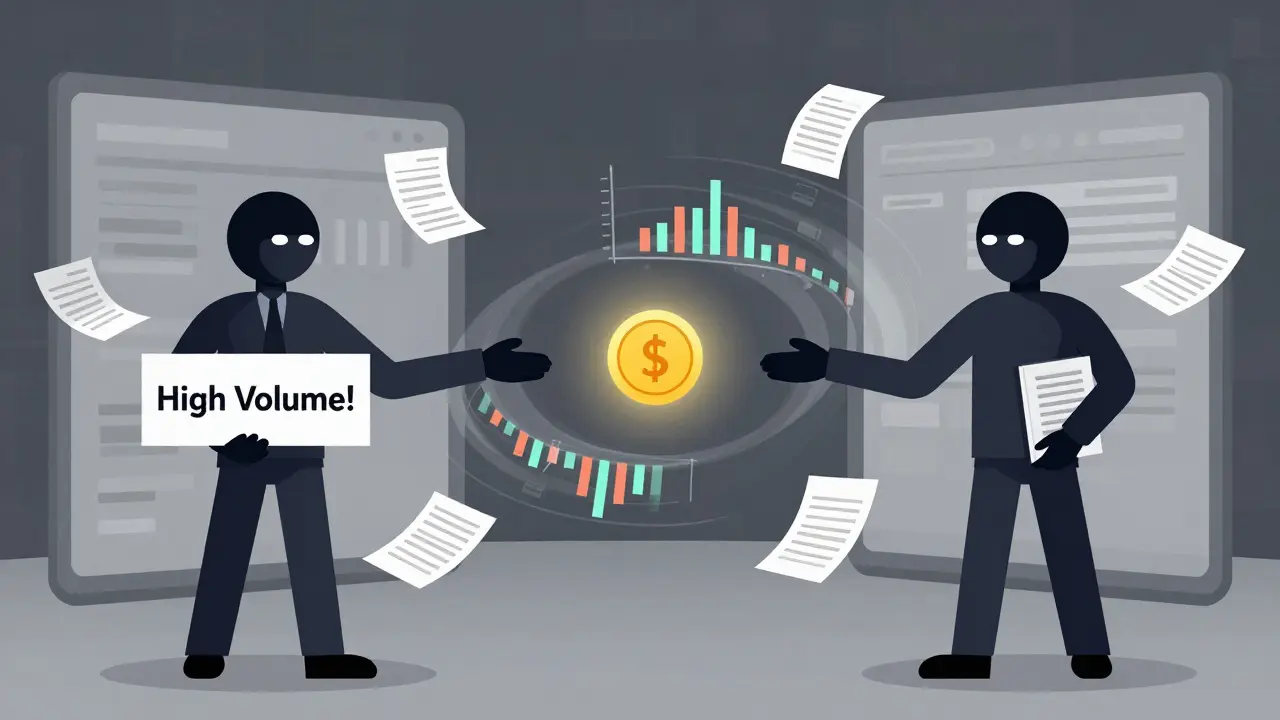
If pump and dump is about hype, wash trading is a practice where traders execute trades between accounts they control to create false impressions of high trading volume and liquidity. It makes a dead market look alive and active.
Why does volume matter? Many investors use trading volume as a proxy for legitimacy and liquidity. High volume suggests that many people are interested in the asset, making it easier to buy or sell without drastically affecting the price. By engaging in wash trading, manipulators can trick algorithms and novice traders into believing there is strong market interest.
This practice is rampant on unregulated cryptocurrency exchanges. Research indicates that wash trading can account for more than 70% of the reported volume on some smaller platforms. Exchanges may even encourage this behavior to attract new listings and users by inflating their own statistics. Detecting wash trading requires sophisticated blockchain analysis to identify circular movements of funds between linked addresses, revealing that the same entity is both buying and selling.
| Tactic | Primary Goal | Key Indicator |
|---|---|---|
| Pump and Dump | Artificially inflate price to sell holdings | Sudden price spikes driven by social media hype |
| Wash Trading | Fake high volume and liquidity | High trade frequency with minimal price change |
| Spoofing | Create false supply/demand signals | Large orders placed and cancelled rapidly |
| Oracle Manipulation | Exploit smart contract pricing flaws | Discrepancy between exchange price and on-chain value |
Spoofing and Sell Wall Tactics
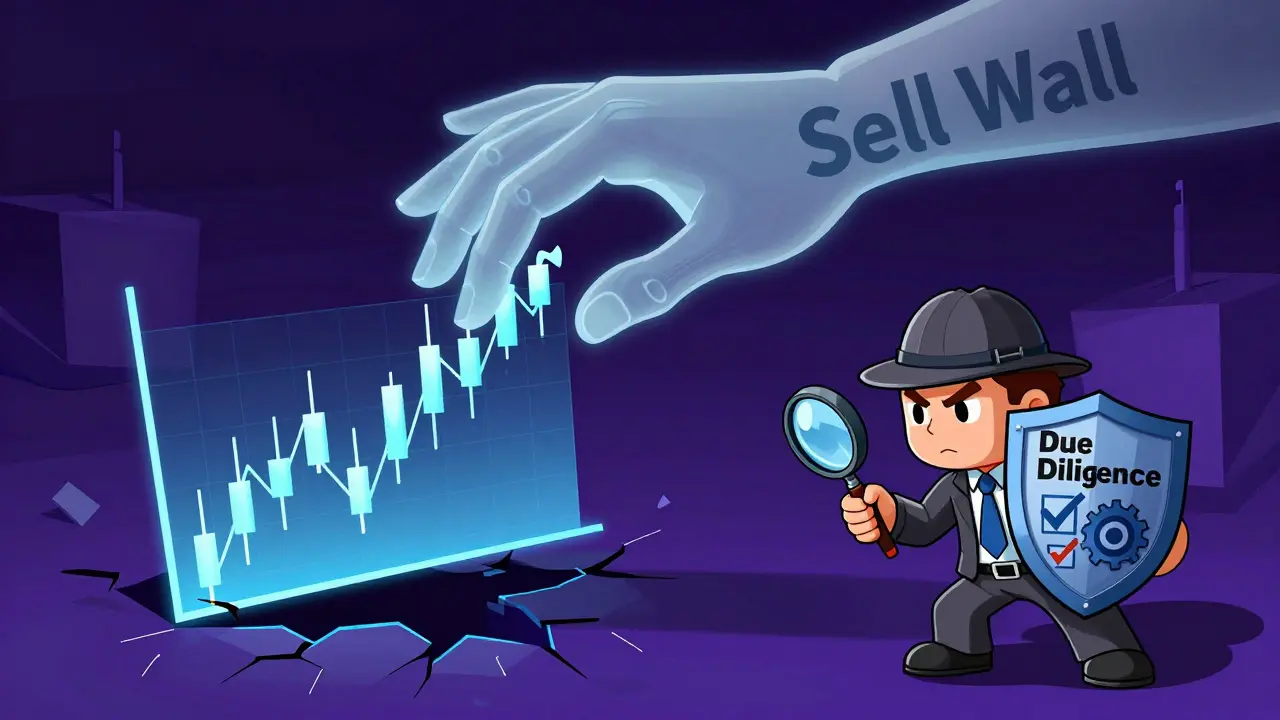
Spoofing involves placing large buy or sell orders with no intention of executing them. The goal is to deceive other traders into thinking there is significant support or resistance at a certain price level. In the crypto world, this is often seen as "sell walls."
A manipulator might place a massive sell order just above the current market price. This creates the appearance of heavy resistance, discouraging other buyers from pushing the price up. While others hesitate, the manipulator quietly accumulates more tokens at lower prices. Once they have gathered enough inventory, they cancel the sell wall. Without the artificial resistance, the price can spike, allowing the manipulator to sell their accumulated tokens at a premium.
This tactic exploits the lower liquidity of many cryptocurrency markets compared to traditional financial instruments. Because fewer genuine trades occur, large spoofed orders have a disproportionate impact on market psychology and price action.
DeFi-Specific Risks: Oracle Manipulation
Decentralized Finance (DeFi) introduced new vulnerabilities, particularly regarding price oracles. An oracle is a service that provides external data, such as asset prices, to smart contracts on the blockchain. If a smart contract relies on a single, manipulable source for pricing, it becomes vulnerable to exploitation.
The most notorious example occurred in October 2022 with Mango Markets, a lending platform on the Solana blockchain. Trader Avraham Eisenberg and his associates exploited the platform’s price oracle. By leveraging the limited liquidity of Mango tokens, they drove up the price artificially. They then used these inflated tokens as collateral to borrow millions of dollars worth of stablecoins. When the manipulation was revealed, the price collapsed, leaving Mango Markets with a $115 million shortfall.
Eisenberg argued that he simply executed a profitable trading strategy within the rules of the protocol. However, the U.S. Securities and Exchange Commission (SEC) charged him with violating anti-fraud provisions. This case highlights the complex legal gray areas in DeFi, where technical exploits and market manipulation often overlap.
How to Protect Yourself from Manipulation
You cannot control what whales do, but you can protect your own capital by adopting a skeptical mindset. Here are practical steps to identify potential manipulation:
- Check Liquidity Depth: Low liquidity means prices can be moved easily with small amounts of capital. If a token has thin order books, it is highly susceptible to manipulation.
- Analyze Volume Spikes: Sudden increases in volume without news or fundamental developments are red flags. Use tools like Chainalysis or Etherscan to verify if the volume is coming from unique addresses or a few repeated ones.
- Beware of Social Hype: If influencers are shilling a coin aggressively, especially one with a recent listing, assume it is a pump until proven otherwise. Do not buy based on FOMO.
- Verify Oracles: For DeFi investments, check how the protocol determines asset prices. Protocols that rely on multiple decentralized oracles (like Chainlink) are generally safer than those using single-source pricing.
- Use Stop-Loss Orders: While not foolproof, stop-loss orders can help limit losses if a manipulated price suddenly reverses.
Remember, if a deal looks too good to be true, it usually is. The cryptocurrency market is evolving, and while regulation is increasing, vigilance remains your best defense.
What is market cap manipulation in cryptocurrency?
Market cap manipulation refers to deceptive practices where traders artificially inflate or deflate the price and trading volume of a cryptocurrency. The goal is to create a false impression of market health, enticing other investors to buy or sell, allowing the manipulators to profit from the resulting price movements.
How can I tell if a cryptocurrency is being manipulated?
Look for warning signs such as sudden, unexplained price spikes, excessive social media hype from unknown sources, and high trading volume on obscure exchanges. Additionally, check if the liquidity is low, which makes it easier for large players to move the price. Tools that analyze on-chain data can also reveal if a small number of wallets are controlling most of the trading activity.
Is wash trading illegal in crypto?
Yes, wash trading is considered illegal market manipulation under securities laws in many jurisdictions, including the United States. However, enforcement in the crypto space is challenging due to the anonymity of transactions and the global nature of exchanges. Regulatory bodies like the SEC are increasingly pursuing cases involving wash trading, as seen in various exchange lawsuits.
What happened in the Mango Markets hack?
In October 2022, a trader named Avraham Eisenberg exploited a vulnerability in Mango Markets' price oracle. By manipulating the price of Mango tokens on a decentralized exchange, he borrowed $115 million in assets. Although he claimed it was a legitimate arbitrage strategy, regulators charged him with market manipulation and fraud, and the platform sued to recover the funds.
Can big exchanges prevent market manipulation?
Major regulated exchanges implement surveillance systems to detect suspicious activities like spoofing and wash trading. However, smaller and unregulated exchanges often lack these resources or incentives. Furthermore, because crypto markets are fragmented, manipulators can move between different platforms to evade detection, making comprehensive prevention difficult.
Comments (10)

- Caique Muniz
- May 19, 2026 AT 07:41 AM
honestly this is just basic stuff that everyone should know by now. why are we still pretending crypto is some magical new frontier when its just the wild west with better graphics? i mean sure, the article explains it but come on, people need to stop being so gullible. its not rocket science to see a pump and dump coming from a mile away if you actually look at the charts instead of just listening to influencers on twitter. typical retail investor behavior right there.

- Bradley Geldenhuys
- May 19, 2026 AT 16:01 PM
look, i get that the system is rigged, but lets not throw the baby out with the bathwater here. yes, manipulation exists, but its also about personal responsibility and learning how to navigate these waters. we have to be smarter than the whales, not just angry at them. its a harsh lesson for sure, but one that builds character and financial literacy in ways traditional markets never did. keep your head up and do your own research because thats the only shield you really got.

- robert Whitehead
- May 21, 2026 AT 12:52 PM
you guys are missing the point entirely. this isn't about 'learning' or 'character building'. it's about fraud. plain and simple. wash trading is illegal in stocks, why is it tolerated here? because regulators are asleep at the wheel or complicit. don't let anyone tell you that 'decentralization' excuses criminal behavior. it doesn't. it just makes prosecution harder. stop romanticizing crime as innovation.

- Mike S
- May 23, 2026 AT 09:44 AM
oh wow, another lecture on ethics from someone who probably lost money on a meme coin last week. spare me the moral high ground. the market is what it is. if you cant handle the volatility, go buy bonds. calling it fraud doesnt change the fact that its a free-for-all. and honestly, half these exchanges are running scams themselves, so dont act like you're the victim when you signed up for the circus.
- robert Whitehead
- May 23, 2026 AT 19:59 PM
exactly my point. its not about handling volatility, its about knowing you're being lied to. there's a difference between risk and deception. spoofing is deception. wash trading is deception. pretending otherwise is just naive. people need to understand that 'the market' isn't an abstract force, it's made of individuals making choices, and some of those choices are criminal.

- H F
- May 23, 2026 AT 21:15 PM
i think we can all agree that transparency is key here. while the tactics described are indeed predatory, focusing solely on blame ignores the opportunity for improvement. blockchain technology actually allows us to track these manipulations more effectively than ever before. we just need better tools and community vigilance. let's work together to build systems that reward honesty rather than exploitation.

- Michael Berggren
- May 24, 2026 AT 21:09 PM
great breakdown! 👍 i especially appreciated the section on oracle manipulation. it's such a niche but critical vulnerability in DeFi that most casual investors overlook. checking liquidity depth and verifying oracles should be step one for any serious trader. stay safe out there folks! 🚀📉

- Kiran CS
- May 25, 2026 AT 07:36 AM
one must appreciate the sheer audacity required to orchestrate such elaborate schemes. truly, the human capacity for deceit knows no bounds. however, I find the suggestion that retail investors can simply 'protect themselves' somewhat patronizing. It assumes a level of sophistication and access to information that the average participant simply does not possess. The game is stacked against them, quite literally.

- Bijan Das
- May 26, 2026 AT 22:04 PM
yeah well, smart people lose money too. dont act like you're above it just because you read a chart. most of you are just gambling with other peoples money. its pathetic really. if you think you can outsmart the bots and the whales, you're delusional. just stick to index funds and save yourself the headache.

- Ashley Rodriguez
- May 27, 2026 AT 20:34 PM
i feel like this whole discussion is getting a bit too negative and i just wanted to say that i think its important to remember that not everyone is trying to scam you. there are genuine projects out there and people who believe in the technology. we just need to be more careful and patient. its easy to get swept up in the hype but taking a step back and doing your homework can make all the difference in the long run.