
You might have seen headlines about a "Pokémon GO killer" raising millions or hitting a $4.60 price tag. If you are looking at SpaceCatch (CATCH) today, those numbers feel like ancient history. As of November 2026, the reality is far more complex. This isn't just another hype-cycle ghost; it is a functioning ecosystem with a specific utility model, but one that has faced significant development shifts and market volatility.
If you are trying to figure out if this coin has legs or if it’s already fallen, you need to look past the marketing fluff. You need to understand how the token actually works, where it lives on the blockchain, and why the project status changed in late 2025. Here is the straight talk on what SpaceCatch is, how CATCH functions, and what risks you should watch before putting any money into it.
The Core Concept: Not Just Another Clicker Game
SpaceCatch is a GameFi product family combining a location-based augmented-reality mobile game, SpaceCatch AR, with SpaceCatch Classic, a browser and Telegram-origin pixel-art competitive game. The central idea here is different from most crypto games. Instead of rewarding you directly with the tradable token for every step you take, SpaceCatch uses a two-layer economy.
In SpaceCatch AR, you use your phone’s camera to scan real-world environments. You fight alien NPCs, complete AI-driven quests, and build shelters. But here is the catch: physical activity generates NFT boosters or game assets, not raw CATCH tokens. These boosters can be used to train your avatar or sold to other players on an external marketplace. This design attempts to stop the token from inflating endlessly because gameplay rewards aren’t automatically minting new coins.
Meanwhile, SpaceCatch Classic serves as a simpler entry point. It started as a Telegram game and evolved into a browser-based competitive title. It keeps the community engaged while the heavier AR tech matures. The goal is to blend physical movement with digital ownership, using Unity for high-quality graphics and backend support provided by professional studios.
Tokenomics: Supply, Vesting, and Inflation Control
To understand the value of CATCH, you have to look at its supply schedule. The total supply is fixed at 100,000,000 tokens. There is no infinite minting here, which helps long-term scarcity. However, how these tokens enter circulation matters more than the total number.
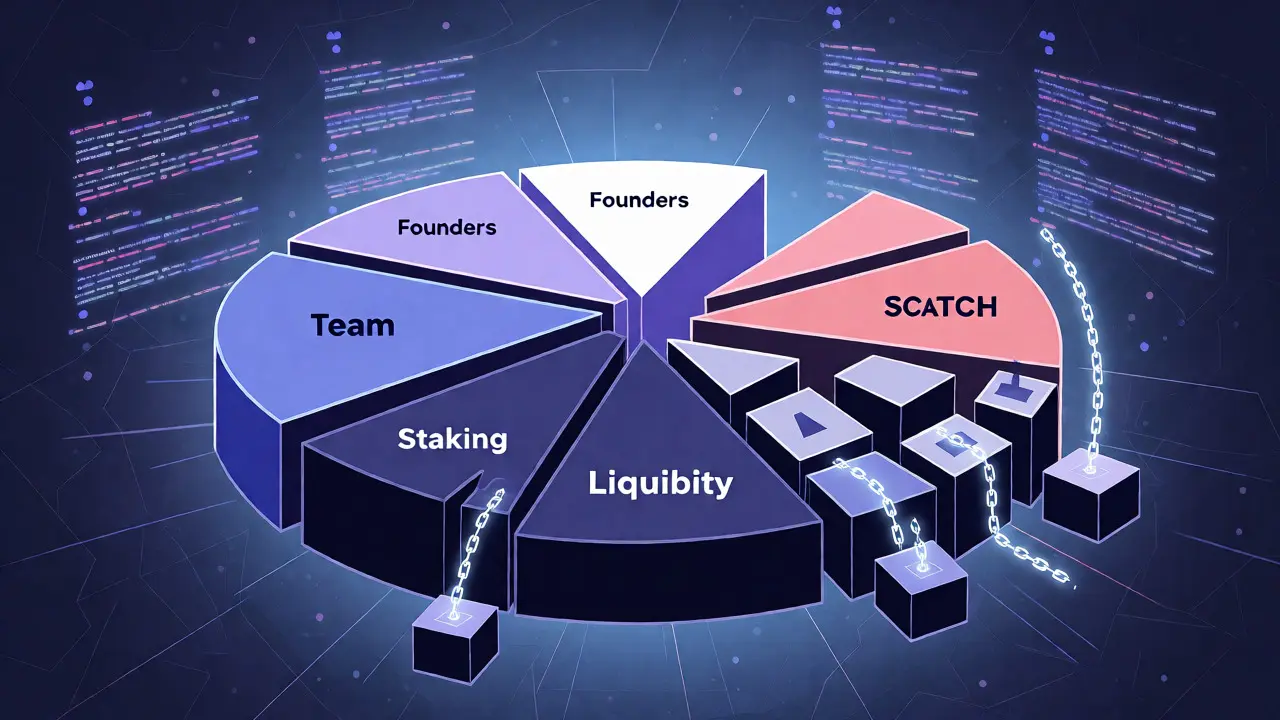
The whitepaper allocates the supply across several buckets. Founders get 7%, the team gets 9%, and advisors take 1%. The bulk goes to public sales (20%), final rounds (13%), staking (20%), liquidity (10%), marketing (10%), and community rewards (10%). Crucially, most of these allocations are locked up. For example, founder tokens had a four-month cliff followed by 20 months of linear vesting. Team tokens had a five-month cliff. This structure was designed to prevent early dumpers from crashing the price immediately after launch.
Staking plays a major role in reducing circulating supply. The staking allocation follows a five-year halving schedule. While some promotional materials advertised monthly returns around 1.7%, you shouldn’t treat this as a guaranteed bank interest rate. Staking rates often fluctuate based on protocol incentives and treasury health. The key takeaway is that a large portion of CATCH is locked in smart contracts, meaning the actual liquid supply available for trading is much smaller than the headline 100 million figure.
Technology and Security: Arbitrum and Audits
CATCH runs on the Arbitrum network. This is a Layer-2 scaling solution for Ethereum, chosen for its low transaction fees and fast confirmation times. If you are moving CATCH, you need to ensure you are selecting the correct network. Sending tokens to the wrong chain usually means they are gone forever.
A critical detail many users miss is the contract migration. The original contract address was 0xf0a479c9c3378638ec603b8b6b0d75903902550b. It has since migrated to 0xbC4c97Fb9befaa8B41448e1dFcC5236dA543217F. Always verify the current contract on Arbiscan before depositing to an exchange or connecting a wallet. Using an old address can lead to lost funds.
Security-wise, the project hired Hacken, a reputable audit firm, to review the smart contracts in June 2024. They examined the ERC-20 token, airdrop mechanisms, staking, and vesting schedules. Hacken identified administrative privileges that allow the team to manage allocations and recover tokens. This means the system is not fully permissionless; the developers retain some control over the contract logic. Additionally, reports mention a CertiK assessment and KYC verification for core team members, adding a layer of transparency regarding who is behind the code.
Market Reality: Liquidity and Volatility
Let’s talk numbers, because they tell a cautionary tale. Early coverage hyped a presale that raised approximately $3.37 million. At its peak, the token reportedly hit $4.60, representing a massive return for early buyers. Fast forward to November 6, 2026, and the picture looks very different.
| Metric | Value | Note |
|---|---|---|
| Price | ~$0.000226 | Extremely low compared to historical highs |
| Market Cap | ~$11,517 | Micro-cap asset |
| Circulating Supply | ~51 Million | Half of total supply is in circulation |
| Rank | #11,211 | Low visibility among thousands of cryptos |
The discrepancy between the $4.60 peak and the current sub-cent price highlights extreme volatility. More importantly, it signals low liquidity. Aggregators like CoinGecko show minimal trading volume. Some sources report active markets on Gate.io and MEXC, while others indicate thin order books. If you try to sell a large amount of CATCH, you might crash the price yourself due to lack of buyers. This is a classic micro-cap risk: easy to buy, hard to exit without slippage.
Development Status: The Pixelfield Handover
This is the most important piece of context for anyone researching SpaceCatch today. The game was initially developed by Pixelfield, a Czech-UK studio known for professional game design. They handled the Unity development, art, and backend for both the AR and Classic versions.
However, in October 2025, Pixelfield announced that their engagement ended. Development transferred to a new studio. The official roadmap, updated recently, still labels the project as being in an "Active soft launch." This phrasing suggests that while the game is playable, it hasn’t reached a full, stable global release with massive user adoption. The handover introduces uncertainty. Will the new team maintain the same quality? Will they push updates regularly? Without independent player analytics or verified retention metrics, "thriving community" claims remain unverified anecdotes rather than data points.
Risks and Practical Considerations
If you are considering buying CATCH, you need to weigh these factors carefully:
- Liquidity Risk: With a market cap under $15k, exiting a position can be difficult. Check live order books on exchanges before committing capital.
- Contract Migration: Ensure you hold the new Arbitrum contract version. Old tokens may not function correctly on all platforms.
- Vesting Unlocks: Even though vesting schedules were set, ongoing unlocks can create sell pressure if team members or early investors decide to cash out.
- Centralization: Admin keys exist. The team can pause transfers or adjust parameters, unlike fully decentralized protocols.
- Adoption Dependency: The token’s value relies on people actually playing the game and wanting the boosters. If player count drops, demand for CATCH evaporates.
Onboarding requires technical comfort. You need a compatible iOS or Android device for the AR experience, a Web3 wallet, and small amounts of ETH on Arbitrum for gas fees. Start small. Test the withdrawal process to ensure your exchange supports the current contract.
Frequently Asked Questions
Is SpaceCatch (CATCH) a good investment in 2026?
It is a high-risk speculative play. The token has experienced a massive drawdown from its historical peaks. Its viability depends entirely on whether the new development team can revive user engagement and increase liquidity. It is currently a micro-cap asset, so only invest what you can afford to lose completely.
How do I earn CATCH in the game?
You generally do not earn CATCH directly from walking or fighting aliens. Physical activity yields NFT boosters and game assets. These can be traded on the marketplace for CATCH, or you can earn CATCH through staking, special events, and milestone rewards.
Which blockchain does CATCH use?
CATCH is an ERC-20 token running on the Arbitrum One network. Make sure your wallet and exchange deposits are set to Arbitrum, not Ethereum Mainnet or BSC, to avoid losing funds.
Who developed SpaceCatch?
The project was incubated by Moon5 Labs and primarily developed by Pixelfield until October 2025. Since then, development has been handed over to a new studio. The founders include Stanislav Lepka and Radek Holubík.
Is the CATCH contract audited?
Yes, Hacken conducted a security analysis of the token, staking, and vesting contracts in June 2024. CertiK also performed assessments and KYC verification for team members. However, audits do not guarantee future performance or protect against market risks.