
Most people buy cryptocurrency because they see a green candle or hear a rumor. That is gambling, not investing. If you want to build real wealth in the blockchain space, you need to stop looking at price charts and start looking at the engine under the hood. Fundamental analysis is the process of determining if a crypto project is actually worth something before you put your money into it.
In traditional finance, you look at earnings reports. In crypto, those don't exist for most projects. Instead, you have to dig into code commits, wallet activity, and token supply mechanics. It feels like detective work, but once you learn the framework, you can spot scams early and find gems that others miss.
The Core Pillars of Crypto Fundamental Analysis
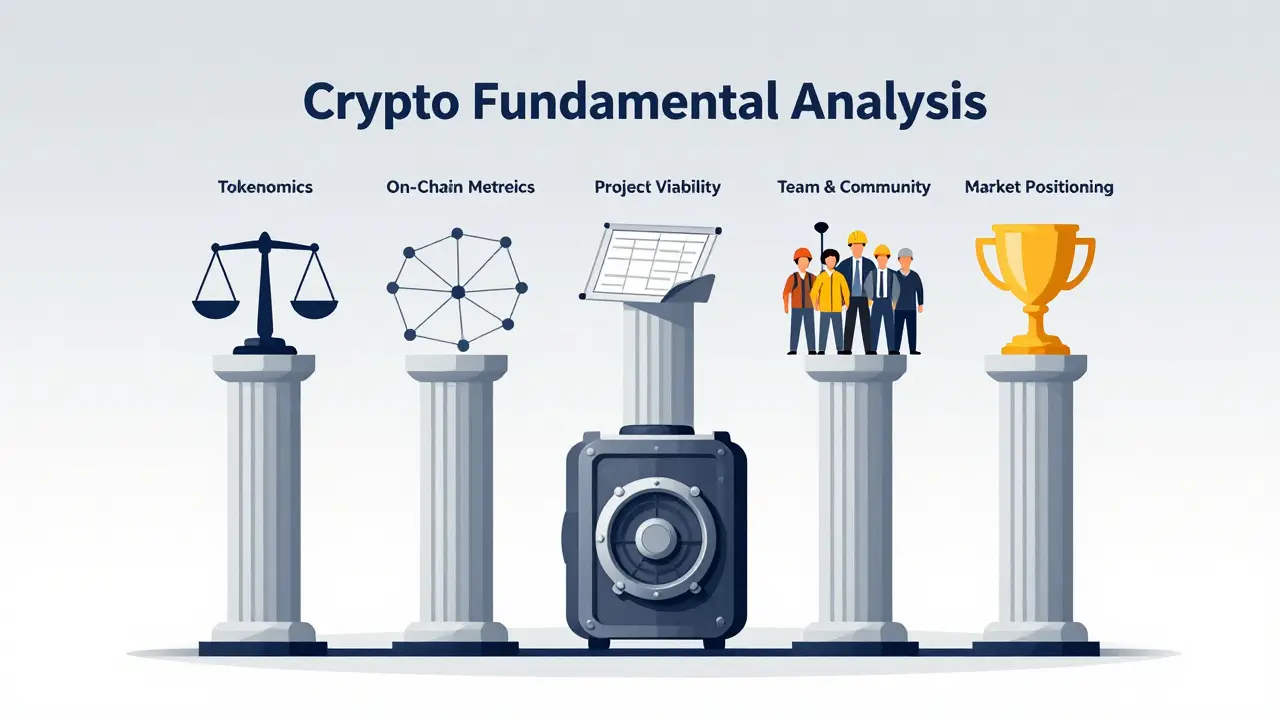
When evaluating a Crypto Project is a decentralized initiative built on blockchain technology that aims to solve specific problems through smart contracts and token economics, you are essentially checking five major pillars. Think of these as the health checkup for any digital asset. If one pillar is weak, the whole structure might collapse.
- Tokenomics: How the money works. Supply, demand, and distribution.
- On-Chain Metrics: Real usage data from the blockchain itself.
- Project Viability: Does the product actually work? Is the roadmap being followed?
- Team & Community: Who is building it, and who is using it?
- Market Positioning: Who are the competitors, and why is this project better?
Let's break down each pillar so you know exactly what to look for.
1. Tokenomics: The Economic Engine
Tokenomics is often the first place where bad projects fail. You need to understand how tokens are created, distributed, and used. If the incentives are misaligned, the project will die.
Start with the Maximum Supply The total number of tokens that will ever exist, such as Bitcoin's hard cap of 21 million. Is there a hard cap? Bitcoin has 21 million. Ethereum does not have a hard cap but burns fees to keep inflation low (around 0.5% annually post-Merge). Infinite supply isn't automatically bad, but it requires constant new demand to maintain value.
Next, look at the Distribution Mechanism How tokens are allocated among founders, investors, community, and reserves. Check the whitepaper. If 50% of tokens go to the team and venture capitalists, be wary. Look at Solana’s initial distribution: 16.23% to founders, 12.92% to the foundation, and 50% to validators/stakers. That is relatively balanced. Contrast this with Terra, which had controversial vesting schedules that eventually contributed to its collapse.
Finally, check the Vesting Schedule The timeline over which locked tokens are released to early investors and team members. When do early investors get their coins? If they unlock in six months, expect a sell-off. Use tools like TokenUnlocks to track this. Long vesting periods (2-4 years) align long-term interests.
2. On-Chain Metrics: Proof of Usage
Marketing claims are cheap. Blockchain data is public and verifiable. This is the biggest advantage crypto has over traditional stocks. You can see exactly who is using the network.
Focus on Unique Active Addresses The number of distinct wallets interacting with the protocol daily or monthly. Glassnode data shows Bitcoin averages 1.1 million unique active addresses per month. If a DeFi protocol claims millions of users but only has 500 active wallets, the numbers are fake.
Look at Transaction Volume The total value of assets transferred or traded on the network. Ethereum processed 1.2 million daily transactions on average in Q3 2023. High volume indicates liquidity and utility. However, beware of "wash trading" on some DEXs where bots create fake volume. Cross-reference volume with revenue.
Consider the Network Value-to-Transaction Ratio (NVT) A metric comparing market cap to transaction volume, similar to P/E ratio in stocks. Chris Burniske popularized the Network Value to Metcalfe's Law (NVM) ratio. Generally, an NVM above 3.5 suggests overvaluation, while below 1.5 may signal undervaluation. It’s not perfect, but it gives you a baseline.
3. Project Viability: Code Over Hype
A beautiful website means nothing if the code is broken. You need to assess whether the project is actually building what it promised.
Check the Whitepaper Quality The foundational document outlining the project's technology, goals, and token model. Binance Research notes that 78% of successful projects update their whitepapers within 12 months of launch. An outdated whitepaper suggests the team has moved on or failed to adapt.
Analyze Roadmap Execution The history of the project delivering on its stated milestones and features. Chainalysis found that projects delivering 80%+ of promised milestones have 3.2x higher survival rates. Did they launch mainnet on time? Did they implement the upgrade they said they would? Missed deadlines are red flags.
Evaluate Technological Innovation The unique technical advantages or novel solutions provided by the project. Does this project solve a problem that couldn't be solved otherwise? Ethereum introduced smart contracts, enabling DeFi. If a project is just a copycat with no innovation, ask yourself why you should care.
4. Team & Community: The Human Element
Technology doesn't build itself. People do. And in crypto, the community can make or break a project.
Examine Developer Activity The level of coding contributions and updates made to the project's GitHub repository. Go to GitHub. Are there recent commits? Santiment data reveals that projects with 15+ active GitHub contributors have 67% higher 2-year survival rates. If the last commit was six months ago, the project might be dead.
Assess Community Engagement The level of interaction and sentiment among users on social platforms like Discord and Telegram. Join their Discord or Telegram. Are people discussing technology and use cases, or just asking "when moon?" Messari’s 2023 Community Health Report found that groups with 10,000+ active members correlate with 42% higher project longevity. But quality matters more than quantity. A small, dedicated group of builders is better than a large group of bots.
Review Partnership Quality Strategic alliances with other established companies or protocols. Chainlink has 1,200+ enterprise integrations. These partnerships validate the technology. Be careful of "announcement-only" partnerships where two logos are slapped together but no actual integration occurs.

5. Market Positioning: Finding Your Edge
No project exists in a vacuum. You must understand who they are fighting against.
Identify Competitive Differentiators Unique features or advantages that set the project apart from rivals. Openware’s analysis found that projects with three or more clear differentiators have 58% higher market capture potential. Why is this DEX better than Uniswap? Is it faster? Cheaper? More private? If you can't answer that, skip it.
Estimate the Total Addressable Market (TAM) The total revenue opportunity available if the project achieved 100% market share. Binance Research calculates that projects addressing markets exceeding $100 billion TAM have 4.7x higher success probability. A niche tool for cat owners might be fun, but it won't reach billions in valuation. Look for broad applicability: payments, identity, gaming, finance.
| Metric | Traditional Finance | Crypto Fundamental Analysis |
|---|---|---|
| Data Source | Financial Statements (10-K, 10-Q) | On-Chain Data, GitHub, Social Sentiment |
| Valuation Metric | P/E Ratio, EPS | NVT, Protocol Revenue, TVL |
| Transparency | Limited, Audited Quarterly | High, Real-Time Public Ledger |
| Key Risk | Accounting Fraud | Smart Contract Bugs, Rug Pulls |
| Success Indicator | Profit Margins, Cash Flow | Active Users, Developer Commits |
Common Pitfalls to Avoid
Even experienced analysts make mistakes. Here are the traps to watch out for.
Overreliance on Whitepapers: A whitepaper is a promise, not a delivery. I’ve seen projects with Nobel-prize-level whitepapers fail because the code was garbage. Always verify code quality.
Igoring Regulatory Risk: The SEC’s action against Ripple showed that token utility and distribution matter legally. Incorporate legal compliance into your framework. 67% of professional analysts now do this. If a project looks like an unregistered security, the risk is high.
Chasing Hype: Just because a project is trending on Twitter doesn’t mean it has fundamentals. FOMO kills portfolios. Stick to your checklist.
Ignoring Token Velocity: If tokens change hands too quickly, demand stays low. Look for mechanisms that encourage holding, like staking rewards or fee discounts for holders.
Building Your Evaluation Framework
You don't need to be a coder to do this. You need discipline. Create a simple spreadsheet. For every project you consider, fill in these fields:
- Max Supply & Circulating Supply
- Team Vesting Unlock Dates
- Number of Active GitHub Contributors (Last 3 Months)
- Daily Active Wallets (Source: Dune Analytics or Etherscan)
- Protocol Revenue (Last Quarter)
- Main Competitors & Key Differentiator
If a project fails three or more of these checks, move on. There are thousands of projects. You don't need to invest in all of them. Focus on the ones with strong fundamentals, transparent teams, and real usage.
Fundamental analysis takes time. Beginners often need 8-12 months to feel comfortable. But the payoff is huge. You stop being a gambler and start being an investor. You sleep better at night knowing your assets are backed by real value, not just hype.
What is the most important metric in crypto fundamental analysis?
There is no single "most important" metric, but Token Utility is widely considered critical. If the token has no real use case (like paying for fees or governance), it is likely just a fundraising mechanism. John Pfeffer of Pfeffer Capital notes that projects with essential token utility have 83% higher survival rates. Combine this with active developer counts and user growth for a complete picture.
How do I check if a crypto project is a scam?
Look for red flags in tokenomics and team anonymity. If 50%+ of tokens are held by the team with short vesting periods, it’s risky. Check GitHub for activity; if there are no commits, the project may be abandoned. Verify partnerships-are they real integrations or just logos? Finally, read the community; if everyone is talking about price pumps rather than technology, be cautious.
Is fundamental analysis useful for short-term trading?
Not primarily. Fundamental analysis is best for long-term investment decisions. Short-term prices are driven by sentiment, news, and technical factors. However, understanding fundamentals helps you avoid buying overvalued assets that will crash when hype fades. Many profitable traders combine fundamental analysis with technical indicators for entry and exit points.
Where can I find reliable on-chain data?
Popular platforms include Glassnode for Bitcoin and Ethereum metrics, Dune Analytics for custom DeFi dashboards, Etherscan for raw blockchain data, and DeFi Llama for Total Value Locked (TVL) comparisons. These tools provide free access to verified on-chain data that cannot be manipulated by marketing teams.
What is the difference between token price and protocol value?
Token price is what people pay to buy the coin. Protocol value is the actual economic activity generated by the network, such as fees collected or services provided. A project can have a high token price but low protocol value if speculation drives the market. Sustainable investments focus on growing protocol value, which eventually supports token price.