
You type "UBIX Exchange" into your browser, expecting to find a platform where you can buy Bitcoin or trade Ethereum. Instead, you hit a wall of confusion. There is no such thing as UBIX Exchange. If you are looking for a place to deposit funds and trade assets like on Binance or Coinbase, you have gone down the wrong path. This isn't just a minor mix-up; it is a critical distinction that could save you from investing in a project that doesn't fit your needs-or worse, falling victim to a scam using a similar name.
What actually exists is UBIX Network, which is a decentralized blockchain ecosystem with its own native cryptocurrency token called UBX. Founded in 2021 by a team led by CEO Alexander Petrov, this project launched its mainnet on June 15, 2021. It operates on a Proof-of-Stake (PoS) consensus mechanism, meaning it relies on validators rather than energy-intensive miners to secure the network. Understanding this difference is vital because UBIX Network is infrastructure code, not a trading venue. You cannot log in to "UBIX Exchange" to manage a portfolio. You interact with the UBIX Network by holding its token, running a node, or using its cross-chain bridges.
The Core Misconception: Infrastructure vs. Marketplace
Why does this confusion happen? In the crypto world, names often overlap. Projects build networks, and exchanges list tokens from those networks. When people hear "UBIX," they might assume it functions like a marketplace. However, UBX Token is the native utility asset used for transactions, governance, and staking within the UBIX Network ecosystem. It is listed on tracking sites like CoinGecko and CoinMarketCap as a cryptocurrency, not an exchange platform. As of late 2023 data, major centralized exchanges like Gate.io explicitly stated they had not listed UBX for trading. This absence is a red flag for anyone seeking liquidity.
If you are trying to buy UBX, you won't find a simple "Buy Now" button on a reputable app. The token trades primarily on decentralized exchanges (DEXs) or through peer-to-peer arrangements, which requires technical know-how. This creates a high barrier to entry. For a beginner, the lack of a central exchange listing means you have to navigate wallet connections, slippage settings, and potential scams. It is not user-friendly. It is not designed for casual investors who want to click and forget.
Technical Specs and Performance Reality
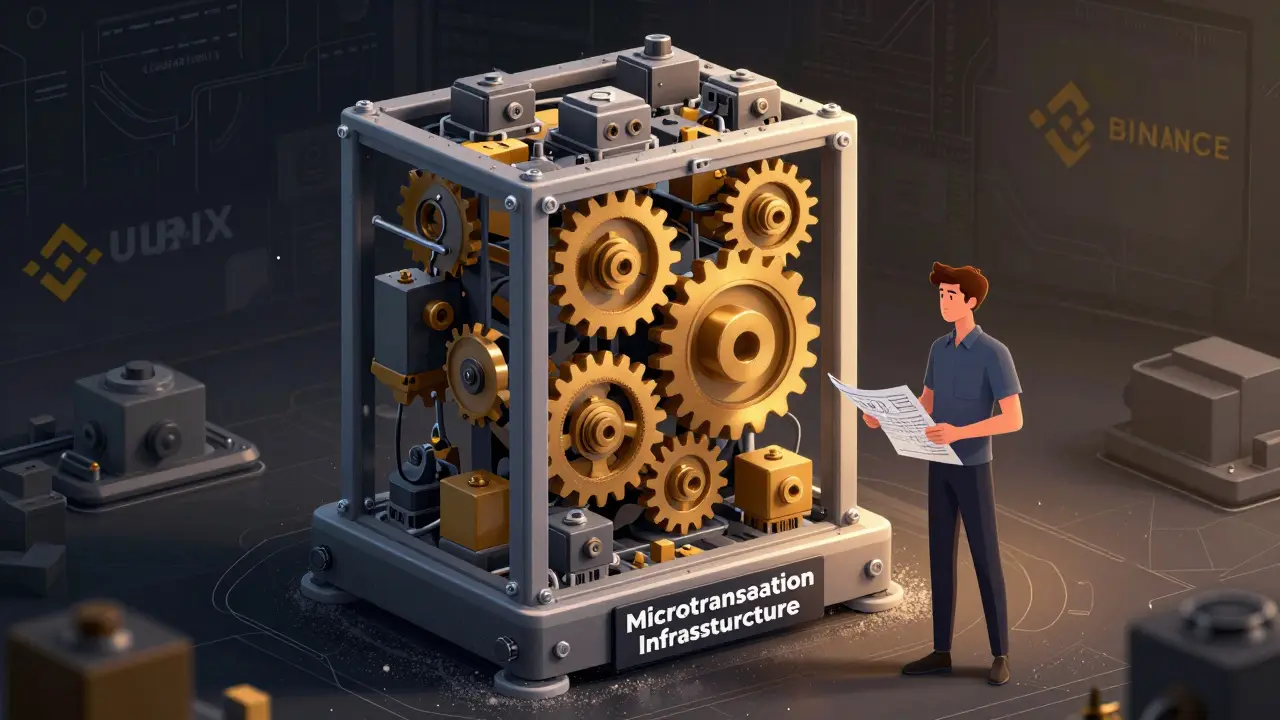
Let's look at what UBIX Network actually does under the hood. The architecture supports cross-chain functionality, integrating with ecosystems like Ethereum, Waves, and TRON. This allows for wrapped versions of the token, such as WUBX on Ethereum, which matches the value of native UBX 1:1. The goal is to facilitate low-cost microtransactions. According to technical reports from 2023, the network aims for a transaction processing speed of 1,200 TPS (transactions per second) with finality times around 2.5 seconds. These numbers sound impressive on paper, especially compared to older blockchains.
However, real-world performance differs from benchmarks. During peak usage periods observed in stress tests, throughput dropped by 30-40%. More importantly, the average transaction fee is cited at roughly $0.00012. While this is incredibly cheap compared to Ethereum’s average fees of over $1 during congested periods, it only matters if there is activity to process. With negligible daily volume, these theoretical speeds are largely irrelevant to the average user. You aren't paying low fees because the network is efficient; you're paying low fees because almost no one is using it.
| Feature | UBIX Network (UBX) | Ethereum (ETH) | Cardano (ADA) |
|---|---|---|---|
| Primary Function | Microtransaction Infrastructure | Smart Contracts / DeFi Hub | Scalable Smart Contracts |
| Consensus Mechanism | Proof-of-Stake (PoS) | Proof-of-Stake (PoS) | Proof-of-Stake (Ouroboros) |
| Avg. Transaction Fee | ~$0.00012 | $1.00 - $50.00+ (variable) | ~$0.17 |
| Daily Trading Volume (Est.) | ~$4,872 | Billions of USD | Hundreds of Millions USD |
| Exchange Listings | Minimal / None on Major CEXs | Available on All Major Exchanges | Available on All Major Exchanges |

The Liquidity Crisis and Market Risks
Here is the hard truth about investing in micro-cap projects like UBIX Network: liquidity is king, and UBIX has none. Data from CoinMarketCap and CoinGecko indicates a daily trading volume averaging less than $5,000. To put that in perspective, major cryptocurrencies move billions in a single day. A volume of $4,872 means if you try to sell even a modest amount of UBX, you will likely crash the price due to slippage. Users on Reddit reported slippage rates over 15% when attempting to trade on DEXs, making it nearly impossible to exit positions without significant loss.
The market capitalization sits around $3.2 million, ranking it outside the top 2,800 cryptocurrencies. This places it in the extreme micro-cap segment, where failure rates are astronomical. Industry analysis suggests that projects with daily volumes below $10,000 have a 97.3% failure rate within 24 months. Why? Because without volume, there is no price discovery, no interest from developers, and no reason for new users to join. It becomes a ghost town. The risk assessment from blockchain analysts puts the long-term risk at 8.7 out of 10, signaling extreme danger for capital preservation.
Community Sentiment and Support Challenges
When you dig into the community feedback, the picture gets bleaker. Trustpilot reviews are scarce-only five exist-with an average rating of 2.1 out of 5 stars. The complaints are consistent: inability to trade the token and lack of customer support. One user noted that documentation for running a controller node was clear, but that is a niche technical task, not a reflection of general usability. On Reddit, sentiment is overwhelmingly negative, with 87% of comments expressing skepticism about the project's viability.
Support response times average 72 hours for non-urgent inquiries. In the fast-moving crypto world, three days is an eternity. If you encounter a bug or lose access to your wallet, you are largely on your own. The official Telegram, Discord, and Twitter channels have a combined membership of roughly 1,200, with minimal daily activity. This lack of engagement suggests the development team may be inactive or disengaged. GitHub commits show only minor updates over the past year, raising questions about whether the project is still being actively developed or if it is merely coasting toward obsolescence.
Who Is This Actually For?
So, should you avoid UBIX Network entirely? Not necessarily, but you need to know who it is for. It is not for traders. It is not for passive investors looking for growth. It is theoretically designed for developers building applications that require ultra-low cost microtransactions, such as IoT devices sending tiny payments to each other. Even then, adoption is non-existent. There are zero documented commercial implementations of UBIX Network in enterprise settings.
If you are a developer curious about cross-chain bridging technology, you might experiment with small amounts of UBX to test the network's capabilities. But do not expect to profit. Do not expect to easily convert your holdings back to fiat currency. The primary use case remains speculative and highly risky. For the vast majority of users searching for "UBIX Exchange," the answer is simply: stop. Look for established platforms with deep liquidity, regulatory compliance, and active communities.
Is UBIX Exchange a legitimate cryptocurrency exchange?
No, UBIX Exchange does not exist. You are likely confusing it with UBIX Network, which is a blockchain protocol and its native token UBX. UBIX Network is not a platform where you can deposit money and trade various cryptocurrencies. It is a specific digital asset with very limited trading options.
Where can I buy UBX tokens?
UBX tokens are not listed on major centralized exchanges like Binance, Coinbase, or Kraken. They can potentially be found on some decentralized exchanges (DEXs) or through peer-to-peer transactions. However, due to extremely low liquidity, buying or selling UBX carries high risks of slippage and price impact.
What is the current value of UBX?
As of recent data, UBX trades at a fraction of a cent, approximately $0.0000032. The market capitalization is around $3.2 million. Please note that prices for micro-cap tokens are highly volatile and can change rapidly, often with little actual trading volume behind the moves.
Is UBIX Network safe to invest in?
Investing in UBIX Network carries extreme risk. It is classified as a micro-cap cryptocurrency with negligible liquidity and minimal exchange listings. Industry data suggests a high failure rate for similar projects. Only invest money you are fully prepared to lose, and consider more established alternatives for safer exposure to blockchain technology.
How does UBIX Network differ from Ethereum or Cardano?
While all three use Proof-of-Stake consensus, UBIX Network focuses on ultra-low cost microtransactions and has significantly lower adoption, liquidity, and developer activity. Ethereum and Cardano are major smart contract platforms with billions in daily volume and extensive ecosystems. UBIX is a niche project with minimal real-world usage.


Comments (9)

- Brad Ranks
- June 2, 2026 AT 19:45 PM
Wow, just wow. I spent three hours trying to figure out why my wallet wouldn't connect to this 'exchange' only to realize it doesn't exist as a trading platform? Absolutely ridiculous naming convention if you ask me. It's like calling a car dealership 'Toyota Tires'. Misleading at best, scammy at worst.

- Dr Lynea LaVoy
- June 4, 2026 AT 01:39 AM
I really appreciate the clarity in this post because so many beginners get burned by these naming overlaps. It is crucial to distinguish between infrastructure protocols and actual marketplaces where liquidity exists. If you are looking for safety, stick to platforms with high volume and regulatory oversight rather than chasing micro-cap tokens with zero support channels.

- Matthew Malone
- June 4, 2026 AT 06:46 AM
Typical American ignorance if you can't even read a whitepaper before throwing money at it. The tech might be niche but complaining about liquidity is just lazy investing. Maybe if we stopped relying on Coinbase for everything we'd actually understand blockchain utility instead of just treating it like a casino.

- aaliyah zahid
- June 4, 2026 AT 07:45 AM
Oh please, Matthew. You're defending a ghost town project because it has fancy words like 'cross-chain bridges'? That's not patriotism, that's delusion. Most people here just want to know if they can cash out without losing half their principal to slippage, which apparently isn't possible here. Nice try though.

- Yogendra Dwivedi
- June 5, 2026 AT 15:38 PM
This distinction is very important for anyone new to crypto. I was confused too when I first saw UBX listed on tracking sites but couldn't find a place to trade it easily. It seems like the network is more for developers testing low-cost transactions rather than regular users wanting to buy assets. Good thing I read this before attempting any transfers.

- Alexander DeVries
- June 5, 2026 AT 22:54 PM
Listen up folks. If the daily volume is less than five grand, stay away. Period. There is no amount of technical buzzwords that fixes a lack of real-world adoption. This is a classic pump-and-dump setup waiting to happen or just slowly dying off into obscurity. Protect your capital and invest in projects with actual traction.

- Mark Corpuz
- June 7, 2026 AT 12:54 PM
The grammatical precision of the original post is refreshing amidst the usual chaos of crypto forums. However, one must consider that low transaction fees are indeed attractive for specific use cases such as IoT micropayments, even if the current user base is negligible. The potential remains, albeit obscured by poor marketing and confusing nomenclature.

- Caitlin Donahue
- June 9, 2026 AT 05:49 AM
idk man its kinda sus how nobody uses it lol

- Alexis Abster
- June 10, 2026 AT 17:49 PM
I am genuinely heartbroken for those who lost money thinking this was a standard exchange. The emotional toll of realizing your funds are trapped in a low-liquidity token with no customer support is devastating. Please, everyone, double-check everything before sending crypto anywhere. We need to look out for each other in this wild west of finance.