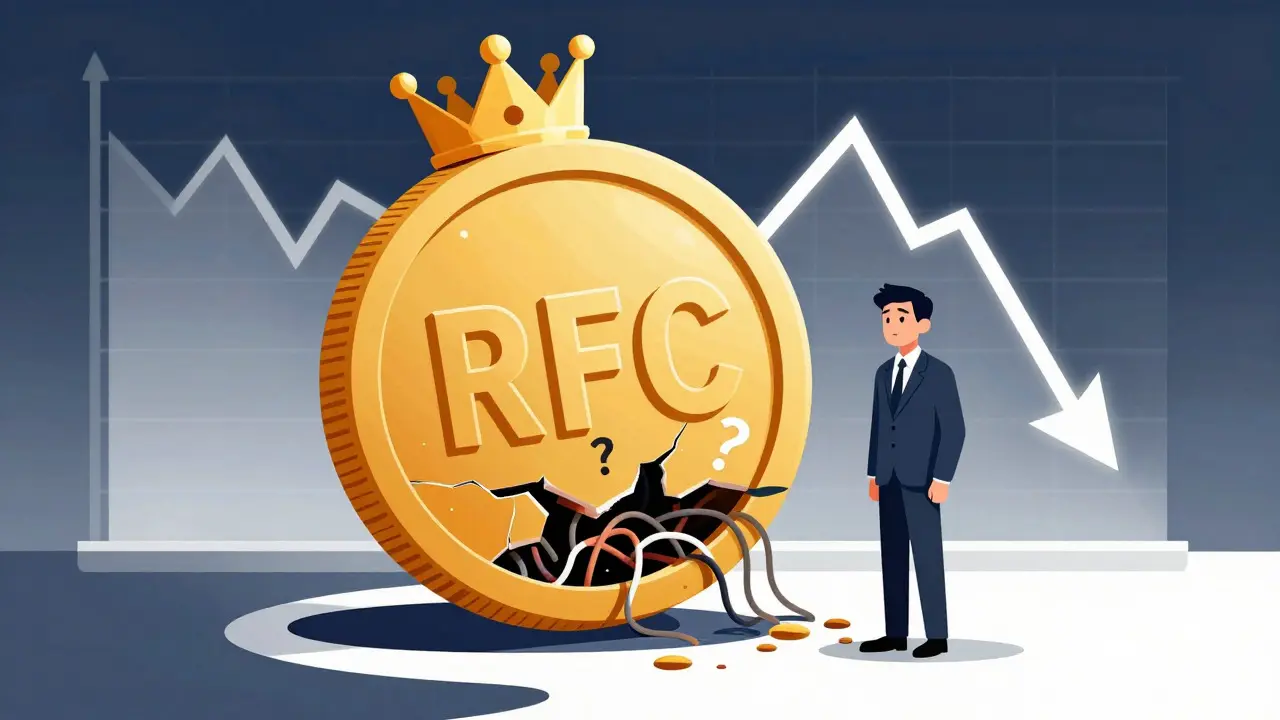

Have you ever stumbled upon a cryptocurrency that promises sustainable mining, exclusive community access, and everyday utility, only to find its price chart looking like a rollercoaster that crashed? That’s exactly what happens when you look at Royal Finance Coin, commonly known by its ticker RFC. It is a small-cap cryptocurrency token associated with the Royal Finance Club, a self-described high-end investor community focused on app-based mining and green energy initiatives.
If you’re asking "What is Royal Finance Coin?" you are likely trying to figure out if this is a legitimate investment opportunity or just another speculative asset. The short answer is: it’s complicated. RFC sits in the murky middle ground of the crypto world-promising innovation but lacking the transparency and liquidity of major coins like Bitcoin or Ethereum. Let’s break down what this token actually is, how it works, and why you need to tread carefully.
The Basics: What Exactly Is Royal Finance Coin?
Royal Finance Coin isn’t a standalone blockchain. Instead, it operates as a token on an existing network. Specifically, most data aggregators list RFC as an ERC-20 style token. This means it lives on the Ethereum blockchain or a compatible layer-2 network. You can verify its existence using the contract address 0x357655df177fb0229dc8aca977114a420bf81799. If you’ve used MetaMask or Trust Wallet before, you know this format well. It allows RFC to be stored in standard digital wallets, traded on decentralized exchanges, and integrated into other DeFi applications.
The project is backed by the Royal Finance Club, which markets itself as a hub for "high-end investors." Their pitch revolves around three main pillars:
- Sustainable Mining: They claim to use "green" mining technology, potentially leveraging renewable energy sources.
- App-Based Utility: Users can mine, hold, and spend RFC through a proprietary mobile application.
- Community Access: Holding the token grants entry to their exclusive investor network.
However, don’t let the fancy marketing fool you. While the concept sounds solid, the execution has been anything but smooth. The lack of detailed technical documentation regarding their mining algorithms or energy consumption metrics makes these claims hard to verify independently.
A History of Extreme Volatility
To understand the risk of holding RFC, you have to look at its price history. Cryptocurrencies are volatile by nature, but RFC takes that to an extreme level. The token became actively trackable in late 2024. Its all-time low (ATL) was recorded around September 20, 2024, at approximately $0.000637.
Then came the spike. In early April 2025, RFC experienced a massive speculative bubble. On April 9, 2025, the price hit an all-time high (ATH) of roughly $0.08145 to $0.08394, depending on the data source. That’s a gain of over 12,000% in less than seven months. For anyone who bought near the bottom, it looked like a miracle.
But here’s the catch. Just as quickly as it rose, it fell. By mid-2025 and into 2026, the price had collapsed by nearly 99%. Current trading prices hover between $0.0001 and $0.005, varying wildly across different platforms due to thin liquidity. This boom-and-bust cycle is typical for micro-cap tokens with low trading volume. It suggests that RFC is driven more by hype and speculation than by fundamental value or widespread adoption.
| Metric | Value | Note |
|---|---|---|
| Total Supply | 5,000,000,000 RFC | Fixed maximum supply |
| Circulating Supply | Unclear / Reported as 0 | Data inconsistency across trackers |
| All-Time High | $0.08394 | April 9, 2025 |
| All-Time Low | $0.000637 | September 20, 2024 |
| Current Price Range | $0.0001 - $0.005 | Highly variable by exchange |
| Market Cap Rank | #5,932 - #39,792 | Micro-cap status |
The Liquidity Problem: Why Prices Vary So Much
One of the biggest red flags with RFC is the discrepancy in pricing across different platforms. You might see one site listing RFC at $0.00014 while another shows $0.0053. Why does this happen? It’s because of extremely low trading volume.
In healthy markets, high trading volume ensures that the buy and sell prices are close together. With RFC, daily volumes often range from just $10 to $2,700. This means there aren’t many buyers or sellers. If you try to sell a large amount of RFC, you could crash the price yourself-a phenomenon known as slippage.
Furthermore, major exchanges like Binance and Coinbase list RFC with a circulating supply of zero and a market cap of zero. This doesn’t mean the coin is worthless; it means their data feeds are incomplete or they are merely mirroring reference prices without active order books. When you trade RFC, you are likely doing so on smaller, less regulated decentralized exchanges (DEXs), where security and liquidity are not guaranteed.

Green Mining Claims vs. Reality
Royal Finance Coin heavily markets its commitment to sustainability. They claim partnerships with entities in Aruba to provide "cutting-edge mining technology" using renewable energy. This is an attractive narrative in an industry often criticized for its carbon footprint.
However, skepticism is warranted. There are no independent environmental audits, no published megawatt usage statistics, and no third-party verification of their energy sources. Without concrete data, these claims remain marketing fluff rather than proven facts. Compare this to established projects like Algorand or Cardano, which have transparent proof-of-stake mechanisms with measurable low energy consumption. RFC’s "green" label lacks the same rigor.
Confusion Alert: Two Different RFC Tokens
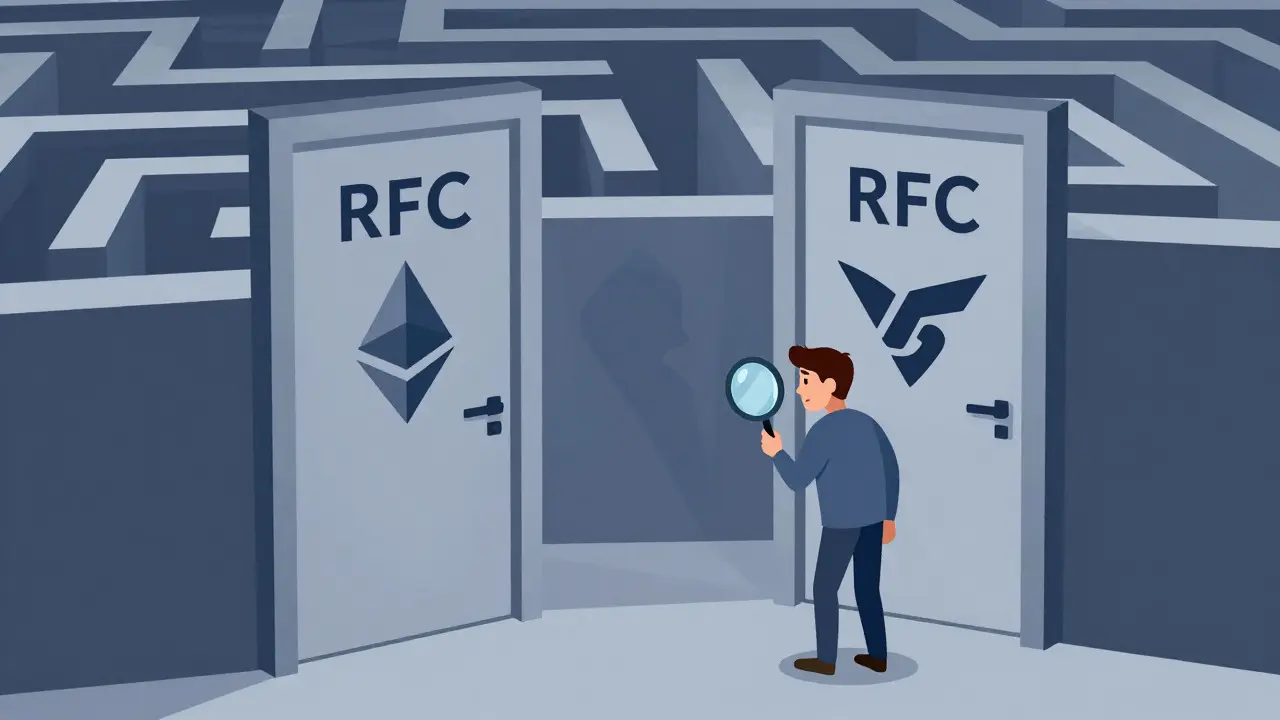
Here is a trap many new investors fall into: ticker symbol confusion. The ticker "RFC" is shared by at least two distinct projects.
- Royal Finance Coin: The ERC-20 token we’ve been discussing, focused on sustainable mining and community access.
- Retard Finder Coin: A meme coin built on the Solana blockchain, launched via Pump.fun. Despite being a completely different project, some aggregators like Gate.com mistakenly label this meme coin’s price page as "Royal Finance Coin (RFC)."
This overlap creates chaos. If you’re looking at price charts or sentiment analysis, you might accidentally be analyzing the meme coin instead of the finance token. Always double-check the contract address and the underlying blockchain (Ethereum vs. Solana) before making any moves.
How to Buy and Store RFC Safely
If you decide to take the plunge despite the risks, here is how you typically interact with Royal Finance Coin:
- Wallet Setup: Since RFC is an ERC-20 token, you’ll need an Ethereum-compatible wallet. MetaMask, Trust Wallet, or Coinbase Wallet are good options. Make sure you add the correct custom token address if it doesn’t appear automatically.
- Acquisition: Because RFC isn’t listed on major centralized exchanges with deep liquidity, you’ll likely need to use a decentralized exchange (DEX) like Uniswap. Connect your wallet, paste the RFC contract address, and swap ETH for RFC. Be aware of high gas fees during peak Ethereum times.
- The App: To participate in their "mining" program, you need to download the official Royal Finance Club app. Verify the source carefully to avoid phishing scams, which are rampant in the micro-cap crypto space.
Is Royal Finance Coin Worth It in 2026?
Let’s be honest. RFC is a high-risk, speculative asset. It lacks the institutional backing, regulatory clarity, and technological uniqueness of top-tier cryptocurrencies. The dramatic price drop from its 2025 peak shows that retail interest fades quickly.
That said, if you believe in the specific vision of the Royal Finance Club and want exposure to a micro-cap token with a niche focus on sustainable mining, RFC offers that entry point. But treat it like venture capital: expect to lose everything, and only invest what you can afford to part with forever. Don’t put your rent money here.
Is Royal Finance Coin (RFC) a scam?
There is no definitive proof that RFC is a scam, but it exhibits many characteristics of high-risk speculative assets. These include extreme volatility, low liquidity, inconsistent data across trackers, and vague technical claims. Always do your own research (DYOR) and be cautious of projects promising high returns with little transparency.
Which blockchain is Royal Finance Coin on?
Royal Finance Coin is primarily listed as an ERC-20 token, meaning it operates on the Ethereum blockchain or compatible EVM networks. However, be careful not to confuse it with the Solana-based meme coin that also uses the RFC ticker.
Why is the price of RFC different on every website?
The price varies because RFC has very low trading volume. Different exchanges and data aggregators pull from different liquidity pools. With few trades happening, a single large buy or sell can drastically change the price on one platform without affecting others.
Can I mine Royal Finance Coin on my computer?
Not in the traditional sense. RFC promotes "app-based mining," which usually refers to cloud mining or earning tokens through engagement within their proprietary mobile app, rather than running hardware miners like ASICs or GPUs at home.
What is the total supply of RFC?
The maximum total supply of Royal Finance Coin is fixed at 5,000,000,000 (5 billion) tokens. However, the actual circulating supply is unclear and often reported as zero or missing on major tracking sites, indicating poor data integration.
Is RFC listed on Binance or Coinbase?
While Binance and Coinbase may display a price for RFC, they typically show zero trading volume and zero circulating supply for this token. This means it is not actively traded on their primary order books, and you will likely need to use a decentralized exchange to buy or sell it.

Comments (7)

- amy miranda
- August 4, 2026 AT 14:19 PM
The sheer audacity of these projects to market themselves as "sustainable" while hiding behind vague claims is absolutely morally bankrupt. It is not just bad business; it is a betrayal of the very environmental ideals they claim to champion. We are drowning in crypto scams that prey on the desperate hope for green energy solutions, yet here we are again with another hollow promise wrapped in glossy marketing. The lack of independent audits is not an oversight; it is a deliberate act of deception designed to lure in unsuspecting retail investors who care about the planet. One has to wonder if the developers even believe their own narrative or if they are simply laughing at the gullibility of the public. This is precisely why the industry needs stricter regulations and less reliance on self-reported data from entities with clear conflicts of interest. It is exhausting to watch the same playbook unfold over and over again with different ticker symbols but identical predatory tactics.

- Ed Wallace
- August 6, 2026 AT 11:00 AM
It is fascinating how human psychology remains the constant variable in this chaotic equation. We see the same patterns of greed and fear driving markets that are supposed to be decentralized and rational. The RFC story is a perfect case study in behavioral economics, where the allure of easy wealth overrides basic due diligence. I often think about how these speculative bubbles reflect our collective desire for meaning in digital spaces. Are we investing in technology, or are we buying into a community identity? The answer seems to be both, which makes the eventual crash all the more poignant. It reminds me of historical tulip mania, only faster and more brutal because of the speed of information flow. Perhaps there is wisdom in recognizing that value is largely a social construct until it isn't.

- Subhash Kashyap Dm
- August 7, 2026 AT 15:19 PM
stop looking at the price charts and look at the contract code you sheeple the centralization is obvious if you actually read the whitepaper which nobody does because they are too busy chasing pumps. the so-called green mining is just a front for washing dirty money through shell companies in tax havens. they control the liquidity pools and can rug pull whenever they want. its a classic pump and dump scheme disguised as innovation. wake up

- Pernelia Wahkan
- August 8, 2026 AT 10:50 AM
I have been tracking similar micro-cap tokens for years, and the discrepancy in circulating supply data is usually the first major red flag. When aggregators like CoinMarketCap or CoinGecko show zero supply or wildly inconsistent numbers, it often means the token lacks proper integration with standard APIs or has been manipulated. For those interested in verifying this themselves, you can check the Ethereum block explorer directly using the contract address provided in the article. You will likely find that most of the tokens are held by a small number of wallets, indicating high centralization. This technical detail is crucial because it explains why the price slippage is so severe. If you try to sell a significant amount, you are essentially crashing your own exit ramp. It is a structural flaw inherent to many low-volume ERC-20 tokens that get hyped on social media without any real utility backing them up.

- Billy Cunningham
- August 9, 2026 AT 11:38 AM
My portfolio took a hit last year because of a token exactly like this 😩😭. I thought the app-based mining was legit until I couldn't withdraw anything. Now I just watch from the sidelines and cry every time I see someone else getting rich quick 📉💔. Why do we keep falling for it?

- Joshua Hofford
- August 9, 2026 AT 13:36 PM
Hey everyone! Look on the bright side, right? Even if RFC crashes, we learn valuable lessons about risk management and skepticism. In my travels across different crypto communities, I've seen this pattern repeat globally. People everywhere are eager to participate in the next big thing, and that enthusiasm is powerful. Maybe the next project will get it right. Keep your chin up and stay curious! The world of finance is evolving rapidly, and being part of the conversation is important. Let's support each other through the ups and downs. We are all in this together, learning as we go. Stay positive!

- Marcia Albert
- August 10, 2026 AT 16:40 PM
Just vibing here watching the chaos unfold from a safe distance.