
Quantum Risk Calculator
Calculate Your Quantum Risk
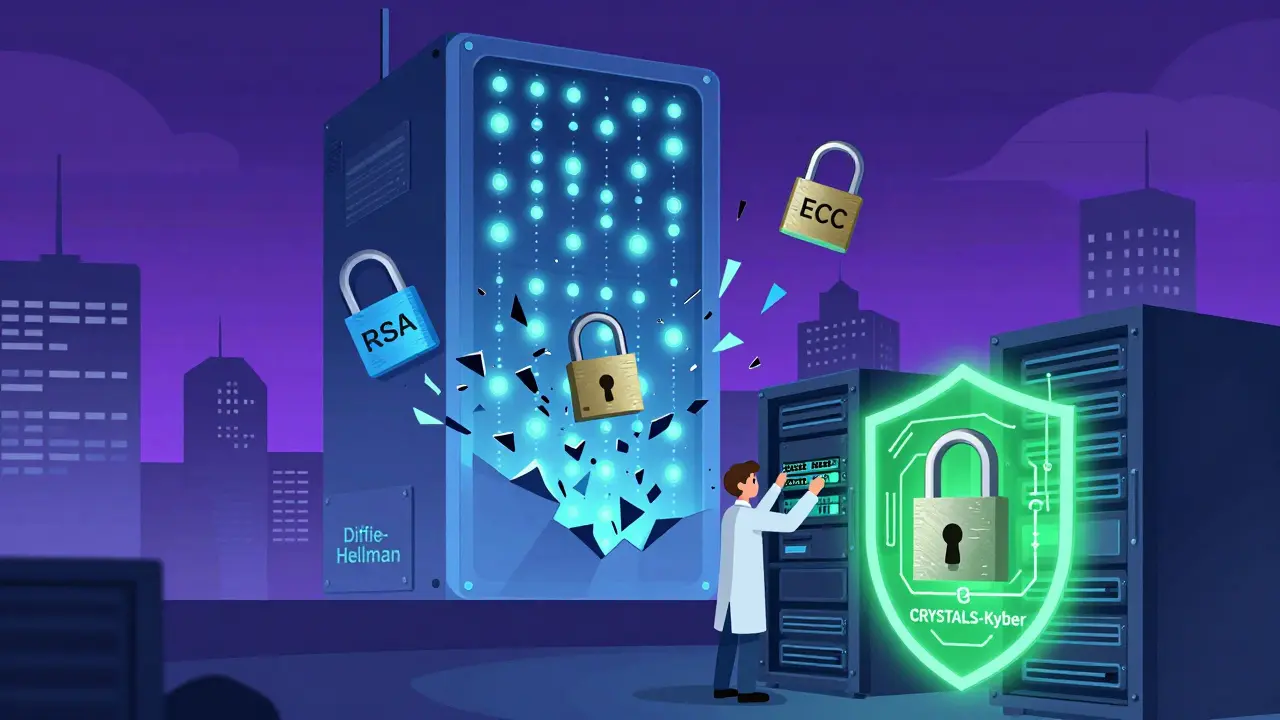
Right now, your bank transactions, medical records, and government secrets are protected by encryption that could be broken by a future quantum computer. Not in 20 years. Not in 30. Maybe as soon as 2030. That’s not science fiction-it’s a real timeline tracked by cybersecurity experts. Quantum-resistant cryptography is the answer. It’s not about stopping quantum computers. It’s about making sure your data stays safe even when they arrive.
Why Your Current Encryption Isn’t Safe Forever
Today, most secure websites, encrypted messages, and digital signatures rely on algorithms like RSA, Diffie-Hellman, and Elliptic Curve Cryptography. These work because they’re hard for regular computers to crack. But they’re not hard for quantum computers-once they’re powerful enough.
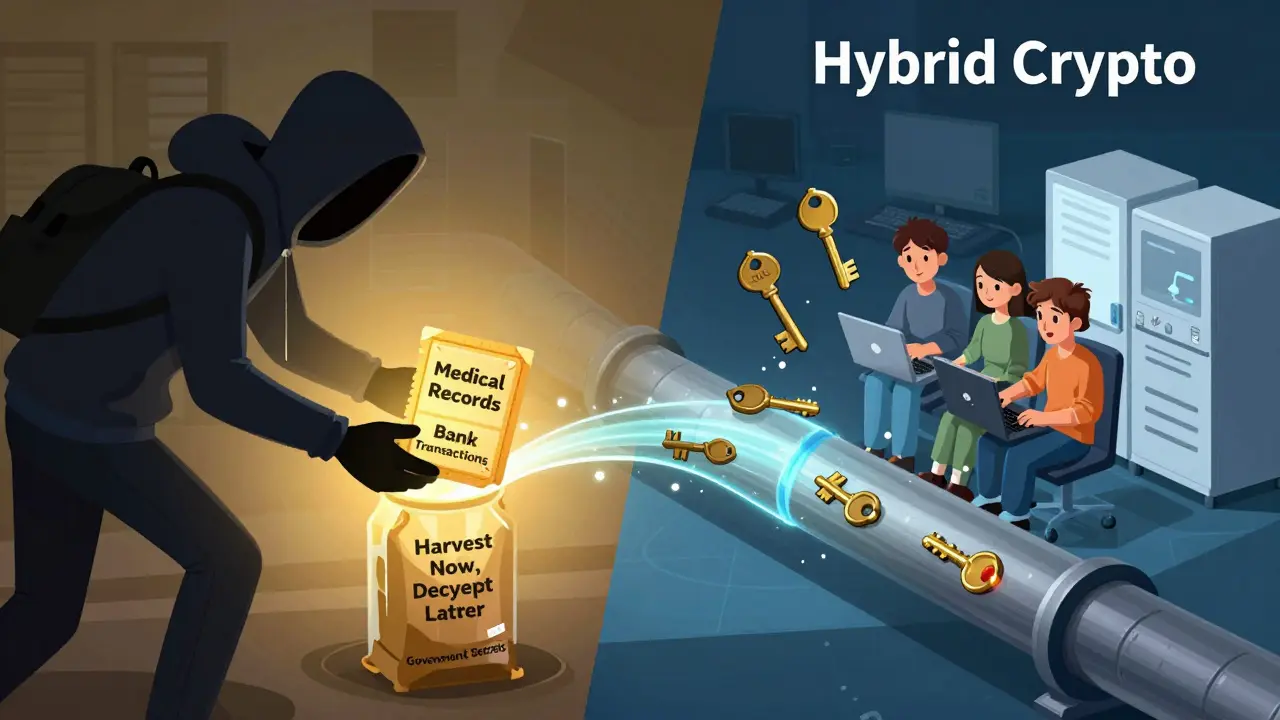
In 1994, mathematician Peter Shor proved that a quantum computer could solve the math problems behind these systems in minutes, not millennia. That’s the problem. Hackers don’t need to break your data today. They just need to steal it and store it. Then, when a quantum computer shows up, they unlock everything. This is called "harvest now, decrypt later." And it’s already happening.
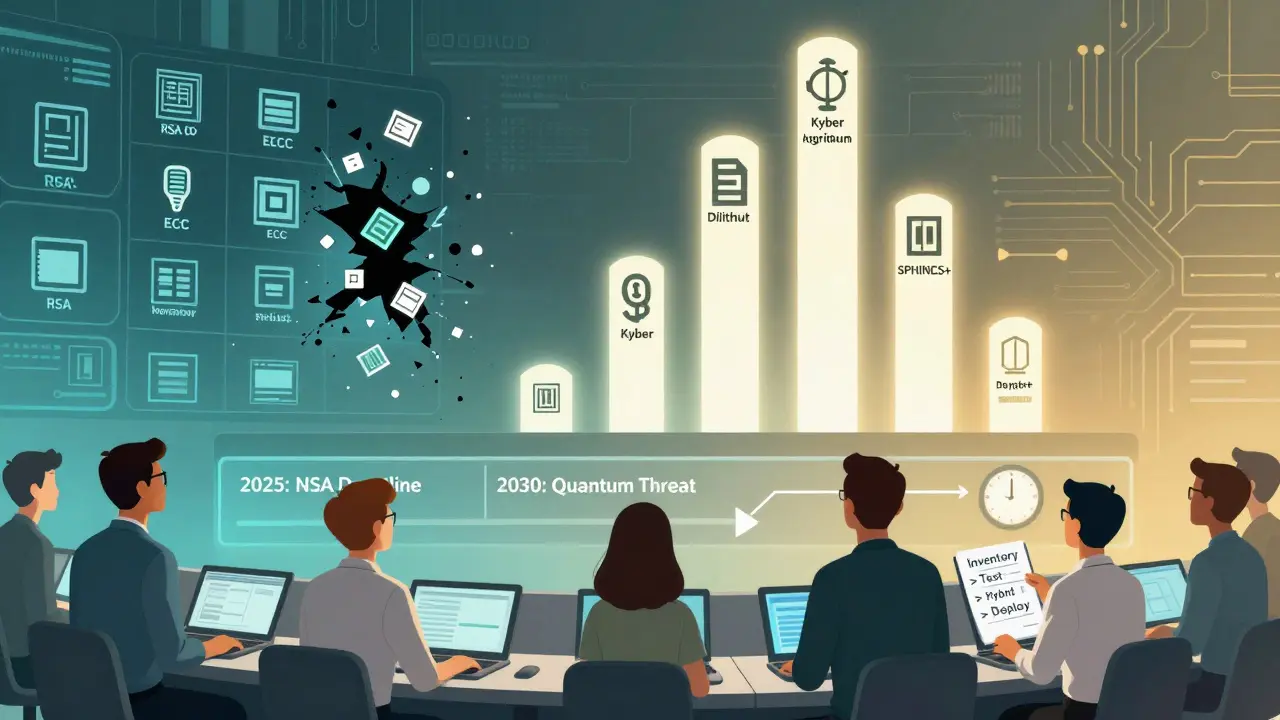
The National Security Agency (NSA) warned in 2022 that all National Security Systems must start moving to quantum-safe crypto by 2025. The European Union’s Cyber Resilience Act requires critical infrastructure to be ready by 2027. If you’re still using old encryption, your data is already at risk-even if you haven’t noticed it yet.
What Quantum-Resistant Cryptography Actually Is
Quantum-resistant cryptography (also called post-quantum cryptography or PQC) is a new set of math-based encryption systems designed to work on today’s computers but stay secure even against quantum attacks. These aren’t magic. They’re just different math.
Instead of relying on factoring large numbers (which quantum computers break), they use problems that even quantum machines struggle with. Think of it like switching from a lock that can be picked with a magnet to one that needs a completely different kind of key-one that quantum tools can’t copy.
The National Institute of Standards and Technology (NIST) spent eight years testing over 70 candidates. In 2022, they picked the first winners. By 2023, they finalized the first standard: CRYSTALS-Kyber for encrypting data and exchanging keys. In 2024, they’re finalizing three more: CRYSTALS-Dilithium for digital signatures, SPHINCS+ as a backup signature method, and FALCON for smaller, faster signatures.
These aren’t theoretical. They’re being built into real systems right now. Google added Kyber to Chrome 125. Microsoft’s Azure Key Vault now supports them. The Internet Engineering Task Force is updating TLS and VPN protocols to include them.
The Four Main Types of Quantum-Resistant Algorithms
Not all quantum-resistant crypto is the same. Each has trade-offs in speed, size, and complexity. Here’s what you need to know:
- Lattice-based (like Kyber and Dilithium): These are the front-runners. They’re fast, have small keys (about 1-2 KB), and work well in most systems. Kyber is already the go-to for securing connections. They’re the most practical choice for most organizations.
- Code-based (like Classic McEliece): These use error-correcting codes from telecom tech. They’re extremely secure but have huge public keys-around 1 megabyte. That’s fine for servers, but terrible for IoT devices or mobile apps. They’re a backup, not a first choice.
- Hash-based (like SPHINCS+): These rely on the strength of hash functions (think SHA-256). They’re proven over decades and don’t depend on new math. But their signatures are big-up to 49 KB-and slow to generate. They’re great for long-term archival security, like signing documents you want to verify 50 years from now.
- Multivariate polynomial: These are fast to verify but need large public keys (10-100 KB). They’re not in NIST’s first round of standards, but they’re still studied for niche uses where speed matters more than size.
For most people, you’ll see Kyber and Dilithium everywhere. They’re the new standard. The others are there for specific cases or as backups if something goes wrong.
Why Hybrid Cryptography Is the Real-World Standard
Switching to new crypto isn’t like updating your phone. You can’t just flip a switch. Systems are old. Contracts are long. Devices are stuck in the field. That’s why no one is going all-in on quantum-resistant crypto right away.
The industry standard is hybrid encryption. That means you run both old and new crypto at the same time. For example, a connection might use both RSA and Kyber to generate a shared key. The final key is derived from both. So even if one breaks-whether it’s RSA from a classical attack or Kyber from a future quantum flaw-the other still protects you.
This isn’t just a safety net. It’s a migration strategy. It lets you test new algorithms in real systems without risking total failure. Companies like QuSecure and IBM use hybrid models in their enterprise tools. Even NIST recommends it in SP 800-208. You don’t need to wait for perfection. You just need to start layering in protection now.
How It Compares to Quantum Key Distribution (QKD)
You might hear about quantum key distribution (QKD) as another way to fight quantum threats. It uses physics-photons and quantum states-to exchange keys. Sounds fancy, right?
But here’s the catch: QKD needs special hardware. Fiber-optic cables. Laser transmitters. Trusted nodes every 100 kilometers. It doesn’t work over the internet. It doesn’t work on phones. It costs 5 to 7 times more than upgrading to quantum-resistant crypto, according to Ericsson’s 2023 analysis.
The NSA says it clearly: "Quantum-resistant cryptography is a more cost-effective and easily maintained solution." QKD is for labs, military bases, or ultra-secure point-to-point links. Quantum-resistant crypto works in your browser, your cloud server, your smart meter, and your laptop. That’s why it’s winning.
Real-World Challenges in Adoption
Switching to quantum-resistant crypto isn’t easy. Here’s what’s slowing it down:
- Larger keys and signatures: Kyber keys are 2-3 times bigger than RSA-2048. SPHINCS+ signatures can be 50 times larger than ECDSA. That means more bandwidth, more storage, and slower transfers.
- Slower performance: Encryption and signing can be 2 to 10 times slower, depending on the algorithm. On a server, that’s manageable. On a smart thermostat? Not so much.
- Cryptographic inventory: Most companies don’t even know where all their encryption is. A 2024 Cloud Security Alliance survey found 68% of IT teams struggled to map their crypto assets. You can’t fix what you can’t see.
- Lack of expertise: Only 12% of security teams have deep knowledge of PQC, according to Ponemon Institute. Most rely on vendors to handle it.
- Interoperability: Different implementations don’t always talk to each other. A key generated by one vendor’s Kyber library might not work with another’s.
The UK’s National Cyber Security Centre recommends a five-year plan: Year 1-2 to find all crypto systems, Year 3 to test pilots, Year 4-5 to roll out. That’s the realistic timeline. Rushing it risks new vulnerabilities.
Who’s Already Using It-and Who’s Falling Behind
Adoption isn’t even. Financial services are leading. 78% of major banks have started testing quantum-resistant crypto, according to FS-ISAC. Governments, healthcare, and critical infrastructure are next.
Manufacturing? Only 35% have started. Retail? Barely 20%. That’s dangerous. Your supply chain data, factory control systems, and logistics records are just as valuable to attackers as bank accounts.
Big tech is pushing it forward. Google, Microsoft, Amazon, and Cloudflare are all integrating PQC into their platforms. Open-source projects like Open Quantum Safe give developers free tools to test it. But the real shift will happen when your bank, your hospital, and your government start requiring it.
What You Should Do Today
You don’t need to build your own crypto. But you do need to act.
- Inventory your systems: Find where you’re using RSA, ECC, or DH. Look at TLS certificates, VPNs, digital signatures, and encrypted databases.
- Ask vendors: Are your software, hardware, and cloud providers planning to support NIST’s PQC standards? Demand timelines.
- Start testing: Use tools like Open Quantum Safe or QuSecure’s platform to test hybrid encryption in a lab environment.
- Plan for hybrid: Don’t wait for perfect. Start combining old and new crypto now.
- Monitor updates: NIST’s final standards for Dilithium, SPHINCS+, and FALCON will be out in late 2024. Update your roadmap when they are.
Quantum-resistant cryptography isn’t a future project. It’s a now project. The data being encrypted today will still be valuable in 2030. If you wait until quantum computers are here, it’s already too late.
What’s Next for Quantum-Resistant Crypto
By 2027, experts at Forrester predict quantum-resistant crypto will be as standard as TLS is today. By 2030, 90% of new systems will include it. The transition will be one of the biggest in cybersecurity history-bigger than Y2K.
But it’s not about fear. It’s about preparation. The math is solid. The standards are coming. The tools are here. The only thing missing is action.
If you’re in finance, healthcare, government, or any industry that handles sensitive data-you’re already behind. Start today. Not tomorrow. Not next year. Today.
Is quantum-resistant cryptography the same as quantum cryptography?
No. Quantum-resistant cryptography (PQC) uses new math to protect data on classical computers. Quantum cryptography (like QKD) uses quantum physics to exchange keys, but requires special hardware and doesn’t work over the internet. PQC is practical for everyday use. QKD is for niche, high-security links.
When will quantum computers break current encryption?
No one knows exactly. But experts like those at QuSecure estimate it could happen as early as 2030. The real threat isn’t today-it’s that attackers are already collecting encrypted data to decrypt later. That’s why action is needed now.
Can I just upgrade my software to fix this?
Not always. Many systems-especially legacy hardware, embedded devices, or custom software-can’t be easily upgraded. You need to audit your crypto inventory first. Some systems may need replacement, not just an update.
Are NIST’s standards trustworthy?
Yes. NIST’s process was open, global, and took eight years. Over 70 algorithms were tested by thousands of cryptographers. While some, like Bruce Schneier, warn that new algorithms haven’t been tested as long as RSA, the selection process is the most rigorous in history. The alternatives-doing nothing-are far riskier.
Does this affect my personal devices like phones and laptops?
Indirectly, yes. Your phone uses TLS to connect to services. Those services are starting to adopt quantum-resistant crypto. You won’t need to do anything-your apps and OS will update automatically. But if you manage enterprise systems, you need to plan ahead.
What happens if a quantum-resistant algorithm gets broken?
That’s why hybrid encryption exists. If Kyber is compromised, the classical algorithm (like RSA) still protects the key. Also, NIST selected multiple algorithms as backups. If one fails, others are ready. Cryptography is about layers, not single points of failure.
Is quantum-resistant crypto expensive to implement?
Compared to doing nothing? No. The cost of a data breach from decrypted secrets could be millions. Implementation costs vary, but most enterprises can integrate PQC through software updates. Hardware upgrades are only needed for very old systems. The real cost is delay-not the tech itself.
Comments (10)

- Brooke Schmalbach
- December 9, 2025 AT 04:35 AM
Let’s be real-this isn’t crypto evolution, it’s crypto desperation. NIST picked Kyber because it’s the least terrible option, not because it’s bulletproof. We’re betting national security on math that’s been tested for *three years* while RSA survived 40. That’s not preparation, it’s gambling with the keys to everything.

- Josh Rivera
- December 10, 2025 AT 08:24 AM
Oh wow, another tech guru telling us we’re all doomed unless we upgrade our toaster firmware. Meanwhile, the NSA’s own internal systems still run on Windows XP servers with SHA-1 certs. If they can’t even fix their own house, why should I trust their ‘quantum-safe’ hype? This is just a vendor-driven panic sale wrapped in a NIST seal.

- Neal Schechter
- December 11, 2025 AT 03:42 AM
For folks just trying to keep their email secure: don’t overthink it. Your email provider, bank, and cloud services are already on it. You won’t notice the switch-it’ll just happen in the background. The real work is for sysadmins, devs, and legacy system owners. If you’re not managing infrastructure, your biggest job is to stop panicking and update your OS when it pops up.

- Elizabeth Miranda
- December 12, 2025 AT 05:16 AM
I appreciate how this breaks down the four algorithm families, but I’d love to see a visual comparison-maybe a table with key size, speed, and device compatibility. Also, the point about hybrid encryption being the pragmatic path is spot on. It’s not about perfection; it’s about layered resilience. We’ve done this before with AES-128 to AES-256, and the transition was seamless for users. This is the same principle, just with higher stakes.

- ronald dayrit
- December 13, 2025 AT 15:48 PM
There’s a deeper philosophical layer here that no one’s talking about. We’re not just upgrading algorithms-we’re surrendering the illusion of cryptographic permanence. For decades, we believed math was eternal. RSA was ‘unbreakable’ until it wasn’t. Now we’re accepting that all crypto is temporary, that every key has an expiration date written in quantum probability. That’s not just a technical shift-it’s a cultural one. We’re learning to live with impermanence in our digital foundations. The real challenge isn’t Kyber or Dilithium. It’s our collective refusal to accept that nothing lasts forever-not even encryption.

- rita linda
- December 14, 2025 AT 11:19 AM
Let me guess-next they’ll tell us to start using quantum-resistant toilet paper. The U.S. spends billions on this while our bridges are collapsing. Meanwhile, China’s already deploying quantum networks. We’re not preparing-we’re doing performative tech theater while the country rots. If you care about security, fix the power grid first. Then we’ll talk about your TLS certificates.

- Mairead Stiùbhart
- December 15, 2025 AT 02:23 AM
Interesting how everyone’s acting like this is some new crisis. In Ireland, we’ve been talking about this since 2020. The EU’s Cyber Resilience Act isn’t a suggestion-it’s law. Companies that ignore it are already liable. The real story isn’t the tech. It’s the fact that 70% of SMEs think ‘quantum’ means a new iPhone feature. Education isn’t optional anymore. It’s survival.

- Tisha Berg
- December 15, 2025 AT 20:32 PM
Just a quick note for small business owners: you don’t need to understand lattice-based math. Just ask your IT vendor: ‘Are you moving to NIST PQC standards by 2025?’ If they stare blankly, find someone who knows. Your data’s worth more than your current contract. Simple as that.

- Chloe Hayslett
- December 17, 2025 AT 18:44 PM
Wow. A 3000-word essay on how we’re all going to die because someone might crack RSA. Meanwhile, the average person still uses ‘password123’ and clicks every phishing link. We’re fighting quantum computers with duct tape and hope. Maybe we should fix the 95% of problems we can actually solve before we panic about the 5% we can’t control yet.

- Madison Agado
- December 18, 2025 AT 03:23 AM
That’s actually the most honest comment here. We’re so obsessed with future threats that we ignore today’s vulnerabilities. A single unpatched server, a misconfigured cloud bucket, a social engineering attack-those are the real killers. Quantum-resistant crypto is vital, but it’s not a magic shield. It’s one layer in a much bigger security onion. And right now, most of us haven’t even peeled the first layer.