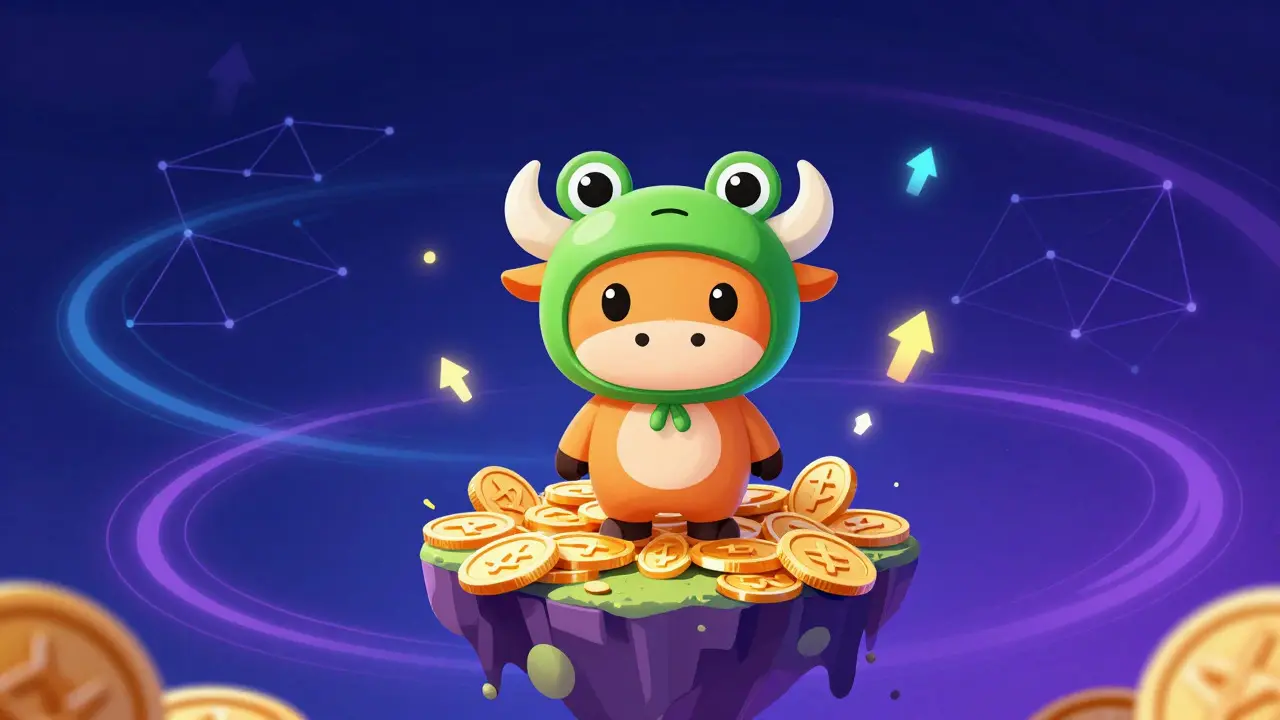

Most people know the frog. Fewer know the bull that followed it into the memecoin trenches. PepeBull (ticker BEEF) is a community-driven, zero-tax cryptocurrency token launched on the Ethereum blockchain in June 2024. It positions itself as a "bullish" derivative of the massive PEPE ecosystem, aiming to capture the speculative energy of meme coins without the usual transaction fees or hidden supply mechanics.
If you are looking at BEEF right now, you are likely asking three things: Is it safe? How do I buy it? And why does the price look like a scientific experiment gone wrong? This guide breaks down the technical reality, the market position, and the practical steps needed to interact with this micro-cap asset in 2026.
The Basics: What Makes BEEF Different?
At its core, PepeBull is a standard ERC-20 token. It doesn’t have a complex whitepaper, a named CEO, or a novel DeFi protocol. Instead, it relies on the "fair launch" narrative popularized by earlier meme successes. The project deployed stealthily on June 19, 2024, with no presale and no public fundraising round before trading began.
Two technical features define its trust model:
- Zero Transaction Taxes: There is no fee deducted when you buy or sell. If you send 100 BEEF, you receive 100 BEEF. This removes a common friction point in many newer meme tokens.
- Renounced Ownership & Burned Liquidity: The deployer gave up control of the smart contract, meaning they cannot change the rules or mint more tokens arbitrarily. Additionally, the initial liquidity pool was burned, making it technically difficult for the team to pull out their funds in a classic "rug pull."
However, "trust" in the memecoin world is relative. While these features mitigate specific risks, they don't guarantee value. The token remains a pure speculative instrument, driven entirely by community sentiment and trading volume rather than utility or revenue generation.
Market Reality: Micro-Cap and Volatile
Let’s talk numbers, because they paint a clear picture of where BEEF sits in the crypto landscape. As of mid-2026, PepeBull has a total supply of 420.69 trillion tokens. All of them are in circulation. Despite this massive number, the market capitalization hovers between $79,000 and $108,000 USD, depending on the data provider.
This places BEEF firmly in the micro-cap tier. To put that in perspective, it ranks around #7,378 globally by market cap. For context, the top 100 cryptocurrencies hold trillions of dollars in value. BEEF holds less than the cost of a few high-end laptops.
| Metric | Value | Context |
|---|---|---|
| Total Supply | 420.69 Trillion | Fixed, all circulating |
| Market Cap | ~$80k - $108k | Micro-cap tier |
| Daily Volume | < $1,000 | Very low liquidity |
| Price Range | $0.00000000018 - $0.00000000024 | Sub-nanocent levels |
| All-Time High | $0.00000001 | Current price is ~92% below ATH |
Where Does BEEF Live? Ethereum vs. Base
Here is where it gets slightly confusing. Most major data aggregators like CoinGecko and CoinMarketCap identify PepeBull primarily as an Ethereum-based token. The main smart contract address starts with 0xbeef698b....
However, some listings, particularly from Japanese sources like TheBitTimes, describe a BEEF token on the Base blockchain (a Layer-2 network built by Coinbase). This version was reportedly deployed in April 2026. It’s unclear if this is an official multi-chain expansion by the original team or simply another token using the same name. Given the lack of centralized documentation, traders should always verify the exact contract address before buying to ensure they are holding the intended asset.
How to Buy and Store PepeBull
You won’t find BEEF on Binance or Coinbase for direct spot trading. Major exchanges treat it as an informational asset. To get your hands on BEEF, you need to use Decentralized Exchanges (DEXs).
- Get a Wallet: You need an EVM-compatible wallet like MetaMask, Trust Wallet, or Ledger. Ensure it is set to the Ethereum network (or Base, if targeting that specific contract).
- Acquire ETH: Buy Ethereum (ETH) on a centralized exchange like Coinbase or Kraken, then transfer it to your wallet address. ETH is the gas currency required to pay for transaction fees on the Ethereum network.
- Add the Token: Open your wallet and manually add the BEEF token using its verified contract address. In MetaMask, you can often click "Import Token" and paste the address found on CoinGecko or CoinMarketCap.
- Swap on Uniswap: Go to Uniswap V2 (the primary venue for BEEF liquidity). Connect your wallet. Select ETH as the "You Pay" asset and BEEF as the "You Receive" asset. Enter the amount and confirm the swap.

Risks and Red Flags to Watch
Investing in BEEF is high-risk speculation, not a long-term investment strategy. Here are the specific factors that make it volatile:
- Liquidity Risk: With under $1,000 in daily volume, exiting a large position can be difficult without crashing the price.
- Data Discrepancies: Some platforms list the max supply as infinite, while others say it's fixed at 420.69 trillion. Until clarified, this creates uncertainty about potential future inflation.
- Lack of Audit: No independent smart contract audit has been widely publicized. While ownership is renounced, bugs in the code could still exist.
- Phishing Scams: Because BEEF has had airdrop campaigns (such as one via AirdropAlert in late 2025), fake websites popping up claiming to be "official" are common. Always check URLs against the project’s Twitter handle (@Pepe0xbeef) or Telegram group.
Is PepeBull Worth Your Attention?
PepeBull appeals to traders who enjoy the raw, unfiltered chaos of the memecoin sector. It offers zero taxes and a fair-launch structure, which are attractive features for short-term speculators. However, its tiny market cap and negligible volume mean it is unsuitable for conservative investors or those looking for stability. If you decide to participate, keep your position size small-small enough that a 50% drop wouldn’t hurt your portfolio. Monitor the official social channels for any updates on the Base chain deployment or new airdrops, as these events are the primary drivers of volume in this niche. For everyone else, BEEF serves as a fascinating case study in how far a purely community-driven token can go without fundamental backing.
Can I buy PepeBull (BEEF) on Binance or Coinbase?
No, not directly. Major centralized exchanges like Binance and Coinbase list BEEF only for informational purposes. To buy it, you must use a decentralized exchange like Uniswap V2 on the Ethereum network.
What is the total supply of BEEF?
The total supply is 420.69 trillion tokens. All of these tokens are currently in circulation, and the contract ownership has been renounced, preventing the team from minting more unless the contract allows for it (which is disputed in some data feeds).
Does PepeBull charge transaction fees?
No. PepeBull operates with 0% buy and sell taxes. You only pay the standard Ethereum network gas fees to execute transactions.
Is there a whitepaper for PepeBull?
There is no formal, detailed whitepaper. Like most meme coins, the project relies on its social media presence, website, and community engagement rather than extensive technical documentation.
Why is the price so low?
The price per token is sub-nanocent (e.g., $0.0000000002) because the total supply is extremely high (420 trillion). The absolute price doesn't reflect the total value of the project; the market cap (Price x Circulating Supply) is the better metric for valuation.

Comments (10)

- Claudio Perrone
- August 25, 2026 AT 06:35 AM
oh my god look at this disaster of a coin
the price is literally zero but with like nine zeros after it which makes me feel rich for some reason
why does everyone keep making these frog bull hybrid things its getting stupid
i tried to buy some last week and my gas fees were higher than the investment itself
pure chaos in the best way possible

- Shawn Schaerer
- August 27, 2026 AT 03:14 AM
One must observe that the fundamental thesis here is entirely decoupled from intrinsic value.
The market cap of eighty thousand dollars suggests a liquidity profile so thin it borders on theoretical.
To engage with such an asset is to accept that slippage will be your primary adversary.
Furthermore, the lack of a whitepaper indicates a reliance on pure sentiment, which is a volatile foundation indeed.
Nevertheless, the renounced ownership provides a baseline of technical trust, even if the economic utility remains nonexistent.
This is not an investment; it is a gamble wrapped in a meme.
The daily volume under one thousand dollars is a red flag that cannot be ignored by any rational actor.
If you proceed, do so with the understanding that exiting may prove as difficult as entering.
The sub-nanocent pricing is merely a cosmetic feature of the high supply count.
In conclusion, treat BEEF as a speculative curiosity rather than a financial instrument.
The risks outweigh the potential rewards for all but the most risk-tolerant individuals.
Let us hope the community sentiment holds, though history suggests otherwise.
It is a fascinating case study in modern digital speculation.
Do not let the colorful branding fool you into believing there is substance here.
Stay vigilant and keep your position size negligible.

- Patrick Quairoli
- August 27, 2026 AT 17:43 PM
this is clearly a rug pull waiting to happen
who burns their liquidity unless they plan to dump it later?
i bet the dev still has keys somewhere
the base chain version is definitely a scam to confuse people
just another way to steal from normies

- Hicham Mounir
- August 28, 2026 AT 22:08 PM
look, if you are going to play with fire you have to wear gloves right?
the article says it well about the slippage being the real enemy here
i got stuck once in a microcap and spent three days trying to sell without losing half my money
it is stressful but also kind of fun when it works out
just dont put more in than you want to lose to the gas fees

- Linda Leeuwesteijn
- August 30, 2026 AT 01:06 AM
Whoa, that daily volume stat is wild 📉
I never realized how thin the books get for these tiny coins!
Always double-check the contract address before swapping, learned that the hard way 😅
Hope everyone stays safe out there! 💖

- Sarah Campbell
- September 1, 2026 AT 00:03 AM
another american made mess right?
why do we always have to clean up after the crypto bros
glad i stick to gold and stocks
this looks like a trap for suckers 🇺🇸

- Phelan Deihl
- September 1, 2026 AT 21:42 PM
i read the whole thing and still confused about the base chain part
seems risky to mix two networks without clear docs
nice writeup though

- Ami Elizabeth
- September 2, 2026 AT 16:43 PM
honestly the name is cringe but the zero tax thing is nice
i saw this on twitter and thought it was a joke
turns out it is real lol

- Zothana Pachuau
- September 4, 2026 AT 15:57 PM
Oh, so you're brave enough to touch the snake, eh?
Just remember, the snake bites back when you least expect it.
Keep your eyes open and your wallet closed tight.
That's all I'll say. Good luck. 🐍

- Aaron Morrissey
- September 5, 2026 AT 18:54 PM
It is truly a magnificent spectacle of human irrationality, isn't it?
We build cathedrals of code only to watch them crumble under the weight of our own greed.
Yet, there is something poetic about a frog becoming a bull in the digital wilderness.
Perhaps we are all just chasing shadows in the dark, hoping for a glimmer of light.
The volatility is terrifying, yes, but it is also the heartbeat of this new era.
Let us not judge the players, for we are all participants in this grand experiment.
May your trades be swift and your exits timely.
Peace be with you in this chaotic marketplace.
What a time to be alive, what a time to speculate.
Embrace the uncertainty, for it is the only constant we have.
The story of BEEF is just one chapter in the endless book of crypto.
Read it carefully, but do not take it too seriously.
After all, it is all just numbers on a screen.
Or is it?
Who can say with certainty in these turbulent times?
Post-Comment
Categories
Popular Articles