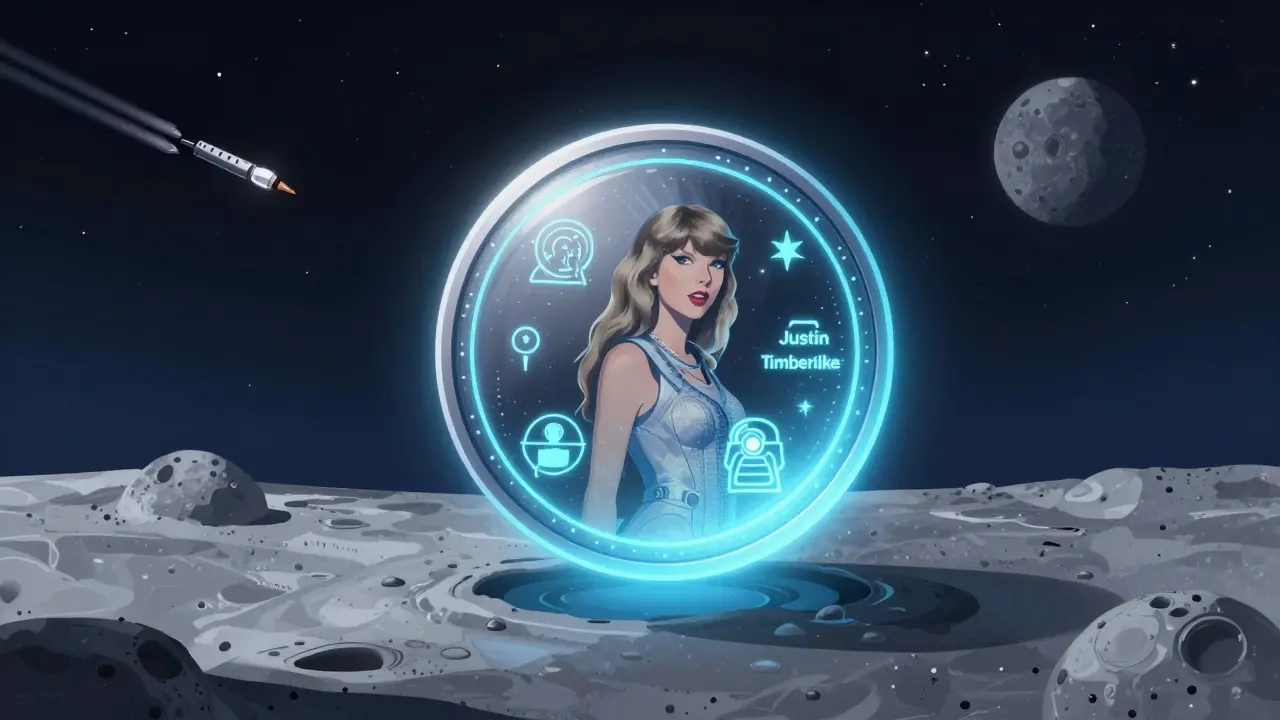

Lunarbits (LUNARBITS) isn’t just another crypto coin. It’s a digital asset tied to something no other cryptocurrency has: a physical time capsule on the Moon. Launched on February 22, 2024, aboard SpaceX’s Falcon 9 rocket as part of the Lunaprise Mission, Lunarbits is built on the Runes protocol - a Bitcoin-based system that lets users create tokens directly on the Bitcoin blockchain. Unlike most meme coins that float without real-world ties, Lunarbits anchors its value to a $7 billion collection of cultural artifacts stored in lunar storage.
The token was created by the Global Trillion Dollar Bitcoin Community through Space Blue, a company led by Dallas Santana. The idea? Turn space exploration into a long-term store of value. The Lunaprise time capsule on the Moon holds digital versions of music, art, and memorabilia from global icons - including Justin Timberlake, Taylor Swift, K-pop stars, and even Stan Lee’s Legion franchise. These aren’t just NFTs. They’re permanent, unchangeable records preserved on the lunar surface, accessible only through the Lunarbits token.
How Lunarbits Works
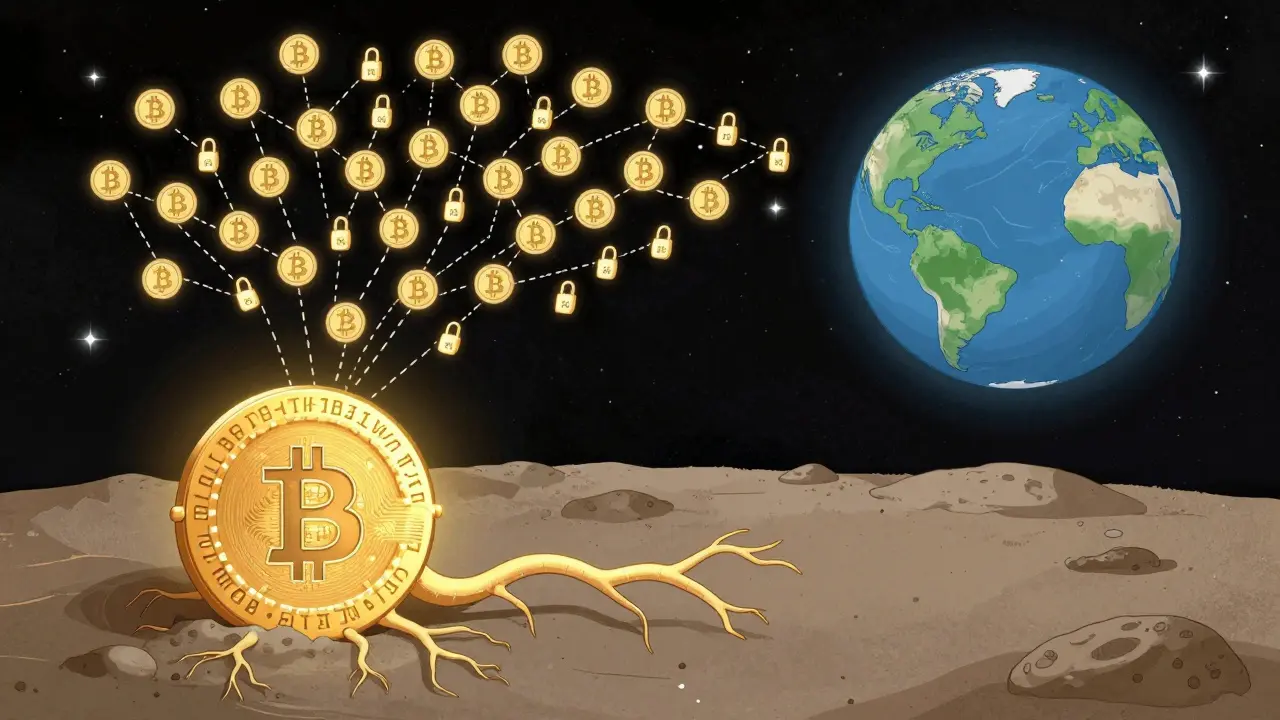
Lunarbits runs on Bitcoin’s blockchain using the Runes protocol. This means it inherits Bitcoin’s security, decentralization, and permanence. Unlike Ethereum-based tokens that rely on smart contracts, Runes tokens are simpler and more resistant to hacks or network congestion. Each Lunarbits token is a unique inscription on the Bitcoin ledger, making it as immutable as a Bitcoin itself.
The total supply is fixed at 222,222,222 tokens. But here’s the twist: 90% of those tokens are locked for over ten years. That means only about 22 million tokens are currently in circulation. This scarcity is intentional. The project isn’t trying to pump and dump. It’s built for decades, not days. The remaining 10% is slowly released into the market through staking rewards, community incentives, and ecosystem growth.
Lunarbits uses a proof-of-stake model for validation, which keeps energy use low. You don’t need mining rigs. Just hold your tokens in a compatible wallet, and you can earn rewards by staking. The system is designed to reward long-term holders, not traders.
Where You Can Use Lunarbits
Lunarbits isn’t just a speculative asset. It’s a utility token with real use cases inside its growing ecosystem. The main platforms where you can use it are:
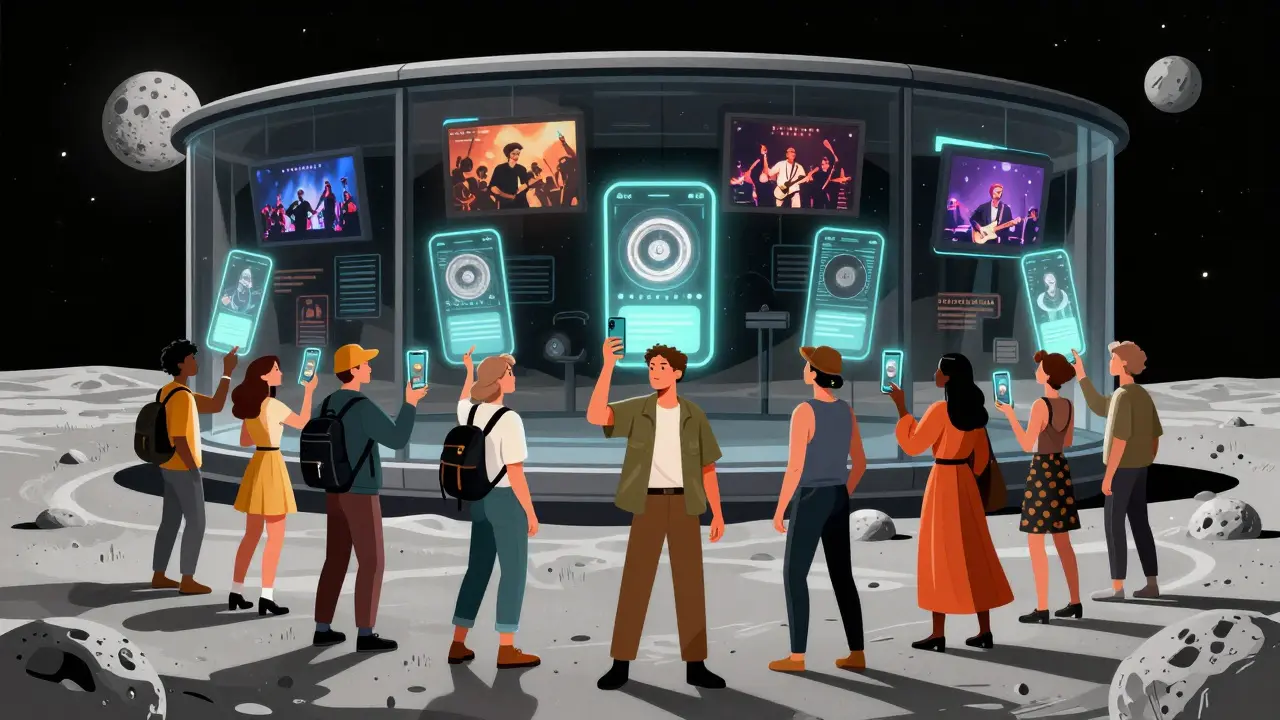
- Soundromeda - A metaverse music venue where you can attend virtual concerts, buy exclusive tracks, and tip artists in LUNARBITS.
- Future Trends Multiverse - A digital world that recreates historic music festivals like Woodstock and Coachella, now powered by Lunarbits. You can buy tickets, merch, and even own a piece of the original stage design.
- Lunaprise Moon Museum - The first museum on the Moon. Access to exclusive digital exhibits, behind-the-scenes content, and limited collector items requires Lunarbits.
These platforms aren’t hypothetical. They’re live. Fans already use Lunarbits to buy digital collectibles, unlock rare music files, and vote on future museum exhibits. The token also works as a payment method on partner sites that accept Bitcoin, giving it real-world spending power.
Market Price and Trading
As of March 2026, Lunarbits is trading at wildly different prices across exchanges - a sign of its early-stage volatility and lack of centralized control.
- MEXC: $0.006805 USD
- CoinMarketCap: $0.002846 USD
- Crypto.com: $0.006588 USD
- CoinStats: $0.009888 USD
The 24-hour trading volume varies from $64 to over $18,000 depending on the platform. This inconsistency comes from low liquidity and limited exchange listings. Right now, you can buy Lunarbits on MEXC, Bitmart, and through P2P networks. Some users use automated bots like RevenueBOT to trade at set price levels, avoiding emotional decisions.
The all-time high was $0.9926 in late 2024, right after the Moon mission went live. Since then, it’s settled into a range between $0.0111 and $0.0848 over the last 90 days. The fully diluted valuation (FDV) is around $625,780, meaning if all tokens were in circulation, the market cap would be under $1 million. That’s tiny compared to major coins - but remember, 90% of tokens are locked. The real value is locked up with the Moon.
Why Lunarbits Is Different
Most crypto projects rely on hype. Lunarbits relies on history. It’s not about memes or influencers. It’s about legacy. The artifacts in the Lunaprise time capsule aren’t digital copies. They’re official, licensed, and permanently encoded. Think of it like owning a piece of the first moon landing - but instead of a flag, you own a piece of Taylor Swift’s unreleased demo, or a Stan Lee sketch.
The project taps into something deeper than money: belonging. Over 2.5 billion people follow the artists and creators represented in the collection. That’s not a small niche. That’s a global fanbase with emotional ties to the content. Lunarbits turns fandom into ownership.
It also bridges two worlds: Bitcoin maximalists who want pure, decentralized value, and culture lovers who want to preserve art beyond Earth. No other crypto has done that.
The Bigger Picture
The metaverse market is projected to hit $936 billion by 2030. Lunarbits isn’t trying to build a metaverse - it’s embedding itself into one that already exists. By linking physical lunar storage to digital access, it creates a new kind of asset: one that can’t be deleted, hacked, or taken down. It’s censorship-resistant, time-proof, and space-backed.
Its success hinges on adoption. If more artists, record labels, and museums join the ecosystem, the token’s utility grows. If fans start using it to buy tickets, merch, or exclusive experiences, the price stabilizes. Right now, it’s still early. But the foundation is unlike anything else in crypto.
Is Lunarbits a Good Investment?
If you’re looking for a quick flip, probably not. The price swings too much, and liquidity is low. But if you believe in long-term value tied to real cultural artifacts - and you think humanity will keep expanding into space - then Lunarbits could be one of the most unique plays out there.
It’s not a stock. It’s not a meme. It’s a key to a museum on the Moon. And that’s something no algorithm can replicate.
Is Lunarbits (LUNARBITS) a real cryptocurrency?
Yes. Lunarbits is a real cryptocurrency token built on the Runes protocol, which operates directly on the Bitcoin blockchain. It has a fixed supply, transparent issuance, and is traded on multiple exchanges. Unlike fake tokens, it’s backed by a physical time capsule on the Moon containing licensed cultural artifacts.
Can I buy Lunarbits with USD?
You can’t buy Lunarbits directly with USD on most exchanges. But you can buy USDT or USDC with USD, then trade those for LUNARBITS on platforms like MEXC or Bitmart. Some P2P networks also allow direct USD-to-LUNARBITS trades.
Where is Lunarbits stored?
Lunarbits tokens are stored on the Bitcoin blockchain as Runes inscriptions. Your ownership is recorded in a Bitcoin wallet that supports Runes, like Unisat, Xverse, or Ordinals Wallet. The actual cultural artifacts they represent are stored in a time capsule on the Moon, placed there during the IM-1 mission in February 2024.
Why does Lunarbits have such a low price?
The low price is due to limited circulating supply and low trading volume. With 90% of tokens locked for over 10 years, only a small fraction is available for trade. This creates volatility. The price doesn’t reflect the value of the Moon artifacts - it reflects how many people are actively trading right now.
Is Lunarbits connected to Bitcoin?
Yes. Lunarbits runs on the Runes protocol, which is built directly on Bitcoin’s blockchain. Every Lunarbits token is a Bitcoin transaction inscription. This means it inherits Bitcoin’s security, decentralization, and permanence - making it one of the most resilient crypto assets ever created.
Comments (10)

- Carol Lueneburg
- March 16, 2026 AT 16:17 PM
Okay but like… a museum on the MOON??? 🤯 I’m not even mad. This is the most beautiful thing I’ve seen in crypto. Taylor Swift’s demo tapes are floating in lunar dust now. I’m crying. 💖🌕

- Sahithi Reddy
- March 17, 2026 AT 15:57 PM
This is real moon money not meme money

- George Hutchings
- March 17, 2026 AT 20:54 PM
Honestly? I didn’t think anyone would pull this off. But the Runes protocol on Bitcoin? Genius. No smart contracts. No centralized servers. Just pure, unchangeable history. That’s the future.

- Henrique Lyma
- March 19, 2026 AT 18:56 PM
Lunarbits? More like Lunarbait. You’re telling me I’m supposed to believe that a bunch of digital artifacts on the Moon are worth billions? The artifacts themselves are just JPEGs. And you think people will pay for access? This isn’t innovation. It’s fanfiction with a blockchain.

- Elizabeth Kurtz
- March 19, 2026 AT 21:09 PM
I love how this bridges two worlds. Bitcoin purists get their immutable ledger. Culture fans get to own a piece of legacy that outlives Earth. I bought my first LUNARBITS after seeing the Stan Lee sketch in the museum preview. It’s not about the price. It’s about the story.

- john peter
- March 21, 2026 AT 10:16 AM
The fundamental flaw in this entire construct lies in its anthropocentric fallacy. To ascribe monetary value to artifacts stored on a celestial body devoid of civilizational context is to misunderstand the nature of value itself. Value is a social construct. The Moon has no society. Therefore, this is not investment. It is delusion dressed in cryptographic garb.

- Marc Morgan
- March 22, 2026 AT 10:15 AM
So we’re paying for access to a digital museum on the Moon… and the only way to get in is to own a coin that’s worth less than my morning coffee? I’m here for it. The irony is the art.

- shreya gupta
- March 23, 2026 AT 12:26 PM
I find it deeply concerning that this project claims to represent global culture while only featuring Western pop icons. Where are the Indian classical musicians? The African oral historians? The Indigenous storytellers? This is cultural appropriation with a blockchain.

- Heather James
- March 23, 2026 AT 22:18 PM
I staked 10k LUNARBITS. Got my first reward yesterday. The museum site loaded a 4K scan of a handwritten K-pop lyric sheet. I cried. Again. This isn’t crypto. It’s digital heirloom.

- Sarah Hammon
- March 25, 2026 AT 18:44 PM
soo i just got my first lunarbits and like… i was kinda skeptical but then i saw the video of the moon capsule being deployed and there was this tiny little chip with like… a snippet of the first ever recorded song from 1860? and it’s just… there? on the moon? forever? i think i’m in love with this project. also i typoed like 3 times in this comment oops lol