
You’ve probably seen ads for fitness trackers or wellness apps promising to change your life. But what if wearing a ring could actually pay you in cryptocurrency? That’s the bold promise behind CUDIS, a project that calls itself the world’s first longevity protocol. It’s not just another meme coin hoping for viral attention; it’s an attempt to merge high-end health tech with the speed of the Solana blockchain.
If you’re wondering whether this is a legitimate investment or just hype, you need to look past the flashy marketing. CUDIS aims to extend human health-span to 140 years-a claim that sounds like science fiction. Yet, they have sold over 20,000 smart rings and secured $5 million in funding from serious investors. In this guide, we’ll break down exactly what CUDIS is, how the token works, and whether the "sweat mining" concept holds water.
What Is CUDIS and Who Is Behind It?
CUDIS is a decentralized platform that rewards users for healthy behaviors using cryptocurrency. Unlike traditional fitness apps that give you points for nothing, CUDIS gives you actual tokens you can trade or spend. The project was launched by a team of serial entrepreneurs with backgrounds from top universities like UCLA and UC Berkeley. Many of them previously worked at tech giants such as Google, Microsoft, and Binance.
The core idea is simple: make health profitable. The ecosystem consists of three main parts:
- The CUDIS Ring: A wearable device that tracks sleep, activity, and biometric data.
- The AI Longevity Hub: Software that analyzes your data to provide personalized health insights.
- The Super App: A mobile interface where you manage your tokens, buy services, and monitor progress.
This setup creates what they call a "health economy." You don’t just track your steps; you earn assets based on them.
How Does the CUDIS Token Work?
The CUDIS token operates on the Solana blockchain. Why Solana? Because it handles about 65,000 transactions per second with fees under $0.00025. This speed and low cost are crucial for a system that might process thousands of micro-transactions daily for small health rewards.
Here is how you actually use the token:
- Sweat Mining: This is the headline feature. You earn tokens by completing verified exercise, improving sleep quality, and hitting other health metrics tracked by the ring.
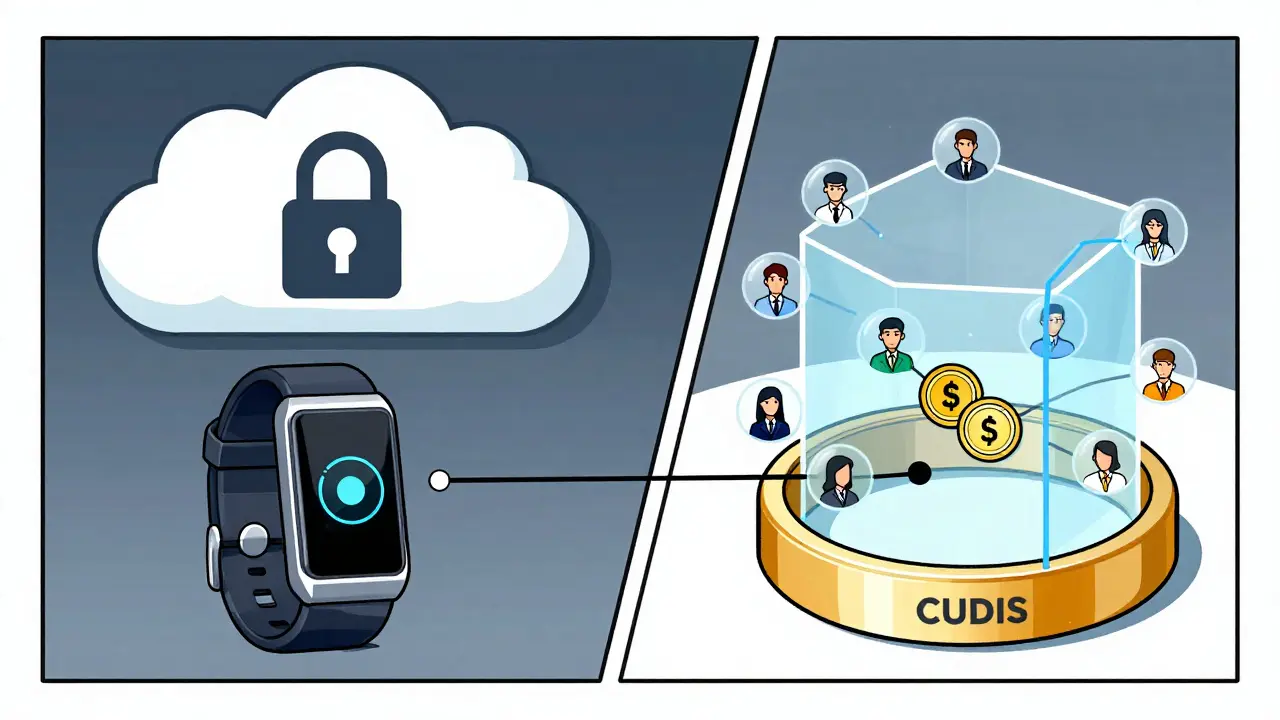
- Data Monetization: You can sell your anonymized health data to researchers and healthcare companies. Smart contracts handle the payment automatically.
- Premium Services: Use tokens to buy advanced analytics, personalized supplements, or coaching within the Longevity Hub.
- Staking: Lock up your tokens to earn passive income and gain voting rights on platform decisions.
- Ecosystem Funding: The token supports new health dApps and research partnerships.
This moves beyond simple "move-to-earn" models like Sweatcoin. Those apps usually offer discounts on products. CUDIS offers liquid crypto assets and governance power.
Funding, Partnerships, and Market Traction
A big question with any new crypto project is: who believes in it? CUDIS raised $5 million in seed funding in September 2024. The round was led by Draper Associates, known for early investments in SpaceX and Tesla. Other backers include Skybridge Capital, Borderless Capital, and MorningStar Ventures. They also received a grant from the Solana Foundation.
On the commercial side, they report selling over 20,000 rings, generating $6 million in revenue. They have more than 200,000 app users. These numbers suggest real product-market fit, not just a whitepaper dream.
Their partnership list is also impressive:
- Solana: Technical infrastructure support.
- UCLA: Potential academic validation of health algorithms.
- Roger Dubuis & Lamborghini: Luxury branding to position the ring as a status symbol.
- Klarity Telehealth: Healthcare integration.
- Jupiter & Magic Eden: Crypto ecosystem integrations for trading.
CUDIS vs. Traditional Fitness Trackers
| Feature | CUDIS | Apple Watch / Fitbit | Sweatcoin |
|---|---|---|---|
| Reward Type | Cryptocurrency (Tradeable) | None / Subscription Discounts | Loyalty Points (Limited Use) |
| Blockchain | Solana | Proprietary Cloud | Various (Often Centralized) |
| Data Ownership | User-Owned (Sellable) | Company-Owned | Shared with Partners |
| Governance | Token Holders Vote | Corporate Decisions | Centralized Team |
| Primary Goal | Longevity & Wealth | Health Tracking | Brand Engagement |
The key difference is ownership. With Apple or Fitbit, the company owns your data and sells insights to advertisers. With CUDIS, you own the data and can sell it directly to researchers via blockchain smart contracts. This shifts the economic power back to the user.
Risks and Challenges to Consider
While the model is innovative, it comes with significant risks. First, there is regulatory uncertainty. Selling health data touches on strict laws like HIPAA in the US and GDPR in Europe. If CUDIS fails to comply, they could face heavy fines or shutdowns.
Second, the scientific claims are ambitious. Extending health-span to 140 years is not currently supported by mainstream medical consensus. While optimizing health is good, promising near-immortality can attract regulatory scrutiny and skepticism from experts.
Third, crypto volatility remains a factor. The CUDIS token hit an all-time high of $0.179 but has seen sharp drops. As of late 2024, it traded around $0.04. If you buy the ring expecting immediate financial returns, you might be disappointed by market fluctuations.
Is CUDIS Right for You?
CUDIS appeals to two types of people: crypto enthusiasts interested in DeSci (decentralized science) and biohackers focused on longevity. If you already wear a tracker and want to monetize your data, it’s worth exploring. If you’re looking for a pure investment, treat it like any other altcoin-high risk, high potential reward.
The hardware requirement is a barrier. You need to buy the ring to fully participate in "sweat mining." This limits accessibility compared to software-only apps. However, the integration of luxury brands suggests they are targeting high-net-worth individuals who value both exclusivity and health optimization.
Can I earn CUDIS tokens without buying the ring?
The primary way to earn tokens through "sweat mining" requires the CUDIS Ring to verify biometric data. Without the hardware, you cannot prove your health metrics on-chain, so earning rewards is limited or non-existent. You can still buy tokens on exchanges to stake or vote.
Is CUDIS listed on Coinbase?
As of late 2024, CUDIS is traded on various decentralized exchanges and some centralized platforms, but there is no official confirmation of a Coinbase listing. Rumors of such a listing caused price spikes, but always verify information from official channels before investing.
How safe is my health data on CUDIS?
CUDIS uses blockchain technology to anonymize data before selling it to third parties. Smart contracts ensure you receive payment only when data is accessed. However, no system is 100% immune to breaches. Review their privacy policy and understand that once data is on a blockchain, it is permanent.
What is the total supply of CUDIS tokens?
The circulating supply is approximately 250 million tokens. Specific details on maximum supply and vesting schedules for team tokens should be checked in their official whitepaper, as inflation can affect long-term value.
Why does CUDIS use Solana instead of Ethereum?
Solana offers higher transaction speeds (65,000 TPS) and lower fees ($0.00025 avg) compared to Ethereum. For a health app processing frequent micro-transactions for step counts or sleep scores, Ethereum’s gas fees would make the service economically unviable for users.