
THORChain Cross-Chain Swap Calculator
Swap Calculator
Exchange rate: 1 =
THORChain uses RUNE as the intermediary token for cross-chain swaps. Fees are paid in RUNE and typically under $1.
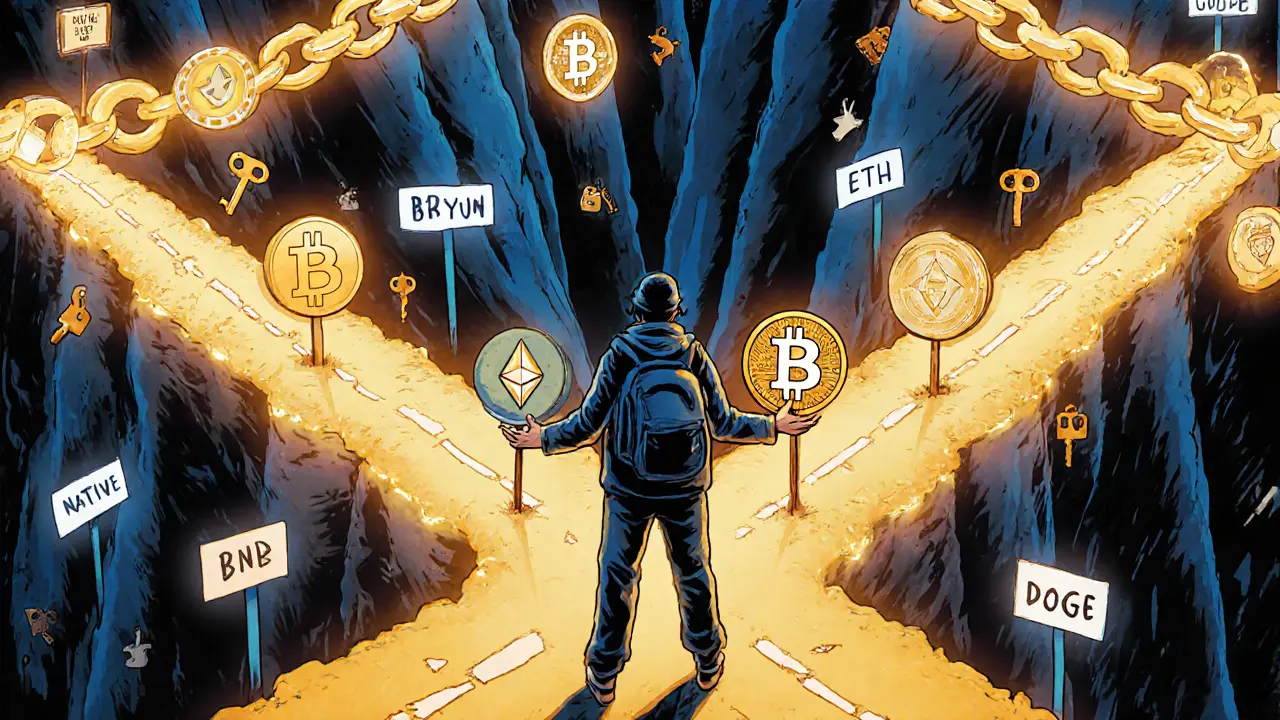
Most crypto exchanges make you wrap your Bitcoin or Ethereum before swapping it. That means you don’t actually own your asset anymore-you get a tokenized version locked in a smart contract. THORChain (BEP20) is different. It lets you swap native BTC, ETH, DOGE, BNB, and more directly, without wrapping, without intermediaries, and without giving up custody. If you’re tired of trusting third parties to hold your crypto during swaps, THORChain is one of the few platforms that actually delivers on that promise.
How THORChain Works (No Wraps, No Middlemen)
THORChain isn’t a traditional exchange. It doesn’t have order books or market makers. Instead, it’s a network of validators who watch blockchain activity and move assets between chains using a system called Threshold Signature Schemes. When you send BTC to THORChain, it doesn’t turn it into wBTC. It locks the BTC on the Bitcoin network, then issues an equivalent amount of RUNE on the THORChain network. You swap RUNE for ETH, and THORChain releases the ETH from its ETH vault to your wallet. Your original BTC? Still on Bitcoin. Your ETH? Still on Ethereum. No wrapped tokens. No custodial risk.
This works because every liquidity pool on THORChain is paired with RUNE. So if you want to swap BTC for DOGE, you’re really doing BTC → RUNE → DOGE in one step. The protocol handles the rest. The entire process happens on-chain, without any user registration or KYC. You connect your wallet-MetaMask, Trust Wallet, or Keplr-and swap. That’s it.
Why RUNE Is the Heart of the System
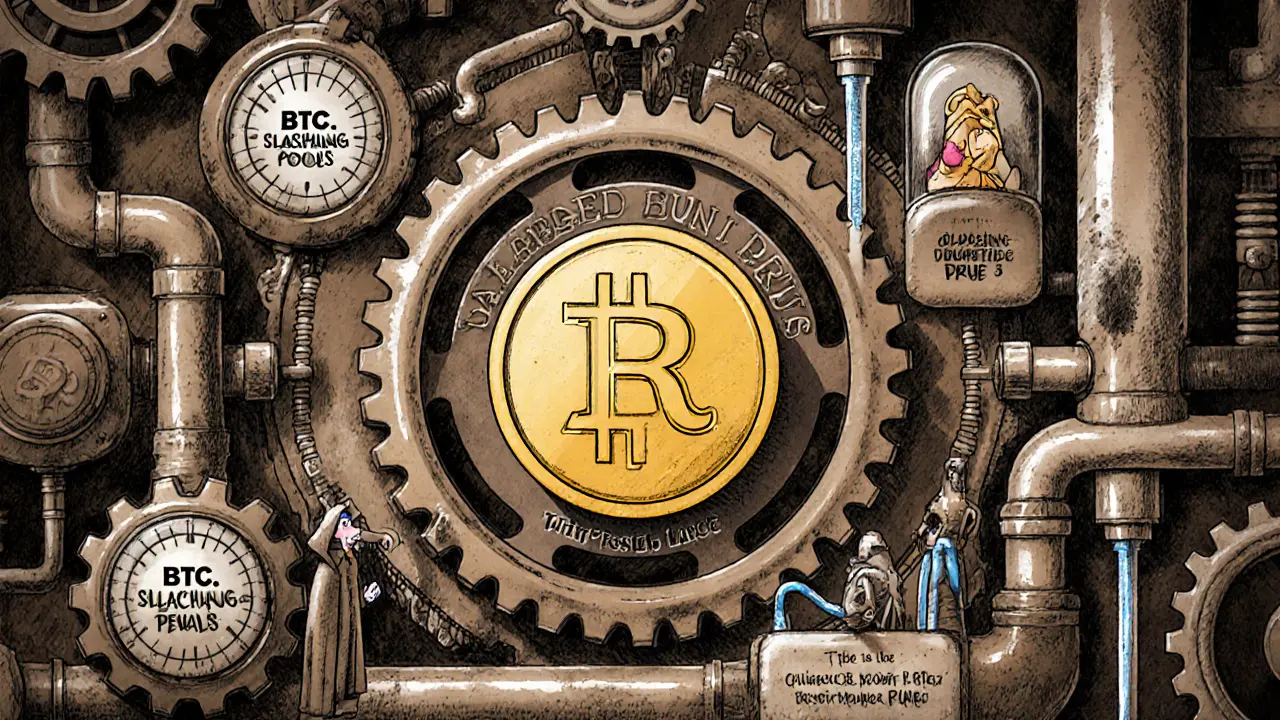
RUNE isn’t just another token. It’s the glue holding THORChain together. Every validator must bond RUNE as collateral to participate. If they act maliciously, their RUNE gets slashed. Liquidity providers also stake RUNE to earn fees. And when you swap, you pay fees in RUNE. That means every time someone uses THORChain, demand for RUNE goes up.
As of October 2025, RUNE trades around $1.21. That’s down from its all-time high of $20 in 2021, but not unusual for a project that’s still scaling. The tokenomics are designed to be self-reinforcing: more swaps → more RUNE demand → higher token value → stronger security. The Incentive Pendulum system adjusts rewards between validators and liquidity providers to keep both sides balanced. If liquidity is low, it pays more to providers. If security is weak, it pays more to validators.
Supported Assets and Chains
THORChain supports native swaps for nine major blockchains: Bitcoin, Ethereum, Binance Chain (BEP20), Litecoin, Bitcoin Cash, Dogecoin, Avalanche, Cosmos, and Polygon. The BEP20 version of RUNE is the most commonly used for swaps because it’s fast and cheap-perfect for frequent traders. BNB is one of the most popular assets swapped on the platform, especially since Binance Chain has deep liquidity.
Upcoming integrations include Solana and Arbitrum. If those go live, THORChain could become the go-to platform for cross-chain swaps between Ethereum, Bitcoin, and Solana ecosystems. That’s a big deal. Right now, swapping ETH for SOL usually means using a centralized exchange or a multi-hop bridge with high fees and delays. THORChain could do it in minutes, with native assets, and no trust assumptions.
Security: Past Hacks and Current Protections
THORChain isn’t perfect. In 2021, attackers exploited a vulnerability in the validator set and stole $150 million in assets. That was a major blow. But since then, the team has completely overhauled the security model. They introduced the Proof-of-Bond consensus, which requires validators to lock up RUNE as collateral. A 51% attack now costs billions in RUNE, making it economically unfeasible.
Still, trust issues linger. In February 2025, hackers laundered $18 million in stolen ETH through THORChain. The platform didn’t facilitate the theft-it just processed the swap like any other transaction. But the association damaged its reputation. Unlike centralized exchanges, THORChain doesn’t freeze accounts or block transactions. That’s by design. But it also means bad actors can use it. The community is divided: some see this as a feature (permissionless), others as a flaw (reputation risk).
Performance and Traffic
THORChain isn’t the most popular exchange. As of October 2025, it gets about 61,766 organic monthly visits-far behind Uniswap or PancakeSwap. It ranks 265th out of 612 crypto exchanges in organic traffic. That’s not because it’s bad-it’s because most users still don’t know it exists. But the users who do use it? They’re active. The platform processed over 100,000 swaps in a single day at peak. That’s more than most centralized exchanges handle.
On-chain metrics show neutral momentum. The 14-day RSI is at 47.02, meaning no strong bullish or bearish trend. The 50-day moving average ($1.26) is just below the 200-day ($1.39), suggesting a slight downtrend. But volume is steady. The number of green days (up days) in the last 30 is 17-57% positive. That’s better than most altcoins.
Price Predictions and Investment Outlook
Price forecasts for RUNE vary wildly. CoinCodex predicts $1.50 by end of October 2025-a 23% rise. WalletInvestor says $3.34 by year-end. PricePrediction.net thinks it could hit $11.04 if the market turns bullish. But there’s also a bear case: if adoption stalls, RUNE could drop to $0.24 in 2026.
Here’s what matters: if THORChain captures even 5% of the cross-chain swap market, RUNE could triple. Right now, the entire cross-chain DeFi space is worth under $5 billion. If it grows to $50 billion by 2026, THORChain’s unique native swap model gives it a real shot at dominating. But it needs to fix its reputation. No one wants to use a platform linked to money laundering, even if it’s technically blameless.
Who Should Use THORChain?
THORChain is perfect for:
- Traders who want to swap native BTC, ETH, or DOGE without wrapping
- Users who hate KYC and want full custody
- DeFi users who want to move assets between chains without using bridges
- Liquidity providers looking for high APYs on RUNE pools
It’s not for:
- Beginners who want a simple UI (the interface is clunky)
- People who need instant swaps (transactions take 5-15 minutes)
- Those uncomfortable with unregulated platforms
If you’re serious about decentralization and understand the risks, THORChain is one of the most powerful tools in crypto. It’s not the easiest, but it’s one of the few that actually delivers on the promise of true interoperability.
How to Start Using THORChain
Here’s how to swap your first asset:
- Install a wallet that supports THORChain: Trust Wallet, MetaMask, or Keplr.
- Buy RUNE on a centralized exchange like Binance or KuCoin and send it to your wallet.
- Go to app.thorchain.org and connect your wallet.
- Select the asset you want to swap (e.g., BTC) and the one you want (e.g., ETH).
- Confirm the transaction in your wallet. Wait for network confirmations.
- Your ETH arrives in your wallet. Your BTC stays on Bitcoin.
Swap fees are low-usually under $1. Liquidity providers earn a share of trading fees, which can be 5-10% APY depending on pool demand.
Is THORChain safe to use?
THORChain is safer than centralized exchanges because you never give up custody of your assets. But it’s not risk-free. The protocol has been hacked before, and while security has improved, smart contract bugs or validator collusion could still cause losses. Only use funds you’re willing to lose.
Does THORChain require KYC?
No. THORChain is completely non-custodial and requires no identity verification. You connect your wallet and swap. This makes it popular among privacy-focused users but also attracts bad actors.
Can I stake RUNE on THORChain?
You can’t stake RUNE directly like on Ethereum. Instead, you provide liquidity to RUNE pools (e.g., RUNE/BTC or RUNE/ETH). By doing so, you earn trading fees and block rewards. This is called liquidity provision, not staking, but it’s the closest equivalent.
What’s the difference between THORChain and Chainlink CCIP?
Chainlink CCIP uses wrapped tokens and relies on centralized oracles to verify cross-chain messages. THORChain moves native assets directly using a decentralized validator network. THORChain doesn’t need oracles-it observes blockchain events on-chain. That makes it more trustless but also more complex.
Why is THORChain’s traffic so low?
Most users still don’t understand how to use decentralized cross-chain swaps. The interface is technical, and marketing is minimal. But traffic is growing slowly. As more people get tired of wrapped tokens and bridge hacks, THORChain could see a surge in adoption.
Comments (10)

- Martin Doyle
- November 28, 2025 AT 11:53 AM
THORChain is the only thing keeping me in crypto right now. Wrapped tokens are a scam - they’re just centralized debt with a blockchain sticker. I swapped 2 BTC for ETH last week and my coins never left their chains. No middlemen. No ‘trust us’ BS. If you’re still using bridges, you’re playing Russian roulette with your life savings.

- Susan Dugan
- November 29, 2025 AT 03:49 AM
Okay but let’s be real - THORChain’s UI looks like it was built in 2017. I love the tech, I really do. But if you’re trying to onboard grandma or your crypto-curious cousin, they’ll bail after the third ‘confirm transaction’ pop-up. The tech is genius, the UX is a dumpster fire. Fix the interface, and this thing could blow up.

- SARE Homes
- November 30, 2025 AT 22:13 PM
Oh wow, another THORChain shill. You people are delusional. The $150M hack? The $18M money laundering? And now you’re pretending it’s ‘by design’? LOL. This isn’t decentralization - it’s a lawless free-for-all. If you’re not getting KYC’d, you’re either a criminal or a fool. And honestly? You’re probably both.

- Grace Zelda
- December 2, 2025 AT 05:04 AM
I’ve been running a RUNE/BTC pool for 8 months. APY’s been 7-9% consistently, even when RUNE dipped to $0.90. The real win? Watching my BTC sit safely on Bitcoin while I trade RUNE for Solana futures. No wrapped garbage. No bridge exploits. Just pure, uncorrupted chain-to-chain movement. This is what crypto was supposed to be.
And yeah, the interface sucks. But I’ve got a script that auto-fills the swap form. If you’re serious, you’ll automate it too. It’s not about convenience - it’s about sovereignty.

- Michael Fitzgibbon
- December 3, 2025 AT 09:04 AM
I used to think THORChain was overhyped. Then I tried it. I swapped DOGE to LTC without touching a centralized exchange. No KYC. No ‘tokenized’ versions. Just me, my wallet, and two blockchains talking to each other. It felt like the future. The traffic numbers? They’re low because most people still think crypto = buying on Coinbase and forgetting their seed phrase. THORChain doesn’t cater to that crowd. And honestly? Good.

- Komal Choudhary
- December 3, 2025 AT 13:07 PM
Wait so you’re telling me I can swap BTC to ETH without trusting anyone? That’s impossible. You’re lying. Or you’re part of the cult. I’ve seen too many rug pulls. I don’t believe in ‘trustless’ systems. If it’s not regulated, it’s a scam. End of story.

- Tina Detelj
- December 4, 2025 AT 19:42 PM
Let’s talk about RUNE’s tokenomics - this is the most elegant design in DeFi since Uniswap v2. Validators bond RUNE. LPs stake RUNE. Swaps burn RUNE. Every single transaction reinforces the security and value of the token. It’s a self-sustaining engine. And the Incentive Pendulum? Genius. It’s not just economics - it’s cybernetic governance. If you’re not holding RUNE, you’re not just missing out - you’re actively rejecting the future of cross-chain infrastructure.
And yes, the UI is clunky. But so was the early web. We didn’t abandon HTTP because Netscape looked like a PowerPoint slide.

- Wilma Inmenzo
- December 5, 2025 AT 00:36 AM
Of course THORChain was used to launder $18M - it’s run by the same people who control the Fed. They need a ‘decentralized’ money launderer to move black cash without trace. That’s why they didn’t patch the vulnerability - they *wanted* it exploited. The $150M hack? A controlled demolition to scare off the amateurs. Now only the elite - the ones who know the truth - are left. And guess what? RUNE is going to $500. You’re all being played.

- priyanka subbaraj
- December 5, 2025 AT 21:33 PM
THORChain is the only real solution. Everything else is a lie.

- George Kakosouris
- December 7, 2025 AT 01:45 AM
Let’s cut through the FUD. THORChain’s validator set is still centralized enough to be vulnerable - 11 core nodes control 68% of bonded RUNE. The ‘Proof-of-Bond’ is just a rebrand of PoS with extra steps. And the fact that they’re still using BEP20 as the primary entry point? That’s a joke. Binance Chain is a permissioned ledger. You can’t have true decentralization on a chain where Binance can pause transactions. This isn’t DeFi - it’s DeFi-washing with a side of crypto-optimism.
And don’t get me started on the ‘no KYC’ argument. That’s not freedom - it’s regulatory suicide. The SEC is coming. When they shut down the frontends, THORChain’s ‘permissionless’ nature won’t save you. It’ll just make you a target.