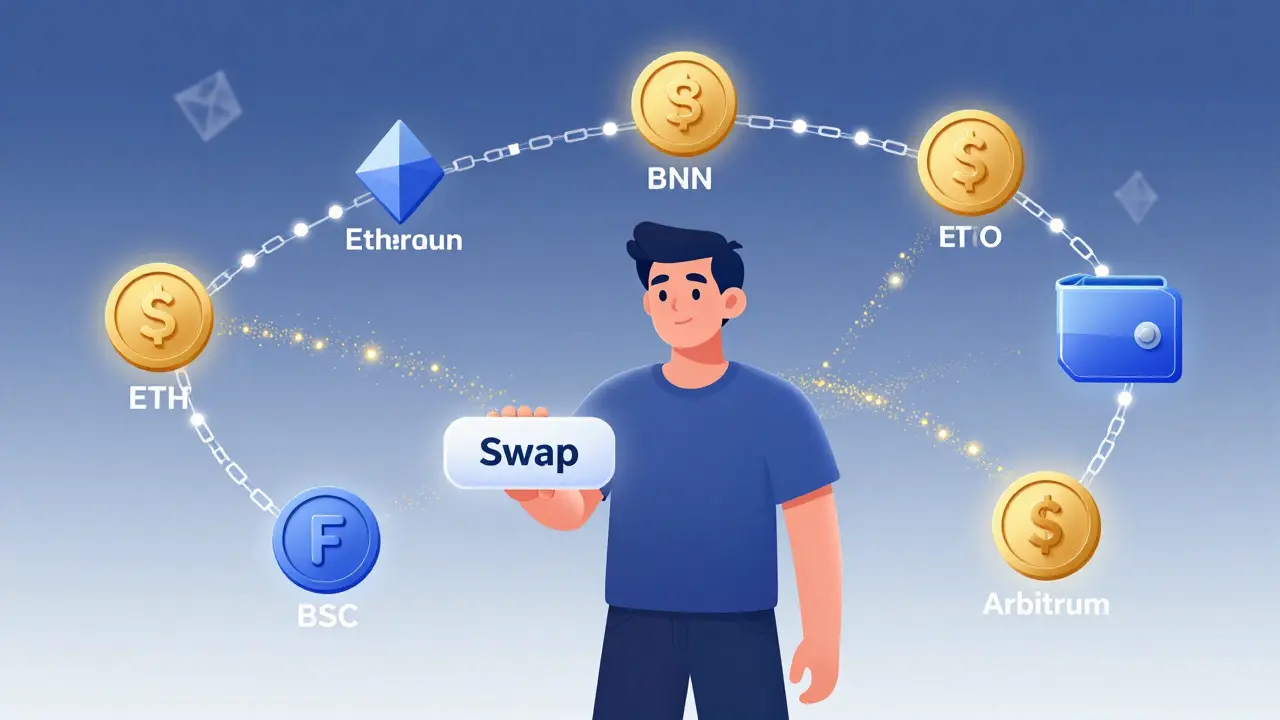

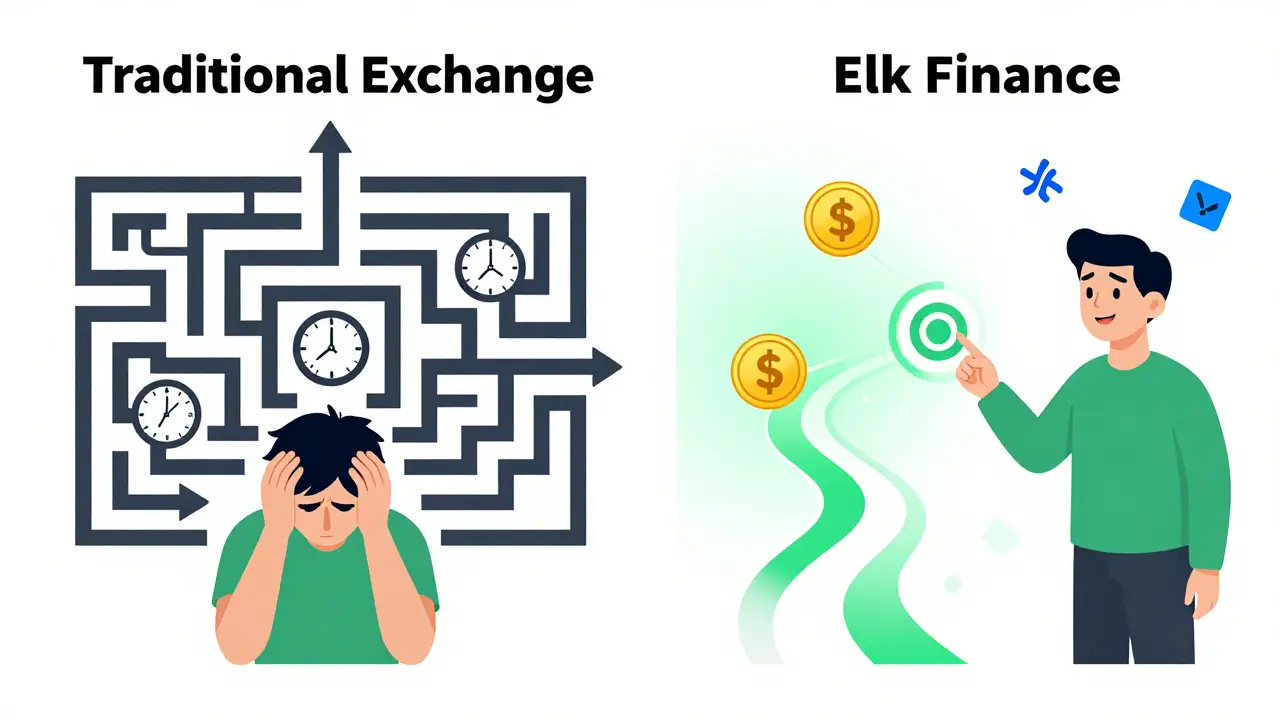
Most crypto users know the frustration: you have ETH on Ethereum, but you need BNB on Binance Smart Chain. You open a centralized exchange, send your ETH, wait for confirmation, pay withdrawal fees, then deposit again on BSC. It’s slow, expensive, and risky. Elk Finance cuts through all that. It’s not another DEX that just trades tokens on one chain. It’s built to move crypto between chains-fast, cheap, and without giving up control of your keys.
What Elk Finance Actually Does
Elk Finance isn’t trying to compete with Binance or Coinbase. It doesn’t offer margin trading, futures, or leverage. Instead, it solves one real problem: cross-chain liquidity. If you’re holding tokens on Polygon, Arbitrum, or Ethereum, and you want to use them on BSC, Elk Finance lets you swap directly between those networks in a single step. No wrapping, no bridging through third parties, no waiting 20 minutes for a transaction to clear.
The platform works as a decentralized exchange (DEX) using automated market makers (AMMs), just like Uniswap or PancakeSwap. But instead of locking liquidity on one blockchain, Elk Finance pools assets across 14 different chains-including Ethereum, BSC, Polygon, Arbitrum, and others. This means when you swap USDC from Ethereum to BNB on BSC, Elk Finance routes the trade through its interconnected liquidity network, not through a centralized bridge.
That’s the core idea: one click, multiple chains. The platform’s slogan-“as straightforward as 1, 2, 3”-isn’t marketing fluff. It’s backed by how the interface works. You pick your token, pick your destination chain, enter the amount, and confirm. The rest happens automatically.
How It Works on Binance Smart Chain
Elk Finance’s integration with BSC is one of its strongest features. BSC users get low gas fees and fast confirmations, which pairs well with Elk’s goal of seamless swaps. To use it, you connect your Web3 wallet-MetaMask, Trust Wallet, or any BSC-compatible wallet-and select the cross-chain swap option. The interface clearly shows the source chain, destination chain, estimated fees, and the amount you’ll receive.
Unlike centralized exchanges, Elk Finance is non-custodial. Your funds never leave your wallet. The smart contracts handle the swap, and you retain full control. This reduces the risk of hacks or exchange freezes, but it also means you’re responsible for your own security. Always double-check contract addresses and never share your seed phrase.
Transaction costs are kept low because Elk Finance optimizes routing across its multi-chain pools. You’re not paying high gas fees on Ethereum just to move to BSC. Instead, the system finds the cheapest path-sometimes using a combination of chains as intermediaries-to minimize your total cost.
The ELK Token: More Than Just a Utility Token
The native token of Elk Finance is ELK. It’s used for governance, paying reduced swap fees, and earning rewards. But the most interesting part? Elk Finance promises that liquidity providers (LPs) won’t lose money.
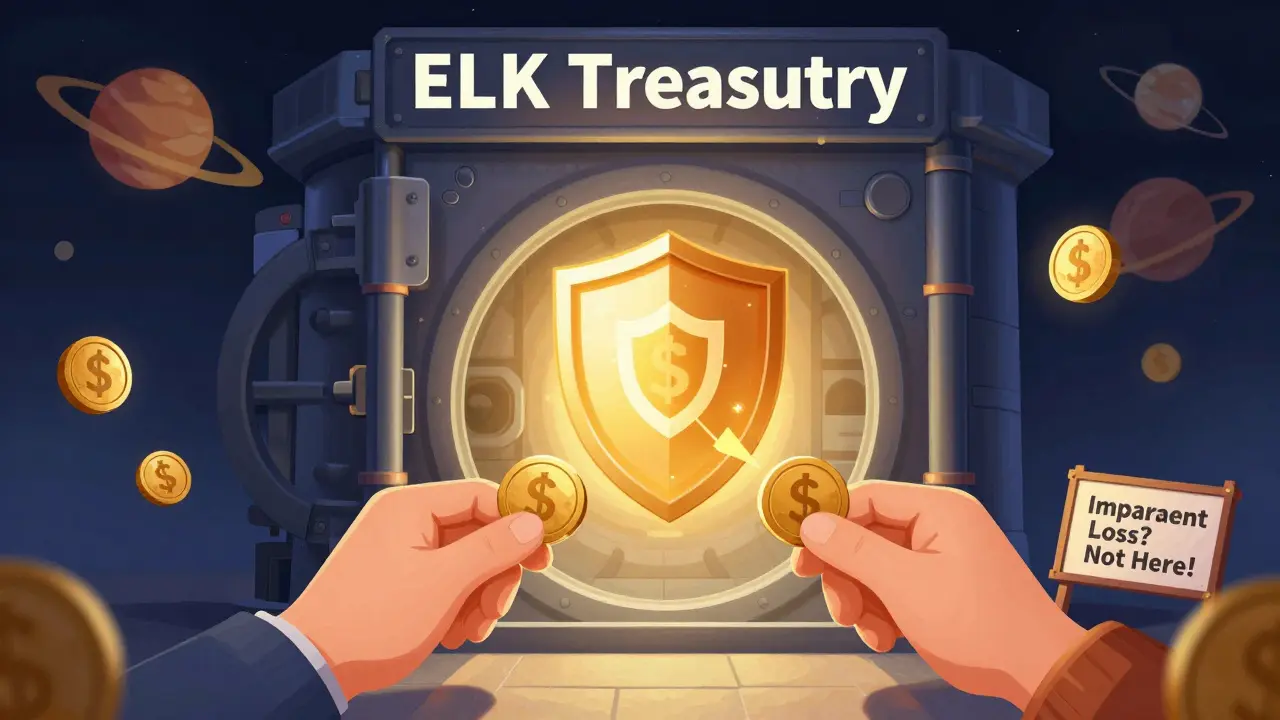
Most DeFi platforms offer yield farming, but impermanent loss is a real risk. If the price of one token in a pair moves sharply, you can end up with less value than you started with-even if the pool earns fees. Elk Finance claims to eliminate this risk. According to their model, if the value of your LP position drops below your initial deposit, the protocol covers the difference using its treasury. This isn’t a common feature. It’s a bold move designed to attract long-term liquidity.
Is it sustainable? That’s the big question. The mechanism isn’t fully documented in public audits, and no third-party security review has been cited in available sources. But the concept alone has drawn attention. If it works as described, it could become a major incentive for liquidity providers who’ve been burned before.
On the market side, ELK has shown some resilience. As of early February 2026, the token was down 7.3% over the past week. That sounds bad-until you compare it to the broader crypto market, which dropped 9.4% in the same period. Elk Finance’s token held up better than most, suggesting some underlying confidence in its utility.
How Elk Finance Compares to Alternatives
Let’s be clear: Elk Finance isn’t for traders looking for leverage or complex derivatives. If you want to go long on Bitcoin with 25x leverage, you won’t find that here. That’s Aboard Exchange’s territory. If you’re looking for yield optimization on a single chain, Convex Finance does that better.
Elk Finance’s only real competition is other cross-chain platforms like Multichain or LayerZero. But where those platforms focus on bridging, Elk Finance focuses on swapping. Bridges move assets from one chain to another. Elk Finance swaps them-immediately, with liquidity pooled across chains.
Here’s how it stacks up:
| Feature | Elk Finance | Aboard Exchange | PancakeSwap | Multichain |
|---|---|---|---|---|
| Supported Chains | 14+ (including BSC, Ethereum, Polygon) | 5 (BSC-focused) | 1 (BSC only) | 20+ |
| Trading Type | Spot swaps only | Perpetual futures (up to 25x) | Spot swaps | Token bridging |
| Non-Custodial | Yes | Yes | Yes | Yes |
| Liquidity Provider Protection | Yes (guarantees minimum return) | No | No | No |
| Fee Structure | Low, optimized routing | High for leverage | Standard DEX fee | Bridge fees apply |
Elk Finance wins on simplicity and safety for users who just want to move tokens between chains. It loses on trading features. But if your goal is to use crypto across networks without hassle, it’s one of the cleanest options out there.
Who Is It For?
Elk Finance isn’t for beginners who don’t know what a wallet is. But it’s also not for advanced DeFi traders who need complex strategies. It’s for the middle ground: people who hold crypto on multiple chains and want to use it without jumping through hoops.
Think of you:
- You’re staking on Polygon but need BNB to join a new BSC launchpad.
- You have USDC on Ethereum and want to buy a token on BSC without converting to fiat first.
- You’re tired of paying $15 in gas to bridge tokens between networks.
If that sounds like you, Elk Finance saves you time, money, and stress. It’s designed for users who care about efficiency, not speculation.
Limitations and Risks
Nothing’s perfect. Elk Finance has gaps.
- No advanced trading-no limit orders, no stop-losses, no leverage. It’s a swap tool, not a trading platform.
- Minimal user reviews-Slashdot, FxVerify, and SourceForge have pages for it, but there are no public ratings or testimonials. That’s unusual for a platform this active.
- Security unknowns-No public audit reports from CertiK, Hacken, or PeckShield are cited. The protocol claims to be secure, but without third-party verification, users must trust the code.
- Price predictions are mixed-WalletInvestor calls ELK a “poor investment” with a projected drop to $0.01962. CoinGecko shows it’s holding up better than the market. One suggests tokenomics are flawed; the other says utility is holding strong.
These aren’t dealbreakers, but they’re red flags you should consider. If you’re using Elk Finance for swaps, the risks are manageable. If you’re buying ELK as an investment, tread carefully.
Final Verdict
Elk Finance isn’t trying to be everything. It’s trying to be the best tool for one job: moving crypto between blockchains without pain. And for that, it delivers.
If you’re on BSC and need to swap from Ethereum, Polygon, or Arbitrum, Elk Finance is one of the few platforms that makes it feel effortless. The liquidity protection model is innovative-if it works as promised, it could change how people think about DeFi liquidity. The token’s relative stability during market drops suggests real usage, not just hype.
But don’t use it for trading. Don’t use it if you need customer support. Don’t use it if you’re uncomfortable with un-audited smart contracts.
Use it if you want to move crypto between chains, fast, cheap, and without handing over your keys. That’s its sweet spot. And right now, very few platforms nail it better.
Is Elk Finance safe to use?
Elk Finance is non-custodial, meaning you keep control of your funds. But there’s no public audit report from a major security firm like CertiK or Hacken. That’s a risk. Use it only with funds you’re comfortable losing, and always verify contract addresses before interacting.
Can I trade futures on Elk Finance?
No. Elk Finance only supports spot swaps between tokens on different blockchains. It doesn’t offer leverage, margin trading, or perpetual contracts. If you want those features, look at Aboard Exchange or Bybit instead.
Does Elk Finance have a mobile app?
No official mobile app exists. You can access Elk Finance through your Web3 wallet’s built-in browser on mobile-like MetaMask or Trust Wallet. The interface works fine on mobile, but there’s no dedicated app with push notifications or extra features.
How do I get started with Elk Finance on BSC?
First, install a BSC-compatible wallet like MetaMask or Trust Wallet. Switch your network to Binance Smart Chain. Then, go to the official Elk Finance website, connect your wallet, select your source and destination chains, choose the tokens you want to swap, and confirm the transaction. Gas fees are low, and swaps happen in seconds.
Is ELK a good long-term investment?
It depends. WalletInvestor predicts ELK will fall to $0.01962, calling it a poor investment. But CoinGecko data shows it’s outperforming the broader market. The token’s value is tied to platform usage. If cross-chain swaps grow in popularity, ELK could rise. If the liquidity protection model fails, it could drop. Don’t invest based on price predictions alone.
Next Steps
If you’re ready to try Elk Finance, start small. Swap $10 worth of USDT from Ethereum to BSC. See how fast it goes. Check the final amount you receive. Compare it to what you’d pay on a centralized exchange. If it’s faster and cheaper, you’ve found a tool worth keeping in your crypto toolkit.
Keep an eye on whether Elk Finance releases an audit report. Watch for updates on new chain integrations. And if you’re a liquidity provider, monitor how the protocol handles impermanent loss protection. That’s where the real innovation is.
Elk Finance isn’t the flashiest platform out there. But in a world of crypto chaos, sometimes the quietest tools are the most useful.

Comments (8)

- AJITH AERO
- February 18, 2026 AT 18:42 PM
So let me get this straight - you’re telling me this platform just swaps tokens between chains without me having to cry into my wallet? Wow. I’m so impressed. Next they’ll invent a toaster that doesn’t burn bread. Guess I’ll put my $5000 in ELK now. 😴

- Angela Henderson
- February 19, 2026 AT 20:14 PM
I mean, I’ve been using crypto for like, five years now, and honestly, the thing that kills me the most is how every single platform makes you jump through a million hoops just to move a token from one chain to another. Like, I get it, blockchain is supposed to be decentralized, but why does it feel like I’m playing a game of telephone with my own money? Elk Finance just... makes sense. It’s not flashy, it doesn’t scream ‘I’m the future!’ - it just quietly does the thing that actually matters. And honestly? That’s kinda beautiful.

- Rajib Hossaim
- February 21, 2026 AT 12:48 PM
While the concept of cross-chain liquidity aggregation is undeniably innovative, one must exercise due diligence before engaging with protocols that lack publicly verifiable smart contract audits. The assertion that impermanent loss is mitigated via treasury-backed guarantees is theoretically compelling, yet it introduces a centralized point of failure that contradicts the foundational ethos of decentralization. One must weigh convenience against systemic risk.

- Jenn Estes
- February 22, 2026 AT 20:00 PM
Oh, so now we’re supposed to be impressed because they don’t have futures? Wow. Groundbreaking. You know what else doesn’t have futures? My ex’s emotional intelligence. At least she was honest about it. This platform is basically a glorified ATM for people too lazy to learn how bridges work. And ‘liquidity protection’? Cute. Until it’s not.

- Chris Thomas
- February 24, 2026 AT 17:12 PM
Look, if you think Elk Finance is doing anything novel, you’ve clearly never heard of LayerZero’s ZRO token or Synapse’s cross-chain liquidity pools. This is just a rebrand of existing omnichain AMM architectures with a marketing gimmick - ‘impermanent loss protection’ is just a liquidity insurance pool with a fancy name. And don’t get me started on the tokenomics. ELK’s utility is functionally identical to UNI’s - but without the liquidity mining incentives or governance weight. You’re not a pioneer. You’re a repackage. And the fact that you’re not audited by CertiK? That’s not a risk. That’s a death sentence.

- Nova Meristiana
- February 25, 2026 AT 14:25 PM
Elk Finance? More like Elk Fiasco. 🤦♀️ I’ve seen more security in a crypto meme coin with a dog logo. ‘No audit’? ‘No app’? ‘No customer support’? Honey, I’m not even mad - I’m just impressed you’re still alive. Also, ‘14 chains’? Lol. I bet 12 of them are dead. And ‘liquidity protection’? That’s just a Ponzi with better CSS. 🙃

- Aileen Rothstein
- February 27, 2026 AT 11:50 AM
I actually tried this out with $10 worth of USDT from Ethereum to BSC. It took 12 seconds. The fee was $0.08. I got every single cent back. No slippage. No drama. No ‘please wait for 3 confirmations’ nonsense. I’ve used bridges that cost me $15 and took 20 minutes. This? This is what crypto should feel like. I’m not saying it’s perfect - I still wish there was an app - but for what it does? It works. And sometimes, that’s all you need.

- JJ White
- February 28, 2026 AT 05:08 AM
YOU THINK THIS IS A REVOLUTION? IT’S A TRAP. A SLOW, SILENT, BEAUTIFULLY DESIGNED TRAP. THEY’RE NOT SOLVING CROSS-CHAIN LIQUIDITY - THEY’RE BUILDING A WORLDS’ FIRST DEFI SUICIDE PACT. ‘IMPERMANENT LOSS PROTECTION’? THAT’S NOT A FEATURE - IT’S A LIE. THEY’RE USING YOUR LIQUIDITY TO FUND THEIR OWN TREASURY, AND WHEN THE MARKET CRASHES - AND IT WILL - THEY’LL BE THE ONES WITH THE GOLDEN PARACHUTE WHILE YOU’RE LEFT WITH A WALLET FULL OF ZEROES. AND THE WORST PART? YOU’LL BE SMILING WHILE IT HAPPENS BECAUSE ‘IT WAS SO EASY.’ I’M NOT JUST WARNED - I’M HAUNTED. 💔🔥