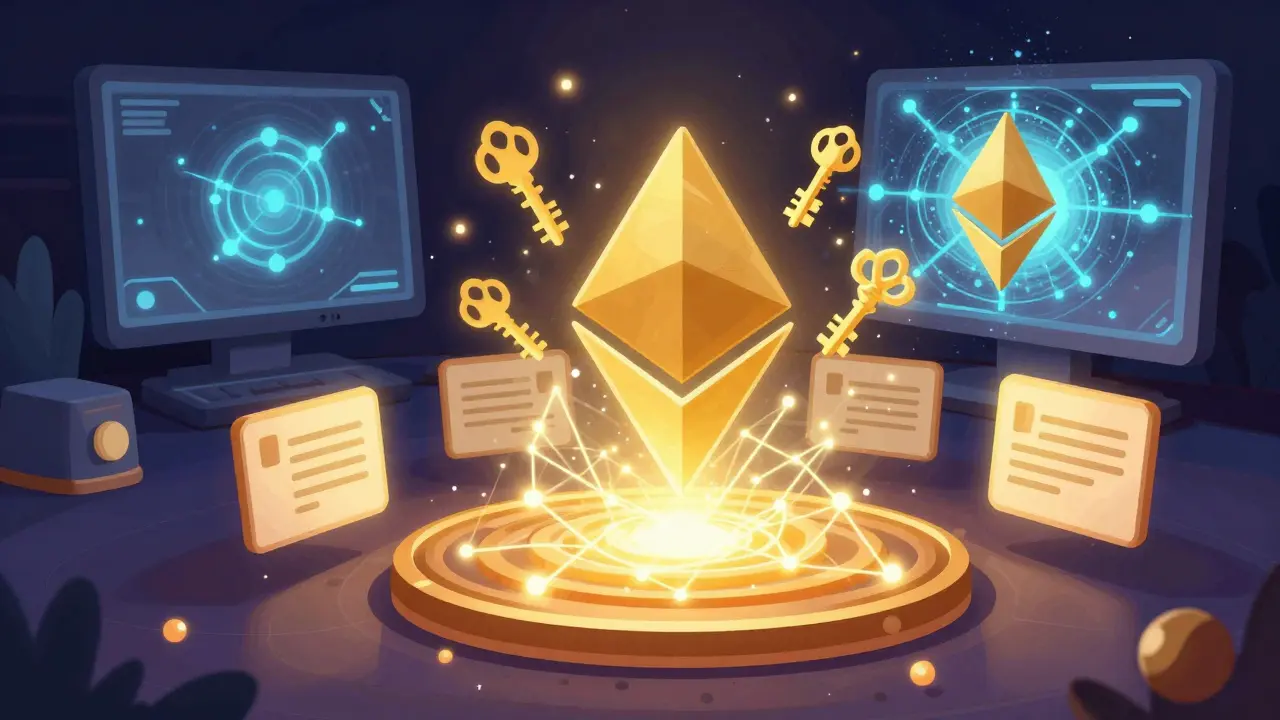

AME Chain (AME) isn’t just another cryptocurrency. It’s one of the first blockchains built from the ground up to survive quantum computing-a threat most crypto projects ignore entirely. While Bitcoin and Ethereum rely on classical encryption that could be broken by future quantum machines, AME Chain uses physics-based security that’s mathematically impossible to crack, even with a quantum computer. That’s not marketing hype. It’s built into every transaction, every smart contract, and every wallet address.
How AME Chain Works: Quantum Security at the Core
Most blockchains use pseudo-random numbers (PRN) to generate keys and signatures. These look random but are actually predictable if you know the algorithm. Quantum computers can exploit that predictability. AME Chain replaces PRN with Quantum Random Numbers (QRN) generated by a laser-based quantum source. This means every cryptographic operation-signing a transaction, hashing a block, or validating a smart contract-uses true randomness from quantum physics. No algorithm. No backdoor. Just nature’s randomness.
The platform runs on the Ethereum Virtual Machine (EVM), so any developer who’s built on Ethereum can deploy their smart contracts on AME Chain without rewriting a single line of code. This compatibility is critical. It means AME Chain doesn’t need to rebuild the entire DeFi ecosystem-it just adds a layer of quantum-proof security on top of what already exists.
Proof-of-Authority: Who Runs the Network?
Unlike Bitcoin’s energy-heavy Proof-of-Work or Ethereum’s Proof-of-Stake, AME Chain uses Proof-of-Authority (PoA). A small group of trusted validators-vetted and identified by real-world identities-handle block production and transaction validation. This makes the network faster and cheaper than PoW chains. It also reduces the risk of 51% attacks because the validators are accountable, not anonymous miners.
PoA isn’t perfect. It’s less decentralized than other models. But for a project focused on security over mass participation, it makes sense. The goal isn’t to have millions of nodes. It’s to have a small, reliable group that can respond instantly to threats, update protocols, and keep the network running smoothly under pressure.
Tokenomics: Where Did All the AME Go?
There are exactly 1 billion AME tokens in existence. All of them. No more will ever be created. As of March 2026, 999,998,302 tokens are in circulation. That’s nearly 100% of the total supply already out in the market.
Here’s how they’re distributed:
- 37.6% - Company reserves and strategic partnerships
- 32% - Community grants (funding for developers, researchers, and projects building on AME)
- 12.8% - Founding team (locked and vested over time)
- 9.6% - Staking rewards
- 8% - Development initiatives
The biggest chunk-over one-third-goes to community grants. That’s unusual. Most projects hoard tokens for the team or investors. AME Chain is betting that the future of the network lies in what developers build on it. If you’re a builder, there’s a real chance you could get funding to create something on AME Chain.

Market Performance: From Market Performance: From $0.12 to $0.0005
.12 to Market Performance: From $0.12 to $0.0005
.0005
AME Chain had a wild ride. It launched in 2020 at $0.0075. By late 2021, it hit an all-time high of $0.123509. That’s a 16.5x return in under two years. But since then, the price has collapsed.
As of March 2026, AME trades around $0.000546. That’s a 99.6% drop from its peak. Trading volume is low-just $63,800 in 24 hours-and almost all of it happens on MEXC Global. The market cap sits at $545,700, making it the #2139 cryptocurrency by market value.
Why the crash? Several reasons. First, the project never broke into mainstream crypto news. Second, quantum computing threats are still theoretical-most investors don’t see the urgency. Third, the rebrand from AMEPAY to AME Chain confused early adopters. Many thought it was a payment coin. Now it’s a security platform. The messaging took time to catch up.
Where Can You Buy AME Chain?
AME Chain is listed on two major exchanges: MEXC Global and LATOKEN. MEXC handles nearly all trading volume. The main trading pair is AME/USDT. You can also trade AME futures if you’re comfortable with leverage.
To buy AME, you’ll need to:
- Create an account on MEXC Global
- Deposit USDT or another supported stablecoin
- Search for AME/USDT in the trading section
- Place a market or limit order
There’s no official wallet from AME Chain. But since it’s EVM-compatible, any wallet that supports Ethereum-like MetaMask, Trust Wallet, or Coinbase Wallet-works. Just add the AME Chain network manually using its contract address: 0x12513335ffd5dafc2334e98625d27c1ca84bff86.
Is AME Chain Worth It?
There are two ways to look at AME Chain.
If you’re an investor looking for quick returns, the answer is likely no. The market is tiny. Liquidity is low. Price swings are extreme. It’s not a coin you’d hold for a few months hoping for a pump.
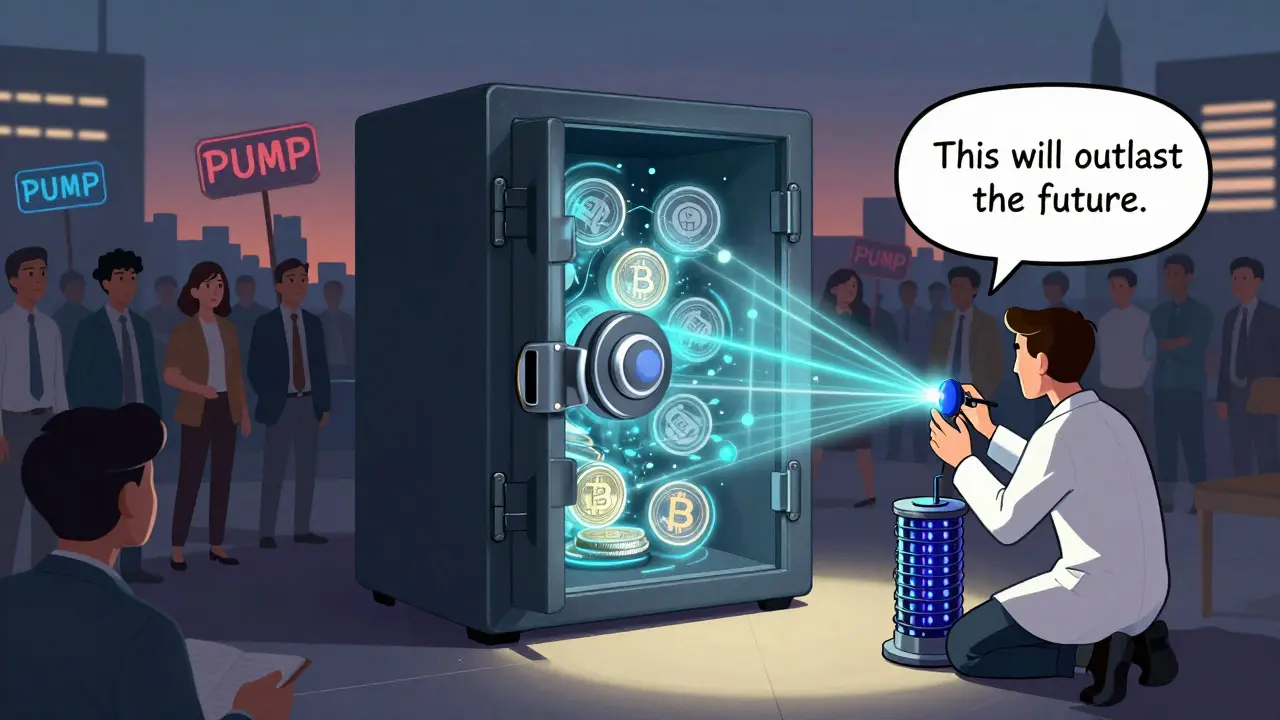
If you’re a technologist who believes quantum computing will break current cryptography within the next 10-15 years, then AME Chain might be one of the few projects actually preparing for that future. It’s not just talking about quantum resistance-it’s building it. No other blockchain has implemented quantum random number generation at the protocol level.
Think of it like buying a fireproof safe in 1980. Back then, most people thought fires were rare. But those who invested in fireproofing did so because they understood the risk. AME Chain is the same. It’s betting on a future most people still think is science fiction.
What’s Next for AME Chain?
There’s no official roadmap posted publicly as of March 2026. But the fact that it’s still trading, still updating its network, and still funding community grants suggests active development. The team has quietly partnered with quantum research labs and cybersecurity firms to test real-world quantum attack simulations on their blockchain.
If they succeed, AME Chain could become the go-to platform for governments, financial institutions, and defense contractors who need long-term cryptographic security. That’s not a small market. It’s a trillion-dollar one.
Right now, AME Chain is a niche project with a huge idea. It’s not popular. It’s not liquid. But it might be the only crypto project designed to outlive the next technological revolution.
Is AME Chain a good investment?
It depends on your goals. If you want quick profits, AME Chain is too volatile and illiquid. If you believe quantum computing will break current encryption and want to back a project that’s already solving that problem, then AME Chain is one of the few serious options. It’s a high-risk, long-term bet on future-proof security.
Can I stake AME tokens?
Yes, 9.6% of the total supply is reserved for staking rewards. However, there is no official staking platform yet. Staking functionality is expected to be rolled out through community-funded projects or partner platforms. Keep an eye on official AME Chain announcements for updates.
Why did AME Chain rebrand from AMEPAY?
The original name, AMEPAY, suggested a payment-focused coin. But the team realized their real innovation wasn’t payments-it was quantum security. The rebrand to AME Chain was meant to clarify their mission: building a blockchain that’s immune to quantum attacks, not just another payment system.
Is AME Chain compatible with MetaMask?
Yes. Since AME Chain is EVM-compatible, you can add it to MetaMask manually. Use the network parameters: Chain ID 12513335, RPC URL https://rpc.amechain.io, symbol AME, and block explorer https://explorer.amechain.io. The contract address is 0x12513335ffd5dafc2334e98625d27c1ca84bff86.
What makes AME Chain different from other quantum blockchains?
Most quantum-resistant blockchains use post-quantum cryptography algorithms-mathematical changes to encryption. AME Chain uses quantum randomness generated by physical laser systems. It doesn’t just resist quantum attacks-it uses quantum physics to make every signature fundamentally unpredictable. This is a deeper, more robust layer of security than algorithmic fixes.
Comments (5)

- Patty Atima
- March 21, 2026 AT 00:01 AM
Honestly? I’m just here because I staked my last $50 on this and now I’m emotionally attached. But hey, if quantum computers ever break Bitcoin, at least I’ll have a front-row seat. 🤷♀️

- Lucy de Gruchy
- March 22, 2026 AT 11:39 AM
Quantum security? More like quantum snake oil. This isn’t physics-it’s a marketing stunt wrapped in jargon. If they’re using "laser-based quantum sources," why isn’t the entire network running in a cryogenic lab? And why is the market cap lower than my coffee budget? This isn’t innovation. It’s a Ponzi with a whitepaper.

- Carol Lueneburg
- March 22, 2026 AT 15:12 PM
I love this so much 🥹 I’m not even a crypto person but this idea? Pure genius. Imagine if we could build something that outlives technology itself. Like a digital time capsule that laughs at AI, quantum computers, and even the next asteroid. The fact that they’re funding devs instead of just hoarding tokens? That’s the kind of vision I want to believe in. I just bought my first AME and I’m not looking back. 🌌💎

- Henrique Lyma
- March 23, 2026 AT 06:38 AM
The entire premise rests on a speculative timeline where quantum computing becomes a real threat before 2035 which is itself a massive assumption. Even if we accept that, the technical implementation is laughably under-documented. No peer-reviewed papers. No open-source quantum RNG module. Just a vague claim about "laser-based systems" and an EVM wrapper. The tokenomics are interesting but irrelevant when the core innovation is neither verifiable nor auditable. This isn’t a blockchain-it’s a speculative essay with a ticker symbol.

- Steph Andrews
- March 25, 2026 AT 01:24 AM
I think this is actually really cool even if no one else gets it. Like imagine being the person who said "hey what if we just used real randomness" instead of pretending math can outsmart nature. The price doesn’t matter. The idea does. And honestly? If quantum computers ever do break everything else, AME will be the one people whisper about like they do about Bitcoin in 2010
Post-Comment
Categories
Popular Articles
Aug 30 2026

Nov 10 2025