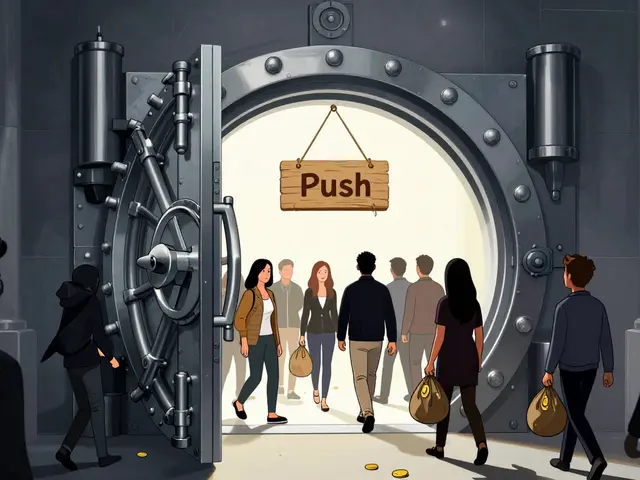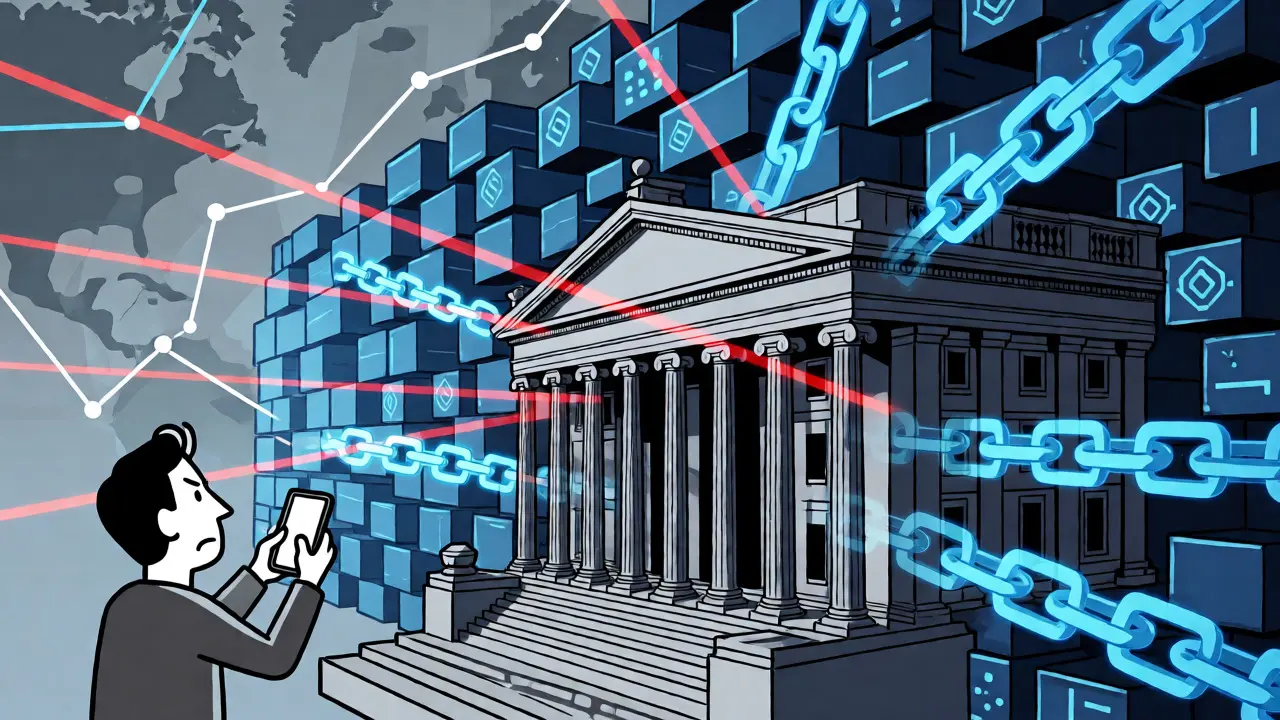

Imagine trying to buy a cup of coffee with money that the entire global banking system refuses to touch. That is essentially the reality for many Iranian users trying to access mainstream cryptocurrency exchanges today. The Office of Foreign Assets Control (OFAC), a branch of the U.S. Treasury Department, has spent the last decade building a high-tech wall around digital assets linked to Iran. This isn't just about blocking a few websites; it’s a complex game of cat and mouse involving blockchain analytics, shadow banking networks, and billions of dollars in oil proceeds.
If you are a trader, a compliance officer, or just someone curious about how geopolitics impacts your portfolio, understanding these restrictions is non-negotiable. Why? Because one wrong click on an exchange can freeze your funds, and one missed check by an exchange can result in massive fines. Let's break down exactly how OFAC targets Iranian crypto access, what happens when rules are broken, and where the industry is heading as we move through late 2026.
The Evolution of Digital Sanctions
Back in 2015, when OFAC first established its cyber-related sanctions program, most people thought of email servers and malware when they heard "cyber threats." They didn't think of Bitcoin addresses. Fast forward to November 2018, and everything changed. OFAC imposed sanctions on two Iranian individuals for facilitating ransomware payments, marking the first time the Treasury published specific digital currency addresses linked to sanctioned entities. This was a wake-up call. It signaled that blockchain transparency, often touted as a benefit for privacy advocates, was actually a powerful tool for law enforcement.
The strategy shifted from vague warnings to precise targeting. By designating specific wallet addresses, OFAC gave exchanges a clear list of "bad actors" to screen against. But this also sparked a migration. As soon as major platforms like Coinbase or Binance started blocking Iranian IPs and screening wallets, users began moving toward privacy-focused coins like Monero or decentralized exchanges (DEXs) where identity checks are looser. The cat-and-mouse game had officially begun.
How OFAC Targets Iranian Networks Today
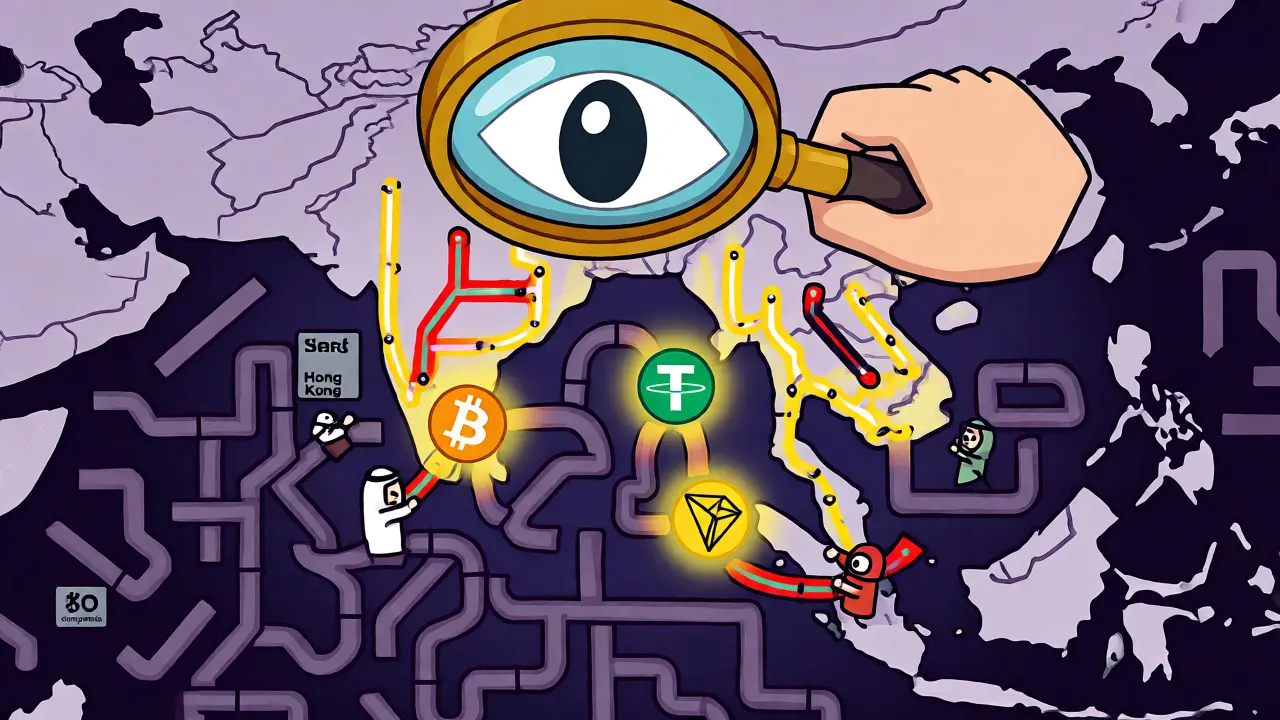
Today, the approach is far more sophisticated than simply blocking an IP address. In September 2025, OFAC dismantled a $600 million shadow banking network used by Iran to launder oil proceeds. This wasn't just a single bank; it was a web of front companies spanning Hong Kong, the UAE, and China. These entities used cryptocurrency to bypass traditional SWIFT transfers, which are heavily monitored by Western banks.
A key part of this enforcement involves the Islamic Revolutionary Guard Corps-Qods Force (IRGC-QF). When OFAC designates an entity associated with the IRGC, every transaction touching their wallets becomes suspect. For example, in recent actions, OFAC listed five specific cryptocurrency addresses-two on Ethereum and three on Tron-linked to facilitators like Arash Estaki Alivand. These addresses held Bitcoin, Ether, Tether, and Tron, showing that Iranian operators diversify their holdings to avoid detection. If your exchange interacts with one of these addresses, even indirectly, you could be flagged for secondary sanctions.
The Compliance Trap: Exchanges Under Fire
You might wonder why major exchanges are so strict. It’s not just bureaucracy; it’s survival. Take ShapeShift AG, a well-known name in the early days of crypto. In September 2025, ShapeShift agreed to pay $750,000 to settle potential civil liability for sanctions violations. Between 2019 and 2021, the platform allowed users from Iran, Cuba, Sudan, and Syria to trade approximately $12.5 million worth of cryptocurrency without adequate screening. That might seem small compared to global trading volumes, but for OFAC, it was proof that the exchange failed to implement basic risk-based controls.
This case set a precedent. It showed that "we didn't know" is no longer a valid defense. Exchanges must now use real-time screening tools to check every wallet address against the Specially Designated Nationals (SDN) list. If a user from Tehran tries to deposit USDT into a compliant exchange, the system checks the source wallet. If that wallet has interacted with a sanctioned address, the deposit gets blocked, or worse, frozen.
The Rise of Successor Exchanges and Evasion Tactics
Sanctions create incentives for innovation-in evasion, that is. When the U.S. Secret Service cracked down on Garantex in March 2025, the operators didn't just shut down. They immediately launched Grinex, a new platform designed to continue serving sanctioned customers. Promotional materials for Grinex openly admitted it was formed to bypass asset freezes. Customers regained access to their funds through a ruble-backed token called A7A5, issued by a firm in Kyrgyzstan.
This pattern is common. When one door closes, another opens in a jurisdiction with less regulatory oversight. Iranian users often migrate to exchanges based in Dubai, Turkey, or Southeast Asia. However, this comes at a cost. These alternative platforms often have lower liquidity, higher fees, and less robust security. You’re trading convenience and safety for access. Plus, if OFAC decides to target the successor exchange, you could find yourself holding tokens on a platform that suddenly disappears or gets blacklisted.
Practical Impact on Iranian Users
For the average Iranian citizen, accessing global crypto markets is a logistical nightmare. Major centralized exchanges geo-block Iranian IPs. Even if you use a VPN, your KYC (Know Your Customer) documents will likely flag you. So, what do they do? Many turn to peer-to-peer (P2P) trading. Platforms like LocalBitcoins (historically) or newer P2P networks allow users to trade directly with each other. Here, the risk shifts from the exchange to the individual. If you sell Bitcoin to someone whose funds are tainted by sanctions, you might inadvertently become part of a laundering chain.
Another workaround is using decentralized finance (DeFi) protocols. Since DeFi runs on smart contracts rather than centralized custodians, it’s harder to block. However, interfaces like Uniswap or Aave often integrate with fiat on-ramps that *are* regulated. So, while you can swap tokens freely, getting that money out into dollars or euros requires crossing a regulated bridge, where OFAC’s reach is longest.

Key Entities and Their Roles
To understand the landscape, you need to know who is playing which role. Here is a breakdown of the main players involved in the current sanctions environment:
| Entity Type | Example/Name | Role in Sanctions Context |
|---|---|---|
| Regulator | OFAC | Enforces economic sanctions; maintains SDN list; blocks transactions. |
| Target Entity | IRGC-QF | Military wing of Iran; primary beneficiary of oil revenue laundering via crypto. |
| Compliance Platform | Chainalysis | Blockchain analytics firm providing tools for exchanges to screen wallets. |
| Evasion Vehicle | Grinex | Successor exchange created after Garantex shutdown to serve sanctioned users. |
| Payment Method | USDT (Tether) | Stablecoin frequently used for cross-border transfers due to low volatility. |
What This Means for Global Investors
Even if you don’t live in Iran, these sanctions affect you. First, there is the risk of "tainted" coins. If you buy Bitcoin from a peer who received it from a sanctioned entity, your wallet history might show interactions with blocked addresses. While rare for retail investors, it’s a growing concern for institutional buyers who demand clean provenance. Second, regulatory pressure is increasing globally. The EU and UK are aligning more closely with OFAC standards, meaning restrictions aren't just a U.S. problem anymore-they're becoming a global norm.
Furthermore, the technology used to enforce these sanctions is improving. Artificial intelligence and machine learning are now standard tools for analyzing transaction patterns. What looked like random noise on the blockchain five years ago is now clearly visible as structured movement of funds. This means evasion tactics that worked in 2020 might fail in 2026.
Looking Ahead: The Future of Crypto Sanctions
We are entering an era of hyper-surveillance in the crypto space. Privacy coins face mounting pressure as regulators demand visibility. Decentralized exchanges are being forced to add optional KYC layers to remain accessible to fiat currencies. For Iranian users, the dream of seamless, borderless financial freedom remains elusive. The gap between the ideological promise of crypto and the geopolitical reality of sanctions continues to widen.
Expect more designations of specific wallet addresses rather than just whole companies. Expect more scrutiny on stablecoin issuers, who act as the gatekeepers between crypto and traditional finance. And expect continued innovation in evasion, particularly through multi-hop transactions across different blockchains to obscure the trail.
Can Iranians still use cryptocurrency?
Yes, but with significant limitations. They cannot easily access major centralized exchanges like Coinbase or Kraken due to geo-blocking and KYC requirements. Instead, they rely on peer-to-peer trades, decentralized exchanges, or smaller regional platforms that may have laxer compliance standards. However, converting crypto back into local currency or international fiat remains difficult due to banking restrictions.
What happens if I send crypto to a sanctioned Iranian wallet?
If you send funds to a wallet address listed on OFAC's SDN list, your exchange may freeze your account pending investigation. In severe cases, the funds could be confiscated. For individual traders, this usually results in a temporary hold and a request for explanation, but repeated interactions can lead to permanent bans from compliant platforms.
Why did ShapeShift get fined?
ShapeShift paid $750,000 because it failed to prevent users from sanctioned countries, including Iran, from trading on its platform between 2019 and 2021. The exchange lacked sufficient screening mechanisms to identify and block these users, violating OFAC regulations despite processing millions of dollars in transactions.
Are all crypto exchanges banned in Iran?
No, not all. International exchanges generally ban Iranian users to comply with U.S. sanctions. However, domestic Iranian exchanges operate locally, allowing citizens to trade crypto within the country. Additionally, some exchanges in jurisdictions like Turkey or the UAE may accept Iranian users, though they face increasing pressure to tighten compliance.
How does OFAC track crypto transactions?
OFAC uses blockchain analytics firms like Chainalysis to monitor public ledgers. They look for patterns of movement, clustering of addresses, and interactions with known sanctioned entities. By publishing specific wallet addresses, they create a database that exchanges use to automatically flag and block suspicious transactions in real-time.

Comments (6)

- Alex DeVito
- November 15, 2026 AT 04:54 AM
It really makes you stop and think about the fundamental nature of money when you read stuff like this, doesn't it? We were sold this whole dream that crypto was going to be this borderless, permissionless utopia where a kid in Tehran could buy coffee from a vendor in New York without any middleman sticking their nose in the transaction, but here we are seeing OFAC build these digital walls that are somehow more rigid than physical borders. It’s almost poetic in a tragic sort of way how the transparency of the blockchain, which was supposed to be our shield against corruption, has actually become the ultimate surveillance tool for the state. I mean, look at the ShapeShift fine; it wasn't even about malicious intent, it was just about failing to keep up with the bureaucratic machinery, and now every single exchange is terrified of making one wrong move because the penalties are so disproportionate to the actual risk. The cat-and-mouse game isn't just between Iran and the US anymore, it's between human ingenuity and algorithmic compliance, and honestly, I’m not sure who wins that battle in the long run because every time someone finds a loophole like Grinex popping up after Garantex dies, the regulators just tighten the noose around the next layer of privacy coins or DeFi protocols. It feels like we’re watching the death of financial anonymity in real-time, replaced by a world where your wallet address carries a history as heavy as your credit score, and if that history has a speck of dust on it, you might find yourself locked out of the global economy entirely.

- Jen Spain
- November 16, 2026 AT 02:53 AM
this is exactly what i’ve been trying to explain to my friends who still think buying bitcoin is some rebellious act against the system!! 😭😭 it’s not rebellion it’s just moving the surveillance to a different ledger lol
i used to try trading from abroad and the geo-blocking is SO frustrating like i’d spend hours setting up vpns only to get flagged for kyc anyway... it’s exhausting being an 'invisible' user in a system designed to see everything 🙄
the part about monero migration hit hard too cause yeah everyone ran there but then exchanges started delisting them left and right so now you’re stuck holding bags of privacy coins you can’t easily swap for usd without jumping through ten hoops 💸💸

- Janna Fazekas
- November 16, 2026 AT 18:29 PM
The assertion that cryptocurrency represents a liberation from traditional banking constraints is largely a myth perpetuated by those unfamiliar with the intricacies of international regulatory frameworks. As demonstrated by the OFAC sanctions, digital assets remain firmly under the jurisdiction of sovereign powers, specifically the United States, which leverages its dominance in global finance to enforce extraterritorial compliance. The migration to decentralized exchanges does not eliminate regulatory oversight; rather, it merely shifts the point of enforcement to fiat on-ramps and off-ramps, where centralized intermediaries retain control. Consequently, the notion of 'borderless' transactions is illusory for users in sanctioned jurisdictions, as the friction costs associated with access and liquidity significantly diminish the utility of such assets. One must acknowledge that until a truly non-custodial, universally accepted medium of exchange exists independent of fiat conversion points, the promise of decentralization remains unfulfilled for the majority of the global population.

- Peter Khan
- November 18, 2026 AT 15:47 PM
👀👀👀 do you see what they're doing?? 👁️👄👁️ they aren't just blocking wallets they are mapping the entire social graph of money flow!! 🕵️♂️💻 it's not about catching bad guys it's about total visibility!!! 👁️🗨️👁️
every transaction is a data point fed into the AI matrix 🤖📊 and once they have the pattern they don't need to block you immediately they just watch... wait... and strike when you least expect it ⚡⛓️
garantex to grinex wasn't an accident it was a test case to see how fast users would migrate 🐇🏃♂️💨 and now they know exactly where the next door will open 🔑🚪
we are living in the panopticon of finance and most people are too busy chasing pumps to notice the bars closing in 🏦🔒📉📉📉

- Jayme Byford
- November 19, 2026 AT 17:09 PM
Oh wow, this is such an important topic! 🌟 I feel like so many people overlook the human cost here. It’s not just about fines or regulations, it’s about real families trying to survive economic isolation.
I remember talking to someone who had to use P2P networks just to send money home, and the stress of wondering if their counterparty was tainted was overwhelming. 😰
But hey, let’s stay positive! Innovation always finds a way, right? Maybe new tech will make these barriers easier to navigate soon! 🚀✨ Keep fighting the good fight everyone! 💪❤️

- Luke Annis
- November 21, 2026 AT 10:55 AM
You speak of walls and games, but you miss the abyss staring back! 😱 The blockchain is not a ledger; it is a mirror reflecting our collective guilt! Every satoshi spent is a scream into the void of compliance! 🌌💸 When OFAC freezes a wallet, they are freezing a piece of the soul! 💔 They claim it is law, but it is alchemy turning gold into lead! ⚗️➡️🧱 The Iranian user is not just a trader; they are a martyr in the temple of Liberty! 🕯️🙏 And we? We are complicit spectators dancing on the edge of a cliff! 🩰🌋 Do you hear the silence of the frozen funds? It is louder than any bull market! 🔇📈 We are all trapped in the sandbox of the Treasury, playing with toys they allow us to touch! 🧸🚫 The chaos is not external; it is internal! 🌀🧠 We seek freedom in code, but we find only chains made of JSON! ⛓️📜 Embrace the despair! For in the freeze, we find the true value of nothing! ❄️💎
Post-Comment
Categories
Popular Articles