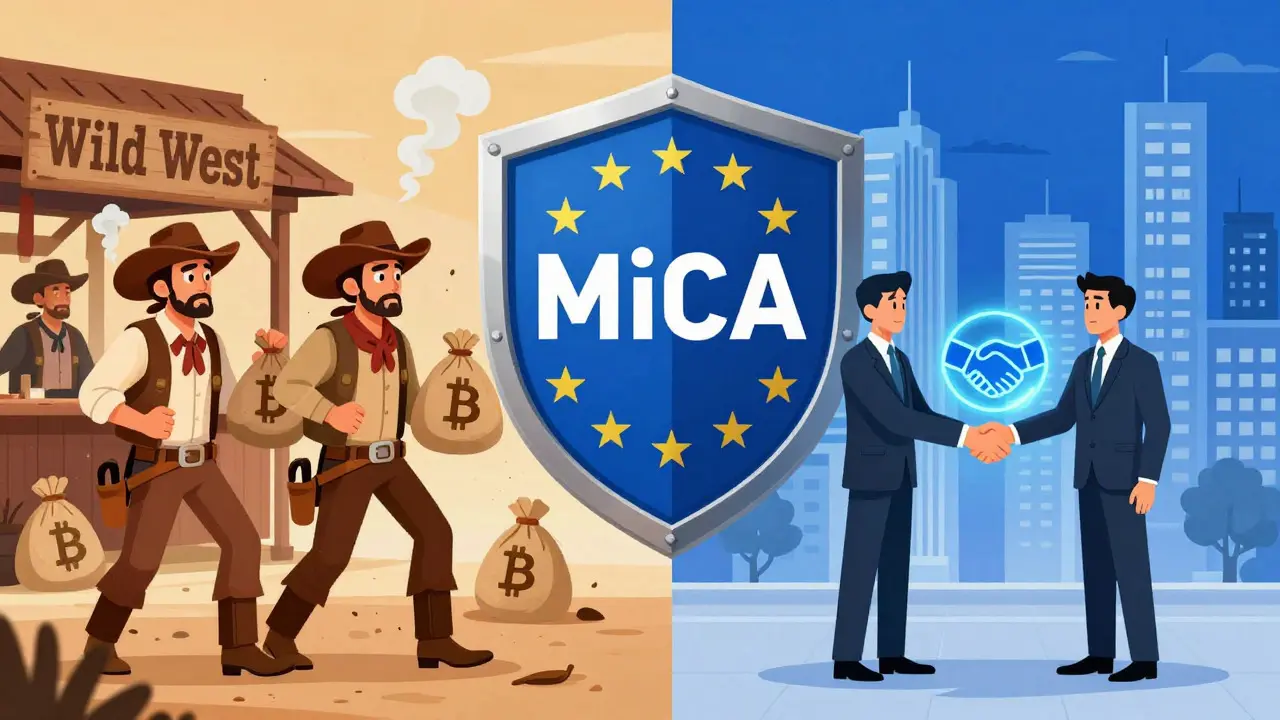

Remember when buying crypto felt like the Wild West? You could sign up on any platform, deposit money, and hope for the best. That era is officially over for anyone operating in or targeting customers within the European Union. Enter MiCA, the regulatory framework that has fundamentally reshaped how digital assets are issued, traded, and held.
If you are a business owner, an investor, or just someone curious about why your favorite exchange suddenly changed its terms of service, this guide breaks down exactly what MiCA is, who it affects, and what you need to do right now in 2026 to stay compliant and safe.
What Is MiCA and Why Does It Matter?
MiCA stands for Markets in Crypto-Assets Regulation. It is not just another rulebook; it is the world’s first comprehensive, supranational legal framework specifically designed for crypto assets. Adopted by the European Parliament in April 2023, MiCA became fully applicable across all 27 EU member states by December 30, 2024.
Before MiCA, if you wanted to run a crypto business in Europe, you had to navigate a nightmare of 27 different national regulations. Some countries were friendly, others hostile, and many were simply unclear. This fragmentation created legal uncertainty for 98% of market participants, according to early European Commission assessments. MiCA solves this by creating a single set of rules. If you get licensed in one country, you can operate everywhere in the EU-a concept known as "passporting."
Why does this matter to you? Because MiCA prioritizes three things: investor protection, market integrity, and financial stability. It ensures that when you buy a token, there is a clear entity responsible for it, adequate reserves back it (if it’s a stablecoin), and strict rules prevent market abuse like insider trading.
The Three Pillars: How MiCA Classifies Crypto Assets
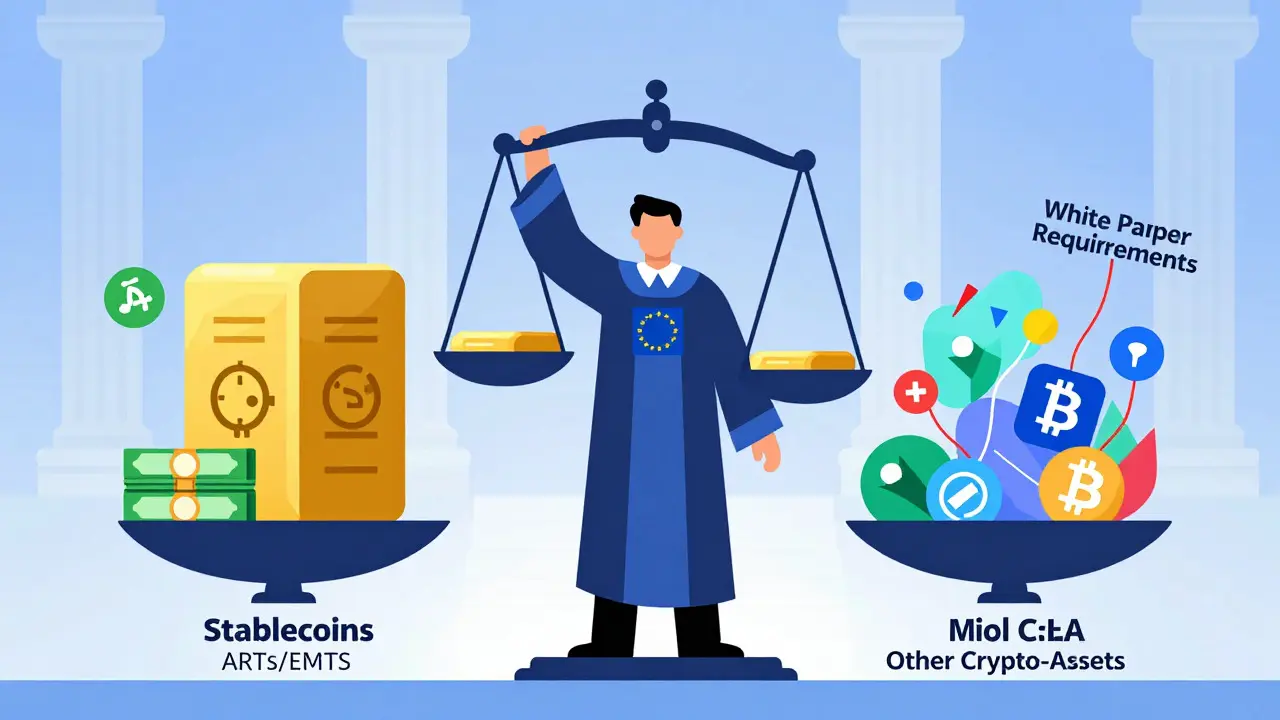
MiCA doesn’t treat all cryptocurrencies the same. It recognizes that a Bitcoin-like asset carries different risks than a dollar-backed stablecoin. To manage this, the regulation divides crypto assets into three distinct categories, each with specific requirements.
- Asset-Referenced Tokens (ARTs): These are tokens that aim to maintain a stable value by referencing multiple official currencies or other assets. Think of them as complex stablecoins. Under Title III of MiCA, issuers must hold 100% reserves plus a 2% buffer. Crucially, at least 60% of these reserves must be in cash or central bank deposits, with no more than 40% in high-quality liquid assets.
- E-Money Tokens (EMTs): Covered under Title IV, these are tokens pegged 1:1 to a single fiat currency (like the Euro). They are treated similarly to electronic money. Only authorized credit institutions or e-money institutions can issue them, ensuring they meet banking-level safety standards.
- Other Crypto-Assets: This catch-all category includes everything else-Bitcoin, Ethereum, utility tokens, and NFTs (mostly). For public offerings of these assets, issuers must publish a detailed white paper approved by regulators. This document must explain the technology, the team, the tokenomics, and the risks involved.
Note that algorithmic stablecoins-those relying on code rather than real-world reserves to maintain their peg-are effectively banned under MiCA due to concerns about stability during market stress.
Who Needs a License? Understanding CASPs
If you provide services related to crypto assets in the EU, you likely fall under the definition of a Crypto-Asset Service Provider (CASP). MiCA defines ten specific services that trigger licensing requirements:
- Custody and administration of crypto-assets
- Exchange between crypto-assets and fiat money
- Exchange between different crypto-assets
- Operation of a trading platform
- Reception and transmission of orders
- Underwriting or placement of crypto-assets
- Advice on crypto-assets
- Portfolio management
- Execution of orders outside a trading platform
- Safekeeping and administration
To become a licensed CASP, you must apply to your local National Competent Authority (NCA)-such as BaFin in Germany, AMF in France, or CONSOB in Italy. The bar is high. Minimum capital requirements range from €150,000 for pure custody services to €730,000 for providers offering multiple services. On top of that, you need robust IT security, a solid business continuity plan, and proof that you can monitor transactions in real-time to prevent money laundering.
| Service Type | Minimum Capital Requirement | Key Compliance Focus |
|---|---|---|
| Pure Custody | €150,000 | Asset segregation, insurance |
| Exchange Services | €350,000 - €500,000 | Market integrity, client funds |
| Multi-Service Providers | €730,000+ | Comprehensive risk management, AML |
Stablecoins: The Strictest Rules in Town
Stablecoins got the most attention during MiCA’s drafting phase, and for good reason. The collapse of TerraUSD (Luna) in 2022 showed the world what happens when stablecoin promises aren’t backed by reality. MiCA responds with some of the toughest rules globally.
For Asset-Referenced Tokens (ARTs), issuers must maintain a 120% reserve coverage ratio during the first six months of operation. After that, it drops to 100%, but the quality of those reserves is strictly monitored. They must be highly liquid and low-risk. E-Money Tokens (EMTs) face even stricter scrutiny because they compete directly with traditional banks. Issuers must redeem tokens instantly upon request, preventing runs on the bank-style scenarios.
One major consequence? Many smaller stablecoin projects have exited the EU market or relocated headquarters to jurisdictions with lighter touch approaches. According to PwC surveys, nearly a quarter of stablecoin issuers considered leaving the EU before full implementation due to these costs. However, for large players like Tether or Circle, MiCA provides a clear path to legitimacy, which institutional investors crave.
Impact on the Market: Consolidation and Trust
It has been two years since full implementation, and the effects are visible. The number of active crypto service providers in the EU dropped by 45% between late 2023 and early 2025. Sounds bad? Maybe. But the remaining firms are stronger. The top 10 MiCA-authorized exchanges now control 67% of EU trading volume, up from 48% pre-MiCA.
This consolidation means less choice for retail users but significantly higher safety. Institutional adoption has skyrocketed. Euroclear reported a 210% year-over-year increase in custody arrangements for MiCA-compliant assets in 2024. Big money likes certainty. When pension funds and hedge funds know their crypto custodian is regulated by ESMA and local NCAs, they move in.
Retail users initially saw a dip in activity as fees rose to cover compliance costs (one Spanish exchange reported a 22% fee hike). However, trust rebounded. By Q4 2024, retail adoption grew by 12% as consumers realized their assets were safer than ever. The "wild west" days are gone, replaced by a mature, regulated market.

Practical Steps for Businesses and Investors
So, what should you do today?
For Businesses: If you haven’t already, start the licensing process. Applications take 9-12 months on average, so delay is costly. Ensure your white paper (if issuing tokens) is exhaustive and legally vetted. Prepare for the upcoming Anti-Money Laundering Authority (AMLA) launch in 2026, which will add new reporting layers for cross-border transactions over €1,000. Don’t ignore DeFi implications either; ESMA is consulting on bringing decentralized protocols under MiCA via a "significant influence" test.
For Investors: Check if your exchange is MiCA-compliant. Look for the license badge on their website. If you hold stablecoins, verify their reserve reports. MiCA requires monthly transparency reports from issuers. Avoid unregulated offshore platforms promising high yields-they are increasingly being blocked by EU payment processors. Finally, understand that not all NFTs are covered yet, but expect changes soon as the EC reviews their classification based on liquidity and fungibility.
Future Outlook: What’s Next for MiCA?
MiCA isn’t static. The European Commission is already looking ahead. Key developments to watch include:
- NFT Regulation: A report submitted in late 2024 proposes bringing ~15% of NFTs under MiCA scope, focusing on those traded frequently or used as investment vehicles.
- DeFi Integration: Expected consultations in 2025-2026 may extend MiCA rules to decentralized applications where developers exert significant control.
- AI-Crypto Hybrids: New amendments are planned to address risks from AI-integrated financial products, with implementation targeted for Q3 2026.
The long-term goal is clear: make the EU the global standard for safe, innovative crypto markets. While some argue MiCA stifles innovation through bureaucracy, others see it as the necessary foundation for mass adoption. As the Bank for International Settlements noted, MiCA’s prudent approach aligns with global best practices for financial stability.
Does MiCA apply to Bitcoin?
Yes, but indirectly. Bitcoin itself is not "issued" by a company, so there is no issuer to regulate. However, any service provider (exchange, wallet, custodian) handling Bitcoin in the EU must be a licensed CASP under MiCA. This ensures your Bitcoin holdings are protected by regulated entities.
Can I still use non-EU crypto exchanges?
Technically yes, but it’s getting harder. Non-EU exchanges cannot actively market to EU residents without a MiCA license. Many have set up EU subsidiaries to comply. Using non-compliant platforms means you lose consumer protections, such as compensation funds if the exchange fails.
How much does it cost to get a MiCA license?
Beyond the minimum capital requirement (€150k-€730k+), expect compliance costs of €250,000 to €500,000 for medium-sized firms. This covers legal fees, IT security upgrades, staff training, and application processing. Startups often find this a significant barrier to entry.
Are algorithmic stablecoins banned in the EU?
Effectively, yes. MiCA requires stablecoins to be backed by high-quality, liquid reserves. Purely algorithmic models that rely on code incentives rather than tangible assets to maintain their peg do not meet these reserve requirements and are thus prohibited.
When will NFTs be regulated under MiCA?
The European Commission submitted its review in December 2024. Specific rules for NFTs are expected to emerge in 2026, focusing on fungible or highly liquid NFTs that resemble securities. Most unique, collectible NFTs will likely remain outside direct MiCA scope unless marketed as investments.