

Running a cryptocurrency business used to feel like operating in the Wild West. Today, it feels more like navigating a minefield where every jurisdiction has its own set of explosives. If you are providing payment services involving crypto assets, the days of vague guidelines are over. Regulators worldwide have moved from observation to enforcement, creating a complex web of rules that dictate how you store funds, verify customers, and report transactions.
The core issue isn't just about following one rulebook. It's about reconciling conflicting demands from different governments. Singapore demands absolute compliance by strict deadlines. The European Union is merging traditional banking laws with new crypto-specific regulations. Japan is tightening security protocols for user assets. And the United States is attempting to clarify decades of regulatory ambiguity. For any service provider, missing even one detail can mean shutting down operations or facing massive fines.
Singapore’s Strict FSMA Deadline and Travel Rule
Singapore has long been considered a friendly hub for fintech innovation, but the Monetary Authority of Singapore (MAS) has shifted toward some of the most stringent oversight in the world. The pivotal legislation here is the Financial Services and Markets Act (FSMA). This act brought digital token services under the same rigorous scrutiny as traditional financial institutions.
The clock stopped ticking on June 30, 2025. That was the absolute final deadline for all platforms providing digital token services to secure proper licensing. MAS made it clear there would be no grace periods and no extensions. If you were operating without a license after that date, you had to cease operations immediately. This zero-tolerance approach signals that Singapore prioritizes market integrity over rapid, unchecked growth.
A critical component of this framework is the implementation of the Travel Rule. This requirement forces crypto platforms to share customer information when processing transfers above specific threshold amounts. Both the sending and receiving platforms must collect and exchange detailed transaction party data. It doesn’t matter which blockchain technology you use; if you move value, you must identify who sent it and who received it. This effectively ends the anonymity many users relied upon for cross-border payments.
Consumer protection measures are equally strict. Platforms are prohibited from allowing credit card purchases of cryptocurrencies, aiming to prevent retail investors from taking on high-risk debt to speculate. Additionally, companies must conduct thorough suitability assessments to ensure they aren't selling complex, high-risk products to inexperienced users. Clear risk disclosures are mandatory, ensuring that marketing materials cannot hide the volatility inherent in digital assets.
European Union: PSD2 and MiCA Integration
In Europe, the regulatory landscape is defined by the interplay between two major frameworks: the Payment Services Directive 2 (PSD2) and the Markets in Crypto-Assets regulation (MiCA). The European Banking Authority (EBA) issued crucial guidance to help National Competent Authorities (NCAs) navigate this overlap, particularly regarding how crypto transfers are classified.
The EBA established March 2, 2026, as a critical authorization timeline. From this date forward, NCAs are expected to require PSD2 authorization for certain crypto-related activities. Specifically, the transfer of crypto assets is viewed as a payment service under the PSD2 framework. However, not all crypto activities fall under this umbrella. The exchange of crypto-assets for funds, or the exchange of crypto-assets for other crypto-assets, remains excluded from PSD2 classification and falls strictly under MiCA licensing provisions.
This distinction matters immensely for your operational setup. If you offer custody services that allow users to initiate transfers, you likely need PSD2 authorization. But if you only facilitate peer-to-peer swaps, MiCA applies. During the transition period, regulators are advised to streamline authorization procedures, maximizing the use of information already provided during Crypto-Asset Service Provider (CASP) applications to reduce bureaucratic redundancy.
Once authorized under PSD2, certain traditional banking rules become less relevant. For instance, requirements regarding unique identifiers like IBANs or open banking provisions may not be prioritized. However, core consumer protections remain non-negotiable. You must implement Strong Customer Authentication (SCA) for accessing custodial wallets that qualify as payment accounts. Payment fraud reporting requirements also apply, ensuring that suspicious activities are flagged quickly. Furthermore, cumulative calculation of own-funds requirements ensures that your financial stability meets the same standards whether you hold euros or electronic money tokens.
Japan’s Evolution: Cold Storage and Licensing Tiers
Japan was one of the first countries to formally recognize Bitcoin as legal property, and its Payment Services Act has evolved significantly since its initial enactment in 2009. The 2019 Amendment marked a turning point, changing the terminology from "virtual currency" to "crypto assets" and introducing stricter operational mandates.
The most significant technical requirement introduced is the mandatory principle of cold wallet storage. Exchange service providers must store users' crypto assets in offline cold wallets. This rule was implemented directly in response to past security breaches at Japanese exchanges, aiming to protect user funds from online hacking attempts. Post-facto reporting of changes to handled assets was replaced with mandatory advance reporting, giving regulators foresight into the types of tokens an exchange intends to support.
The licensing structure became more granular with the introduction of a three-tier system comprising Type 1, Type 2, and Type 3 licenses. This tiered approach allows regulators to tailor oversight based on the volume and complexity of transactions. Stablecoin accommodations were also integrated into the framework, raising transfer limits and clarifying the legal status of these pegged assets.
In March 2025, the Japanese Cabinet approved further amendments to the Payment Services Act. These updates address emerging technological advancements and new use cases, though detailed implementation guidelines are still rolling out. The consistent theme in Japan’s regulatory evolution is systematic adaptation: starting with basic registration systems in 2016, moving to strict security mandates in 2019, and now refining the framework to handle derivatives and unfair trading practices like price manipulation.
United States: The CLARITY Act and Jurisdictional Clarity
The United States has historically struggled with fragmented oversight, often relying on "regulation by enforcement." The proposed CLARITY Act aims to fix this by establishing clear boundaries between the Commodity Futures Trading Commission (CFTC) and the Securities and Exchange Commission (SEC).
The Act categorizes crypto assets into three distinct groups: digital commodities, investment contract assets, and permitted payment stablecoins. This classification determines which regulator holds jurisdiction. Digital commodities generally fall under CFTC oversight, while investment contracts remain under SEC purview. Permitted payment stablecoins get their own specific regulatory pathway.
For intermediaries, this means clearer rules for broker-dealers and alternative trading systems (ATSs). The SEC is directed to allow digital commodities and permitted payment stablecoins to be brokered, traded, or custodied by registered entities. Crucially, the Act prevents the SEC from barring trading platforms from exemption eligibility simply because they list digital assets alongside traditional securities. This separation helps legitimize crypto trading venues that previously operated in a gray area.
The CLARITY Act also modernizes recordkeeping requirements, allowing broker-dealers and exchanges to use blockchain technology for books and records. This acknowledges the reality of decentralized ledgers while maintaining transparency. Additionally, the Act grants the SEC discretion to provide exemptions for certain decentralized finance (DeFi) activities, recognizing that traditional intermediary models don't always fit code-based protocols.

Navigating Cross-Jurisdictional Compliance Challenges
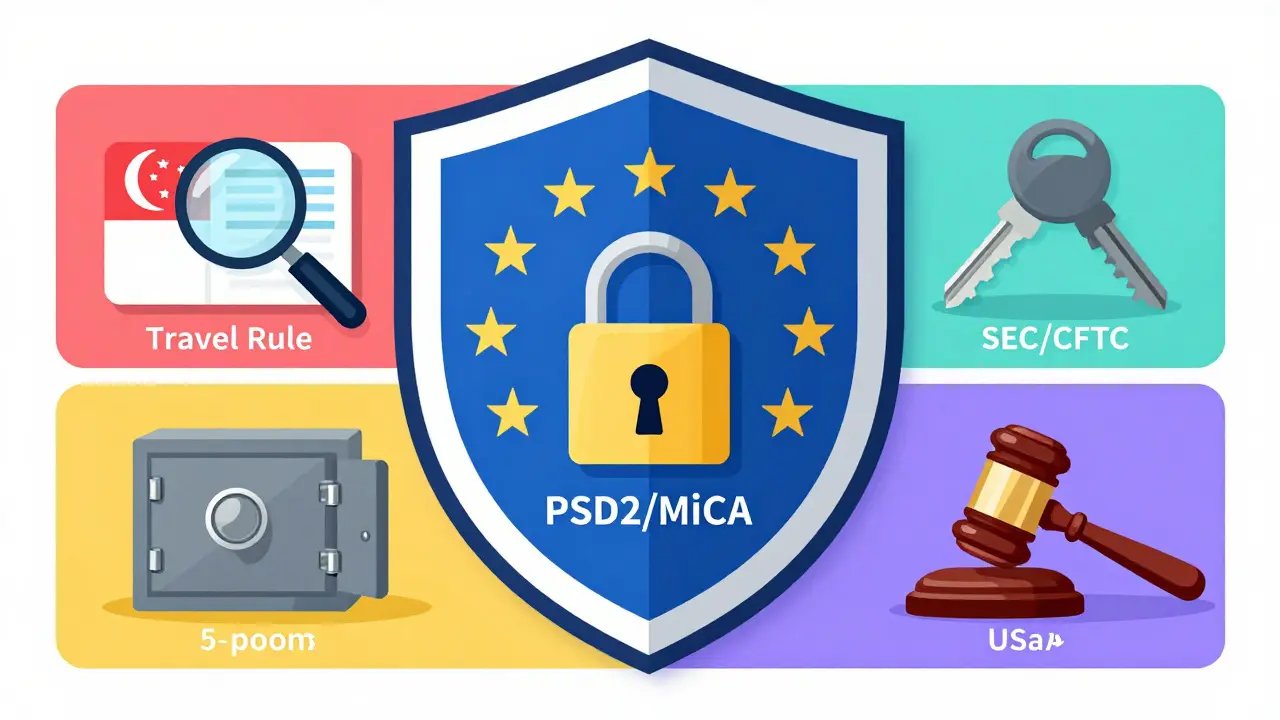
If you operate globally, you face the challenge of divergent timelines and technical specifications. Singapore’s hard deadline of June 30, 2025, created immediate urgency, while Europe’s March 2, 2026, timeline offers a longer preparation window. Japan focuses heavily on physical security of assets through cold storage mandates, whereas Singapore emphasizes transaction monitoring via the Travel Rule.
Consumer protection standards also vary. Singapore bans credit card purchases to limit retail leverage. Europe focuses on authentication and fraud reporting. The U.S. emphasizes investor protection through clear jurisdictional definitions. Enforcement approaches differ too: Singapore takes a zero-tolerance stance with no grace periods, while European authorities provide no-action guidance during transitions, and Japan evolves its rules systematically in response to market developments.
To manage this complexity, multinational providers must implement jurisdiction-specific compliance programs. This often means building separate tech stacks for KYC (Know Your Customer) processes, transaction monitoring, and asset custody depending on the region. The cost of implementation is high, but the cost of non-compliance-shut-down orders, heavy fines, or criminal liability-is far greater.
| Jurisdiction | Key Legislation | Critical Deadline/Timeline | Primary Focus | Unique Requirement |
|---|---|---|---|---|
| Singapore | Financial Services and Markets Act (FSMA) | June 30, 2025 (Final) | Market Integrity & Consumer Protection | Mandatory Travel Rule compliance; No credit card purchases |
| European Union | PSD2 & MiCA | March 2, 2026 (Authorization) | Integration of Banking & Crypto Rules | Strong Customer Authentication (SCA) for custodial wallets |
| Japan | Payment Services Act | Ongoing (Amendments in 2025) | Asset Security & Operational Transparency | Mandatory cold wallet storage for user assets |
| United States | CLARITY Act (Proposed) | TBD (Pending Passage) | Jurisdictional Clarity (SEC vs CFTC) | Three-tier asset classification; Blockchain recordkeeping allowed |
Practical Steps for Immediate Compliance
Regardless of where you operate, several foundational steps can prepare your business for these evolving regulations. First, audit your current asset custody solutions. If you are storing user funds in hot wallets, you are already non-compliant in jurisdictions like Japan. Move to institutional-grade cold storage solutions immediately.
Second, review your KYC and AML (Anti-Money Laundering) protocols. Ensure your systems can capture and transmit originator and beneficiary information for transactions exceeding local thresholds. This is essential for Travel Rule compliance in Singapore and increasingly important globally.
Third, segment your product offerings based on asset type. Clearly distinguish between payment tokens, utility tokens, and security tokens. This alignment with the U.S. CLARITY Act’s categorization will make it easier to determine which regulator you need to engage with.
Finally, establish a dedicated compliance team or partner with specialized legal counsel. Generalist lawyers often lack the technical depth to understand blockchain mechanics combined with financial law. You need experts who can interpret nuanced directives like the EBA’s No Action letters or MAS’s specific guidance on digital token services.
What happens if I miss the Singapore FSMA deadline?
If you did not secure a license by the June 30, 2025 deadline, you must cease all digital token services immediately. MAS has stated there are no grace periods or extensions. Continuing to operate without a license can result in severe penalties, including criminal prosecution and permanent bans from the financial sector.
Does MiCA replace PSD2 for crypto businesses?
Not entirely. MiCA covers the exchange of crypto-assets for funds or other crypto-assets. However, if your service involves transferring crypto assets as a payment method, PSD2 still applies. You may need both MiCA CASP authorization and PSD2 payment institution licensing depending on your specific services.
Is hot wallet storage still allowed in Japan?
No. Since the 2019 Amendment to the Payment Services Act, cold wallet storage is the mandatory principle for protecting users' crypto assets. Exchanges must keep the vast majority of assets offline to mitigate the risk of cyberattacks.
How does the CLARITY Act affect DeFi projects?
The CLARITY Act directs the SEC to consider exemptions for certain decentralized finance activities. While it doesn't automatically legalize all DeFi protocols, it provides a structured pathway for the SEC to define which decentralized activities fall outside traditional securities laws, offering potential clarity for developers and users.
What is the Travel Rule in crypto?
The Travel Rule requires Virtual Asset Service Providers (VASPs) to share transaction details, including sender and receiver information, for transfers above a certain threshold. This ensures that crypto transactions are as traceable as traditional bank transfers, helping to combat money laundering and terrorist financing.



Comments (9)

- Jan Gilmore
- May 19, 2026 AT 16:14 PM
Let's cut through the noise here because most people reading this are still thinking in 2017 terms. The Travel Rule isn't a suggestion, it's a hard constraint for any VASP that wants to survive beyond six months. I've been advising three major exchanges on their KYC stacks and the integration with blockchain analytics firms like Chainalysis or Elliptic is non-negotiable now. If you're trying to route transactions without sharing originator data above the threshold, you're not just risking fines, you're risking your banking relationships entirely. Traditional banks will de-risk you faster than MAS can fine you. The CLARITY Act in the US is nice theory but until it passes, we're still operating under SEC enforcement actions which means every listing decision is a potential lawsuit waiting to happen. Japan's cold storage mandate is actually the smartest move here because it forces custodians to take security seriously instead of blaming 'unhackable' code when keys are leaked from hot wallets.

- Samara McCallum
- May 20, 2026 AT 07:47 AM
it feels like we are building a cage for ourselves and calling it safety
i miss the days when anonymity was a feature not a bug

- Sheldon Friesen
- May 20, 2026 AT 13:18 PM
Oh, look at us! We're all so upset about losing our anonymity, aren't we? It's almost as if the entire point of financial regulation is to prevent money laundering and terrorist financing! Who would have thought?! I mean, really, can we blame the regulators for wanting to know who is sending what to whom? It's not exactly rocket science. And while we're at it, let's remember that Singapore's zero-tolerance policy is actually a breath of fresh air compared to the wild west of unregulated exchanges that used to vanish with user funds. So please, keep complaining about the 'cage,' but maybe acknowledge that the cage keeps the wolves out! Or at least makes sure they have ID cards!

- Tricia Alach
- May 21, 2026 AT 13:18 PM
i think its interesting how europe is trying to merge psd2 with mica
it seems like they want to treat crypto like normal money but also keep it special
does this mean my wallet needs an iban too lol
im confused abot the sra requirements

- robert Whitehead
- May 22, 2026 AT 17:33 PM
You are missing the forest for the trees. The EBA guidance is crystal clear: if you are providing custody and allowing transfers, you are a payment institution under PSD2. Period. There is no ambiguity here unless you choose to ignore basic legal definitions. MiCA covers the asset itself, but the service of moving value is regulated by existing financial infrastructure laws. This is why so many startups fail-they try to build a 'crypto-only' silo and then get hit with compliance costs they didn't budget for because they refused to understand that finance is finance. You cannot escape AML/KYC obligations by changing the underlying technology. The state has total visibility into economic activity, and it always will. Your confusion is a liability.

- Caique Muniz
- May 22, 2026 AT 19:01 PM
typical gov overreach
why do i need to prove im me to send coins
just let us live

- Mike S
- May 23, 2026 AT 23:02 PM
Ah, the classic 'just let us live' argument from someone who probably thinks Bitcoin is magic internet money that exists outside of reality. Let me explain something to you, you naive child. Anonymity is not a right; it is a privilege that criminals abused until everyone else got burned. Now that the house is on fire, you want to complain about the fire department showing up? Singapore banned credit card purchases for a reason-because retail investors were leveraging debt to gamble on volatile assets and then crying when they lost everything. It’s not oppression; it’s consumer protection. But sure, keep whining about 'freedom' while your savings get drained by hacks and scams because you refused to follow basic security protocols.

- Bradley Geldenhuys
- May 24, 2026 AT 05:13 AM
look man i get the frustration but japan did the right thing with cold storage
after mt gox everyone should have known better
its not about trust its about math and physics
if ur keys are online they are vulnerable
stop being lazy and secure ur assets properly
its easy if u care

- H F
- May 26, 2026 AT 01:13 AM
This is absolutely brilliant analysis! I have been watching the regulatory landscape shift from the sidelines, and seeing it laid out like this is incredibly helpful. The distinction between the US approach and the EU/Singapore models is stark. It really highlights how fragmented the global market still is. For anyone trying to launch a cross-border product, this complexity is a nightmare. I am currently working on a DeFi protocol and the uncertainty around the CLARITY Act is keeping us up at night. Will the SEC grant exemptions? Will they enforce old rules? It’s a game of chicken with regulators. Great post for breaking down these dense legal frameworks into actionable insights. Definitely bookmarking this for our next compliance review meeting!