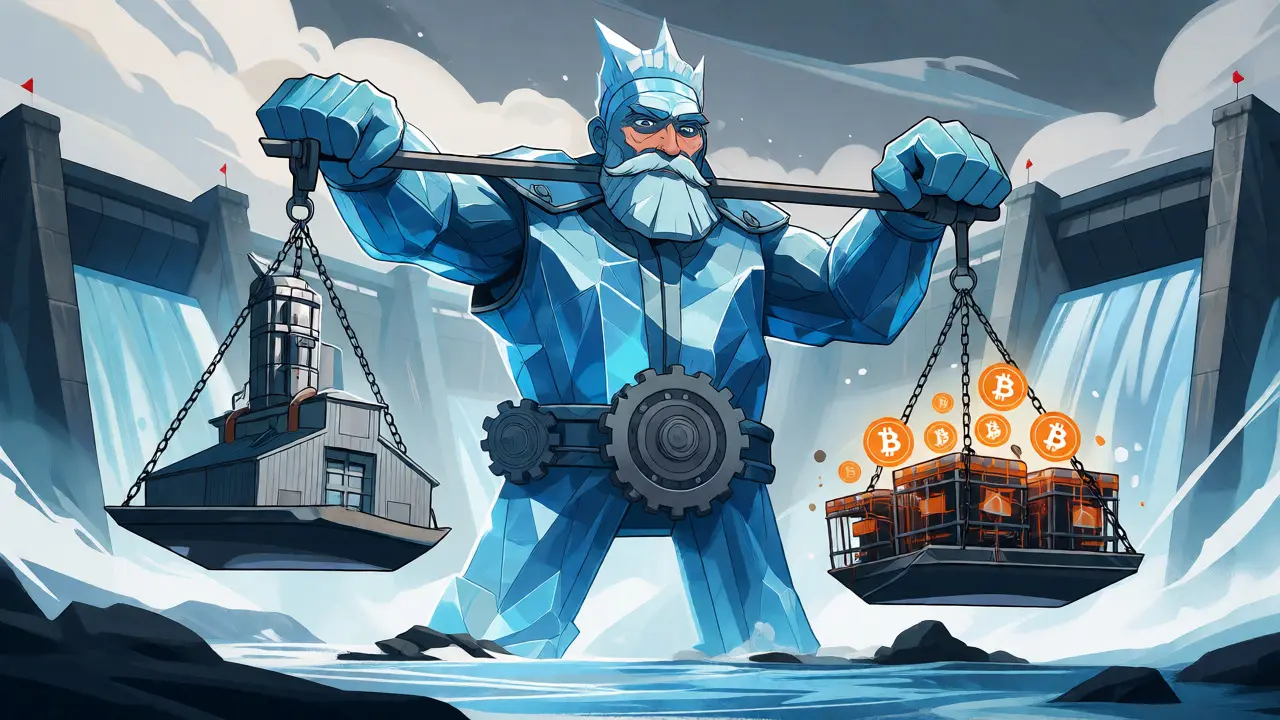

Imagine flipping a switch in your house and realizing the entire national grid is holding its breath. That’s the reality for Landsvirkjun, Iceland’s national power company and largest electricity producer. For years, the country was the wild west of cryptocurrency mining, fueled by cheap geothermal and hydroelectric power. But that era is shifting. If you’re looking to mine Bitcoin or Ethereum in Reykjavik today, you aren’t just dealing with hardware costs; you’re navigating a complex web of utility restrictions, government scrutiny, and a delicate balance between industrial profit and residential stability.
The End of the Free-for-All Era
It wasn’t long ago that setting up a mining rig in Iceland felt like a no-brainer. The air was cold, the energy was green, and the cost per kilowatt-hour was incredibly low. By 2017, data centers were consuming nearly 90% of the power used by non-residential sectors. This surge put massive strain on the grid. Today, Landsvirkjun doesn’t just sell you power; they ration it based on strategic priorities.
The core issue isn’t that Iceland hates crypto. It’s that the country has limited capacity. While renewable sources cover 100% of electricity generation, building new dams or drilling new geothermal wells takes years, not months. When a single large-scale mining facility can consume as much electricity as a small town, the utility company has to pick winners. Currently, priority goes to established aluminum smelters-traditional heavy industry that employs thousands of locals. Crypto miners are often seen as transient tenants who might leave if prices drop, leaving stranded infrastructure behind.
How Landsvirkjun Allocates Power
You can’t just walk into Landsvirkjun and buy a gigawatt. The process involves rigorous application procedures and strict contractual terms. The utility company uses a tiered system to decide who gets access to the grid. If you want to operate a data center in Iceland, you need to prove more than just financial solvency.
- Grid Stability Impact: Miners must demonstrate how their load affects voltage and frequency stability. Sudden spikes in demand can destabilize the local grid.
- Long-Term Commitment: Contracts often require minimum usage periods. You can’t sign up for two years and then bail out when Bitcoin hits a bear market.
- Infrastructure Investment: In many cases, miners are expected to co-invest in transmission lines or substations needed to support their specific location.
This creates a high barrier to entry. Small-to-medium miners often find themselves priced out or simply denied connection because they lack the scale to justify dedicated infrastructure upgrades. Instead, they rely on third-party hosting providers who have already secured bulk contracts with Landsvirkjun, paying a premium for the convenience.
| Access Model | Target User | Cost Structure | Restriction Level |
|---|---|---|---|
| Direct Contract (Landsvirkjun) | Mega-miners (>5MW) | Negotiated fixed rates + infrastructure fees | High (Strict vetting) |
| Third-Party Hosting | Mid-sized miners | Premium markup on kWh + service fees | Medium (Provider dependent) |
| Residential/Small Commercial | Hobbyists | Standard regulated tariff | Low (But capacity constrained) |
Government Pressure and Political Shifts
The restrictions aren’t just coming from the utility boardroom. They’re driven by political pressure. In March 2024, Iceland’s Prime Minister publicly expressed a desire to reduce the footprint of cryptocurrency mining. Why? Because ordinary citizens noticed their own bills creeping up and worried about the environmental impact of rapid industrial expansion in pristine areas.
The Icelandic government views crypto mining through two lenses: economic opportunity and resource management. On one hand, companies like Hive Blockchain Technologies bring foreign capital and jobs. On the other, there’s a fear that Iceland is becoming a "power dump" for global speculation rather than a sustainable economy. This tension results in tighter regulations. New projects face longer approval times, and existing operations are scrutinized for compliance with environmental standards, particularly regarding heat waste and water usage for cooling systems.
The Environmental Paradox
Here’s the irony: Iceland markets itself as a green mining hub. With geothermal and hydro power, the carbon footprint of mining here is near zero compared to coal-powered farms in Texas or Kazakhstan. Yet, "green" doesn’t mean "impact-free." Geothermal plants require significant water resources and land use. Rapid expansion of mining facilities puts pressure on these finite natural assets.
Landsvirkjun enforces strict environmental guidelines as part of their power contracts. If a mining operation fails to manage its thermal discharge properly or causes local ecological disruption, the utility can penalize them or even revoke power privileges. This adds an operational layer of complexity that purely financial models often ignore. You aren’t just buying electrons; you’re buying permission to exist within a fragile ecosystem.
Strategic Workarounds for Miners
So, is Iceland closed for business? Not entirely. Smart operators are adapting. Instead of fighting for direct grid connections, many are partnering with local municipalities or smaller regional utilities that have excess capacity. Others are focusing on modular, scalable solutions that can be ramped up or down quickly without requiring massive permanent infrastructure changes.
Another trend is the shift toward blockchain services beyond pure Proof-of-Work mining. Some companies are pivoting to provide data storage or AI computing power, which offers more stable revenue streams and aligns better with Iceland’s goal of diversifying its tech sector. This reduces the risk of being labeled a "speculative bubble" by regulators.
Can I connect my home mining rig directly to Landsvirkjun?
Generally, no. Landsvirkjun primarily serves large industrial customers. Home users and small businesses purchase electricity through local distribution companies, such as Veitur or HS Orka, which buy wholesale power from Landsvirkjun. Your ability to mine depends on your local distributor’s capacity and pricing tiers.
Why does Landsvirkjun prioritize aluminum smelters over crypto miners?
Aluminum smelting is a foundational industry in Iceland, providing stable, long-term employment and contributing significantly to GDP. These industries have decades-long contracts and predictable loads. Crypto mining is viewed as more volatile, with demand fluctuating based on coin prices, making it a riskier investment for grid planning.
Are there bans on new crypto mining licenses in Iceland?
There is no outright ban, but there is a moratorium-like effect due to capacity constraints. New applications for large-scale power connections are subject to intense review. The government and Landsvirkjun are cautious about approving new mega-farms until they can guarantee grid stability and environmental compliance.
Does using renewable energy exempt miners from restrictions?
No. While renewable sourcing is a key selling point for Iceland, the restriction is about physical grid capacity and resource management, not just carbon emissions. Even green energy requires infrastructure to transmit and distribute, which is currently saturated.
What happens if I violate my power contract terms?
Violations, such as exceeding agreed-upon load limits without notice or failing environmental checks, can result in fines, increased rates, or temporary power cuts. In severe cases, Landsvirkjun may terminate the supply agreement, forcing the miner to shut down operations.
The Future Outlook
Iceland remains attractive, but the days of easy money are gone. The national power company is acting as a gatekeeper, ensuring that growth is sustainable and beneficial to the nation as a whole. For investors and miners, this means doing your homework. You need to understand the regulatory landscape, secure reliable partners, and plan for higher operational costs.
If you’re serious about operating in Iceland, start by engaging with local distribution networks rather than aiming straight for Landsvirkjun. Build relationships with local communities. Show that you’re not just extracting value, but contributing to the local economy. The restrictions are real, but so is the opportunity for those who play by the rules.