
You’ve probably seen the ticker NANA pop up on a chart or in a chat group. It sounds cute. It’s easy to remember. But if you are looking for a straightforward answer to "what is this coin?", you are going to hit a wall of confusion. That is because there isn’t just one NANA Token. There are several completely different projects using the same name, mostly living on the Solana blockchain, which is a high-performance network known for fast transactions and low fees. Some are tied to video games, others are pure internet memes about whales or bananas, and almost all of them carry massive risk.
If you clicked here thinking you found the next big thing, pause for a second. By mid-2026, most versions of NANA have shrunk to microscopic market caps, with some trading volumes dropping to less than a dollar a day. This article breaks down exactly what these tokens are, why they exist, and why you need to be incredibly careful before putting even a single cent into them.
The Two Main Versions of NANA
To understand NANA, you first have to realize it is not a unified project. It is a label shared by at least two major distinct assets, plus a handful of smaller offshoots. Confusing them is the fastest way to lose money.
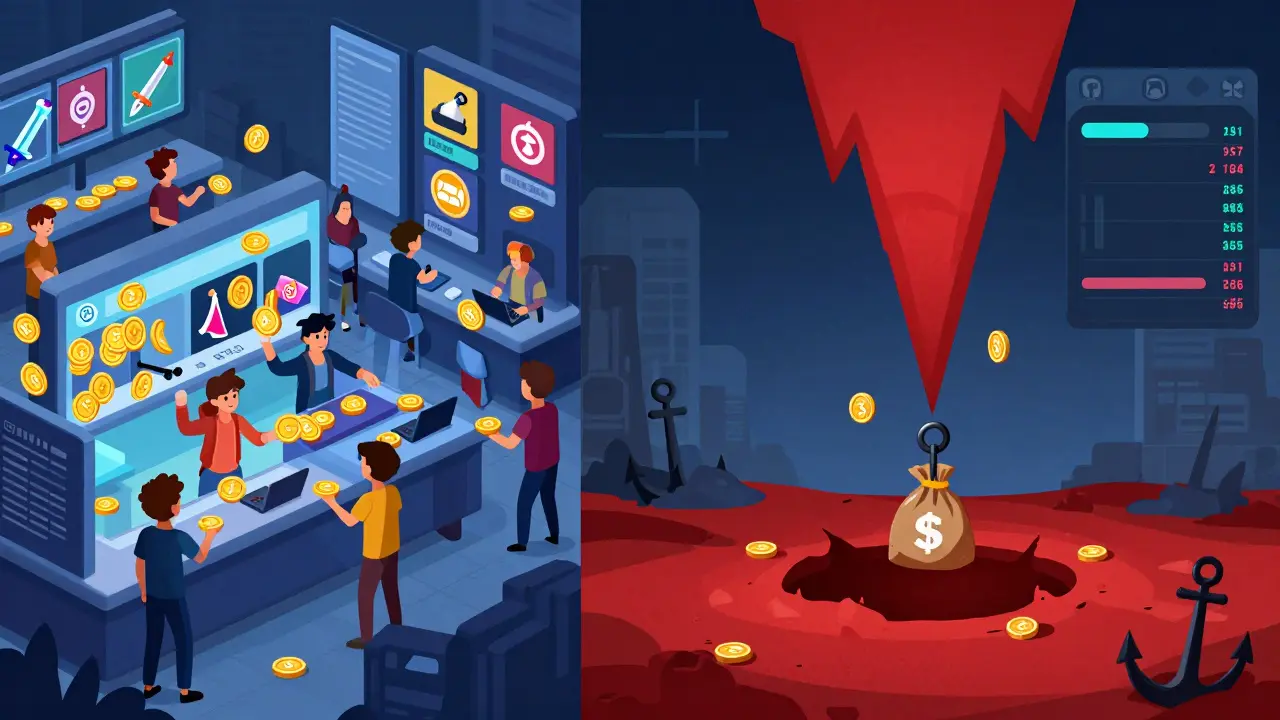
The first version is a utility token for a video game called The Heist, an idle game built on the Solana blockchain. In this context, NANA is meant to be an in-game currency. Players use it to upgrade character skills, buy cosmetic skins, and mint new Non-Fungible Tokens (NFTs). It was officially launched around April 2021. The idea was that as the game grew, demand for the token would rise. However, data from late June 2026 shows this version has effectively stalled, with trading halted on many tracked exchanges and a fully diluted valuation (FDV) hovering near $3,000.
The second, and perhaps more volatile version, is a meme coin inspired by a viral Japanese beluga whale named Nana. This token was launched via Pump.fun, a platform designed for rapid deployment of low-cap meme tokens on Solana. Unlike the gaming token, this NANA has no technical utility. Its value comes entirely from community hype, internet culture, and speculation. In March 2026, this token briefly spiked to a market cap of roughly $335,000, only to crash back down to under $4,000 within months. This pattern-massive spike followed by a steep decline-is classic behavior for nano-cap meme coins.
How Do You Actually Use NANA?
Your experience with NANA depends entirely on which version you hold. If you are playing The Heist, the process is relatively structured. You start by setting up a Solana wallet, such as Phantom Wallet, a popular digital wallet for managing Solana assets and NFTs. You acquire SOL (Solana’s native currency), swap it for NANA on a decentralized exchange (DEX), and then use those tokens inside the game interface to enhance your characters. The utility here is clear: the token makes your gameplay better or allows you to access new content.
For the meme coin variant, there is no "use" case other than holding and hoping the price goes up. Traders interact with this token through DEXs like Raydium or Jupiter, swapping SOL for NANA based on the NANA/SOL trading pair. Because these tokens often launch with simple bonding curves on platforms like Pump.fun, early buyers can see rapid gains, but latecomers often face severe slippage. Slippage means that when you try to sell, the price drops significantly between the time you click "sell" and the time the trade executes, because there aren't enough buyers to absorb your order.
Tokenomics and Market Reality in 2026
Let’s look at the numbers, because they tell a stark story. When analyzing any crypto asset, you need to look at supply, liquidity, and market capitalization.
| Variant | Type | Approx. Market Cap | Daily Volume | Status |
|---|---|---|---|---|
| The Heist NANA | Gaming Utility | ~$3,024 USD | ~$9 USD | Trading Halted/Low Activity |
| Beluga Whale NANA | Meme Coin | ~$3,600 USD | ~$0.32 USD | Highly Illiquid/Nano-Cap |
| MEME-NANA / Others | Meme/Charity | Unverified/Varies | Negligible | Speculative/Fringe |
Notice the daily volume figures. For the Beluga Whale NANA, Phantom Wallet data from June 2026 showed only three trades involving three distinct traders in a 24-hour period. That is not a liquid market; that is a ghost town. If you tried to sell $100 worth of this token, you might not find a buyer, or the price would collapse instantly.
The total supply also varies wildly. One listing shows 100 million tokens, while another shows nearly 1 billion (998.88 million). Without knowing the exact contract address you are looking at, you cannot accurately assess scarcity. This fragmentation is a major red flag for investors.
Why Are These Tokens So Risky?
You might be wondering, "If the market cap is so small, why does anyone care?" The answer is speculation. Traders love micro-cap tokens because a small amount of money can move the price dramatically. But this works both ways. Here are the specific dangers associated with NANA tokens:
- Liquidity Traps: With daily volumes under $10, exiting a position is difficult. You could be stuck holding a bag of tokens that you literally cannot sell without crashing the price further.
- Rug Pull Potential: Many meme coins on Pump.fun are created by anonymous developers. While some are community-driven, others are designed to drain liquidity once early adopters pump the price. Always check if the liquidity is locked.
- Data Misclassification: Aggregator sites sometimes mix up tokens. One major financial news outlet incorrectly listed NANA as a global exchange platform rather than a token. Relying on a single source for information can lead to costly mistakes.
- No Regulatory Protection: These are unregulated instruments. If the project team disappears, or if the smart contract has a bug, there is no insurance, no customer support, and no legal recourse.
Bitrue, a cryptocurrency exchange, explicitly warned in March 2026 that the Pump.fun NANA is suitable only for traders who fully understand the risks of nano-cap assets. They noted that the token’s value relies almost entirely on social media engagement, which is fleeting.

How to Verify Which NANA You Are Looking At
Before you buy anything, you must do your due diligence. Since multiple tokens share the ticker "NANA," you cannot trust the symbol alone. Here is how to verify the asset:
- Check the Contract Address: This is the unique fingerprint of the token on the blockchain. For the Beluga Whale meme coin, the Solana contract address ends in "...pump," indicating its origin on Pump.fun. For The Heist token, the address will be different. Copy and paste the address into a block explorer like Solscan, a tool for exploring transactions and accounts on the Solana blockchain.
- Verify Liquidity: Look at the 24-hour trading volume. If it is less than $100, treat it as extremely high risk. Low volume means you may not be able to exit your position.
- Check Holder Distribution: On Solscan, look at the top holders. If one wallet holds more than 20-30% of the supply, the risk of a dump is very high. A healthy distribution usually has thousands of small holders, though even that doesn't guarantee safety for meme coins.
- Cross-Reference Listings: Check CoinMarketCap and CoinGecko. If a token is listed on one but not the other, or if the data conflicts significantly, proceed with extreme caution. Unverified listings often carry penalties and lower reliability scores.
Is There Any Future for NANA?
As of June 2026, the outlook for NANA tokens is bleak for mainstream adoption. The gaming variant has seen its trading activity dry up, suggesting that player interest in The Heist may have waned or shifted to other incentives. The meme variant has undergone the typical lifecycle of a viral coin: a brief explosion of interest followed by a long, slow bleed of value.
For NANA to recover, it would need a catalyst. For the gaming token, this would require a major update to The Heist that drives renewed demand for in-game upgrades. For the meme token, it would need a fresh wave of viral attention on social media, perhaps tied to a new trend or celebrity endorsement. Without these external forces, the tokens remain fringe assets with negligible liquidity.
New variants continue to appear, such as banana-themed charity tokens or MEME-NANA listings on smaller exchanges like XT.com. However, these lack the track record or transparency to inspire confidence. They represent the chaotic, experimental nature of the Solana ecosystem, where anyone can create a token in minutes. Just because you can create it doesn't mean it has value.
What is the current price of NANA Token?
There is no single price for NANA because multiple tokens use this ticker. As of mid-2026, the gaming NANA trades around $0.00001013 USD, while the meme NANA fluctuates wildly but has recently hovered near similar micro-values with extremely low volume. Prices change rapidly and vary by exchange.
Is NANA Token a scam?
Not necessarily a scam in the traditional sense, but it is an extremely high-risk speculative asset. Many NANA variants are unverified, have low liquidity, and are prone to manipulation. The lack of regulatory oversight and the potential for "rug pulls" make them dangerous for inexperienced investors.
Which blockchain is NANA Token on?
All major versions of NANA Token operate on the Solana blockchain. They are typically implemented as SPL (Solana Program Library) tokens, which allow for fast and cheap transactions compared to Ethereum-based ERC-20 tokens.
Can I buy NANA Token on Binance?
Binance lists NANA in its data aggregators, but it often shows zero circulating supply and zero trading volume on its own platform. This suggests that while Binance tracks the price, you may not be able to actually trade it directly on their centralized exchange. Most trading happens on decentralized exchanges (DEXs) or smaller platforms.
What is the difference between The Heist NANA and the Meme NANA?
The Heist NANA is a utility token used for in-game purchases and upgrades in the Solana game "The Heist." The Meme NANA is a speculative token inspired by a viral beluga whale, launched on Pump.fun, with no functional utility beyond trading and community hype.
How do I check the contract address for NANA?
You can find the contract address on token tracking sites like CoinGecko, CoinMarketCap, or Solscan. Always verify the address matches the specific variant you intend to buy (gaming vs. meme) before connecting your wallet to a decentralized exchange.
Comments (5)

- Melissa L
- July 1, 2026 AT 23:56 PM
honestly this is so confusing why are there like a million nana coins?? i just wanted to buy the whale one but now im scared i will lose all my money lol

- Robert Hundley
- July 2, 2026 AT 23:34 PM
Hey there! :D Don't let the jargon scare you too much. It's actually pretty wild how many projects just copy the name 'NANA' because it sounds catchy. The key takeaway here is that most of these are basically digital confetti at this point. If you're not playing The Heist or actively trading on Pump.fun for fun, there really isn't a use case. Stay safe out there and keep your SOL in your pocket unless you're ready to gamble! \/\/

- nancy jarecki
- July 4, 2026 AT 08:26 AM
The epistemological crisis inherent in this tokenomic fragmentation is precisely what plagues the Solana ecosystem. To conflate a utility-based asset with a zero-sum meme derivative is a category error of the highest order. The liquidity metrics provided-specifically the sub-dollar daily volume-indicate a market structure that is functionally inert. This is not an investment vehicle; it is a speculative mirage designed to exploit cognitive biases regarding scarcity and viral trends. The lack of regulatory oversight merely exacerbates the principal-agent problem, leaving retail participants exposed to asymmetric risk without recourse. One must scrutinize the contract address with forensic precision, as ticker symbols are virtually meaningless in this unregulated wilderness. The data suggests that both variants have failed to achieve network effects sufficient to sustain value accrual. Consequently, any capital allocation to NANA tokens represents a rational expectation of total loss. The narrative of 'gaming utility' has clearly decoupled from actual user engagement, rendering the tokenomics obsolete. We are witnessing the inevitable entropy of low-quality assets in a hyper-competitive blockchain environment.

- Routh Middaugh
- July 5, 2026 AT 07:38 AM
I think we can all agree... that checking the contract address is vital!! It is easy to get lost... in the hype! But as the article points out... the volumes are tiny! So please be careful!!!

- Rob Morton
- July 6, 2026 AT 07:59 AM
It is fascinating to consider the psychological drivers behind holding such illiquid assets. When the fundamental utility evaporates, what remains is purely social consensus. For the Beluga Whale variant, the value was never intrinsic but derived entirely from collective belief. Once that attention shifts, the asset collapses under its own weight. This mirrors broader philosophical questions about the nature of value itself. Is value objective, or is it a shared hallucination? In the context of nano-cap meme coins, it appears to be the latter. The gaming token offers a sliver of tangible interaction, yet even that has faded. This suggests that convenience and novelty are poor foundations for long-term economic structures. Perhaps the lesson here is not about crypto specifically, but about human behavior in decentralized systems. We seek community and identity, often at great financial cost. The transparency of the blockchain allows us to see this process in real-time, which is both enlightening and sobering.