
Have you ever watched a trade execute on a decentralized exchange is a blockchain-based trading platform that allows users to trade cryptocurrencies directly from their wallets without intermediaries only to see the final amount received significantly less than expected? You aren't alone. This gap between expectation and reality is usually caused by two hidden costs: trading fees and slippage.
In 2025, the DEX market exploded with an average monthly volume of $412 billion. While platforms like Uniswap is the dominant DEX protocol launched in November 2018 by Hayden Adams offer freedom from centralized custodians, they come with a complex cost structure. Unlike centralized exchanges where fees are transparent and fixed, DEX costs fluctuate based on network congestion, liquidity depth, and smart contract logic. Understanding these mechanics is the difference between profitable trading and slowly bleeding capital.
Understanding the Anatomy of DEX Fees
When you click "swap" on a DEX interface, you aren't just paying one fee. You are paying for the service of the protocol and the computational power of the blockchain. These costs fall into two distinct buckets: protocol fees and gas fees.
Protocol fees are the standard commission charged by the DEX itself. Most major protocols charge between 0.02% and 0.30% per trade. For example, Uniswap charges a standard 0.30% swap fee. This money doesn't disappear; it is distributed to liquidity providers (LPs) who risk their capital to facilitate trades, and a small portion goes to the protocol treasury. Newer platforms try to undercut this. Aerodrome is a DEX on the Base layer-2 network offering tiered pricing, for instance, offers 0.02% fees for stablecoin pairs and 0.20% for volatile assets.
Gas fees are the transaction costs paid to the blockchain network validators or miners to process your trade. This is where the experience diverges sharply depending on which chain you use. On Ethereum mainnet, a simple trade can cost between $50 and $100 during peak hours. In contrast, layer-2 solutions like Polygon is a layer-2 scaling solution for Ethereum offering lower gas costs or Arbitrum is an optimistic rollup layer-2 network for Ethereum keep these costs pennies. If you are trading small amounts, say $50 worth of tokens, a $60 gas fee on Ethereum effectively wipes out your position. Always check the gas price before confirming a trade on high-congestion networks.
What Is Slippage and Why Does It Happen?
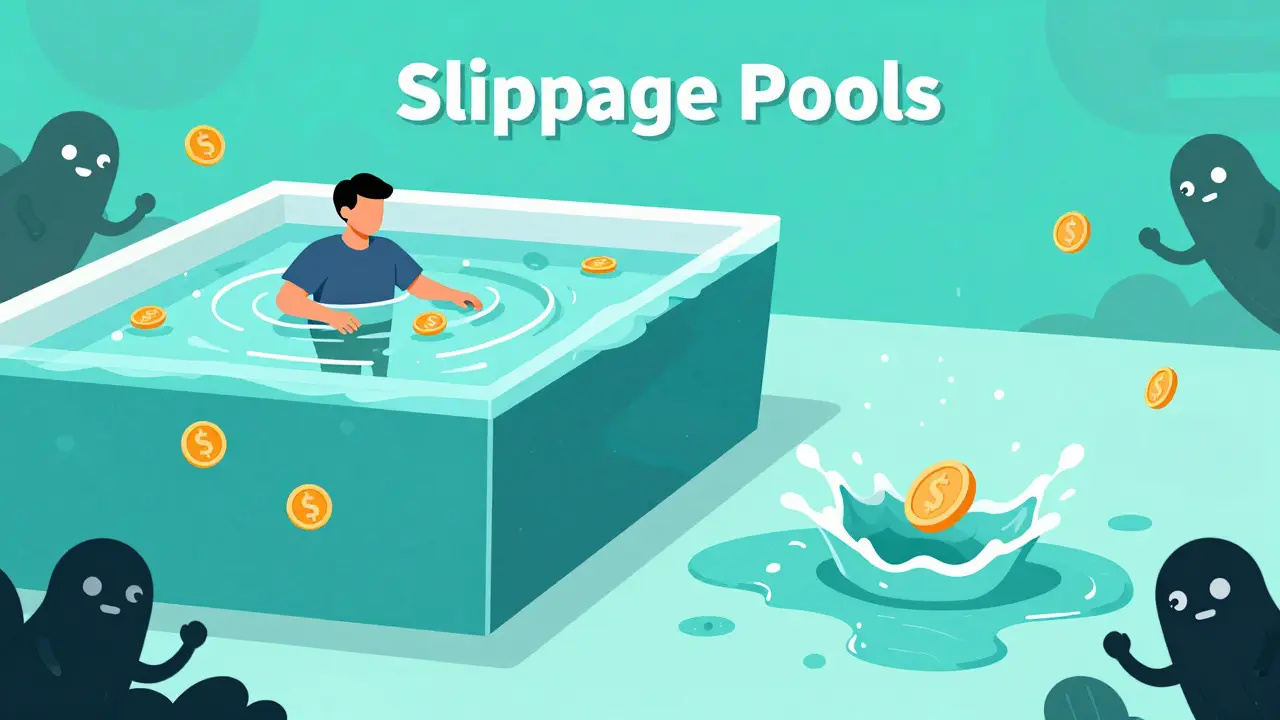
Slippage is the difference between the expected price of a trade and the price at which the trade is actually executed. In traditional finance, this might be negligible. In DeFi, it can be devastating if you don't understand liquidity pools.
DEXs do not use order books like Binance or Coinbase. Instead, they use Automated Market Makers (AMMs). When you buy a token, you are pulling it from a pool. As you buy more, the supply in the pool decreases, and the price increases according to a mathematical formula. If the pool has low liquidity, buying even a modest amount can push the price up significantly, resulting in high slippage.
- High Liquidity Pairs: Major pairs like ETH/USDC have deep liquidity. Slippage here is minimal, often just a few basis points (fractions of a percent).
- Low Liquidity Tokens: New or obscure tokens may have shallow pools. Slippage can easily range from 0.3% to 1% or higher.
- Volatile Markets: During fast-moving markets, prices change rapidly. By the time your transaction is processed, the price may have moved against you.
Additionally, Maximal Extractable Value (MEV) bots monitor the mempool for large pending transactions. They can front-run your trade, buying the asset before you to sell it back to you at a higher price, artificially inflating slippage. This is why professional traders often use private RPC nodes or MEV protection services.
How to Minimize Your Trading Costs
You cannot eliminate fees entirely, but you can optimize them. Here are practical strategies used by experienced DeFi traders to reduce the effective cost of each trade.
- Use Aggregators: Tools like 1inch is a DEX aggregator that sources liquidity across multiple platforms split your trade across multiple DEXs and liquidity pools to find the best possible price. This reduces slippage by accessing deeper combined liquidity.
- Choose the Right Chain: If speed and low cost are priorities, avoid Ethereum mainnet for daily trading. Use Layer-2 networks like Arbitrum, Optimism, or Polygon. For ultra-low costs, consider high-throughput chains like Solana is a high-performance blockchain processing over $1.5 billion in daily trades, where DEXs like ORCA is a popular DEX on the Solana blockchain charge flat 0.30% fees with negligible gas costs.
- Set Slippage Tolerance Wisely: Most interfaces allow you to set a maximum slippage tolerance. For stablecoins, set it low (0.1% - 0.5%). For volatile altcoins, you may need to increase it to 1% - 3% to ensure the transaction doesn't fail due to minor price fluctuations.
- Trade During Off-Peak Hours: Gas fees on Ethereum correlate with network usage. Trading when fewer people are active (often weekends or late nights UTC) can save you significant money on gas.

DEX vs. Centralized Exchanges: The Cost Comparison
Is it always cheaper to trade on a DEX? Not necessarily. Let's look at the numbers.
| Cost Factor | Centralized Exchange (e.g., Binance) | Ethereum Mainnet DEX (e.g., Uniswap) | Layer-2 DEX (e.g., QuickSwap on Polygon) |
|---|---|---|---|
| Trading Fee | ~0.1% | 0.30% | 0.30% |
| Gas/Network Fee | $0 (included in spread) | $50 - $100+ | $0.01 - $0.10 |
| Slippage Control | High (Order Book) | Variable (Liquidity Dependent) | Variable (Liquidity Dependent) |
| Custody Risk | High (Exchange holds funds) | Low (Self-custody) | Low (Self-custody) |
For a small trade of $100, a centralized exchange is vastly superior in terms of pure cost. The 0.1% fee is $0.10, and there is no gas fee. On Ethereum mainnet, you would pay $0.30 in protocol fees plus potentially $60 in gas, totaling over 60% of your trade value in costs. However, for large institutional trades, DEXs can offer better privacy and direct settlement without counterparty risk.
The Future of DEX Efficiency
The industry is actively working to solve these friction points. Uniswap v4 is the next generation of the Uniswap protocol introducing batch processing introduces hooks and batch processing capabilities that promise to significantly reduce gas costs by combining multiple actions into a single transaction. Furthermore, account abstraction standards (ERC-4337) are enabling "gasless" transactions, where relayers pay the gas fee on behalf of the user, often subsidized by the protocol or token incentives.
As cross-chain infrastructure matures, liquidity fragmentation will decrease. Bridges are becoming faster and more secure, allowing aggregators to access liquidity across Ethereum, Solana, and Cosmos simultaneously. This means that even if a specific pair has low liquidity on one chain, an aggregator can source it from another, reducing slippage for everyone.
What is the typical slippage tolerance for a DEX trade?
For highly liquid pairs like ETH/USDC, a slippage tolerance of 0.1% to 0.5% is usually sufficient. For newer or less liquid tokens, you may need to set it between 1% and 3%. Setting it too low causes failed transactions (wasting gas), while setting it too high exposes you to bad execution prices or sandwich attacks by bots.
Why are gas fees so high on Ethereum compared to other chains?
Ethereum has limited block space and high demand. Users bid against each other to get their transactions included in the next block. Layer-2 solutions like Arbitrum and Polygon process thousands of transactions off-chain and bundle them onto Ethereum, drastically reducing the individual cost per trade.
Do DEX aggregators really reduce slippage?
Yes. Aggregators like 1inch or Matcha scan multiple DEXs and liquidity pools simultaneously. If one pool doesn't have enough depth for your entire trade without high slippage, the aggregator splits the order across several pools to achieve the best average price.
What is MEV and how does it affect my trade?
Maximal Extractable Value (MEV) refers to profits miners or validators make by reordering, including, or excluding transactions. Bots use MEV to front-run large trades, buying the asset before you and selling it back to you at a higher price. This increases your slippage. Using private RPC endpoints or MEV-protecting wallets can mitigate this.
Is it safer to trade on a CEX or a DEX?
It depends on what you fear more. CEXs pose counterparty risk-if the exchange hacks or goes bankrupt, you lose your funds. DEXs pose smart contract risk-if the code has a bug, funds can be drained. However, DEXs offer self-custody, meaning you control your private keys. For long-term holding, DEXs are generally preferred by crypto natives.