

It sounds like a contradiction that shouldn't work. You have one of the world's harshest tax regimes for digital assets, yet you also have a population that refuses to stop buying them. That is exactly what is happening in India right now. As of mid-2026, India holds the number one spot in global cryptocurrency adoption, even while slapping traders with some of the highest costs in the industry. It is a paradox that has regulators scratching their heads and investors doubling down anyway.
You might wonder why anyone would trade here when the government seems determined to make it expensive. The answer lies in the sheer size of the market and the cultural shift toward digital ownership. But to understand this dynamic, we need to look at the specific rules that create this friction and how people are navigating them.
The VDA Framework: How India Classifies Crypto
To get your head around the Indian system, you first need to know how the government sees these assets. They do not call them "cryptocurrency" in legal terms. Instead, they use the term Virtual Digital Assets (VDAs). This classification was introduced under Section 2(47A) of the Income Tax Act. It covers everything from Bitcoin and Ethereum to non-fungible tokens (NFTs).
This label matters because it dictates how you pay taxes. VDAs are treated as capital assets, but with a twist. Unlike stocks or real estate, where you can offset losses against gains, VDAs operate in a silo. If you lose money on Bitcoin, you cannot use that loss to reduce the tax bill on your profits from Ethereum. This isolation makes the tax burden feel much heavier than it might appear on paper.
The regulatory landscape involves several bodies working together, sometimes creating confusion for the average trader:
- Central Board of Direct Taxes (CBDT): They set the policy and decide the tax rates.
- Income Tax Department: They enforce compliance and audit returns.
- FIU-IND: The Financial Intelligence Unit handles anti-money laundering (AML) oversight.
- Reserve Bank of India (RBI): While not directly taxing crypto, they monitor systemic risks and often express caution about digital currencies affecting financial stability.
For the user, this means you are not just dealing with one agency. You are navigating a web of regulations designed to track every rupee that moves through the digital asset space.
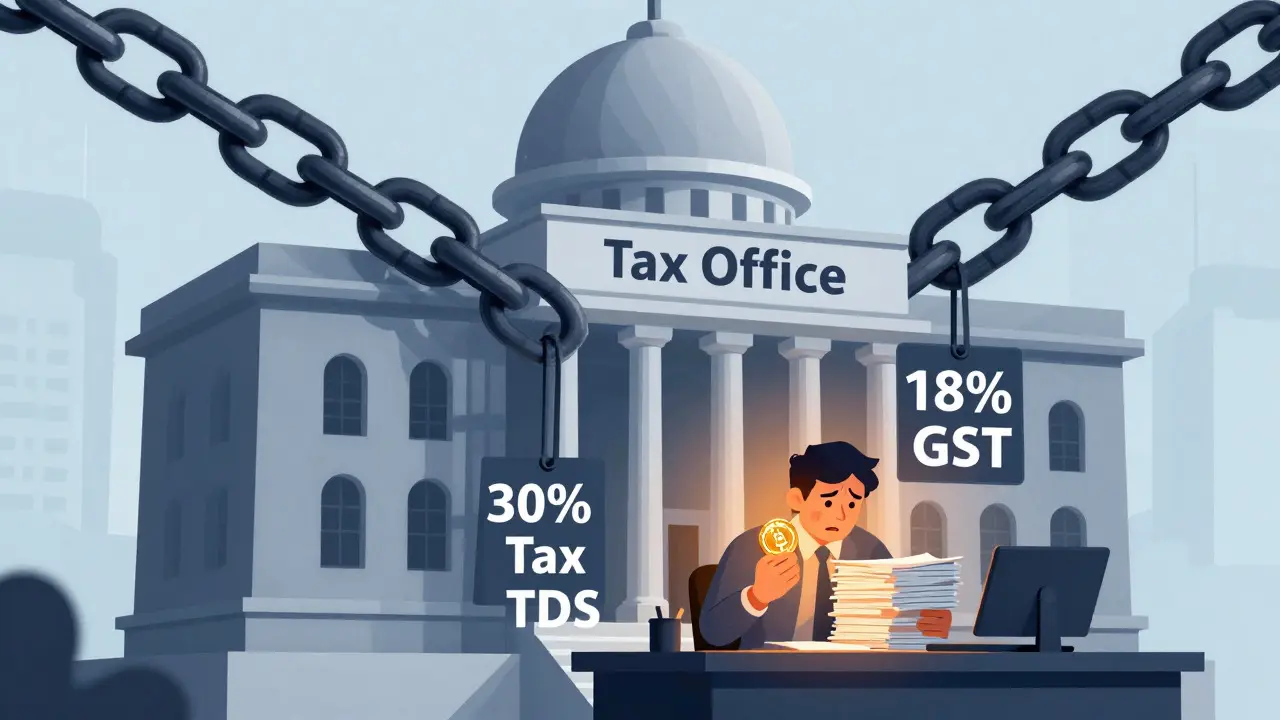
The Cost of Trading: 30% Tax, 1% TDS, and 18% GST
Let’s talk numbers, because this is where the "restrictions" part of the title comes into play. India’s crypto tax framework is widely considered one of the most punitive globally. Here is the breakdown of what you pay when you trade:
| Tax Component | Rate / Amount | Trigger Condition | Key Restriction |
|---|---|---|---|
| Capital Gains Tax | 30% | On all profits from VDA sales | No loss set-off allowed; treated like lottery winnings |
| Tax Deducted at Source (TDS) | 1% | Transactions exceeding ₹50,000 | Deducted automatically by exchanges; impacts liquidity |
| Goods and Services Tax (GST) | 18% | On platform services (fees, deposits, withdrawals) | Applied since July 2025; mandatory registration for platforms |
The 30% flat tax rate is steep. In many other countries, long-term capital gains on crypto are taxed at lower rates, similar to stocks. In India, it does not matter if you held Bitcoin for five days or five years; the profit is taxed at 30%. On top of that, you cannot claim any expenses. Your internet bill, your laptop cost, or even the trading fees you paid to the exchange? None of those count as deductible expenses. Only the actual purchase price of the coin counts as your "cost of acquisition."
Then there is the 1% TDS. Every time you sell crypto worth more than ₹50,000 (approximately $600 USD), the exchange deducts 1% immediately. This is not a final tax payment; it is an advance. However, it ties up your cash flow. For high-frequency traders, this constant deduction creates a significant liquidity crunch. You have to wait until you file your annual return to get that money back, assuming you owe less than what was deducted.
The newest layer is the 18% GST, which kicked in fully for crypto platforms in July 2025. Platforms are now classified as "Online Service Providers" under Section 2(102) of the CGST Act. This means whether you are paying a trading fee, withdrawing funds, or using staking services, you are paying 18% GST on top of the base fee. This effectively raises the operational cost of trading for every user.
Why Adoption Is Still #1: The Human Factor
If the taxes are this bad, why is India still the global leader in adoption? The data shows millions of active users, and the trend is growing. There are three main reasons for this resilience.
1. Demographic Momentum India has a massive young population that is digitally native. For many millennials and Gen Z Indians, crypto is not just an investment; it is a way to participate in the global economy. With inflation fluctuating and traditional savings accounts offering modest returns, digital assets offer a perceived hedge against currency devaluation. The desire to own a piece of the future outweighs the fear of current taxes for many.
2. Lack of Alternatives In many parts of the world, people turn to crypto because banks are inaccessible. In India, banking penetration is high, but the appeal of borderless transactions remains strong. Remittances are huge in India. Sending money home via traditional channels can be slow and expensive. Crypto offers speed and lower transaction costs, even after accounting for taxes, for large cross-border transfers.
3. Cultural Acceptance The stigma around crypto has faded significantly. What started as a niche interest for tech enthusiasts has become mainstream. You see crypto ads on TV, discussions in family WhatsApp groups, and educational content on YouTube. Once a technology becomes culturally embedded, restrictive laws rarely kill it; they just push it underground or offshore.
The Exodus: Trading Offshore and Regulatory Pushback
Here is the catch. While domestic adoption is high, the *activity* is leaking out. Because the local tax burden is so heavy, many sophisticated traders and firms are moving their operations overseas. This is known as "regulatory arbitrage."
Users are signing up for international exchanges that do not comply with Indian TDS norms. These offshore platforms allow users to trade without the 1% automatic deduction. However, this comes with risk. If the Indian government decides to crack down on these foreign entities, users could find their access cut off abruptly. We have seen hints of this with the blocking of certain websites in the past.
This migration of volume worries the Central Board of Direct Taxes (CBDT). They are losing visibility into the market. When trades happen on offshore servers, it becomes harder for the Income Tax Department to verify holdings and ensure compliance with Schedule VDA reporting.

A Shift in Wind: The August 2025 Consultations
Recognizing that the current model might be stifling growth and driving business away, the government took a major step in August 2025. The CBDT launched comprehensive consultations with crypto companies and stakeholders. This was the first serious review of the crypto tax policy since its implementation in 2022.
The questionnaires sent to exchanges were blunt. They asked:
- Has the 30% flat tax eliminated market liquidity?
- Is the 1% TDS on every trade excessive?
- Are offshore exchanges gaining an unfair advantage over local players?
- Should India draft comprehensive crypto legislation instead of relying on patchwork tax rules?
This signals a potential pivot. Regulators realize that a purely punitive approach may not be sustainable. Industry experts suggest that a move toward a more nuanced framework-perhaps allowing loss set-offs or reducing the TDS rate-could bring trading volume back onshore. This would increase transparency and potentially boost tax revenue in the long run by formalizing the market.
Practical Steps for Traders in 2026
If you are trading crypto in India today, you need to be organized. The complexity of the tax code means mistakes are easy to make, and penalties are harsh. Here is how to stay compliant and protect your portfolio:
- Track Every Transaction: Do not rely on memory. Use portfolio tracking software that integrates with Indian exchanges to log every buy, sell, and transfer. You need this data for Schedule VDA reporting.
- Understand Schedule VDA: When filing your Income Tax Return (ITR), you must disclose all crypto holdings and trades in Schedule VDA. Failure to report can lead to scrutiny and penalties. Treat this as a mandatory checklist item.
- Manage TDS Cash Flow: Since 1% is deducted at source, ensure you have enough liquid cash to cover your living expenses or new investments. Do not assume the deducted amount is gone forever; it is credited to your tax account, but you won't see it until refund processing.
- Account for GST: Be aware that your effective trading cost is higher due to the 18% GST on fees. Factor this into your profit calculations before deciding to execute a trade.
- Consider Long-Term Holding: While the 30% tax applies regardless of holding period, minimizing the number of taxable events (sales) reduces the frequency of TDS deductions and simplifies your compliance burden. Fewer trades mean fewer headaches.
The landscape is evolving. Keep an eye on announcements from the CBDT and the Ministry of Finance. The consultations from late 2025 may lead to policy changes in the upcoming fiscal year. Staying informed is your best defense against unexpected regulatory shifts.
Is cryptocurrency legal in India?
Yes, cryptocurrency is legal in India. It is recognized as a Virtual Digital Asset (VDA) under the Income Tax Act. However, it is not legal tender, meaning businesses are not required to accept it as payment for goods and services. You can buy, sell, and hold crypto, but you must pay taxes on any profits.
Can I offset crypto losses against gains in India?
No, currently you cannot. Under the existing tax regime, losses from one Virtual Digital Asset cannot be set off against gains from another. Even losses within the same asset class are generally not adjustable against other income sources. This is one of the most criticized aspects of the current law.
What is the 1% TDS on crypto transactions?
The 1% Tax Deducted at Source (TDS) is an automatic deduction applied by crypto exchanges when you sell digital assets worth more than ₹50,000 in a single transaction. This amount is sent directly to the government and credited to your tax account. It is an advance payment toward your final tax liability, not an additional tax.
Does the 18% GST apply to my crypto holdings?
No, GST does not apply to the value of your crypto holdings. The 18% Goods and Services Tax applies only to the services provided by crypto platforms. This includes trading fees, deposit charges, withdrawal fees, and staking rewards processed through the platform. It is a tax on the service, not the asset itself.
Will crypto tax laws change in 2026?
Potential changes are under discussion. Following the CBDT consultations in August 2025, there is ongoing dialogue between regulators and industry stakeholders. While no new laws have been passed as of mid-2026, there is a possibility that future budgets may introduce reforms such as allowing loss set-offs or adjusting TDS rates to improve market liquidity.
Do I need to report crypto if I made no profit?
Yes. Under Schedule VDA of the Income Tax Return, you are required to disclose all crypto holdings and transactions, regardless of whether you made a profit or a loss. Transparency is key to compliance. Hiding holdings can lead to severe penalties during audits.
Is it safer to use offshore exchanges to avoid taxes?
Not necessarily. While offshore exchanges may not deduct TDS, you are still legally obligated to report your global income to the Indian tax authorities. Using offshore platforms increases the risk of being flagged for non-compliance if the government blocks access or shares data with international partners. It is a high-risk strategy.
Categories
Popular Articles