
There is a lot of noise online about whether you can use your own crypto keys in India. You might have heard whispers that the government is cracking down on non-custodial wallets or that holding Bitcoin outside an exchange is illegal. The short answer? No, there is no ban. In fact, using a non-custodial crypto wallet is a digital tool where users hold their own private keys to control assets without intermediary custody is completely legal. However, the rules around how these wallets interact with Indian banking and tax systems are tricky. If you are trying to figure out if you should move your funds from an exchange like CoinDCX or WazirX to a hardware device like Ledger, this guide will clear up the confusion.
The Myth of the Ban: What the Law Actually Says
Let’s get straight to the point. The Indian government has never proposed banning non-custodial wallets. In October 2025, Union Minister Piyush Goyal made it very clear: while private cryptocurrencies face heavy taxation, there is no outright prohibition. The confusion often stems from the Financial Intelligence Unit's (FIU) March 2023 notification. This rule required all Virtual Digital Asset Service Providers (VASPs) to register. The problem? The initial wording didn't clearly separate custodial services (like exchanges) from non-custodial ones (like MetaMask or Trust Wallet).
This created a gray area. For a long time, users worried that simply running a node or using a self-custody app might put them in violation of Anti-Money Laundering (AML) laws. But here is the reality: non-custodial wallets do not hold your money. They only help you access what is already on the blockchain. Because they don't touch your assets, they aren't technically 'service providers' in the same way an exchange is. Recent draft amendments by the Ministry of Finance in October 2025 even suggested explicitly stating that non-custodial providers who don't handle fiat conversion shouldn't be classified as VASPs. This is a huge win for decentralization fans.
Custodial vs. Non-Custodial: Why It Matters for Your Security
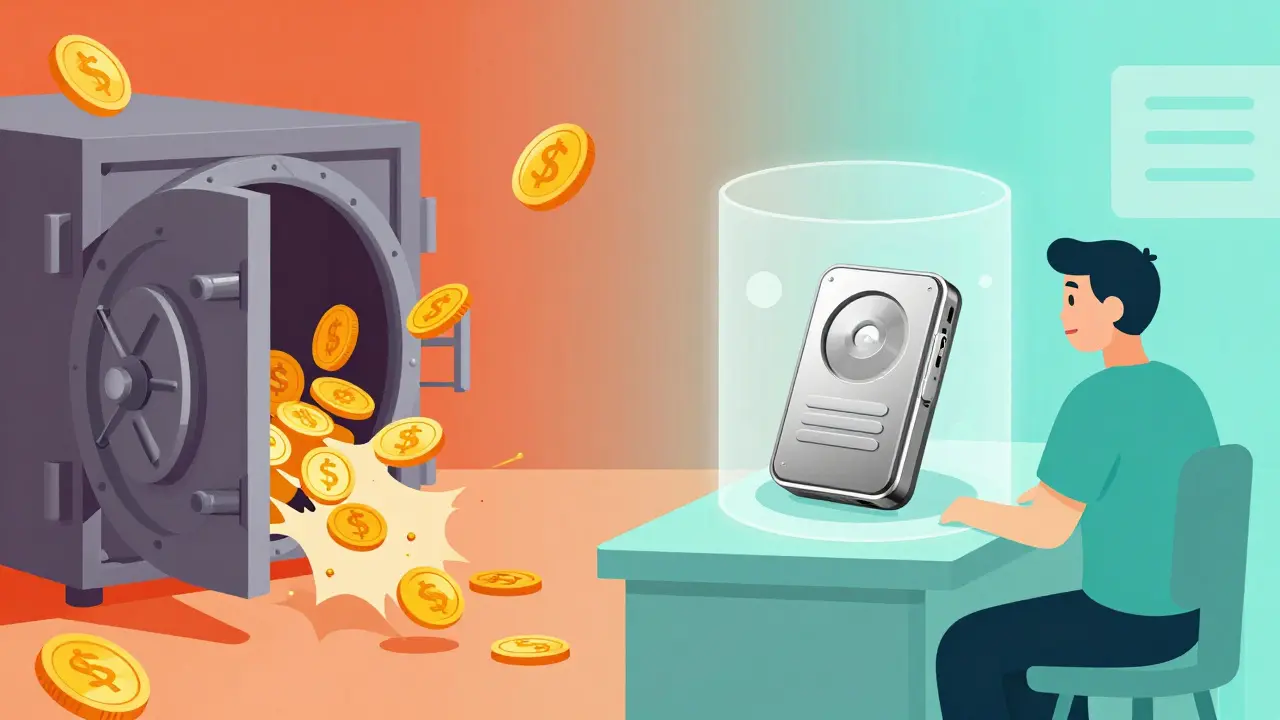
To understand why regulations differ, you need to know how these wallets work. Think of a custodial wallet (like Binance or CoinSwitch Kuber) as a bank. They hold your keys. If the bank gets hacked, loses the keys, or freezes your account, you are stuck. Remember the $230 million WazirX breach in July 2024? That incident pushed over 1.2 million Indian users to migrate to cold storage solutions overnight.
In contrast, a non-custodial wallet puts you in charge. Devices like the Ledger Nano Stax is a hardware security device that stores private keys offline to prevent remote hacking attempts cost around ₹13,999 as of late 2025, but they offer peace of mind. Software options like Exodus or Trust Wallet are free and keep your keys on your phone or computer. The trade-off? Responsibility. If you lose your seed phrase (that list of 12-24 words), no customer support team can help you. There is no 'forgot password' button in crypto.
| Feature | Custodial (e.g., CoinDCX) | Non-Custodial (e.g., Ledger, MetaMask) |
|---|---|---|
| Key Control | Exchange holds keys | User holds keys |
| Hack Risk | High (if exchange is breached) | Low (unless user makes error) |
| TDS Handling | Automated deduction at source | User must track and report manually |
| INR On-Ramp | Easy (UPI/Bank Transfer) | Limited (P2P or third-party gateways) |
| Regulatory Status | Must be FIU registered | Generally exempt from VASP registration |
The Real Hurdle: Taxes and TDS Compliance
While the wallets themselves aren't banned, the financial activity around them is heavily monitored. India imposes a flat 30% tax on capital gains from crypto and a 1% Tax Deducted at Source (TDS) on transactions above certain thresholds. Here is where non-custodial wallets get complicated. When you trade on an exchange, they deduct the 1% TDS automatically. When you send Bitcoin from your Ledger to another wallet, no one deducts anything.
This doesn't mean you avoid taxes. It means *you* have to calculate them. According to Koinly's October 2025 India tax report, nearly 45% of users make mistakes when calculating TDS for off-exchange transfers. If the Income Tax Department asks for proof, you need auditable trails. The Reserve Bank of India clarified in October 2025 that all VDA transactions above ₹50,000 must maintain these records. Many users rely on tools like BitcoinTaxes.in to generate these reports, as manual tracking is prone to errors.
Buying Crypto Without an Exchange: The INR Problem
You can own a non-custodial wallet, but how do you get crypto into it? This is the biggest pain point for Indian users. Most major non-custodial wallets do not support direct UPI payments or Indian bank transfers. As of October 2025, only about 3 out of 10 major non-custodial wallets had integrated local payment gateways.
Most Indians follow a two-step process:
- Buy crypto on a compliant, FIU-registered exchange (like CoinSwitch or ZebPay) using UPI.
- Transfer the assets to their non-custodial wallet for safekeeping.

Safety Tips for Using Non-Custodial Wallets in India
Since you are your own bank, security falls entirely on your shoulders. Here is how to stay safe:
- Protect Your Seed Phrase: Write it down on paper. Never take a screenshot. Never store it in a cloud note. 76% of support queries for hardware wallets relate to lost recovery phrases. Once lost, funds are gone forever.
- Beware of Phishing: Scammers love targeting crypto users. Only download wallet apps from official sources. Google Play updated its policies in late 2025 to require licenses for custodial apps, which actually helps clean up the market, but always double-check URLs.
- Use Hardware for Large Amounts: Keep daily spending coins in a software wallet like MetaMask, but store your long-term holdings in a hardware wallet like Ledger. The latter offers 98.7% protection against remote attacks because the keys never leave the device.
- Track Every Move: Use tax software to log every transaction. Even if you just swap tokens within your non-custodial wallet, it may be considered a taxable event under Indian law.
What Does the Future Hold?
The regulatory landscape is shifting. Experts like Dr. Rajesh Saraf predict that India will formally recognize non-custodial wallets as user-controlled tools rather than regulated service providers by mid-2026. This would align India with global standards set by frameworks like the EU's MiCA, which explicitly exempts non-custodial wallets from licensing.
For now, the ecosystem is growing. India ranks second globally in non-custodial wallet adoption, with nearly 19 million active users. Despite the complexity, the demand for self-sovereignty is driving innovation. Companies are working on better INR integration, and educational resources are becoming more accessible. If you are new to this, start small. Learn the basics of seed phrases before moving significant funds. The freedom of non-custodial wallets is real, but it comes with the responsibility of being your own guardian.
Is it illegal to use MetaMask or Trust Wallet in India?
No, it is not illegal. Using non-custodial wallets like MetaMask or Trust Wallet is perfectly legal in India. The government regulates the trading platforms (exchanges) through the FIU, but individuals holding their own keys in personal wallets are not breaking any laws.
Do I need to pay TDS when sending crypto from my Ledger wallet?
Yes, you are liable for the 1% TDS if the transaction value exceeds the threshold, but unlike exchanges, your wallet won't deduct it automatically. You must track these transactions and declare them in your income tax return. Failure to do so can lead to penalties during audits.
Can I buy Bitcoin directly with UPI in a non-custodial wallet?
Direct UPI integration in non-custodial wallets is currently very limited. Most Indian users buy crypto on a regulated exchange first and then transfer it to their non-custodial wallet. Some newer apps are testing P2P features, but standard UPI buy buttons are rare in pure self-custody apps.
What happens if I lose my Ledger device?
If you have your 24-word recovery phrase (seed phrase) written down safely, you can buy a new Ledger device and restore your funds instantly. The device itself is just a tool; your keys live on the blockchain. However, if you lose both the device AND the seed phrase, your funds are permanently inaccessible.
Will the government ban non-custodial wallets in the future?
It is highly unlikely. Banning non-custodial wallets would contradict the principles of decentralization and is technically difficult to enforce since the code is open-source. Current regulatory trends suggest clarification rather than prohibition, aiming to distinguish between risky exchanges and secure personal storage.
Comments (9)

- Scott Miller
- June 27, 2026 AT 03:52 AM
Wake up people. The government isn't banning wallets, they are just trying to squeeze every last rupee out of you through that insane 30% tax. It is a cash grab disguised as regulation. You hold your keys, you hold the power, but don't let them trick you into thinking it's easy. The TDS tracking alone is a nightmare designed to make you quit. Stay sharp and keep your assets off those centralized exchanges if you value your freedom.

- Carol @minaszilda
- June 28, 2026 AT 11:11 AM
I think we can all agree that self-custody is empowering. It is about taking responsibility for our own digital lives. The guide mentions seed phrases clearly, which is vital. We must protect these words with our lives. There is no reset button. This is why education matters so much in this space. Let us support each other in learning these tools safely.

- Rob Morton
- June 28, 2026 AT 20:37 PM
The distinction between VASP registration and non-custodial usage is fascinating. It raises questions about the nature of sovereignty in a digital age. If the state cannot touch the keys, does it still have jurisdiction? The October 2025 amendments suggest a shift toward recognizing user agency. I wonder how long this philosophical alignment will last before political pressures mount again. The gray area is where innovation thrives, but also where risk lurks.

- Routh Middaugh
- June 29, 2026 AT 23:19 PM
It is interesting, really! The way the regulations evolve, doesn't it? One day it is a gray area, the next day it is a clear path! Or so we hope! The hardware wallet prices are steep, though! Who can afford ₹13,999 for peace of mind?! But then again, losing everything is worse! So maybe it is worth it? We shall see! The future is uncertain, after all!

- ross harris
- June 30, 2026 AT 07:36 AM
Listen to the sheeple crying about taxes. They want their mommy government to hold their hand and deduct TDS for them. Pathetic. Real alphas know that privacy is the ultimate currency. The 'gray area' is just a playground for the enlightened who understand that code is law, not some bureaucrat in Delhi. The WazirX hack was a gift from the universe, showing everyone that trusting third parties is for losers. Embrace the chaos. Your Ledger is your fortress. Build it strong or get rekt by the system.

- Carl Belgrave
- June 30, 2026 AT 16:59 PM
This is absolute nonsense promoting foreign tech over local stability. India needs control, not this anarchist crypto nonsense. The fact that you have to manually track taxes shows the system is broken and dangerous for our citizens. We should be supporting regulated Indian exchanges that follow the rules, not hiding behind MetaMask like criminals. National security comes first. Stop spreading this confusion to innocent people who just want to save money safely.

- Carl Hanzel
- July 1, 2026 AT 21:07 PM
You are all missing the point entirely. The real issue is not the ban, it is the psychological trap of ownership. When you hold your own keys, you become paranoid. You check your portfolio every five minutes. You worry about phishing links. It is exhausting. The convenience of custodial wallets is underrated because most people do not want the burden of being their own bank. They want to forget about it. Self-custody is a hobby for masochists.

- Daniel J. Cox
- July 3, 2026 AT 01:44 AM
Cool stuff! :) I love seeing more clarity on this topic. In Australia, we deal with similar tax headaches, so I feel you guys in India. The UPI integration issue is tricky, but P2P is growing fast everywhere. Just remember to backup your seed phrase on steel if you can! Fireproofs! Stay safe out there! \/

- Emma Rémond
- July 4, 2026 AT 08:59 AM
Fascinatingly, the epistemological framework of non-custodial architecture fundamentally challenges the hegemonic structures of traditional financial intermediation. However, one must critically evaluate the ontological implications of private key management within the socio-legal matrix of emerging markets. The dichotomy between custodial fiat-gated entry points and decentralized exit strategies creates a complex regulatory arbitrage opportunity. It is imperative that stakeholders engage in rigorous hermeneutic analysis of the FIU notifications to discern the latent semantic nuances of compliance obligations. Ignorance of the taxonomic classification of VASPs is not a valid defense in judicial proceedings.